
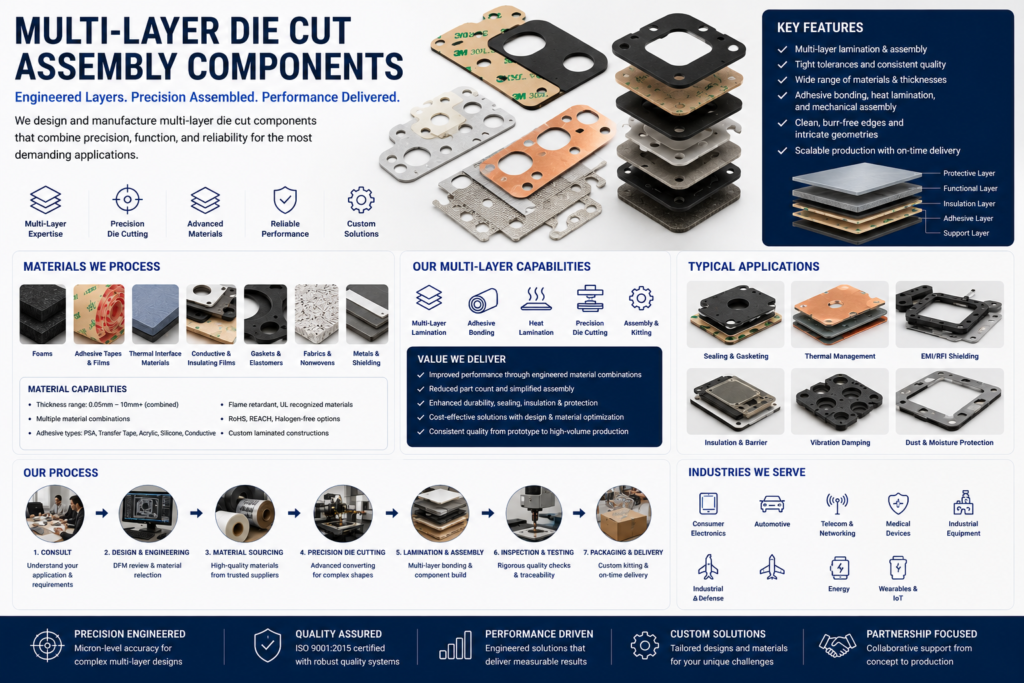
How Custom Die Cut Materials Improve Product Reliability Without Changing the Main Design?
Product failures rarely originate from major design flaws. More often, they come from small issues that appear after mass production begins. A battery rattles inside a housing. A display develops light leakage. A wire harness wears against a bracket. A seal loses compression after months of use. These problems may seem minor, but they can lead to warranty claims, assembly delays, and customer dissatisfaction.
Custom die cut materials improve product reliability by solving sealing, cushioning, insulation, vibration, thermal management, and assembly issues without requiring changes to the product's primary design. By adding precisely engineered die-cut components, manufacturers can eliminate failure points while maintaining existing tooling, housings, and product architecture.
For OEM manufacturers, this approach often provides the fastest and most cost-effective path to improving product performance.
Why Reliability Problems Often Appear After Product Launch
Many products pass laboratory testing but encounter new challenges in real-world environments.
Common causes include:
- Vibration
- Temperature cycling
- Moisture exposure
- Dust intrusion
- Material wear
- Assembly variation
Redesigning the entire product can be expensive and time-consuming.
Custom die-cut materials allow engineers to address specific weaknesses without changing the main structure.
Theme: Precision Die Cut Engineering Solutions
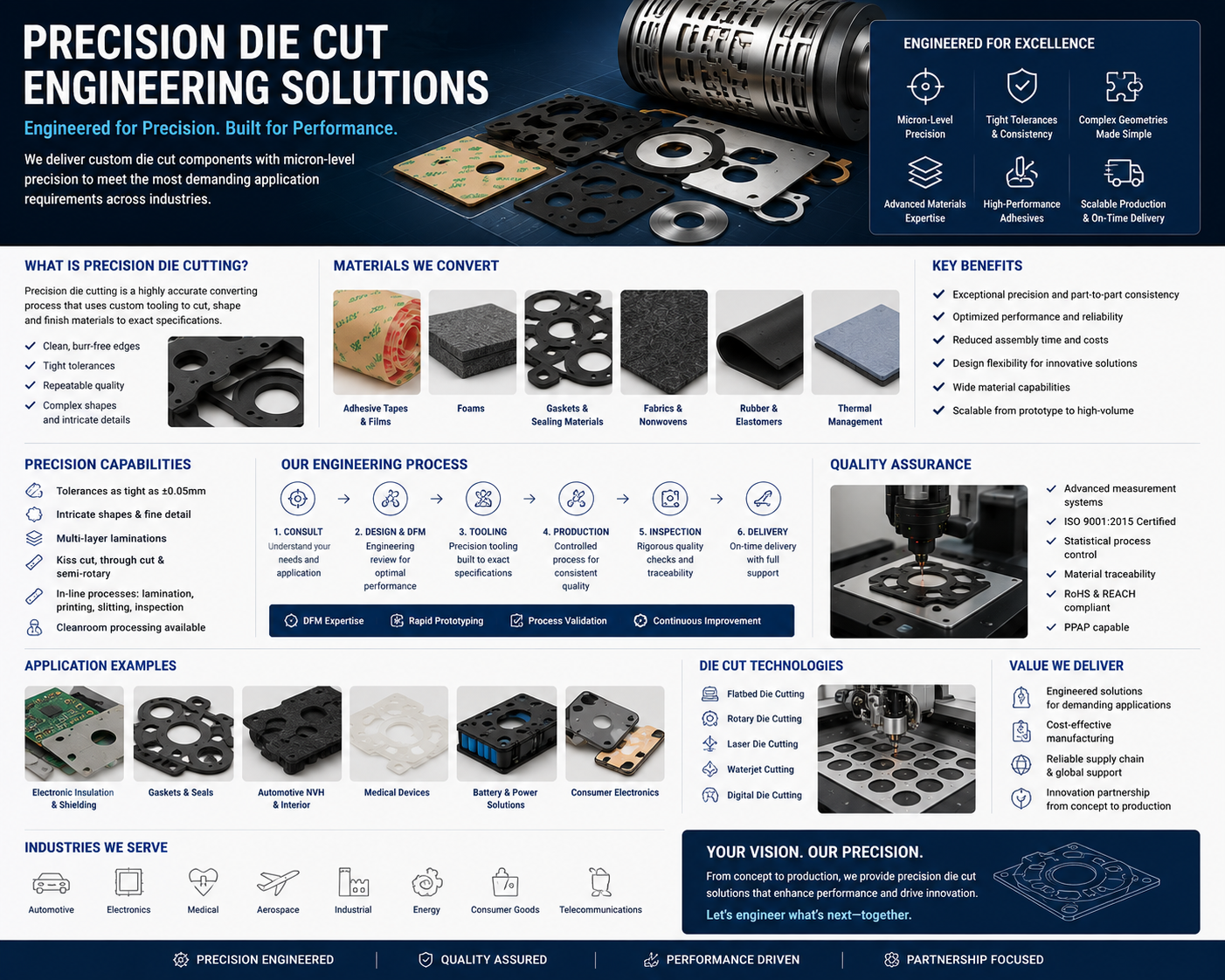
Improving Sealing Performance Without Redesign
One of the most common reliability improvements involves sealing.
Products may experience:
- Dust ingress
- Water intrusion
- Air leakage
- Pressure loss
Instead of redesigning housings, engineers can add custom die-cut:
- Foam gaskets
- Silicone seals
- EPDM sealing components
- Waterproof adhesive structures
These components create effective barriers while fitting within existing assembly spaces.
Typical Applications
- Automotive electronics
- Wearable devices
- Industrial control systems
- Consumer electronics
Reducing Vibration and Noise
Many reliability issues are caused by repeated vibration.
Examples include:
- Connector loosening
- Wire abrasion
- Trim rattling
- Component movement
Custom die-cut materials help absorb vibration energy.
Common solutions include:
- EVA foam pads
- PE foam cushions
- Non-woven felt components
- Rubber isolation pads
These materials can often be added without modifying the product housing.
Protecting Sensitive Electronics
Electronic components are increasingly compact and sensitive.
Problems may include:
- Electrical shorts
- EMI interference
- Component movement
- Mechanical shock
Die-cut materials provide protection through:
- Electrical insulation films
- EMI shielding materials
- Cushioning foams
- Thermal interface components
This improves long-term reliability while maintaining the original product layout.
Theme: Precision Electronic Die-Cut Components
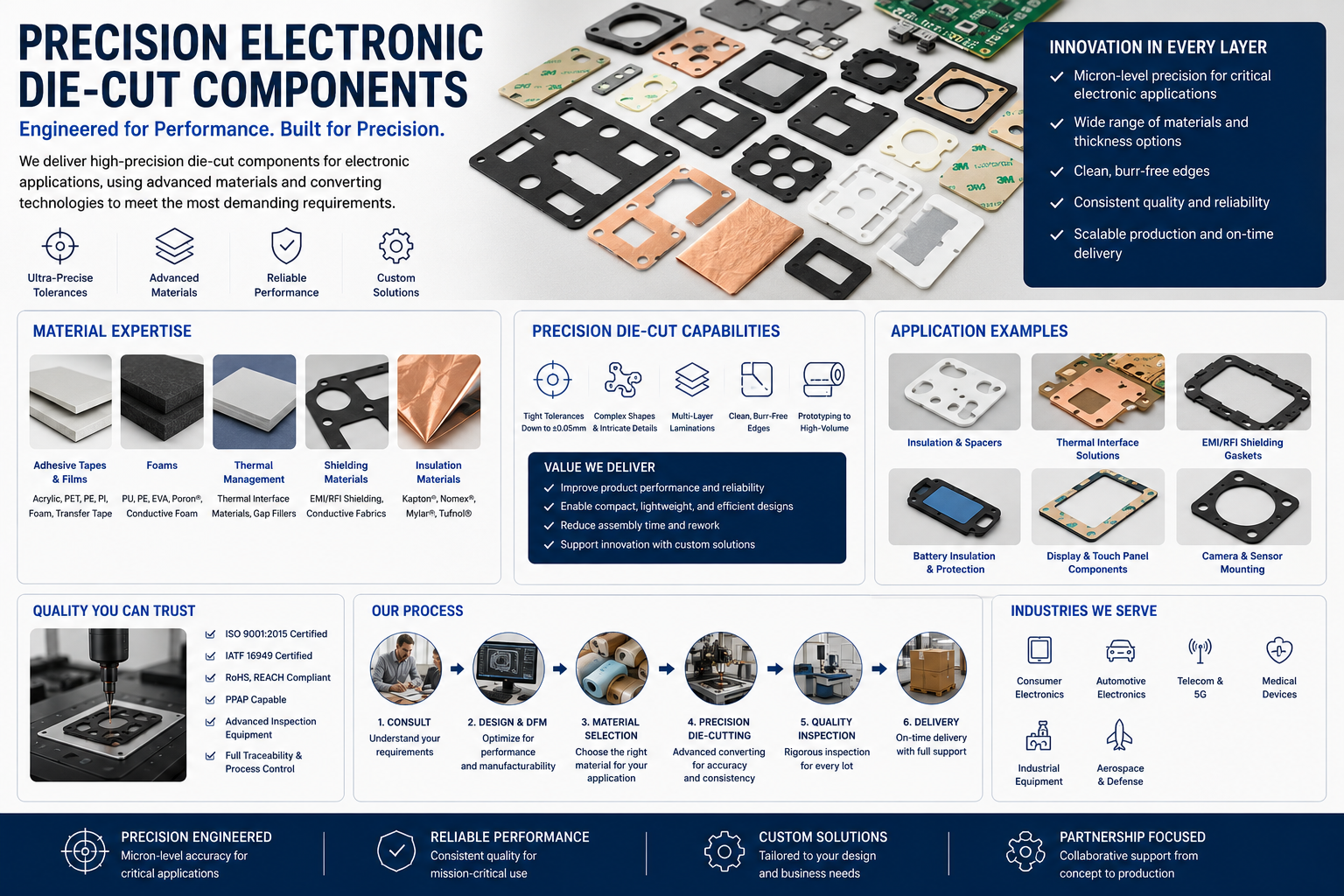
Improving Thermal Management
Excess heat is one of the leading causes of electronic failure.
Instead of redesigning the enclosure, manufacturers often use die-cut thermal materials such as:
- Thermal interface pads
- Graphite films
- Heat-spreading materials
- Insulation barriers
Benefits include:
- Lower operating temperatures
- Improved battery life
- Better component stability
Thermal management improvements can significantly extend product lifespan.
Eliminating Light Leakage in Displays
Display modules frequently experience:
- Light leakage
- Reflection issues
- Optical contamination
Custom die-cut light-blocking materials can solve these problems without modifying the display design.
Common materials include:
- Black PET films
- Light-blocking foam
- Optical-grade adhesive components
These solutions are widely used in:
- Smartphones
- Tablets
- Automotive displays
- Wearable devices
Enhancing Assembly Consistency
Some reliability problems originate from assembly variation rather than product design.
Die-cut materials can improve assembly consistency by:
- Providing positioning features
- Simplifying installation
- Reducing operator error
- Improving part alignment
This helps maintain consistent performance across production batches.
Theme: Multi-Layer Die Cut Assembly Components
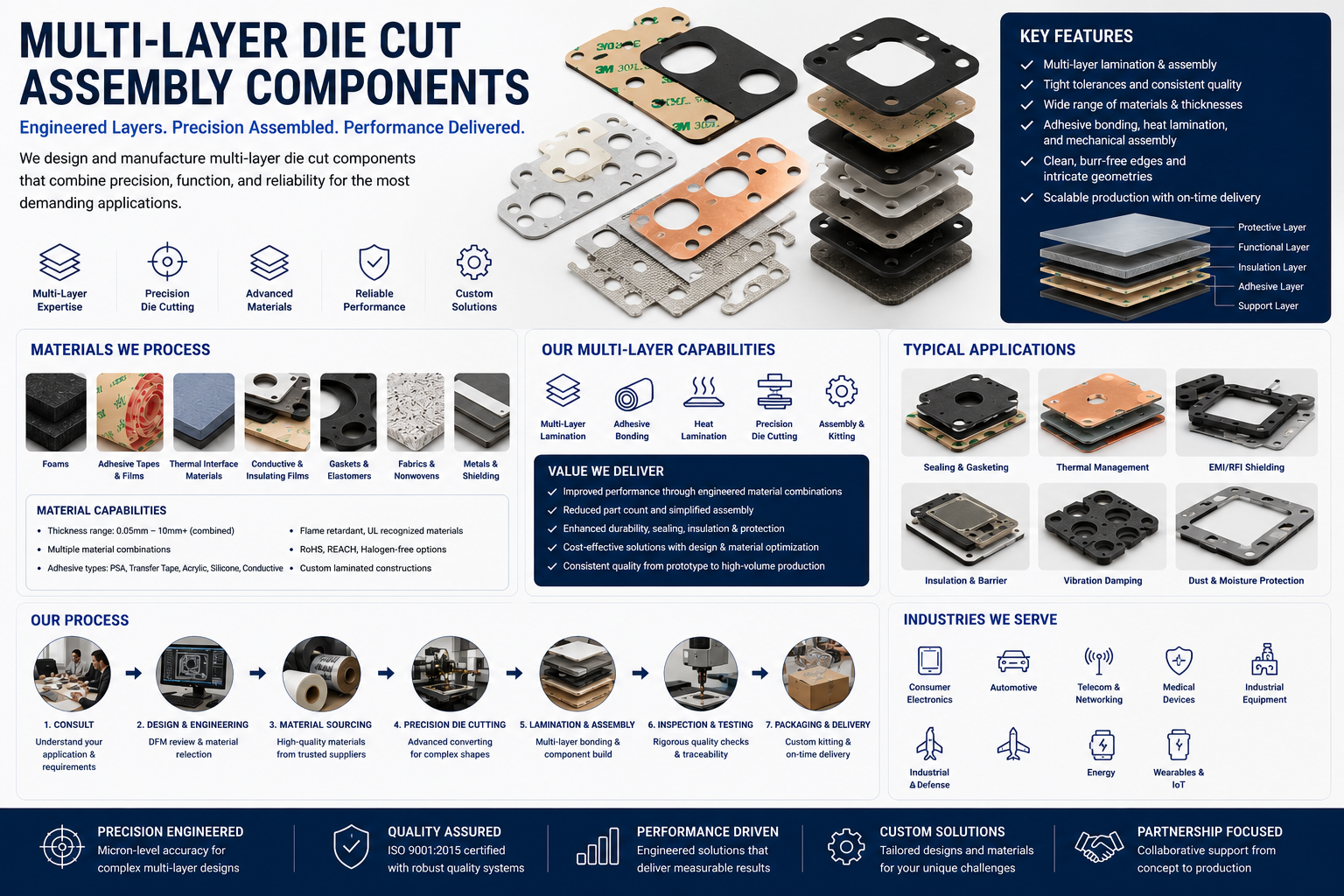
Extending Product Life Through Wear Protection
Moving parts often experience wear over time.
Examples include:
- Wire harnesses
- Hinges
- Sliding components
- Interior trim systems
Die-cut protective materials help reduce friction and abrasion.
Common solutions include:
- Felt pads
- Non-woven components
- Protective films
- Wear-resistant tapes
These materials increase durability without changing mechanical designs.
Supporting Automotive Reliability
Automotive applications demand long-term performance under:
- Temperature extremes
- Vibration
- Moisture
- UV exposure
Custom die-cut materials are commonly used for:
- NVH insulation systems
- Battery protection
- Wire harness management
- Sealing solutions
By integrating these materials into existing assemblies, manufacturers improve reliability without redesigning major vehicle components.
Why OEM Manufacturers Prefer Die-Cut Solutions
Compared with redesigning plastic housings or metal structures, die-cut solutions offer:
Faster Implementation
Changes can often be validated within weeks.
Lower Cost
No major tooling modifications are required.
Reduced Risk
The primary product architecture remains unchanged.
Easier Manufacturing Integration
Die-cut parts can often be added directly to existing assembly processes.
For many reliability issues, die-cut materials provide the highest return on investment.
How Sanken Manufacturing Supports Reliability Improvement
Dongguan Sanken Electronics Manufacturing Co., Ltd. specializes in custom die-cut solutions that improve product performance and reliability.
Our capabilities include:
- Precision die cutting
- Automotive NVH felt components
- PET insulation film converting
- Foam gasket manufacturing
- EMI shielding solutions
- Adhesive laminating
- Custom rubber sealing products
Key Advantages
- OEM and ODM customization
- ISO 9001 certified quality management
- RoHS and REACH compliant materials
- Domestic and overseas production bases
- Cleanroom precision manufacturing
- Tool development from drawings or samples
We support automotive, consumer electronics, wearable devices, industrial equipment, and medical product manufacturers worldwide.
Featured Snippet Summary
Custom die-cut materials improve product reliability by addressing sealing, vibration, insulation, thermal management, EMI protection, and wear-related issues without requiring changes to the product's primary design. These solutions help manufacturers reduce failures, improve durability, and maintain assembly efficiency.
Conclusion
Many product reliability challenges can be solved without redesigning housings, changing mechanical structures, or investing in expensive new tooling. Custom die-cut materials provide targeted solutions that improve sealing, cushioning, insulation, thermal management, and vibration control while fitting seamlessly into existing designs.
For OEM manufacturers seeking faster improvements with lower risk and lower cost, precision die-cut components often deliver the most effective path to enhanced product reliability and long-term performance.