
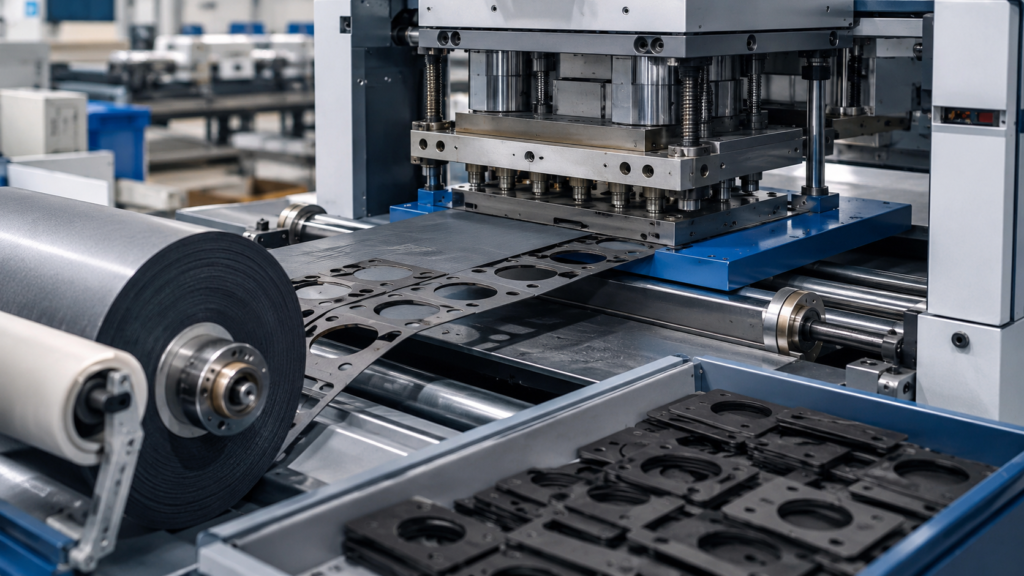
Die cutting works by using a custom die, blade or rotary tool to cut flexible materials into precise shapes for OEM assembly. Materials such as foam, adhesive tape, PET film, rubber, non-woven fabric and insulation sheets can be converted into gaskets, pads, spacers, protective films, sealing parts and other custom components.
For OEM manufacturing, die cutting is not only a cutting process. It affects part tolerance, edge quality, adhesive position, liner release, waste removal, assembly speed and long-term product reliability.
At Sanken Manufacturing, die cutting is used together with material selection, adhesive lamination, prototyping, inspection and mass production support to help automotive, electronics, appliance and industrial customers produce stable custom parts.
What Is Die Cutting?
If you need a simpler explanation of the term itself, you can also read what is die cut definition, meaning, and applications.
Die cutting is a manufacturing process that uses a shaped tool (die) and controlled pressure to cut specific outlines, holes, perforations, or internal windows from materials.
The die is made according to a technical drawing or digital design file. Once installed in the machine, it produces identical parts repeatedly.
Because the tool defines the geometry, every finished component matches the same specification.
How Does the Die Cutting Process Work?
Die Cutting Process Step by Step
| Step | What Happens | Why It Matters |
|---|---|---|
| Material selection | Foam, tape, film, rubber, felt or insulation material is selected | Affects sealing, cushioning, insulation and durability |
| Tooling design | A die or cutting tool is designed based on drawings or samples | Controls shape, holes, tolerance and repeatability |
| Laminating | Adhesive, liner, film or foam layers may be combined | Creates multilayer functional parts |
| Cutting | The die cuts the material by flatbed, rotary or kiss cutting | Defines final part geometry and edge quality |
| Waste removal | Unwanted material is removed from the sheet or roll | Affects production speed and clean part separation |
| Inspection | Dimensions, holes, edges, adhesive position and surface quality are checked | Reduces assembly failure and customer rejection |
| Packaging | Parts are supplied in rolls, sheets, pieces or kits | Supports customer assembly efficiency |
The die cutting process typically includes the following steps:
1. Material Preparation
For foam-based components, this process is commonly used to turn foam rolls or sheets into die cut foam parts for sealing, cushioning, spacing, and assembly.
Materials are supplied as:
- Rolls (for high-volume production)
- Sheets (for flatbed processing)
Common materials include:
- Foam (closed-cell and open-cell)
- Rubber
- Adhesive tapes
- Films and laminates
- Non-woven fabrics
- Paperboard
- Insulation materials
Proper tension control is essential to prevent stretching and dimensional drift.
2. Lamination (If Required)
Some products require multiple layers.
Examples:
- Foam + adhesive
- Film + adhesive
- Multi-layer insulation constructions
The layers are bonded under controlled pressure before cutting. This prevents air bubbles, misalignment, and delamination.
3. Die Cutting Method
There are two main die cutting technologies:
Rotary Die Cutting
- Uses a cylindrical rotating die
- Operates in roll-to-roll production
- Ideal for high-volume manufacturing
- Common for labels, adhesive parts, and thin films
Advantages:
- High speed
- Stable pitch control
- Automation compatibility
- Efficient for mass production
Flatbed Die Cutting
- Uses vertical press force
- Suitable for thicker materials
- Often used for foam and rubber components
- Good for medium or short production runs
Advantages:
- Strong cutting force
- Excellent dimensional accuracy
- Flexible for complex geometries
4. Kiss-Cut vs Through-Cut
Kiss-Cut
The die cuts only the top layer while keeping the liner intact.
Common for:
- Die cut stickers
- Adhesive labels
- Peel-and-place components
This format improves application speed and keeps parts organized.
Through-Cut
The die cuts completely through all layers.
Used for:
- Non-adhesive parts
- Packaging inserts
- Fully separated components
5. Waste Matrix Removal
After cutting, the unused material (matrix) is removed.
Stable waste stripping is critical to:
- Maintain continuous production
- Prevent machine jams
- Ensure clean edges
Poor matrix design can interrupt automation.
6. Finishing and Delivery Formats
Finished die-cut parts can be delivered as:
- Rolls
- Sheets
- Pre-counted stacks
- Kitted assemblies
- Automation-ready formats
The delivery format directly affects labor cost and assembly efficiency.
What Materials Are Used in Die Cutting?
How Different Materials Behave During Die Cutting
| Material | Common Die Cutting Challenge | Typical OEM Use |
|---|---|---|
| Foam | Compression, thickness variation and edge deformation | Gaskets, cushioning pads and acoustic parts |
| Adhesive tape | Liner damage, adhesive overflow and peeling issues | Bonding parts, tape frames and pull tabs |
| PET film | Tension stretching and hole alignment | Insulation films, protective films and spacers |
| Rubber | Rebound, tearing and edge quality | Seals, pads, washers and vibration parts |
| Non-woven felt | Fiber dust and thickness control | Acoustic pads, anti-rattle pads and automotive NVH parts |
| Protective film | Curling, release force and residue control | Surface protection and temporary masking |
Die cutting is compatible with many industrial materials, including:
- Closed-cell foam
- Open-cell foam
- Rubber sheets
- Adhesive tapes
- Protective films
- Non-woven materials
- Laminated constructions
- Packaging board
Material properties such as compression resistance, elasticity, and adhesive performance must be considered during design.
Why Is Die Cutting Important in Manufacturing?
Die cutting provides:
Dimensional Consistency
Every part matches the technical drawing.
Mass Production Efficiency
Suitable for high-volume OEM manufacturing.
Reduced Labor
Kiss-cut formats enable fast peel-and-place assembly.
Automation Compatibility
Roll-based formats support dispensing systems.
Improved Quality Control
Stable geometry reduces assembly defects and rework.
For automotive, electronics, medical, and industrial applications, these advantages are essential.
Common Problems Die Cutting Helps Prevent
Properly engineered die cutting reduces risks such as:
- Edge lifting
- Dimensional variation
- Adhesive failure
- Slow manual trimming
- Packaging misalignment
- Production line jams
Tool design, material selection, and process control are critical to performance.
How to Specify a Die Cutting Project
To ensure accurate quotation and stable production, provide:
- Material type and thickness
- Adhesive requirements
- Tolerance specifications
- Operating environment (temperature, humidity, exposure)
- Annual volume forecast
- Delivery format (roll, sheet, kit)
- Technical drawings or cut files
Clear specifications help prevent surprises in mass production.
Featured Snippet Summary
Die cutting works by using a custom die, blade or rotary tool to cut flexible materials into precise shapes. In OEM manufacturing, the process may include material selection, lamination, tooling, kiss cutting, waste removal, inspection and packaging. It is commonly used for foam gaskets, adhesive tape parts, PET films, rubber pads, protective films and non-woven components.
Conclusion
Die cutting works by using a custom cutting tool to convert flexible materials into precise shapes for OEM assembly. The process may include material selection, adhesive lamination, tooling, cutting, waste removal, inspection and packaging.
For OEM buyers, die cutting quality affects sealing, cushioning, bonding, insulation, acoustic control, assembly efficiency and long-term reliability. The best result comes from matching the right material, tooling method, tolerance, adhesive structure and delivery format.
Need custom die cut parts for an OEM project?
Send us your drawing, sample, material requirement, adhesive structure, tolerance, application environment, annual volume and packaging preference. Sanken can help review material selection, die cutting method, lamination structure, inspection points and delivery format before sampling and mass production.
Related Articles
- What Is Die Cut? Definition, Meaning and Applications
- From Foam Rolls to Finished Parts: How Die Cutting Works
- Understanding Rotary Die Cutting: Process, Advantages and Materials
- How Die Cut Parts Are Supplied in Sheets, Rolls, or Kits
- How to Choose the Right Die Cutting Manufacturer for Your OEM Project