
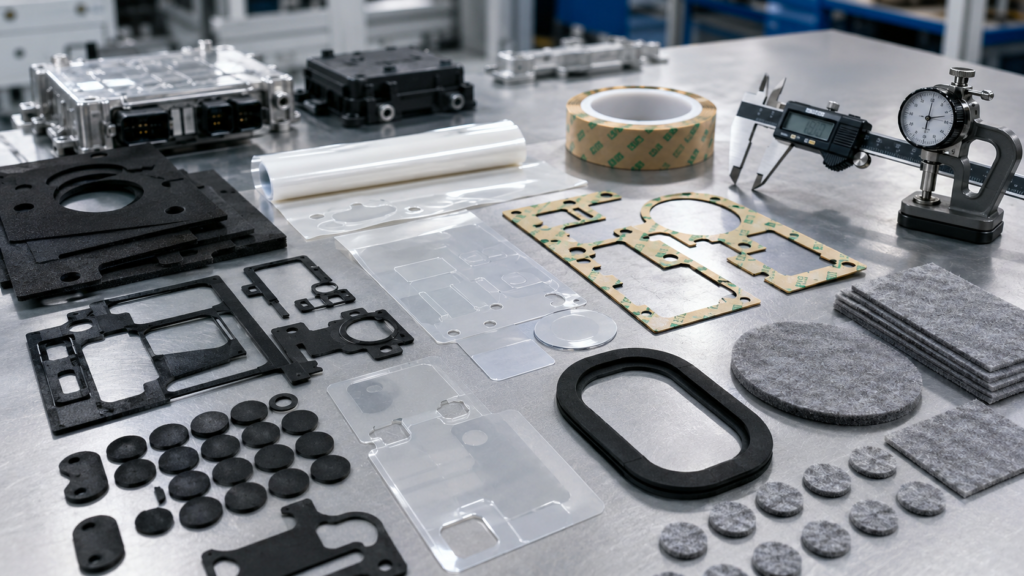
Choosing a precision die cutting supplier is not only about finding a factory that can cut foam, rubber, PET film, adhesive tape or non-woven felt into a required shape. For OEM buyers and engineers, the real question is whether the supplier can understand the part function, control tolerance, reduce sampling risk and support stable mass production.
A low-price supplier may produce a sample that looks acceptable, but if material behavior, adhesive lamination, tooling, inspection or packaging is not controlled properly, problems may appear later during assembly. These problems can include poor sealing, hole misalignment, adhesive overflow, unstable liner release, deformation, high scrap rate and delayed delivery.
For OEM projects, precision die cutting services should support the full process from material review and prototyping to inspection and mass production.
Why This Topic Matters for OEM Manufacturing
Precision die-cutting components are usually small, but they often affect the reliability of the whole product.
In automotive electronics, a foam gasket may protect a housing from dust, water, vibration, and noise.
In consumer electronics, a PET insulation film may prevent short circuits and support accurate assembly.
In medical devices, an adhesive pad may need stable bonding, clean edges, and consistent liner release.
In industrial equipment, rubber pads, sealing components, and felt parts may protect against vibration, air leakage, and wear.
This means buyers should not choose a die-cutting supplier only by unit price. The supplier must be able to support engineering review, material selection, trial production, tolerance control, adhesive lamination, inspection, and packaging.
A supplier that only asks for the drawing and quantity may miss important risks. A professional supplier asks about the application, assembly method, material environment, critical dimensions, testing needs, and mass production volume.
Common Problems and Production Risks
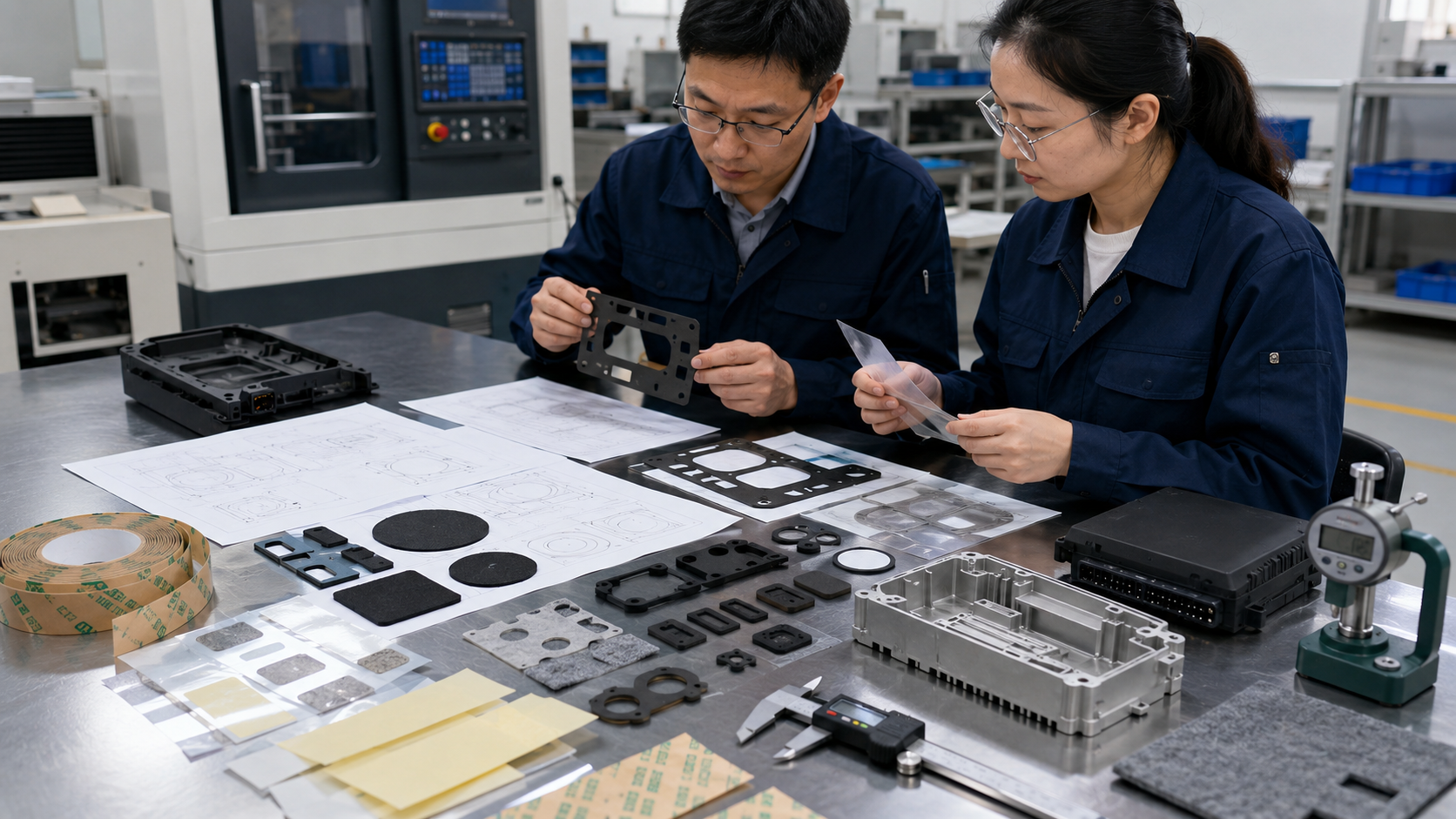
Many die-cutting sourcing problems happen because the supplier is selected too quickly. A quotation may look attractive, but the hidden cost appears later through failed samples, repeated tooling changes, poor assembly efficiency, or unstable batch quality.
| Supplier Selection Problem | What May Happen | OEM Risk |
|---|---|---|
| Supplier only quotes by drawing | Application details are ignored | Wrong material or process |
| Weak tolerance control | Holes and edges shift | Assembly mismatch |
| Poor adhesive lamination | Adhesive overflow or peeling | Contamination and failure |
| No material behavior review | Foam tears or film curls | Sampling delay |
| Weak waste removal process | Parts deform during stripping | Low yield |
| No inspection plan | Defects reach assembly line | Higher rejection rate |
| Poor packaging design | Parts deform in transport | Assembly difficulty |
| Limited engineering support | Problems are found too late | Repeated trials and extra cost |
For OEM buyers, the cheapest quote may not be the lowest total cost.
If one rejected batch causes assembly delay, customer complaint, or urgent rework, the saving from a lower unit price can disappear quickly.
What Buyers or Engineers Should Check First
Before choosing a precision die-cutting component supplier, buyers should check whether the supplier can support the full project, not just the cutting step.
| Checklist Item | What to Ask the Supplier | Why It Matters |
|---|---|---|
| Application review | Do you ask where and how the part is used? | Confirms functional requirements |
| Material selection | Can you advise foam, rubber, PET, tape, or felt options? | Prevents wrong material choice |
| Tolerance control | Can you identify critical dimensions? | Protects assembly fit |
| Adhesive lamination | Can you control adhesive, liner, and cutting depth? | Reduces peeling and overflow |
| Tooling method | Which cutting process is suitable? | Improves edge quality and yield |
| Trial support | Can you review risks before tooling? | Reduces failed samples |
| Inspection capability | What dimensions and defects are checked? | Improves batch stability |
| Packaging format | Can parts be supplied in rolls, sheets, kits, or trays? | Supports customer assembly |
| Mass production control | Can trial results be repeated in batches? | Reduces long-term risk |
A good supplier should be able to explain why a material or process is suitable.
If the supplier cannot explain tolerance, adhesive behavior, waste removal, or packaging risk, the project may face problems later.
Material and Process Considerations
Different materials require different production strategies.
Foam is commonly used for sealing, cushioning, vibration reduction, sound absorption, and gap filling. But foam can compress, stretch, tear, or deform if the density, thickness, wall width, or cutting pressure is not suitable.
Rubber is used for sealing, anti-slip, cushioning, and shock absorption. It may require stable thickness, clean edges, and controlled rebound.
PET, PI, and PC films are used for insulation, protection, spacing, and electronic assembly. These materials often need clean cutting, accurate holes, and stable dimensions.
Double-sided adhesive tapes and transfer adhesives are used for bonding and assembly. They may require lamination, kiss cutting, liner selection, adhesive overflow control, and clean release.
Non-woven felt is used for automotive NVH, anti-rattle, acoustic insulation, filtration, and cushioning. It requires attention to thickness variation, fiber shedding, edge quality, and compression.
A professional supplier should understand how each material behaves during cutting, lamination, stripping, packaging, and final assembly.
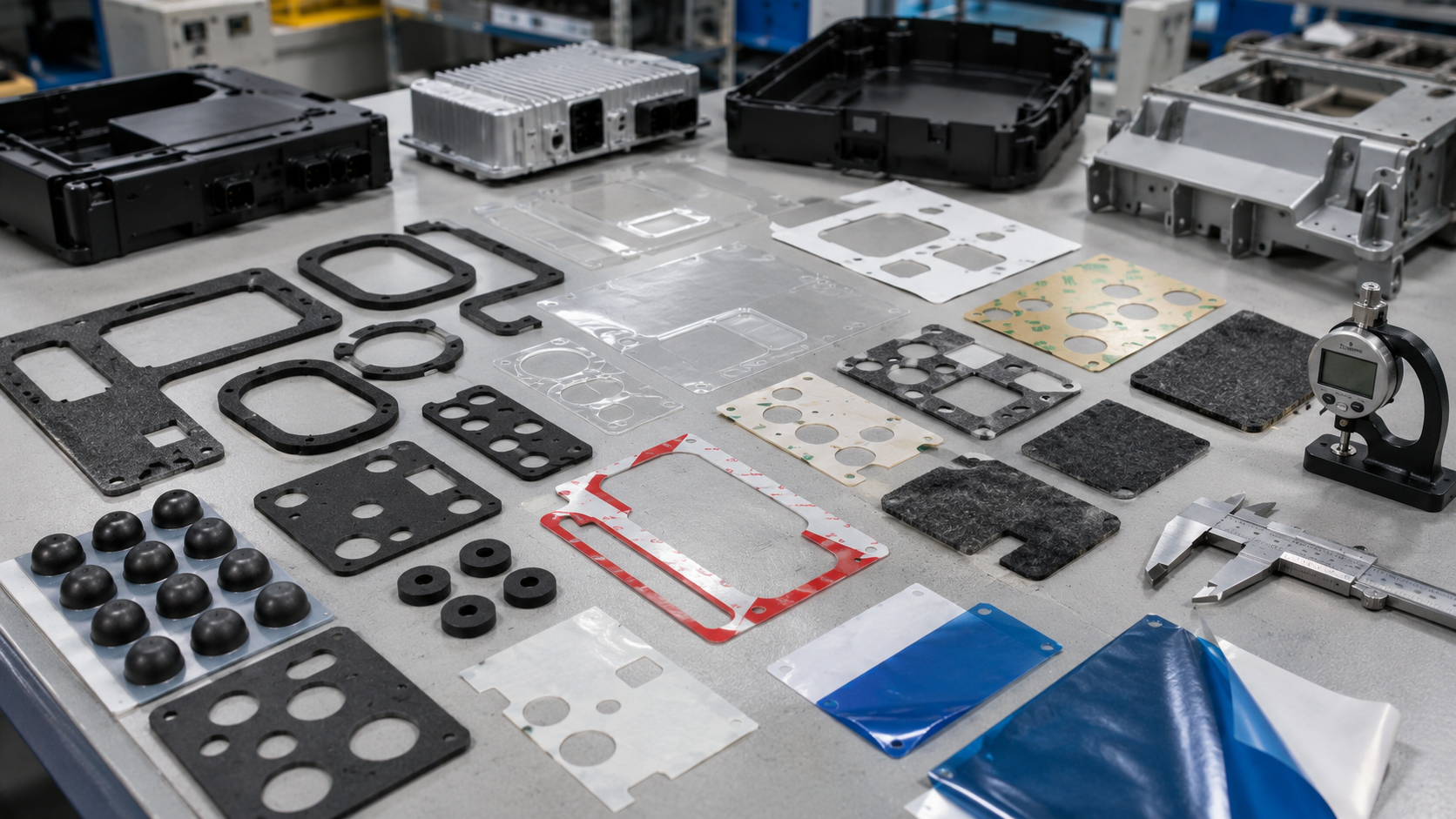
The right supplier should also select the right process.
Flatbed die cutting may be suitable for thicker foam, rubber, or lower-volume custom parts.
Rotary die cutting may be suitable for roll materials, adhesive tapes, films, and high-volume production.
Kiss cutting is important for adhesive-backed components where the top material must be cut without cutting through the release liner.
Lamination may be required when foam, film, felt, or rubber needs adhesive backing.
The process should match the material, shape, tolerance, volume, and delivery format.
How to Evaluate Engineering Support
Engineering support is one of the biggest differences between a basic supplier and a reliable die-cutting partner.
A basic supplier may say, “Send the drawing, we can make it.”
A better supplier will ask questions first.
For example:
- What is the final application?
- Is the part used for sealing, insulation, bonding, cushioning, or sound absorption?
- Which dimensions are critical?
- What is the assembly method?
- Does the part need adhesive backing?
- What is the bonding surface?
- Will the part face heat, humidity, vibration, or compression?
- Is the part supplied in sheets, rolls, or individual pieces?
- How will the customer inspect or validate the sample?
These questions help prevent trial failures.
For example, a foam gasket may need a wider sealing wall. A PET film may need improved hole tolerance. An adhesive-backed tape part may need a different liner. A non-woven felt pad may need better edge control.
Good engineering support helps customers solve these issues before tooling.
How Sanken Helps Reduce Risk Before Mass Production
Sanken Manufacturing helps OEM customers review die cut components before production by checking material behavior, adhesive structure, tolerance feasibility, waste removal risk, inspection points and delivery format.
For foam gasket projects, we check density, thickness, compression range, sealing wall width and waste removal risk.
For adhesive-backed parts, we review adhesive type, liner release, lamination stability, kiss cutting depth and edge overflow risk.
For PET insulation films and non-woven felt parts, we focus on dimensional stability, clean edges, hole alignment, fiber condition and assembly fit.
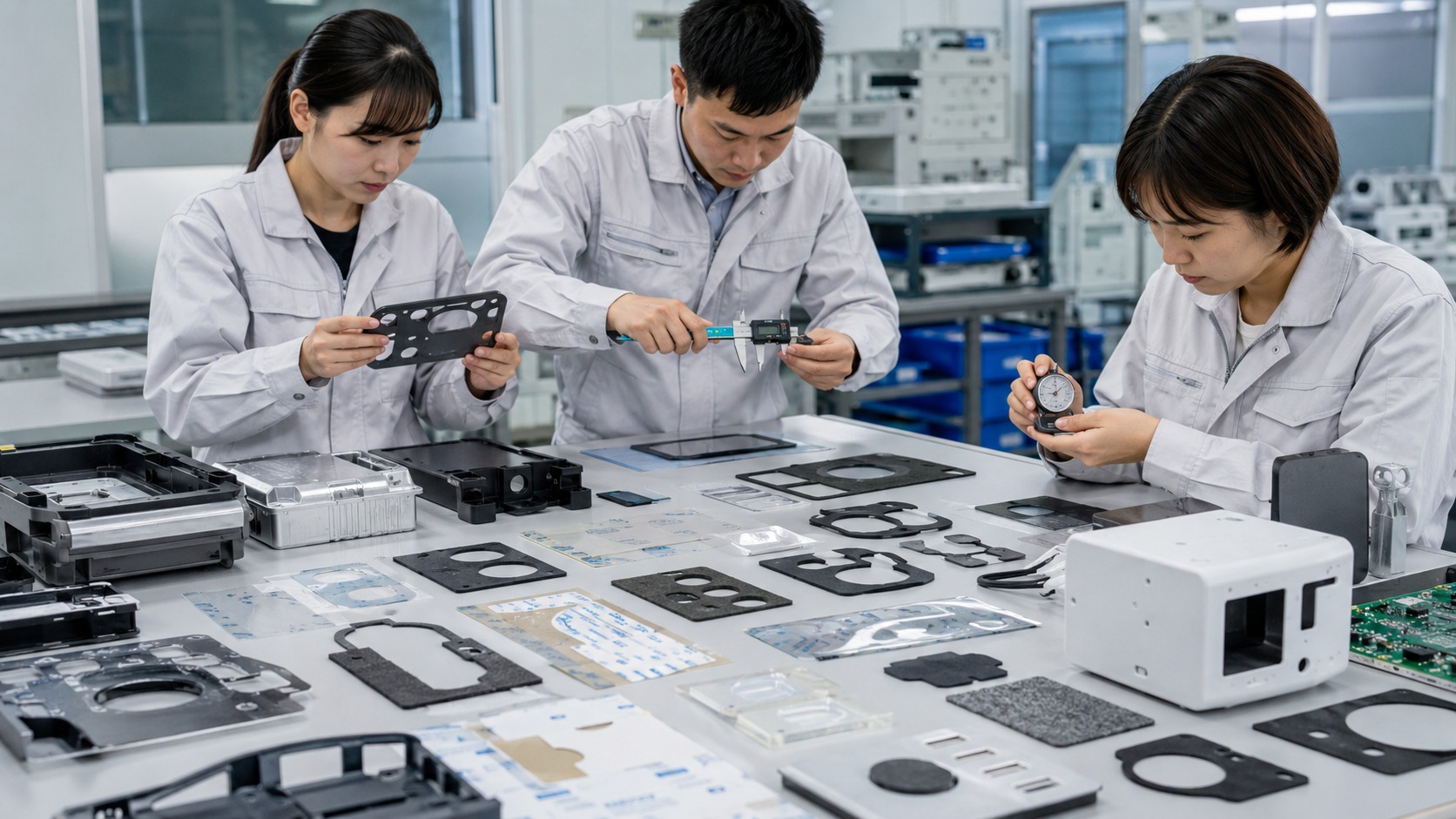
A good supplier should help customers move from drawing to sample and from sample to stable mass production.
That is the real value of choosing the right precision die-cutting component supplier.
Conclusion
Choosing a precision die-cutting component supplier is an engineering and purchasing decision, not just a price comparison. The right supplier should understand materials, tolerances, adhesive behavior, tooling, waste removal, inspection, packaging, and mass production stability.
At Sanken, we help OEM buyers and engineers reduce risk before production by reviewing each die-cut component as a functional part. This approach helps customers avoid repeated trials, improve assembly efficiency, and receive more reliable custom die-cut components for automotive, electronics, medical, appliance, and industrial applications.