
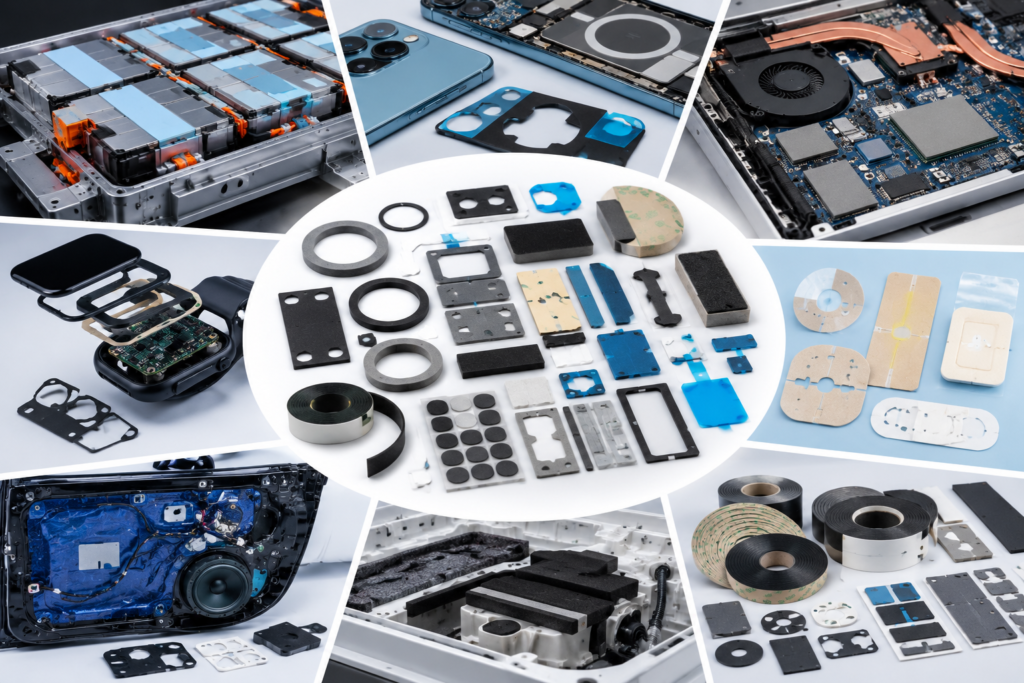
Custom Die-Cut Components for Automotive, Electronics and Medical OEMs
Custom die-cut components for automotive, electronics and medical OEMs are small parts, but they often carry important functions inside the final product. A foam gasket may prevent dust and vibration. A PET insulation film may protect a circuit. A medical adhesive pad may need stable bonding and clean cutting. If the material, tolerance, adhesive, or process is wrong, the problem may not appear until assembly or field use.
At Sanken, we support OEM customers that need precision die cutting, material converting, adhesive lamination, foam and rubber parts, PET insulation films, non-woven felt components, sealing gaskets, and custom industrial parts. For buyers and engineers, choosing the right die-cut component is not only a sourcing decision. It is a reliability decision.
Why This Topic Matters for OEM Manufacturing
Automotive, electronics, and medical OEMs all use die-cut components, but their risks are different.
Automotive parts often face heat, vibration, compression, dust, moisture, and long service life requirements.
Electronics parts often require thin materials, clean edges, accurate holes, stable adhesive, and insulation performance.
Medical device components often require cleanliness, consistency, skin-contact material review, traceability, and controlled adhesive behavior.
In all three industries, the part may be small, but the cost of failure can be high.
A gasket that leaks can damage an electronic control unit.
A film that shifts can cause insulation failure.
A foam pad that compresses poorly can create noise or assembly gaps.
An adhesive part that peels too early can slow production or reduce product reliability.
This is why OEM buyers should not treat die-cut parts as simple cut shapes. They should evaluate the full material structure, tolerance, application environment, production method, and quality control process.
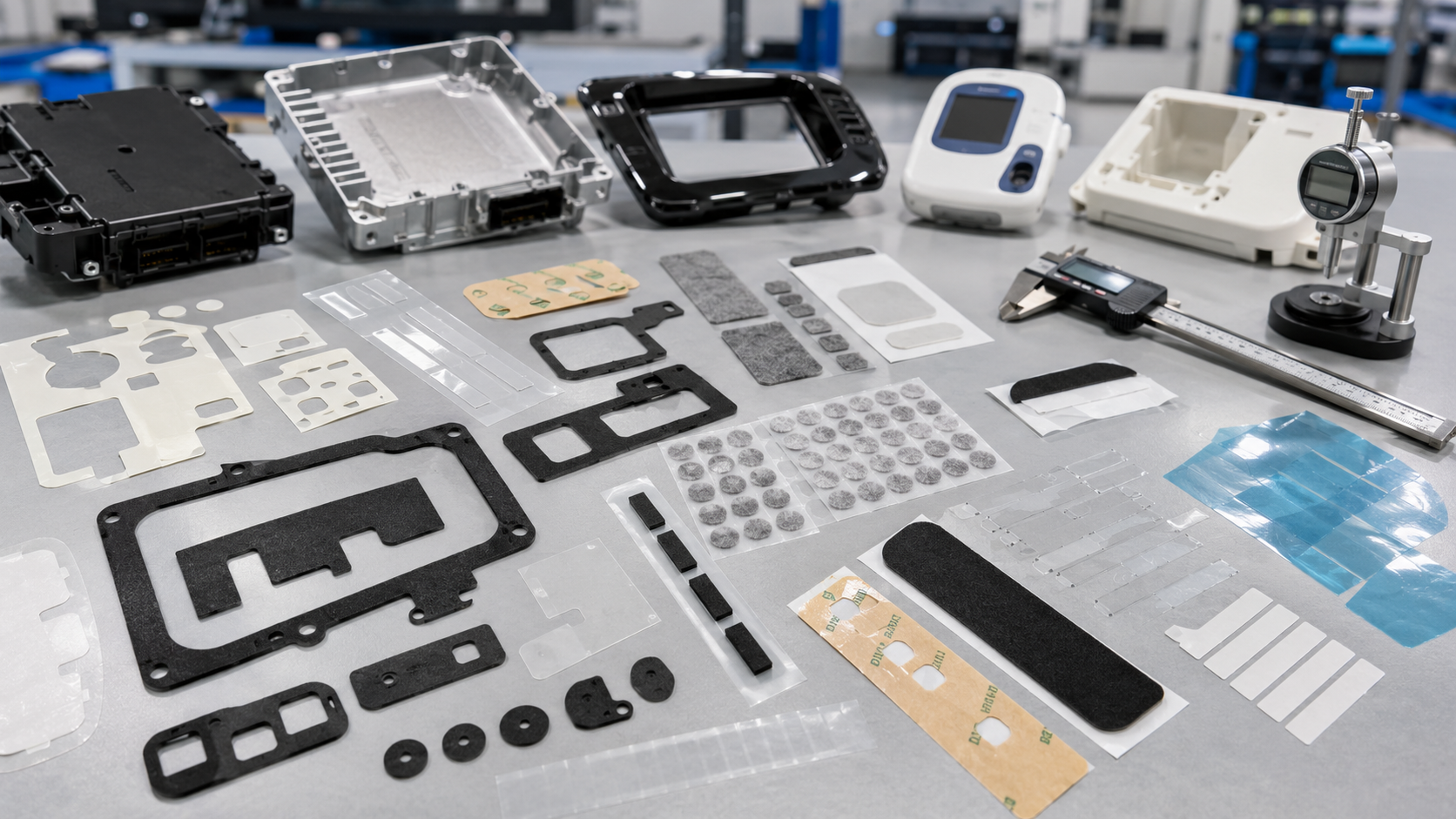
Common Problems and Production Risks
Many die-cut component problems happen because the project is quoted before the functional risks are understood. A drawing may show the shape, but it does not always show compression load, bonding surface, temperature exposure, clean handling needs, or assembly method.
| Problem | Common Cause | OEM Risk |
|---|---|---|
| Poor sealing | Wrong foam density or gasket thickness | Dust, water, air, or noise leakage |
| Hole misalignment | Weak tolerance control | Assembly delay or rejected parts |
| Adhesive peeling | Wrong adhesive or poor surface match | Bonding failure |
| Adhesive overflow | Excessive cutting pressure or soft adhesive | Contamination and poor appearance |
| Film deformation | Thin material or poor tension control | Difficult assembly or insulation risk |
| Rough edges | Wrong tooling or cutting method | Poor fit or particles |
| Foam compression loss | Wrong material for service environment | Long-term sealing failure |
| Batch inconsistency | No process control plan | Mass production instability |
These risks are especially important when the component is used in safety-related or reliability-sensitive products.
For example, an automotive electronics gasket may need stable compression after heat aging and vibration. A PET insulation film inside an electronic device may need tight hole alignment. A medical adhesive component may need clean edges and stable release from the liner.
The supplier must understand the difference between cutting a shape and producing a functional OEM component.
What Buyers or Engineers Should Check First
Before ordering custom die-cut components, buyers and engineers should define the real application requirements. This helps avoid repeated samples, wrong materials, unnecessary tooling changes, and unstable mass production.
| Checklist Item | What to Confirm | Why It Matters |
|---|---|---|
| Industry application | Automotive, electronics, medical, industrial | Defines quality and material requirements |
| Function | Sealing, bonding, insulation, cushioning, protection | Guides material selection |
| Material type | Foam, rubber, PET, adhesive tape, felt, silicone | Affects cutting and performance |
| Thickness | Nominal thickness and tolerance | Controls fit, compression, and function |
| Critical dimensions | Holes, edges, openings, sealing walls | Protects assembly and reliability |
| Adhesive structure | Adhesive type, liner, bonding surface | Prevents peeling, shifting, or overflow |
| Environment | Heat, humidity, vibration, skin contact, chemicals | Prevents long-term failure |
| Assembly method | Manual, fixture, automated, screw compression | Affects part layout and delivery format |
| Testing needs | Compression, peel, aging, insulation, cleanliness | Confirms performance before production |
| Packaging | Roll, sheet, individual piece, kit | Supports efficient assembly |
A good buyer checklist should separate critical dimensions from non-critical dimensions.
Not every part needs extreme tolerance everywhere. But areas that affect sealing, bonding, insulation, screw alignment, sensor clearance, or assembly positioning should be controlled carefully.
This is how engineers protect product performance while keeping cost reasonable.
Automotive OEM Die-Cut Components
Automotive OEMs use custom die-cut components in interiors, electronics, lighting, battery systems, sensors, displays, and industrial vehicle assemblies.
Common automotive die-cut parts include:
- Foam sealing gaskets
- Rubber pads
- Non-woven felt NVH parts
- PET and PI insulation films
- Adhesive-backed tapes
- Anti-rattle pads
- Cushioning spacers
- Dustproof and waterproof seals
- Thermal and electrical insulation parts
Automotive applications often require long-term reliability.
The part may face heat, vibration, compression, moisture, dust, and repeated mechanical stress. A foam gasket that looks good during sampling may fail later if compression recovery is poor. An adhesive pad may peel if the surface energy of the housing is not considered. A non-woven felt part may need stable thickness and clean cutting to control noise and rattling.
For automotive electronics, hole position, sealing wall width, gasket thickness, and adhesive placement are especially important. If one hole shifts or one sealing wall becomes too narrow, the part may not sit properly in the housing.
At Sanken, we review automotive die-cut parts based on application function, not only drawing shape.
Electronics OEM Die-Cut Components
Electronics OEMs often need thin, precise, and clean die-cut components.
These parts may be used in displays, batteries, cameras, speakers, sensors, wearable devices, circuit boards, and small housings.
Common electronics die-cut components include:
- PET insulation films
- PI insulation films
- PC films
- Double-sided adhesive tape parts
- Protective films
- Foam spacers
- Conductive and shielding materials
- Light-blocking films
- Cushioning pads
- Dustproof gaskets
Electronics projects usually require accurate dimensions and stable handling.
Small holes, thin strips, narrow bridges, and multilayer materials can create production challenges. Adhesive-backed parts may require kiss cutting, clean liner release, and controlled adhesive edges. Thin films may curl, stretch, or shift if tension is not managed.
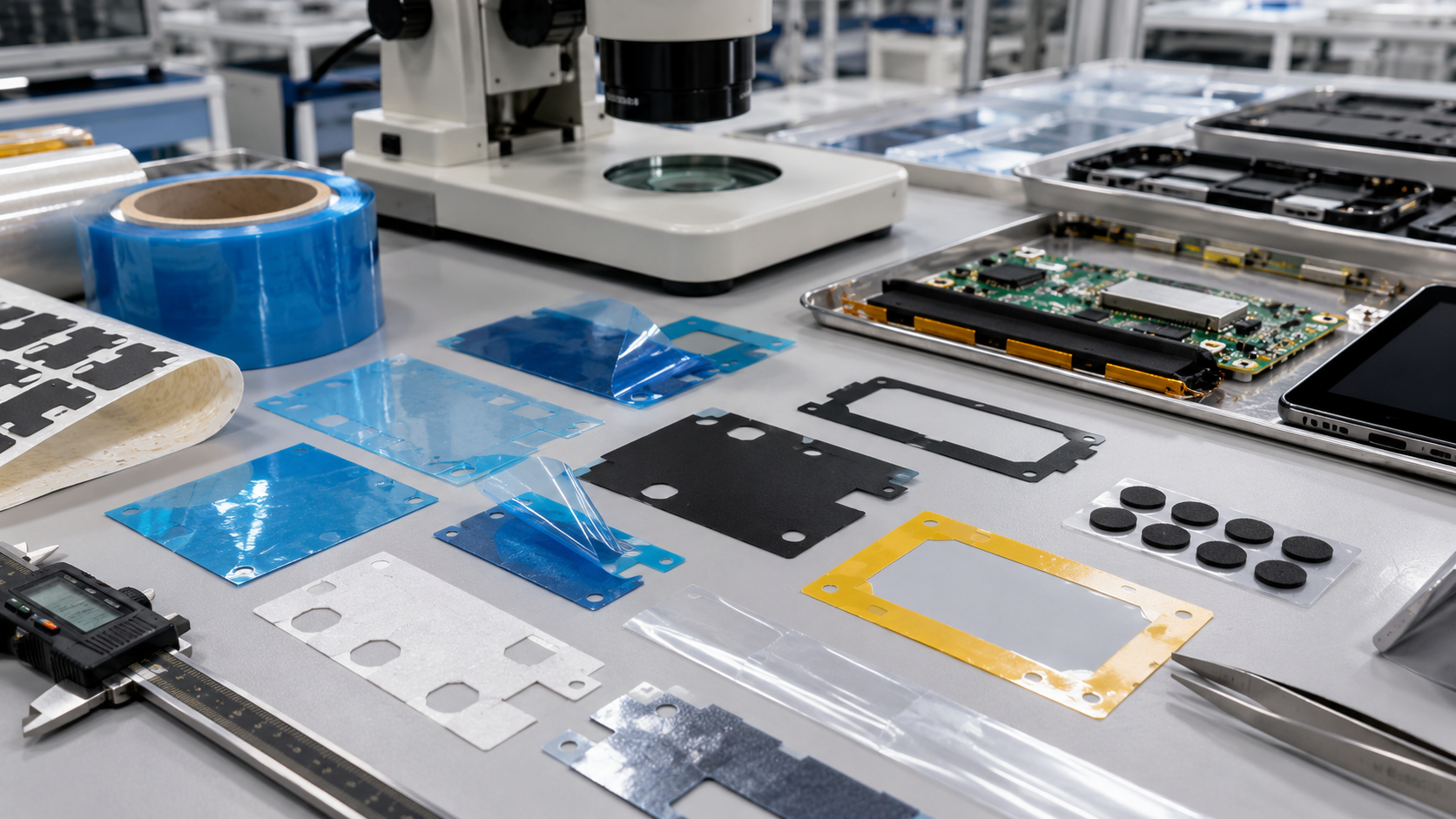
For electronics OEMs, the key is not only whether the part can be cut. The key is whether it can be assembled quickly without shifting, tearing, peeling, or contaminating nearby components.
Sanken supports electronics customers by reviewing material thickness, tolerance, adhesive structure, cutting method, liner selection, and packaging format before mass production.
Medical OEM Die-Cut Components
Medical OEM applications require extra attention to cleanliness, stability, and material consistency.
Common medical die-cut components may include:
- Medical adhesive pads
- Foam cushioning parts
- Protective films
- Skin-contact adhesive components
- Disposable device pads
- Barrier films
- Sealing and insulation components
- Non-woven or fabric-based parts
Medical applications often have stricter expectations for clean handling, material traceability, adhesive consistency, and dimensional stability.
A small edge defect may create particles.
A liner release problem may slow assembly.
An unstable adhesive may affect product performance.
A material change without review may create validation problems.
For medical OEMs, supplier communication must be clear from the beginning. The buyer should confirm material requirements, cleanliness expectations, packaging method, tolerance needs, and testing standards before sampling.
At Sanken, we understand that medical-related die-cut components must be controlled carefully from material selection to production and packaging.
Material and Process Considerations
The right material depends on the final function.
Foam is often used for sealing, cushioning, gap filling, vibration reduction, and dust protection. The engineer should review density, compression recovery, thickness, and sealing width.
Rubber is used for sealing, shock absorption, and anti-slip applications. It may require good rebound, clean edges, and stable thickness.
PET film is used for insulation, protection, spacing, and electronic assemblies. It requires dimensional stability, clean holes, and accurate edge control.
Adhesive tape is used for bonding and assembly. The adhesive must match the bonding surface, temperature condition, liner release requirement, and installation process.
Non-woven felt is used for acoustic control, anti-rattle, cushioning, and filtration. The engineer should review thickness variation, fiber condition, cutting edge, and application environment.
Silicone foam or silicone rubber may be used where heat resistance, flexibility, and long-term recovery are important.
The process must also match the material.
Flatbed die cutting may be suitable for thicker foam, rubber, and smaller production runs. Rotary die cutting may be better for high-volume roll materials, adhesive tapes, and films. Kiss cutting is important for adhesive-backed parts where the material must remain on the release liner.
A professional supplier should recommend the process based on part structure, material behavior, tolerance, quantity, and delivery format.
How Sanken Helps Reduce Risk Before Mass Production
Sanken helps OEM customers reduce risk before mass production by reviewing the part as a complete system.
For automotive components, we focus on sealing reliability, compression performance, vibration resistance, adhesive stability, and assembly fit.
For electronics components, we focus on clean cutting, dimensional accuracy, insulation performance, adhesive control, and small feature stability.
For medical-related components, we focus on cleanliness, material consistency, edge quality, adhesive behavior, and packaging control.
Our process support includes precision die cutting, material converting, adhesive lamination, foam and rubber converting, PET film cutting, non-woven felt processing, kiss cutting, inspection, and custom packaging.
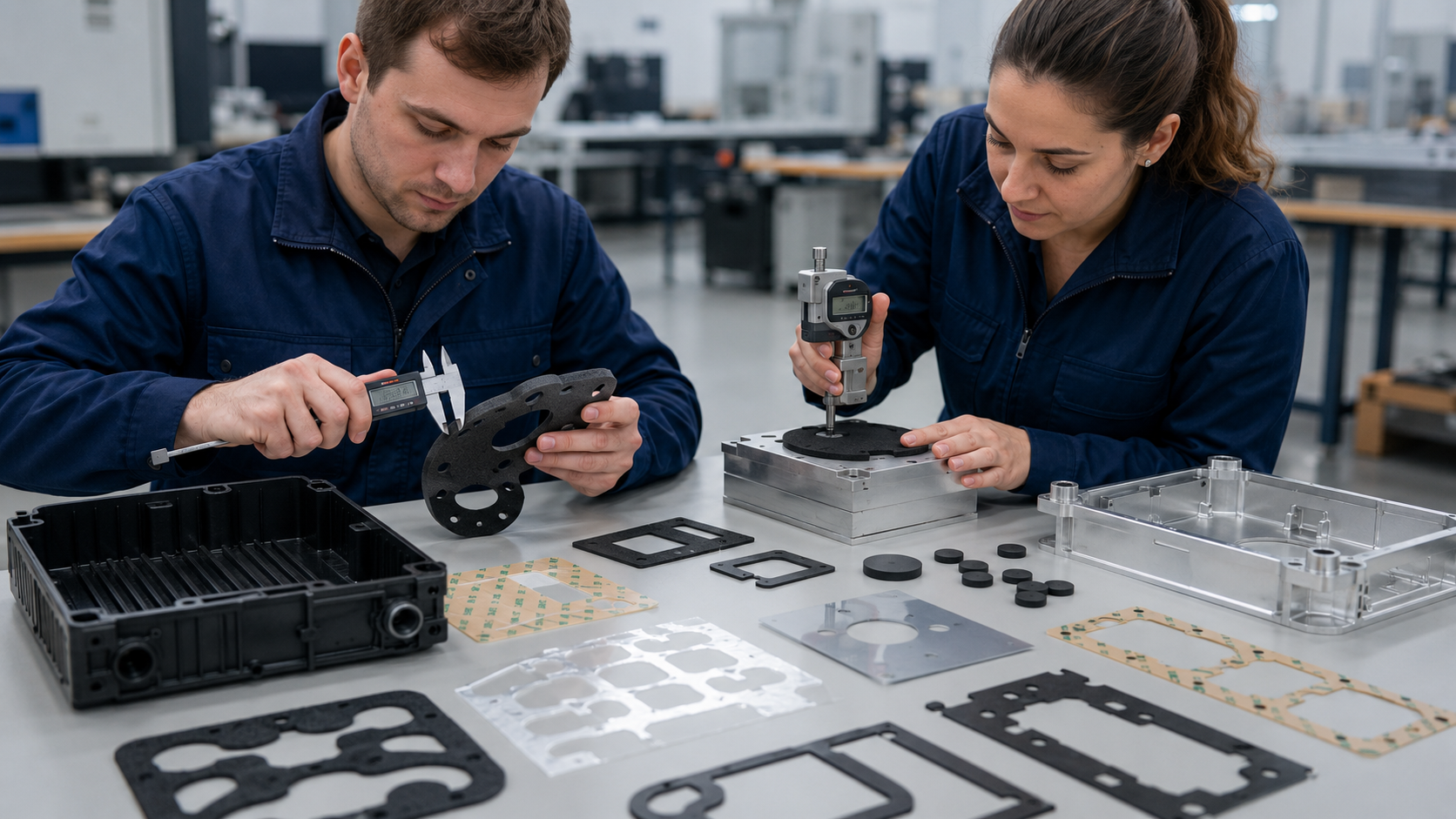
We also help customers identify common risks before tooling:
- Minimum width too narrow
- Hole-to-edge distance too small
- Foam too soft for the required gasket shape
- Adhesive not suitable for the bonding surface
- Tolerance too tight for the material
- Waste removal too difficult
- Packaging likely to deform the part
- Sample approval not enough for batch stability
This early review helps reduce repeated trials, tooling corrections, scrap, delivery delays, and assembly problems.
For OEM buyers, the goal is not just to receive parts. The goal is to receive parts that work consistently in production.
FAQ
What are custom die-cut components?
Custom die-cut components are flexible material parts cut into specific shapes for sealing, bonding, insulation, cushioning, protection, spacing, sound control, or assembly support. They are often made from foam, rubber, PET film, adhesive tape, non-woven felt, silicone, or laminated materials.
Which industries use custom die-cut components?
Automotive, electronics, medical, appliances, industrial equipment, optical devices, battery systems, and consumer products all use custom die-cut components.
What materials are commonly used for OEM die-cut parts?
Common materials include PU foam, EVA foam, PE foam, EPDM foam, CR foam, rubber, silicone foam, PET film, PI film, PC film, double-sided adhesive tape, protective film, non-woven felt, and laminated materials.
Why do OEM die-cut parts fail during sampling?
They may fail because of poor material selection, unrealistic tolerance, narrow wall design, adhesive overflow, liner release problems, rough cutting edges, hole misalignment, or difficult waste removal.
How can buyers choose the right die-cutting supplier?
Buyers should choose a supplier that can review material behavior, critical dimensions, adhesive structure, tooling method, inspection needs, packaging format, and mass production repeatability before making samples.
Are automotive, electronics, and medical die-cut parts produced the same way?
No. The basic die cutting process may be similar, but the requirements are different. Automotive parts often focus on vibration, sealing, and aging. Electronics parts focus on precision, insulation, and clean handling. Medical parts focus on cleanliness, consistency, adhesive stability, and packaging control.
Conclusion
Custom die-cut components for automotive, electronics and medical OEMs must be designed and produced with function, material behavior, tolerance, adhesive structure, cleanliness, and mass production stability in mind. A small gasket, film, pad, or adhesive part can affect the reliability of the entire product.
At Sanken, we support OEM buyers and engineers with precision die cutting, material converting, adhesive lamination, foam and rubber parts, PET insulation films, non-woven felt components, sealing gaskets, and custom industrial components. By reviewing risk before mass production, we help customers reduce trial failures, improve assembly efficiency, and receive more reliable custom die-cut parts.
Image Prompts for Generation
Image Prompt 1 – Custom die-cut components for automotive electronics and medical OEMs
A realistic industrial product photography scene showing a wide range of custom die-cut components arranged neatly on a clean engineering workbench. Include black foam sealing gaskets, rubber pads, PET insulation films, adhesive-backed tape parts with release liners, non-woven felt pads, and thin protective films. The background should include automotive electronics housings, small electronic device covers, and medical device component shells to clearly show the three target industries: automotive, electronics, and medical OEM manufacturing. Add inspection tools such as digital calipers and a thickness gauge in the background, but keep the main focus on the finished die-cut components. Use clean factory lighting, high-resolution industrial product photography style, realistic material textures, no text, no labels, no arrows, no icons, and no logos.
Image Prompt 2 – Precision die-cut PET insulation films and adhesive parts for electronics OEMs
A realistic close-up electronics manufacturing scene showing precision die-cut PET insulation films, adhesive-backed tape parts, foam spacers, and protective films prepared for electronic device assembly. The parts should be thin, cleanly cut, and arranged near circuit board housings, battery module components, sensor covers, or display module parts. Show release liner, small holes, inner cutouts, and accurate edge profiles to communicate tight tolerance and clean die cutting. Include optical inspection tools, calipers, and clean assembly fixtures on a professional electronics OEM workbench. Use high-resolution industrial photography, bright neutral lighting, realistic cleanroom-style environment, no text, no labels, no logos, no arrows, and no icons.
Image Prompt 3 – OEM engineers inspecting custom die-cut components before mass production
A realistic OEM engineering validation scene showing engineers or technicians inspecting custom die-cut components before mass production. The scene should include foam sealing gaskets for automotive electronics, PET insulation films for electronic devices, adhesive-backed medical pads, rubber cushioning parts, non-woven felt components, and industrial enclosure samples on a clean assembly bench. Engineers should be checking hole alignment, edge quality, adhesive positioning, liner release, compression fit, and dimensional accuracy using calipers, gauges, and inspection fixtures. The image should communicate B2B OEM quality control, pre-production validation, and risk reduction before mass production. Use professional factory lighting, high-resolution industrial application photography style, no text, no labels, no arrows, no icons, and no logos.