

How to Choose Flexible Custom Die-Cut Foam Inserts
Flexible custom die-cut foam inserts are used to hold, cushion, protect, and position products without creating too much pressure. They are common in electronics packaging, medical device trays, automotive component protection, precision instruments, tool cases, wearable devices, and industrial product shipping.
The key word is flexible.
A foam insert should not only match the product shape. It should also adapt to small size differences, absorb movement, protect delicate surfaces, and make loading or removal easy.
For OEM buyers, the real question is not simply “Which foam insert looks good?” The better question is:
“Which flexible foam insert can protect my product during handling, transport, and assembly without causing scratches, pressure marks, loose fit, or slow packing?”
A good foam insert reduces damage. A poor one can create hidden cost.
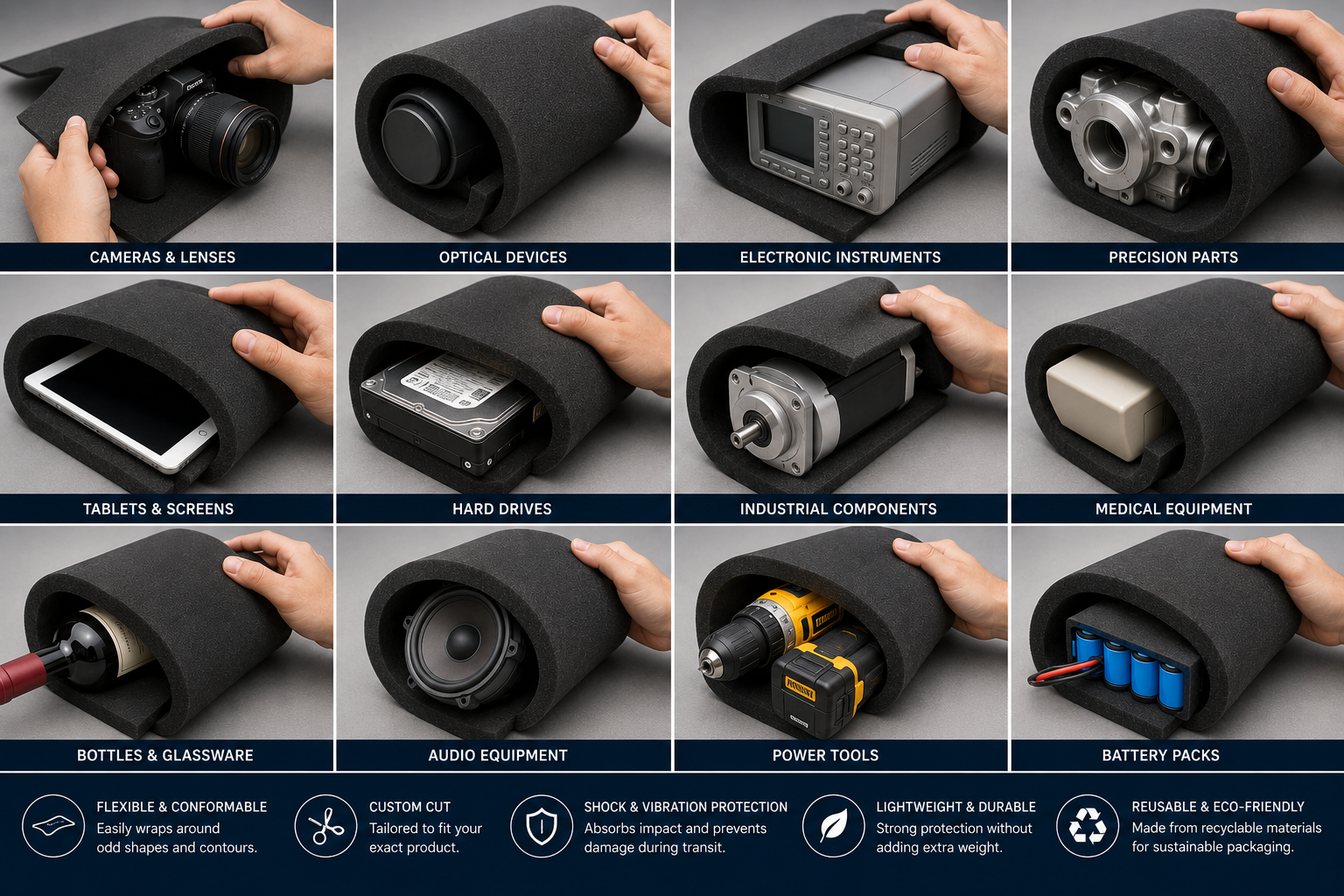
Start With the Product’s Weak Points
Do not start by choosing foam color or thickness.
Start by checking where the product can fail.
Ask:
- Is the product surface easy to scratch?
- Are there lenses, screens, buttons, ports, or sensors?
- Is the product heavy on one side?
- Does it have sharp edges?
- Does it need finger access for removal?
- Will it move during shipping?
- Will the foam touch painted, coated, glossy, or optical surfaces?
A flexible foam insert should support strong areas and avoid pressing on fragile areas.
For example, a sensor module may need support around the housing, not directly on the lens. A display part may need edge support, not pressure on the screen center. A medical device may need stable positioning but easy removal with gloves.
The best foam insert is designed around the product’s real risk.
Choose the Right Foam Type
Different foam materials provide different flexibility and protection.
| Foam Type | Best For | Main Concern |
|---|---|---|
| EVA foam | General protection, firm support, clean appearance | May feel too firm for delicate surfaces |
| PE foam | Packaging inserts, lightweight protection, moisture resistance | Less soft than PU foam |
| PU foam | Soft cushioning, delicate products, comfort contact | Can compress more easily |
| EPDM foam | Automotive protection, sealing, vibration resistance | Higher cost than basic foam |
| Rubber foam | Damping, sealing, industrial protection | Heavier and may need testing |
| Silicone foam | Heat-resistant or special applications | Higher material cost |
For flexible inserts, PU foam or softer PE/EVA foam may be considered when the product needs gentle cushioning. For stronger positioning, higher-density EVA or PE foam may work better.
Soft does not always mean better.
If the foam is too soft, the product may sink or move. If it is too firm, the insert may create pressure marks. The right foam balances support and flexibility.
Match Foam Density to Product Weight
Foam density affects how much support the insert provides.
A lightweight electronic accessory may only need soft foam. A metal component, medical device, or industrial tool may need higher-density foam to prevent bottoming out.
If the product is too heavy for the foam, the insert may collapse during shipping. The product may then hit the bottom of the box or press against another part.
If the foam is too dense, impact force may transfer to the product instead of being absorbed.
For important products, sample testing should include real product weight, drop movement, stacking pressure, and transport vibration.
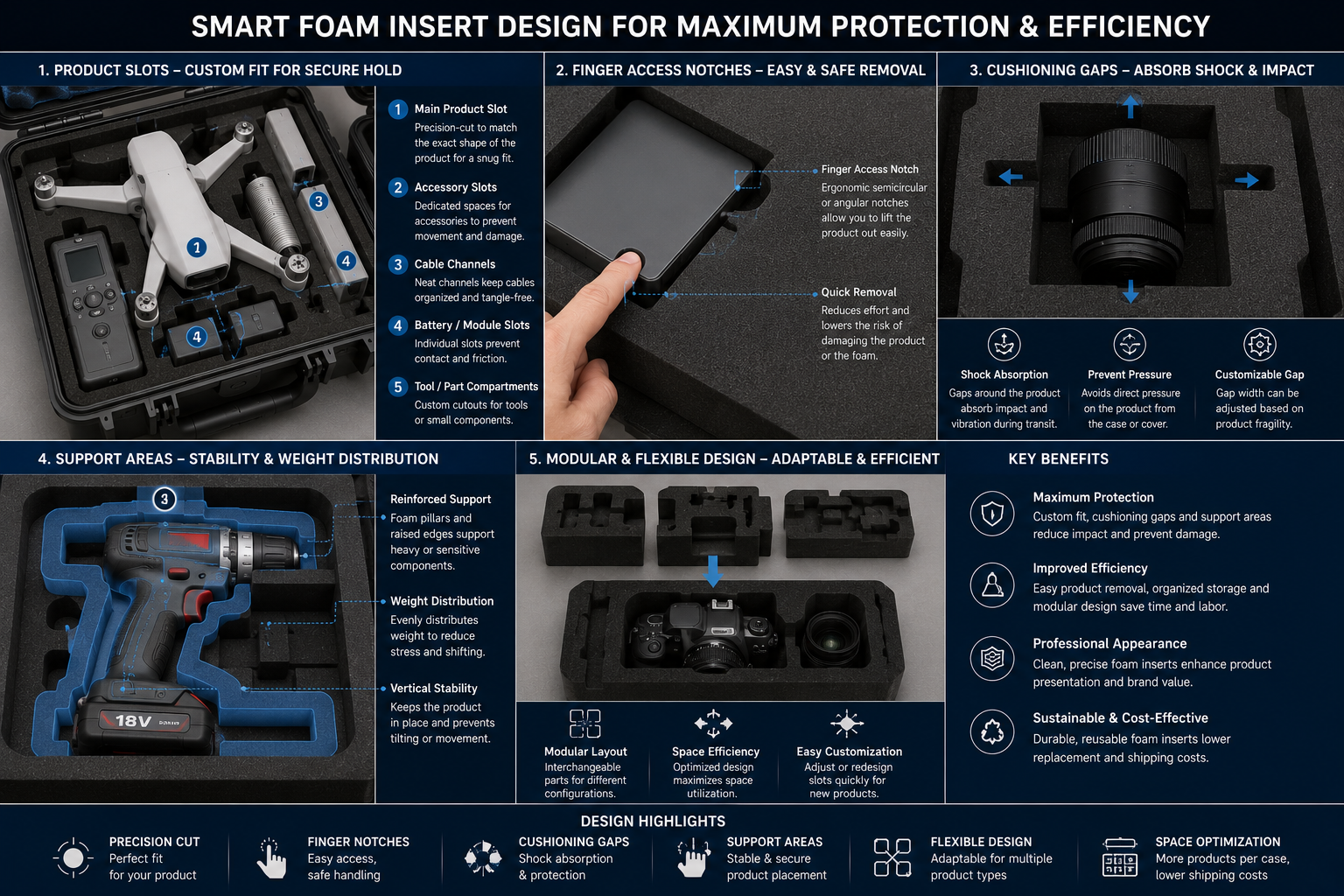
Design the Cavity for Fit and Removal
A flexible insert should hold the product securely, but it should not trap it.
Good cavity design considers:
- Product outline
- Clearance
- Insertion direction
- Removal direction
- Finger notches
- Product weight distribution
- Fragile contact areas
- Surface finish
- Tolerance variation
- Packaging space
One common mistake is cutting the cavity exactly the same size as the product. This may look precise, but it can be too tight in real use.
Small clearance is often needed for easy loading and removal.
Finger access is also important. If workers or customers struggle to remove the product, they may pull too hard, scratch the surface, or deform the insert.
Consider Compression and Rebound
Flexible foam inserts must compress and recover properly.
Compression helps absorb shock and hold the product. Rebound allows the foam to return to shape after pressure.
Poor compression behavior can cause problems:
- Foam stays flattened.
- Product becomes loose.
- Sealing force is lost.
- Packaging looks used or damaged.
- Product moves during transport.
- Insert no longer holds repeat shipments.
For reusable packaging, rebound is especially important. A foam insert used many times must recover after repeated product loading.
For one-time shipping, the requirement may be less strict, but the foam still needs enough compression strength to protect the product during transport.
Decide Whether Adhesive Backing Is Needed
Some foam inserts need adhesive backing to stay fixed inside a box, tray, housing, case, or assembly.
Adhesive-backed foam inserts are useful when:
- The insert must not shift.
- Packing speed matters.
- The foam is attached to a lid or base.
- The product needs fixed positioning.
- The insert is part of an assembly process.
But adhesive backing adds another design question.
The adhesive must match the box material, plastic tray, metal surface, painted part, or other substrate. If the adhesive is too weak, the insert lifts. If it is too strong and removal is required, it may damage the surface or leave residue.
For mass production, the release liner should also be easy to peel. A good liner design can save assembly time.
Check Edge Quality
Clean edges make foam inserts look more professional and reduce debris.
Rough edges may cause:
- Loose foam particles
- Poor appearance
- Difficult product insertion
- Surface contamination
- Customer complaints
- Inconsistent fit
For electronics, optical parts, medical devices, and precision instruments, edge quality matters more because particles and dust can create defects.
Die cutting, kiss cutting, skiving, laminating, and controlled packaging can help improve consistency.
Think About Packaging Experience
Foam inserts are not only protective. They also affect customer perception.
A clean custom insert makes the product look organized and secure. A loose or rough insert can make even a high-value product feel cheap.
For premium products, consider:
- Clean cavity shape
- Consistent edge quality
- Easy product removal
- Correct foam firmness
- Neat layout
- No unnecessary pressure points
- Good fit with the box or case
For industrial products, appearance may be less important than protection, but easy handling and stable positioning still matter.
Common Mistakes Buyers Should Avoid
Choosing Foam Only by Thickness
Thickness alone does not define protection. Density, hardness, rebound, and compression behavior are equally important.
Making the Cavity Too Tight
A tight cavity may look precise, but it can scratch the product or slow down packing.
Ignoring Product Weight
Soft foam may fail when the product is heavy or sharp.
Forgetting Finger Access
If the product is hard to remove, users may damage the product or foam.
Using One Foam for Every Product
Different products may require different foam densities, layers, or cavity designs.
Skipping Real Shipping Tests
A foam insert that looks good in the office may fail during transport.
Questions to Ask Before Ordering
Before ordering flexible custom die-cut foam inserts, confirm:
- What product needs protection?
- What is the product weight?
- Which surfaces are fragile or easy to scratch?
- Is the insert for packaging, storage, transport, or assembly?
- Should the foam be soft, medium, or firm?
- Does the product need finger access?
- Is the insert disposable or reusable?
- Does it need adhesive backing?
- Will it face vibration, compression, humidity, or heat?
- Does the foam need clean edges?
- What tolerance is acceptable?
- Should samples be tested before mass production?
These questions help reduce repeated sampling and wrong foam selection.
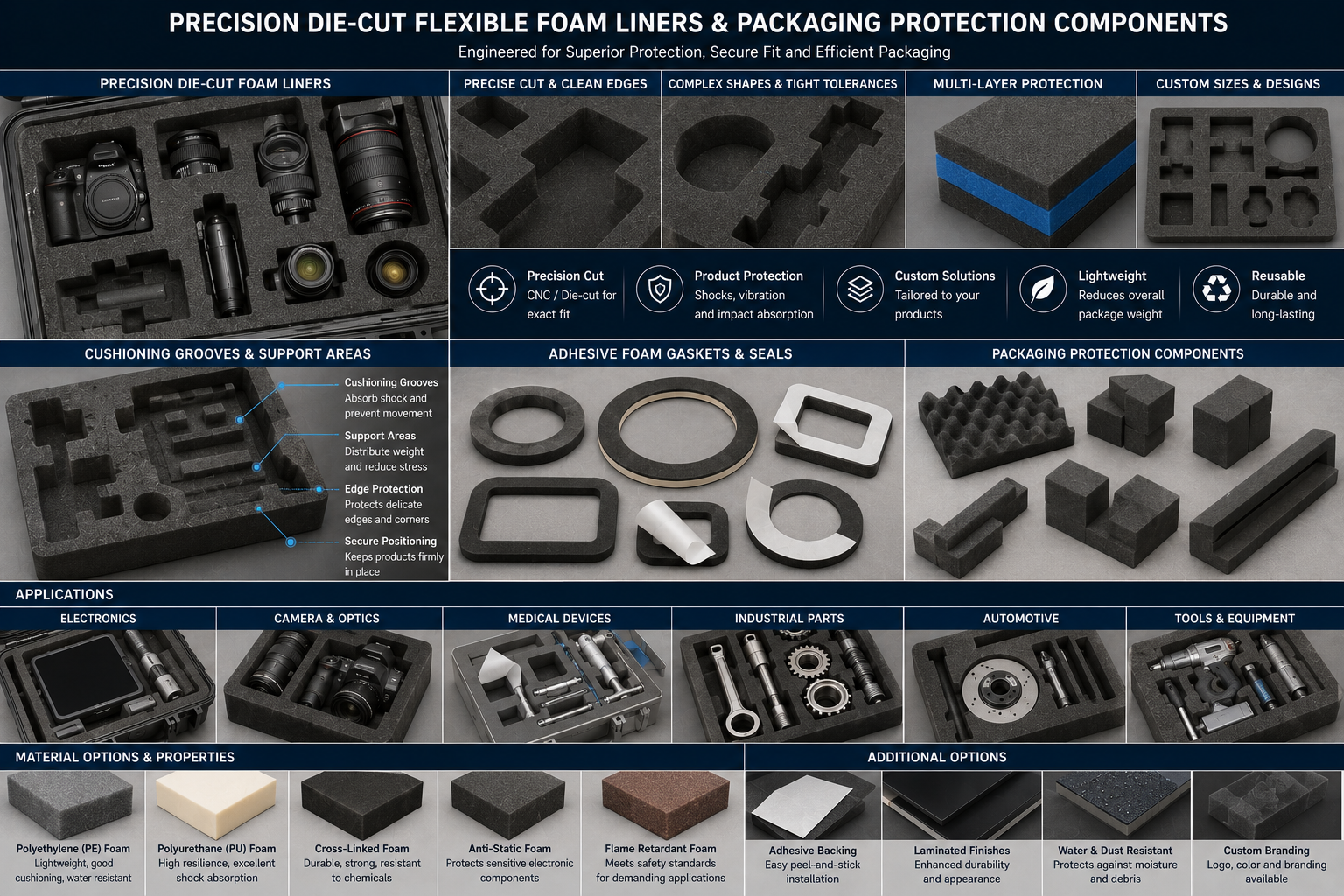
How Sanken Helps With Flexible Foam Inserts
Sanken Manufacturing helps OEM customers design and produce custom die-cut foam inserts based on real protection needs.
We help review whether the main risk is movement, impact, surface scratching, loose fit, pressure damage, adhesive lifting, or slow packing.
Sanken supports foam die cutting, adhesive lamination, kiss cutting, foam tape converting, custom packaging inserts, prototype sampling, and mass production supply.
The goal is not only to cut foam into a shape. The goal is to make the insert fit the product, protect it reliably, and support smoother production.
Conclusion
To choose flexible custom die-cut foam inserts, start with the product’s weak points, weight, surface sensitivity, handling method, and shipping conditions. Then select the foam type, density, cavity design, adhesive structure, and edge quality based on the real protection requirement.
The best foam insert is not always the softest or thickest one. It is the insert that holds the product securely, cushions impact, avoids scratches, allows easy removal, and performs consistently in real packaging or assembly.
When designed correctly, flexible custom foam inserts can reduce damage, improve packing efficiency, enhance product presentation, and help products reach customers safely.