
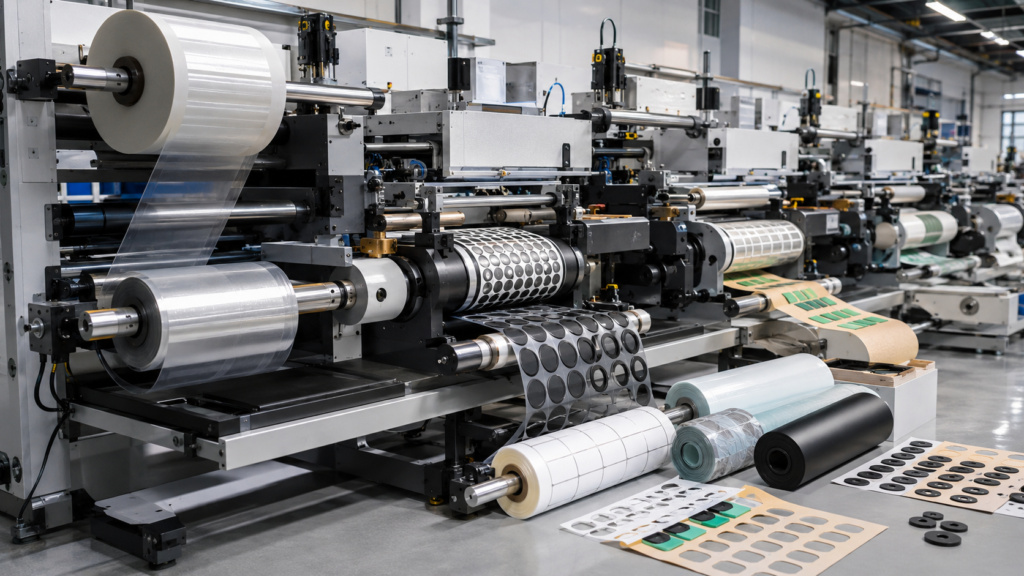
Manufacturers often struggle to choose the right high-volume cutting method for flexible materials. Wrong process selection increases tooling costs and slows delivery. Rotary die cutting solves this with speed, accuracy, and automation readiness.
Rotary die cutting is a continuous roll-to-roll converting process that uses a cylindrical die to cut shapes from roll-fed materials at high speed.It is widely used for adhesive tapes, foam materials, PET films, protective films, rubber sheets, non-woven felt and precision sealing components in automotive, electronics, appliance and industrial OEM applications.
How does rotary die cutting work and why is it ideal for high-volume production?
Many engineers understand die cutting generally but are less familiar with how rotary die cutting differs from flatbed cutting. Knowing the workflow helps determine when it becomes the most cost-efficient option.
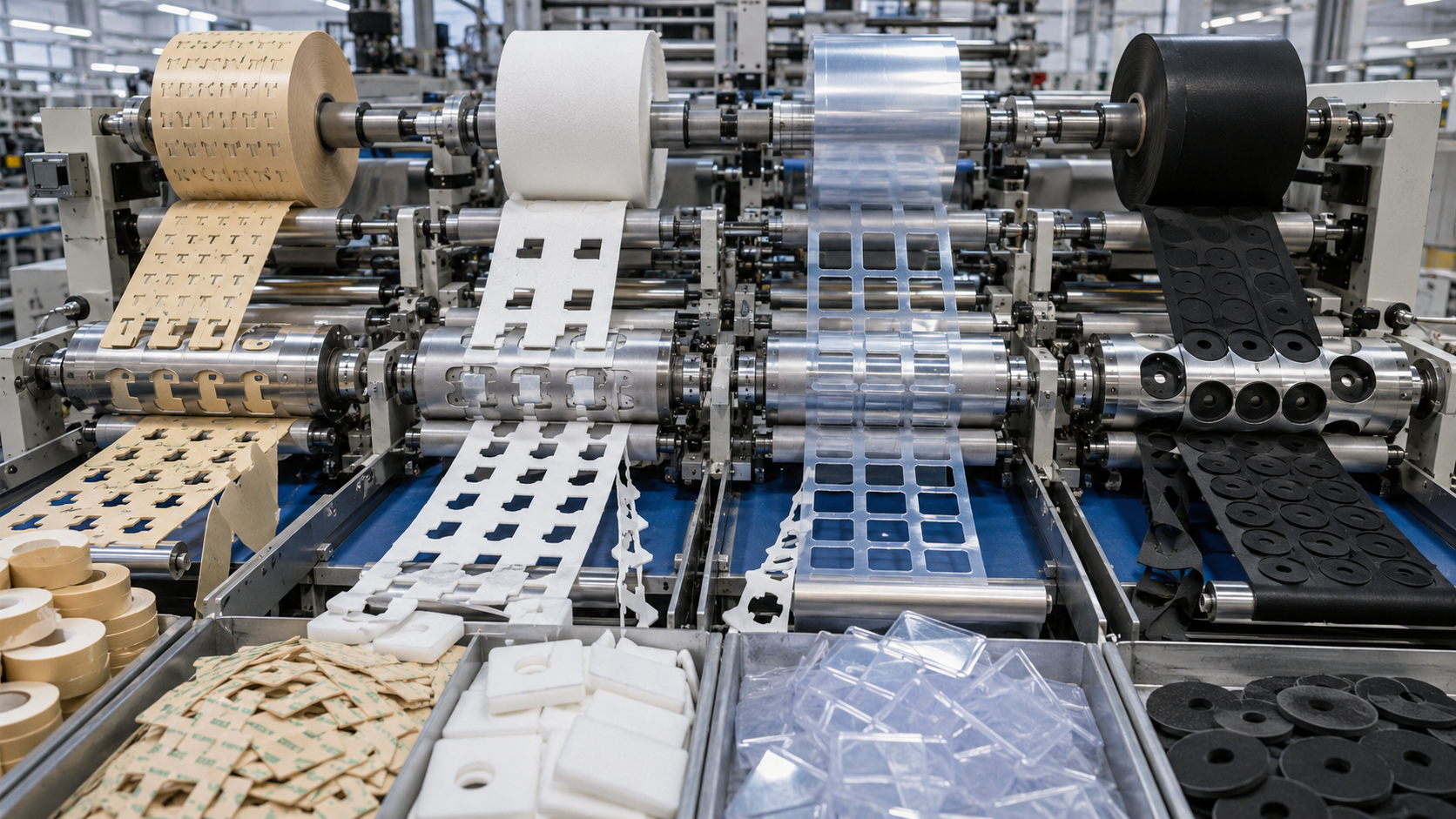
Rotary die cutting uses a cylindrical die mounted on a rotating press that continuously cuts material as it feeds through rollers. This allows fast, repeatable production with excellent positional accuracy.
Insight:
In many OEM programs, switching from flatbed to rotary die cutting after pilot validation can reduce per-unit cost once production volumes become stable, especially for multilayer adhesive assemblies.
Dive deeper: step-by-step rotary die cutting workflow
Typical rotary die cutting production includes:
| Step | Operation | Purpose |
|---|---|---|
| Roll material loading | Continuous feeding setup | Enables uninterrupted production |
| Web tension control | Material alignment and feeding control | Helps maintain dimensional stability |
| Die cylinder rotation | Contact cutting action | Produces consistent shapes |
| Kiss cutting | Cuts material without cutting through the liner | Supports easy peeling and assembly |
| Waste matrix removal | Scrap separation | Improves material yield and handling |
| Inline inspection | Quality monitoring | Maintains tolerance control |
| Rewinding or stacking | Output handling | Supports automation and packaging |
Because the process runs continuously instead of vertically pressing sheets, production speed increases dramatically compared with flatbed systems.
What materials can be processed using rotary die cutting?
Some manufacturers assume rotary die cutting only works for labels or packaging materials. In industrial environments, however, it supports a wide range of functional materials used in precision assemblies.
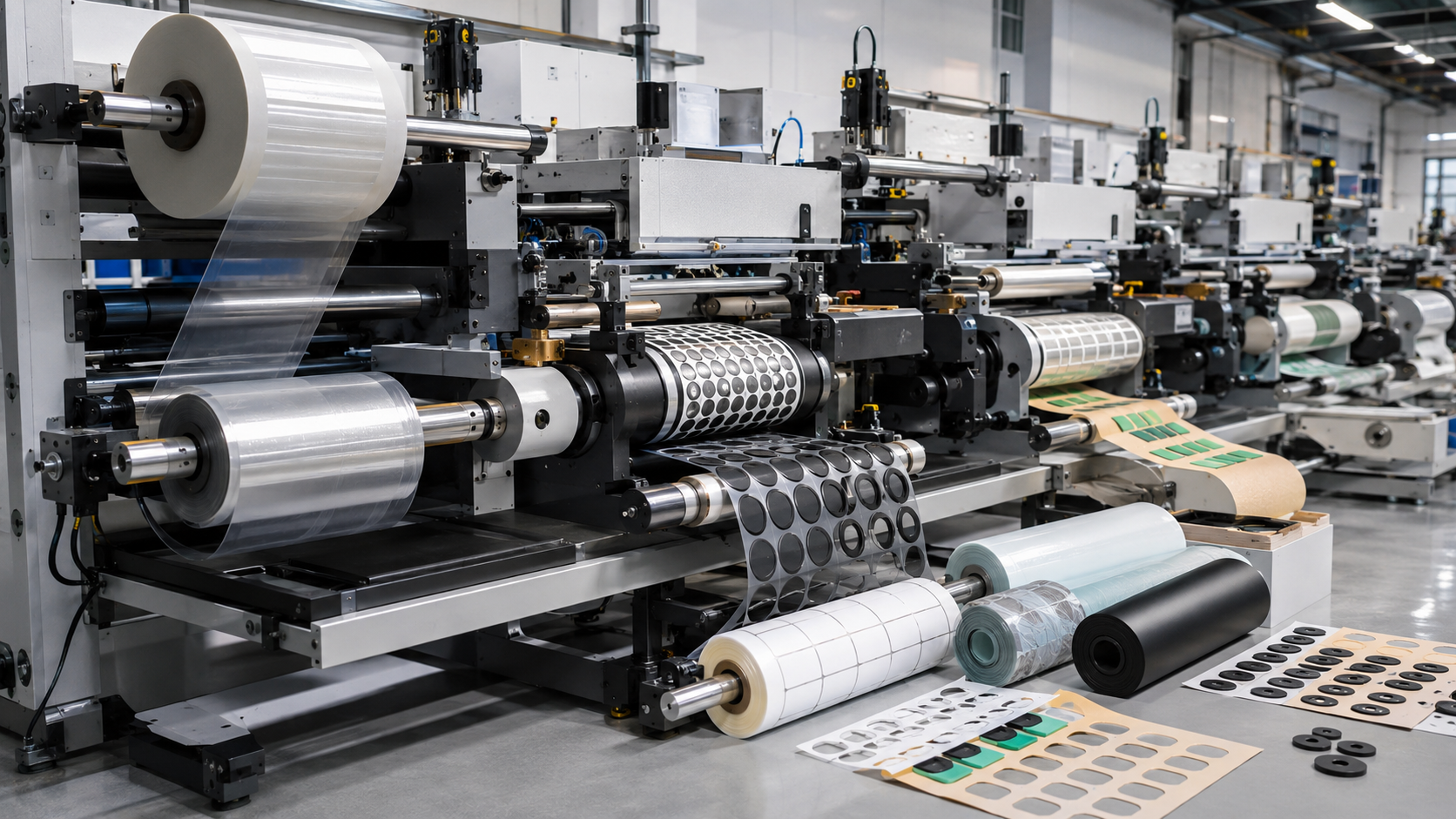
Common rotary die cutting materials include:
- Double-sided adhesive tapes
- PET insulation films
- Protective films
- EVA, PE, PU and EPDM foams
- Silicone foam sheets
- Rubber sheets
- Release liners
- Non-woven felt materials
- Multilayer laminated materials
Insight:
Roll-fed material compatibility makes rotary die cutting especially effective for laminated structures such as foam-tape-film stacks commonly used in battery packs and display modules.
Dive deeper: material selection by industry application
| Industry | Typical Materials | Functional Role |
|---|---|---|
| Automotive | Foam, rubber, non-woven felt, adhesive tape | Sealing, cushioning, NVH and anti-rattle support |
| Electronics | PET film, protective film, adhesive tape | Insulation, spacing, bonding and surface protection |
| Appliances | Foam, rubber, PET film, protective film | Sealing, cushioning, insulation and vibration control |
| Optical and display | PET film, protective film, black light-blocking film | Surface protection, spacing and light control |
| Industrial OEM assembly | Foam, rubber, adhesive tape, laminated materials | Bonding, sealing, cushioning and assembly support |
Selecting roll-based materials early ensures better process compatibility and stable production speed.
What are the advantages of rotary die cutting compared with flatbed die cutting?
Choosing between rotary and flatbed die cutting is one of the most common engineering decisions during production scaling. Understanding the advantages helps avoid unnecessary tooling transitions later.
Rotary die cutting offers clear benefits in speed, automation integration, and repeatability for medium-to-high-volume production environments.
Insight:
In adhesive-backed component manufacturing, rotary die cutting allows lamination, cutting and waste removal in a single continuous workflow, which improves alignment accuracy between functional layers.
Dive deeper: rotary vs flatbed die cutting comparison
| Feature | Rotary Die Cutting | Flatbed Die Cutting |
|---|---|---|
| Production speed | Very high | Medium |
| Best volume range | Medium to high volume | Prototype to mid-volume |
| Material format | Roll-fed materials | Sheet or roll materials |
| Automation compatibility | Excellent | Moderate |
| Tooling change flexibility | Moderate | Strong |
| Multilayer converting | Strong advantage | Possible but slower |
| Cost efficiency for large runs | High | Lower |
| Best use case | Repeated roll-to-roll production | Thicker materials, samples or lower-volume parts |
Because tooling rotates continuously, rotary systems support stable long-run production with minimal downtime.
Where is rotary die cutting used in automotive, electronics, and medical manufacturing?
Modern product designs require lightweight structures, compact assemblies, and reliable insulation layers. Rotary die cutting supports these requirements through precise roll-to-roll conversion.
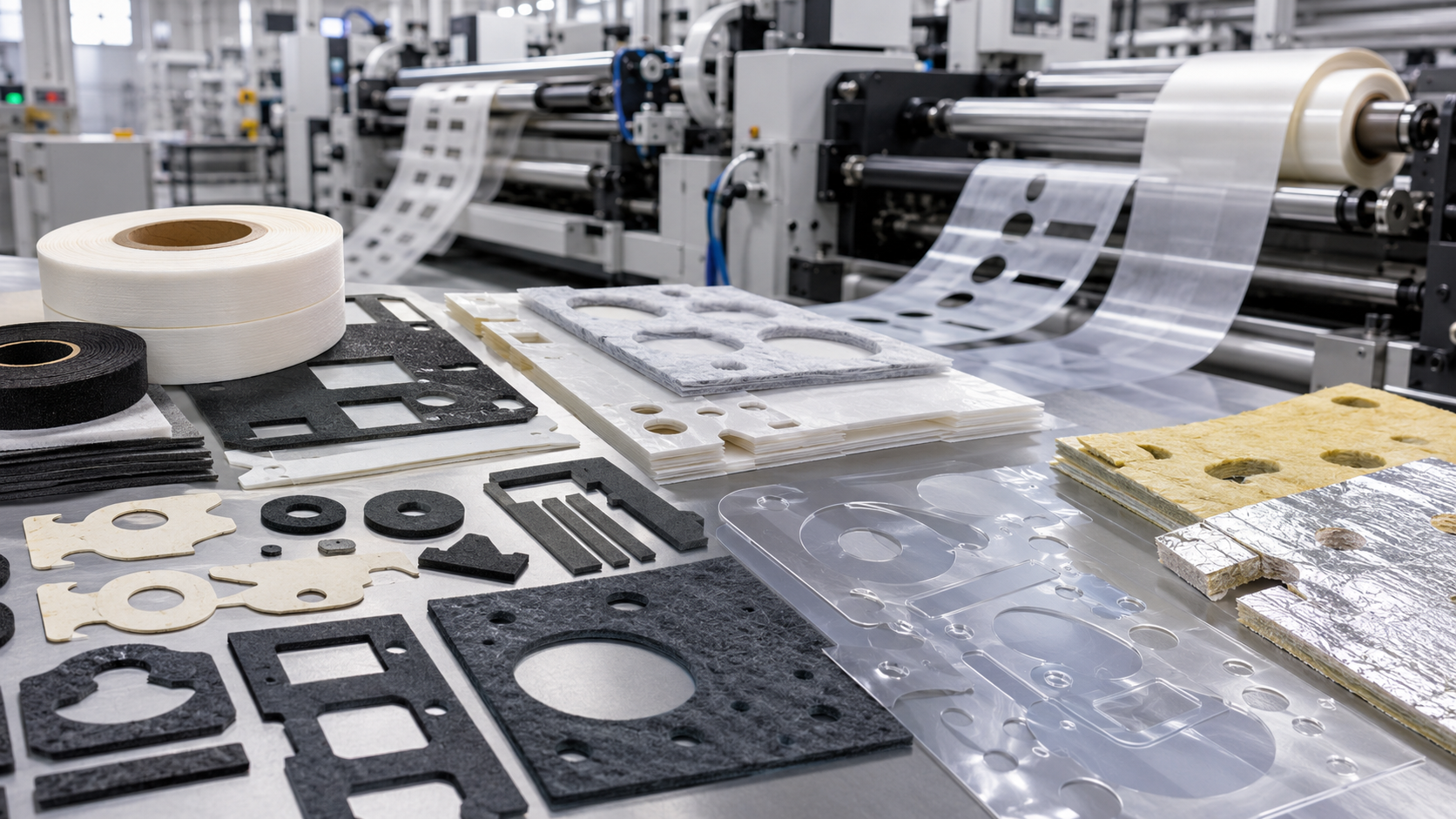
Typical rotary die cutting applications include:
- Adhesive-backed foam gaskets
- Automotive sealing tapes
- PET insulation films
- Protective films with release liners
- Foam cushioning pads
- Non-woven felt NVH parts
- Display bonding and spacing components
- Rubber pads and sealing parts
- Multilayer laminated die cut components
Insight:
In battery module production, rotary die cutting enables consistent multilayer alignment across thousands of repeated parts, improving assembly efficiency and long-term reliability.
Dive deeper: why engineers choose rotary die cutting for scalable production
| Advantage | Manufacturing Benefit |
|---|---|
| Continuous processing | Faster throughput |
| Stable dimensional repeatability | Improved quality consistency |
| Inline lamination capability | Reduced assembly steps |
| Kiss cutting control | Easier peeling and liner-backed delivery |
| High material utilization | Lower waste rate |
| Automation compatibility | Reduced labor dependency |
| Roll-to-roll output | Better support for high-volume OEM assembly |
These capabilities make rotary die cutting one of the most efficient flexible-material processing solutions for large-scale custom die cut parts manufacturing.
Conclusion
Rotary die cutting is a high-speed roll-to-roll converting process for flexible materials such as adhesive tape, foam, PET film, protective film, rubber and non-woven felt. It is especially suitable for repeated parts, liner-backed structures, multilayer materials and medium-to-high-volume OEM production.
The best result depends on material selection, web tension, tooling accuracy, kiss cutting depth, waste removal, inspection and final delivery format.
Need rotary die cut components for an OEM project?
Send us your drawing, sample, material structure, adhesive requirement, liner type, tolerance, annual volume and delivery format. Sanken can help review rotary die cutting feasibility, lamination structure, tooling method, inspection points and packaging before sampling and mass production.