
What are the thermal properties of insulating materials?
Heat looks polite in CAD. Then the prototype runs hot. A small hotspot grows, plastic softens, adhesive creeps, and labels curl. Your test fails late and the ship date slips. That’s the problem. We solve it by choosing insulation for real conditions and converting it into repeatable die-cut parts today.
The thermal properties that matter most are thermal conductivity, thermal resistance, specific heat, density, emissivity, and thermal diffusivity. But in manufacturing, numbers only matter after compression, moisture, and aging. Insulation must keep installed thickness under clamp load, stay dimensionally stable, and bond reliably to your substrate. When we match the right material stack-up to your failure mode and deliver it in a line-friendly format, you get predictable temperatures, fewer cosmetic rejects, and fewer rework loops during ramp for your team.
Want a fast decision? Tell us what fails first: hotspot, warped plastic, adhesive creep, or label curl. We engineer the stack-up and die-cut format to beat it every shift too.
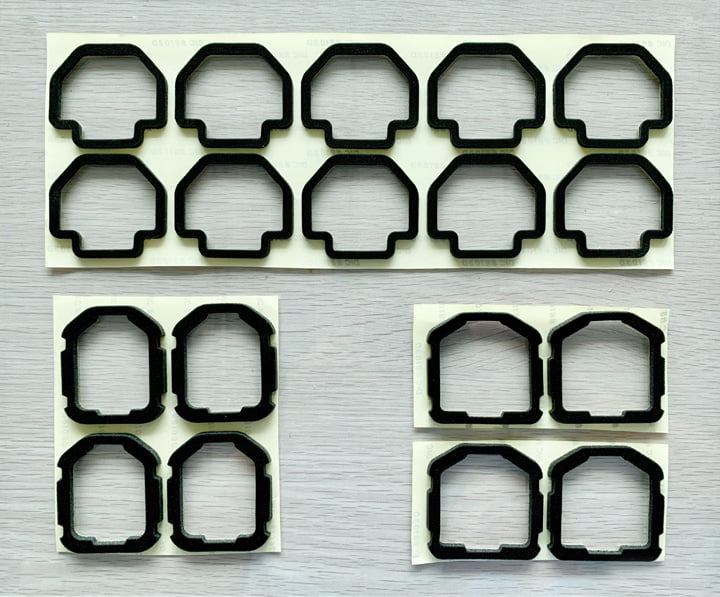
What is thermal conductivity, and why does it decide most performance?
Thermal conductivity is how easily heat flows through a material.
Lower conductivity means heat moves slower.
That sounds simple.
The trap is assuming the datasheet value will match your installed part.
In production, conductivity shifts with temperature.
It shifts with density.
It shifts when foam cells collapse under compression.
That is why we care about installed thickness, not free thickness.
A crushed insulator becomes a thermal bridge.
When we build a die-cut insulation pad at Sanken, we design around clamp points.
Screws.
Ribs.
Frames.
Those are heat shortcuts.
We block the shortcuts first.
What is thermal resistance, and why do engineers talk about R-value?
Thermal resistance is the practical version of conductivity.
It tells you how much heat gets through for a given thickness.
More thickness usually means more resistance.
Usually.
Here is the buyer pain: you add thickness, then assembly crushes it.
Now you paid for thickness you did not keep.
Your temperature barely moves.
Your boss asks why.
We solve that by choosing materials that hold thickness under load.
We also control the outline so the part seats consistently.
If it shifts, gaps open.
Gaps turn into convection paths.
Convection is heat with legs.
What is specific heat, and why does it matter for temperature spikes?
Specific heat is how much energy a material can absorb before its temperature rises.
High specific heat can smooth short spikes.
It buys time.
This matters when your product has bursts.
Charging.
Heaters.
Motors that pulse.
But we do not use specific heat as a magic fix.
If the heat must leave, it still needs a path.
Sometimes you need insulation.
Sometimes you need conduction into a heat spreader.
Sometimes you need both, layered correctly.
How do density and thickness change insulation, and where do teams get burned?
Density and thickness change everything.
Thicker often insulates better.
Denser sometimes insulates worse, because it replaces still air with solid material.
Foam is the classic example.
Its insulation power comes from trapped air.
Compress it too much, and you lose the air pockets.
Now conduction rises.
Your seal is tight, but your thermal barrier is weak.
This is why we ask about compression set and rebound, not just thermal targets.
If the part must seal and insulate, we tune density and geometry together.
And yes, corners matter.
Sharp corners lift first and leak heat paths first.
What is emissivity, and when do reflective films actually help?
Emissivity is how strongly a surface radiates heat.
Low emissivity surfaces radiate less.
Reflective films can reduce radiative heat transfer.
They work best when there is an air gap.
If you press foil tight to a hot surface, conduction dominates.
Then the reflective story disappoints.
OEM pain point: plastics haze, labels curl, and films warp near hot parts.
That can be radiation, not conduction.
When we see line-of-sight to a hotspot, we consider a reflective layer in the stack-up.
Then we die cut it so it places fast and stays aligned.
What is thermal diffusivity, and why does response time matter?
Thermal diffusivity describes how quickly a material’s temperature changes when heat hits it.
Low diffusivity means heat spreads slowly.
High diffusivity means heat spreads quickly.
For buyers, this shows up as timing.
Does a surface spike fast?
Does it cool slowly?
Does your sensor see a jump that trips protection?
When we select insulation, we look at steady-state and response.
A material can be “good” and still fail if the transient spike is your real limit.
This is why we always ask about duty cycle, not just maximum temperature.
How do moisture and aging change thermal behavior over time?
Insulation that absorbs moisture usually loses performance.
Water carries heat better than still air.
Moisture also changes adhesion.
Then parts lift.
Then gaps open.
Then convection starts.
Aging matters too.
Adhesives soften.
Foams take set.
Films shrink slightly.
Your “perfect” insulation becomes a leaky patchwork after cycles.
So we validate like production, not like a lab demo.
We check after dwell time.
We check after heat cycling.
We check after shipping vibration if cosmetics matter.
If you skip this, you approve a moment, not a process.
What thermal tests should you run before ordering at scale?
Start with your failure mode.
Hotspot?
Burn mark?
Adhesive creep?
Label curl?
Then test to reproduce it.
We like simple gates.
Measure temperature at fixed points.
Run your duty cycle.
Repeat after aging.
Compare before and after compression.
Then add assembly realism.
Same clamp load.
Same surfaces.
Same cleaning step.
Same operator method.
If your insulation is die-cut and adhesive-backed, include a placement test.
Time the install.
Check edge lift after 24–72 hours.
If operators need “special technique,” the design is not ready.
My BeeChair CEO joke is that comfort is repeatability.
A chair that feels great for one minute but collapses after an hour is a bad chair.
Insulation is the same.
Does thicker insulation always reduce heat transfer?
Often, until assembly crushes it. Installed thickness is what matters.
Is air the best insulator?
Still air is excellent. But if air moves, convection carries heat fast.
Do reflective foils solve overheating?
They help when radiation is the main path. They are not a cure-all for conduction.
What should you send Sanken to evaluate an insulation part?
A drawing or cut line, stack-up limits, clamp points, substrate material, temperature range, duty cycle, and how the part is applied.
Can you combine insulation and sealing in one die-cut part?
Yes. We often build foam + adhesive + film stacks so one placement does both jobs.
How do you prevent edge lift on insulation pads?
We use corner radii, enough bonding land, clean surfaces, and validation after 24–72 hours.
Conclusion
Thermal properties are not just conductivity. They include resistance, specific heat, density, emissivity, and how all of them change with compression, moisture, and aging. Tell us your hotspot and clamp load, and we will design a die-cut insulation stack that stays stable at volume and keeps your assembly line fast and predictable.