
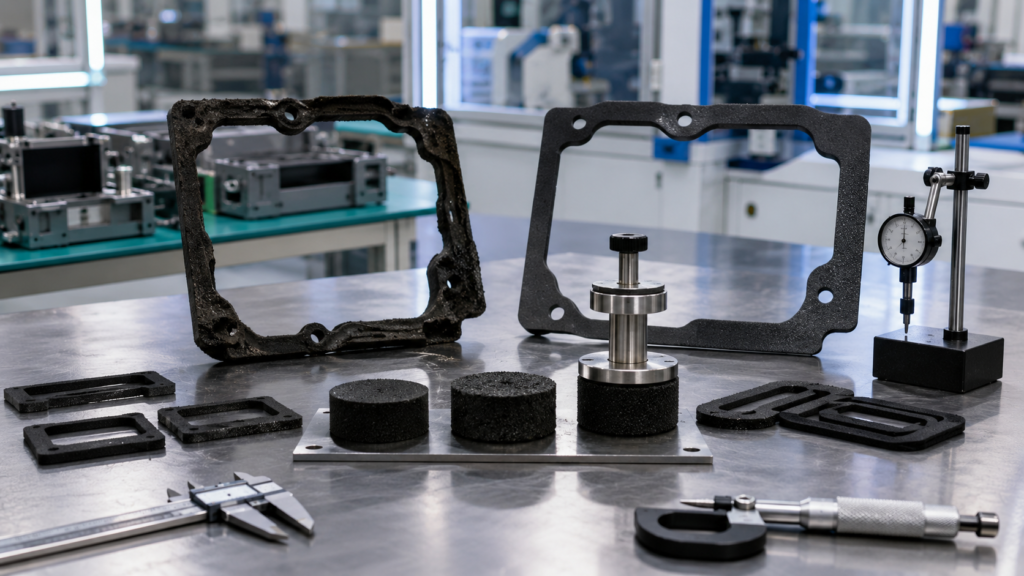
Why Do Foam Gaskets Lose Sealing Performance Over Time?
Foam gaskets often fail slowly. At first, everything looks fine. The part fits. The adhesive holds. The product passes assembly. Then months later, leakage, dust, noise, vibration, or weak compression appears. I have seen OEM buyers discover too late that the real problem started with material aging, poor compression design, or unstable die cutting control.
Foam gaskets lose sealing performance over time because the material can compress permanently, harden, shrink, absorb moisture, lose adhesive strength, or deform under heat, vibration, and long-term pressure. A gasket must keep enough recovery force to maintain contact between two surfaces. At Sanken, we prevent sealing failure by selecting the right foam, controlling compression range, laminating the correct adhesive, and verifying die cut quality before mass production.
A foam gasket is small, but it carries a big job. If it stops sealing, the whole product can look unreliable.
What happens to foam gaskets after long-term use?
Foam gaskets seal by compression.
When the gasket is squeezed between two surfaces, it fills gaps and creates sealing pressure.
Over time, the foam may lose its ability to recover.
This is called compression set.
If the foam remains flattened after pressure is released, the gasket cannot maintain sealing force anymore.
That is when gaps appear.
Then air, dust, water, noise, or vibration can pass through.
For automotive electronics, appliance housings, lighting modules, battery systems, and industrial equipment, this can create serious quality problems.
Is compression set the main reason foam gaskets fail?
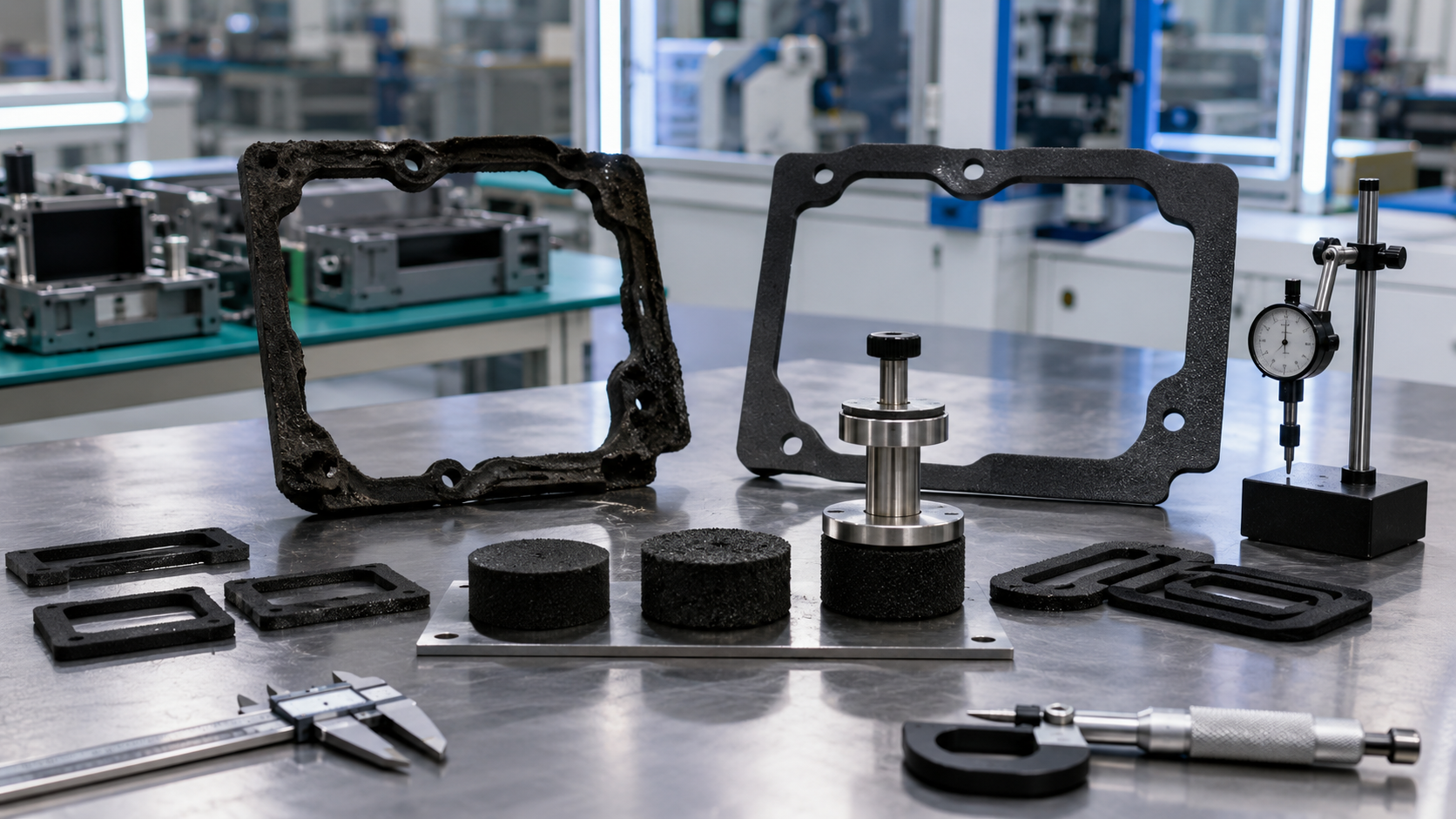
Yes, compression set is one of the biggest reasons.
A foam gasket may look thick before assembly.
But after long-term compression, it may become thinner and weaker.
This happens when the foam structure cannot rebound properly.
Common causes include:
- Wrong foam density
- Excessive compression
- High temperature
- Long-term clamping force
- Poor material quality
- Chemical or moisture exposure
- Aging under vibration
If the gasket cannot recover, sealing pressure drops.
At Sanken, we review compression range before production.
We do not only ask, “What thickness do you need?”
We ask, “How much gap must this gasket seal, and how long must it stay compressed?”
That question saves buyers from many future headaches.
Why does the wrong foam material lose sealing faster?
Different foams age differently.
EVA, PU, PE, EPDM, CR, PVC, and silicone foam all have different strengths.
Some are better for cushioning.
Some are better for waterproof sealing.
Some perform better under heat or outdoor conditions.
Some are only suitable for light-duty indoor use.
If buyers choose foam only by price or thickness, sealing failure becomes more likely.
For example, a soft PU foam may work well for dust control inside electronics, but may not be the best choice for strong waterproof sealing.
EPDM foam may perform better for weather resistance.
Silicone foam may perform better when heat resistance and long-term recovery are required.
At Sanken, we help customers match foam material to real application conditions instead of guessing from a material name.
How does heat affect foam gasket sealing?
Heat accelerates aging.
Many foams become harder, softer, brittle, or permanently compressed when exposed to high temperature for a long time.
In automotive electronics, battery modules, lighting systems, and appliances, temperature can change frequently.
This creates thermal stress.
The gasket may expand, shrink, or lose recovery.
The adhesive backing may also soften, shift, or peel.
Heat-related gasket failure often appears as:
| Problem | Result |
|---|---|
| Foam hardening | Poor surface contact |
| Foam softening | Loss of sealing force |
| Shrinkage | Gaps and leakage |
| Adhesive creep | Gasket shifting |
| Compression loss | Weak long-term sealing |
This is why temperature resistance must be checked before mass production.
A gasket that works at room temperature may fail badly inside a hot automotive housing.
Can moisture damage foam gasket sealing?
Yes.
Moisture can reduce sealing performance depending on the foam structure.
Closed-cell foam usually resists water better than open-cell foam.
Open-cell foam may absorb moisture more easily.
Moisture can cause:
- Swelling
- Softening
- Mold risk in some environments
- Adhesive weakening
- Dimensional instability
- Lower insulation performance
For waterproof or outdoor applications, foam selection must be very careful.
At Sanken, we often review whether the gasket needs water resistance, dust protection, acoustic absorption, or simple cushioning.
These are different functions.
One foam cannot do everything perfectly.
That is why application review comes before material recommendation.
Why does adhesive failure make foam gaskets lose sealing?
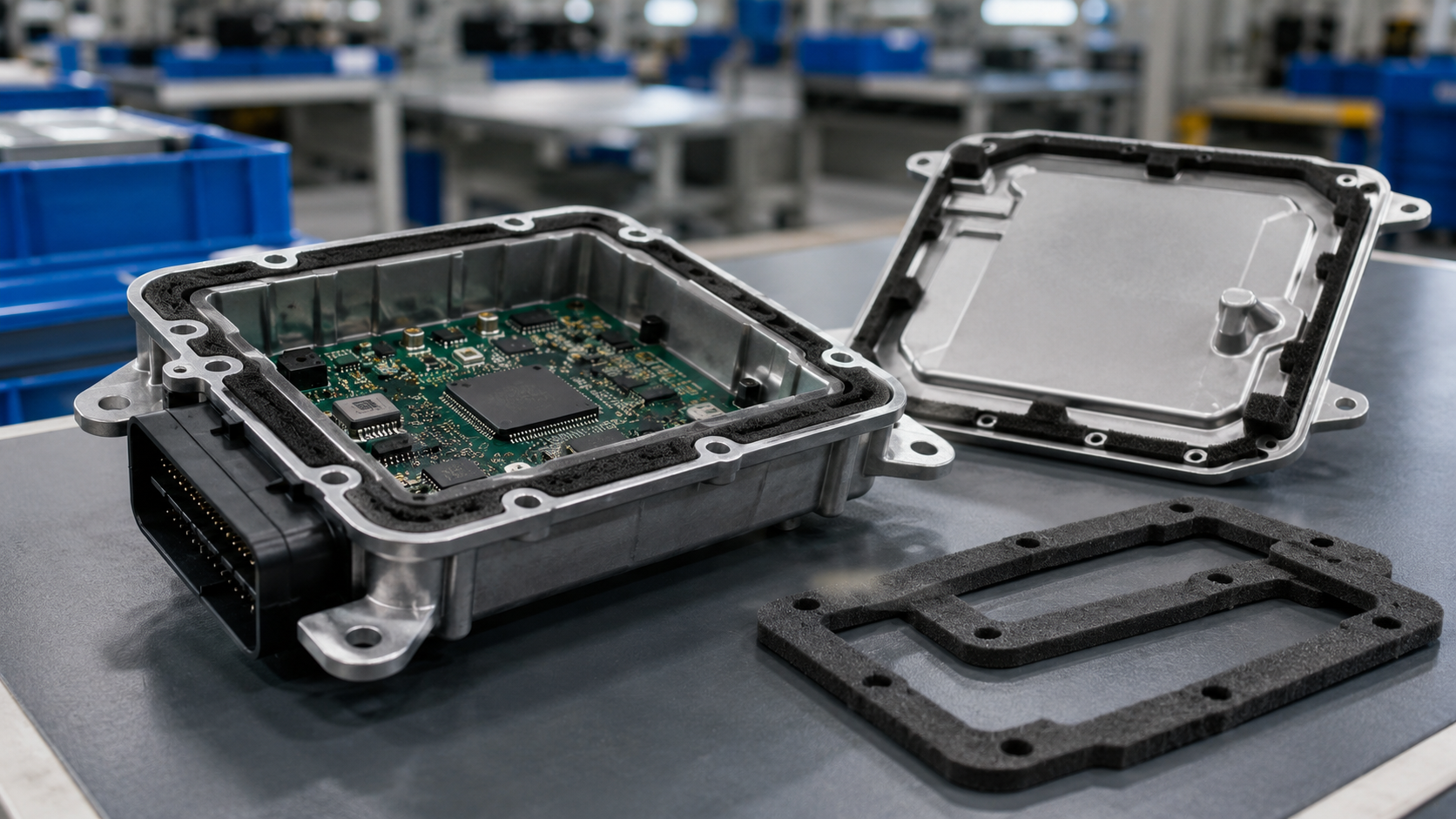
Many foam gaskets use adhesive backing.
The adhesive helps hold the gasket during assembly.
But if the adhesive fails, the gasket may lift, shift, curl, or peel away.
Then sealing performance drops.
Adhesive failure may come from:
- Wrong adhesive type
- Low surface energy plastic
- Dust or oil on the bonding surface
- Poor lamination pressure
- High temperature
- Humidity
- Weak liner release control
- Adhesive aging during storage
Acrylic adhesive, rubber adhesive, and silicone adhesive all behave differently.
The right choice depends on the bonding surface and working environment.
At Sanken, we combine foam converting, adhesive laminating, kiss cutting, and inspection.
That helps us control the full gasket structure, not just the foam shape.
A gasket that seals well but falls off during assembly is still a failed gasket.
How does poor die cutting affect long-term sealing?
Even the right foam can fail if the die cutting process is poor.
Poor die cutting creates hidden leakage paths.
Common problems include:
- Rough edges
- Foam dust
- Torn cells
- Uneven thickness
- Hole misalignment
- Adhesive overflow
- Deformed profiles
- Poor liner release
These problems may not look serious at first.
But after assembly, vibration, and compression, they become bigger.
A rough edge may create a small air path.
A shifted hole may cause uneven pressure.
Adhesive overflow may contaminate the sealing surface.
At Sanken, we control tooling, cutting pressure, waste removal, lamination tension, and final inspection.
This is how we help customers avoid the “sample looks good, bulk order fails” problem.
Does gasket design affect long-term sealing?
Yes.
Design matters as much as material.
A foam gasket may fail if the design creates uneven compression.
Common design problems include:
- Too narrow sealing width
- Sharp corners
- Thin walls around holes
- Oversized openings
- Poor screw pressure distribution
- No allowance for material compression
- Wrong gasket thickness for the gap
If the housing surface is uneven, the gasket must compensate.
If screw pressure is concentrated in only a few points, the gasket may compress unevenly.
Then leakage starts where pressure is weakest.
At Sanken, we review drawings before tooling.
Sometimes a small design adjustment can improve sealing performance and reduce cost.
Good engineering is not always complicated.
Sometimes it is simply catching the mistake before the mold or die is made.
Why do foam gaskets fail after vibration?
Vibration is common in automotive, industrial, appliance, and electronic products.
Over time, vibration can cause foam fatigue.
It can also weaken adhesive bonding.
A gasket under vibration may slowly move, flatten, crack, or lose contact pressure.
This is especially important for:
- Automotive control modules
- EV battery systems
- Air ducts
- Speaker assemblies
- Industrial equipment covers
- Appliance motors and panels
For vibration applications, foam resilience and adhesive shear strength matter.
At Sanken, we review both cushioning and sealing requirements.
A gasket may need to reduce vibration and seal at the same time.
That usually requires better material matching and tighter process control.
How can buyers prevent foam gasket sealing loss?
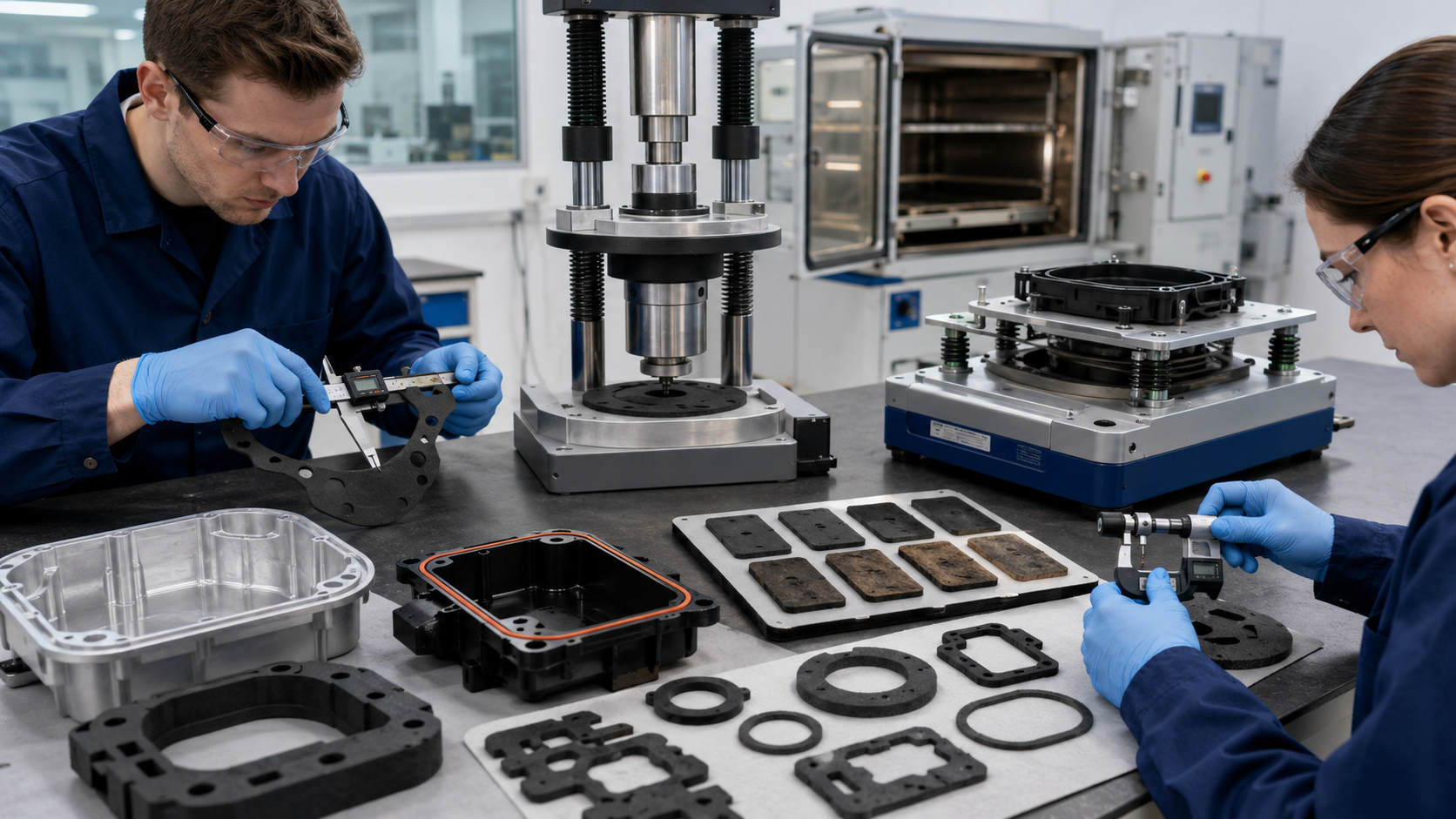
Buyers should not wait until mass production to check performance.
Before ordering foam gaskets, I recommend confirming:
- What must the gasket seal against?
- What temperature range will it face?
- Will it contact water, dust, oil, or chemicals?
- What compression range is required?
- How long will it stay compressed?
- Does it need adhesive backing?
- What surface will the adhesive bond to?
- What tolerance is critical for assembly?
- What tests should be completed before mass production?
If these questions are ignored, the project depends too much on luck.
I prefer engineering over luck.
Luck has terrible quality control.
Why do OEM customers choose Sanken for foam gaskets?
At Sanken, we are not only cutting foam.
We help customers build reliable sealing parts.
Our capabilities include:
- Precision die cutting
- Foam converting
- Adhesive laminating
- Kiss cutting
- Multi-layer bonding
- Hot pressing
- Spraying and gluing
- Silk screen printing
- Injection molding support
For OEM customers, this means fewer supplier gaps, stronger engineering support, and more stable mass production.
We help customers review material, thickness, adhesive, tolerance, packaging, and validation before bulk orders begin.
That is how we reduce sealing failure risk.
Conclusion
Foam gaskets lose sealing performance over time because of compression set, aging, heat, moisture, vibration, adhesive failure, poor design, or weak die cutting control. At Sanken, we help OEM buyers prevent these problems through better material selection, precision converting, adhesive lamination, and validation before mass production.