

Why Is PET Film Commonly Used in Electronics?
PET film is commonly used in electronics because it solves a difficult problem: electronic products need materials that are thin, stable, insulating, protective, clean, and easy to process at the same time.
A smartphone, camera module, battery pack, display screen, wearable device, speaker, sensor, or automotive electronic unit may contain many small PET film parts. These parts are usually hidden, but they help prevent short circuits, scratches, dust contamination, assembly misalignment, adhesive failure, and surface damage.
For OEM buyers, the question is not simply “Why use PET film?” The better question is:
“Can this PET film part protect my electronic assembly without creating new problems during die cutting, bonding, handling, and mass production?”
That is where material selection, adhesive structure, thickness tolerance, cleanliness, and precision converting become important.
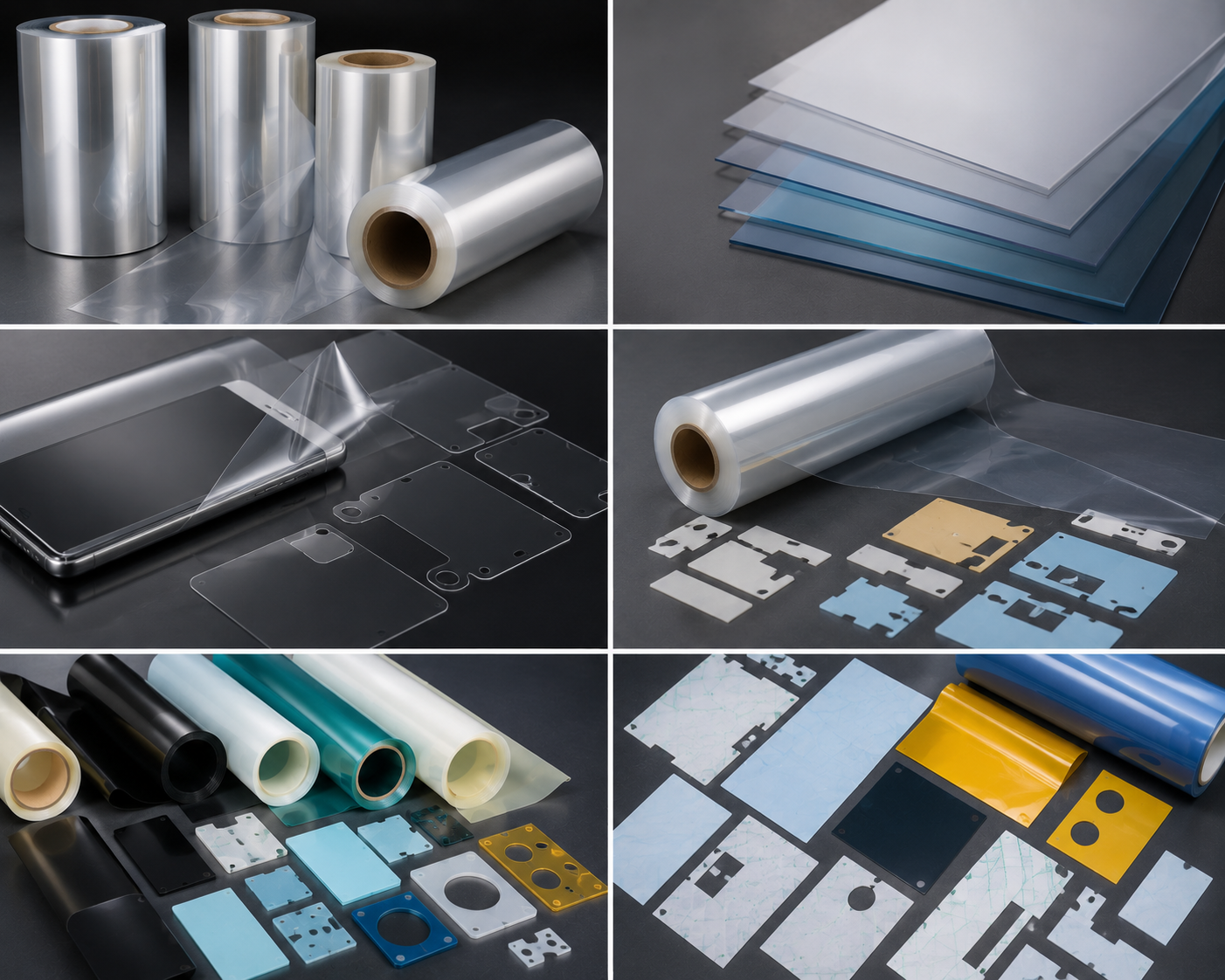
PET Film Is Thin but Functionally Strong
Modern electronics have very limited internal space. Every layer must be thin, but it still needs to perform reliably.
PET film is valued because it can provide multiple functions in a thin material form:
- Electrical insulation
- Surface protection
- Scratch resistance support
- Spacer control
- Dust blocking
- Adhesive carrier support
- Display protection
- Battery protection
- Temporary process protection
- Die-cut functional components
This is why PET film is widely used in phones, tablets, laptops, smartwatches, displays, sensors, cameras, batteries, medical electronics, and automotive electronic modules.
A thick material may protect well but take up too much space. A very soft material may cushion well but lose shape. PET film offers a useful balance: thin, stable, clean, and process-friendly.
PET Film Helps Prevent Electrical Problems
One of the most important reasons PET film is used in electronics is electrical insulation.
Electronic products contain conductive parts placed very close together. Batteries, circuits, metal frames, connectors, flexible printed circuits, and shielding materials may all sit within a compact structure.
Without proper insulation, the product may face:
- Short circuit risk
- Electrical leakage
- Local overheating
- Component failure
- Safety issues
- Assembly rejection
A die-cut PET insulation film can create a thin barrier between sensitive areas.
For example, PET film may be used between a battery and a metal bracket, around a circuit board, under a conductive component, or near a display module. The film may look simple, but it protects the product from hidden electrical risk.
PET Film Maintains Dimensional Stability
Electronics assembly requires parts to stay in the right position.
If a film stretches, shrinks, curls, or warps, it can create misalignment. This is especially risky for display modules, camera modules, battery systems, and sensor assemblies.
PET film is commonly chosen because it has good dimensional stability compared with many softer plastic films.
This helps reduce problems such as:
- Misaligned insulation areas
- Poor fit inside compact housings
- Film curling during assembly
- Edge lifting after bonding
- Shrinkage after heat exposure
- Poor matching with die-cut holes or windows
For small electronic parts, dimensional stability is not a minor detail. A small shift can expose a conductive area, block an opening, or interfere with assembly.
PET Film Works Well for Precision Die Cutting
Electronics manufacturers rarely use PET film only as a flat sheet. They usually need custom-shaped parts.
PET film can be die cut into:
- Insulation patches
- Protective covers
- Spacer films
- Frame-shaped films
- Display auxiliary films
- Battery protection layers
- Camera module support films
- Adhesive-backed parts
- Small washers or rings
- Thin precision liners
PET film is suitable for precision die cutting because it can hold clean edges and accurate shapes when processed correctly.
But this does not mean every PET film part is easy.
Thin PET film may attract static dust. Adhesive-backed PET may lift at the edge. Small holes may be difficult to strip cleanly. Protective films may scratch if handling is poor.
So buyers should not only ask whether the supplier can cut PET. They should ask whether the supplier can control PET film behavior during lamination, die cutting, waste removal, inspection, and packaging.
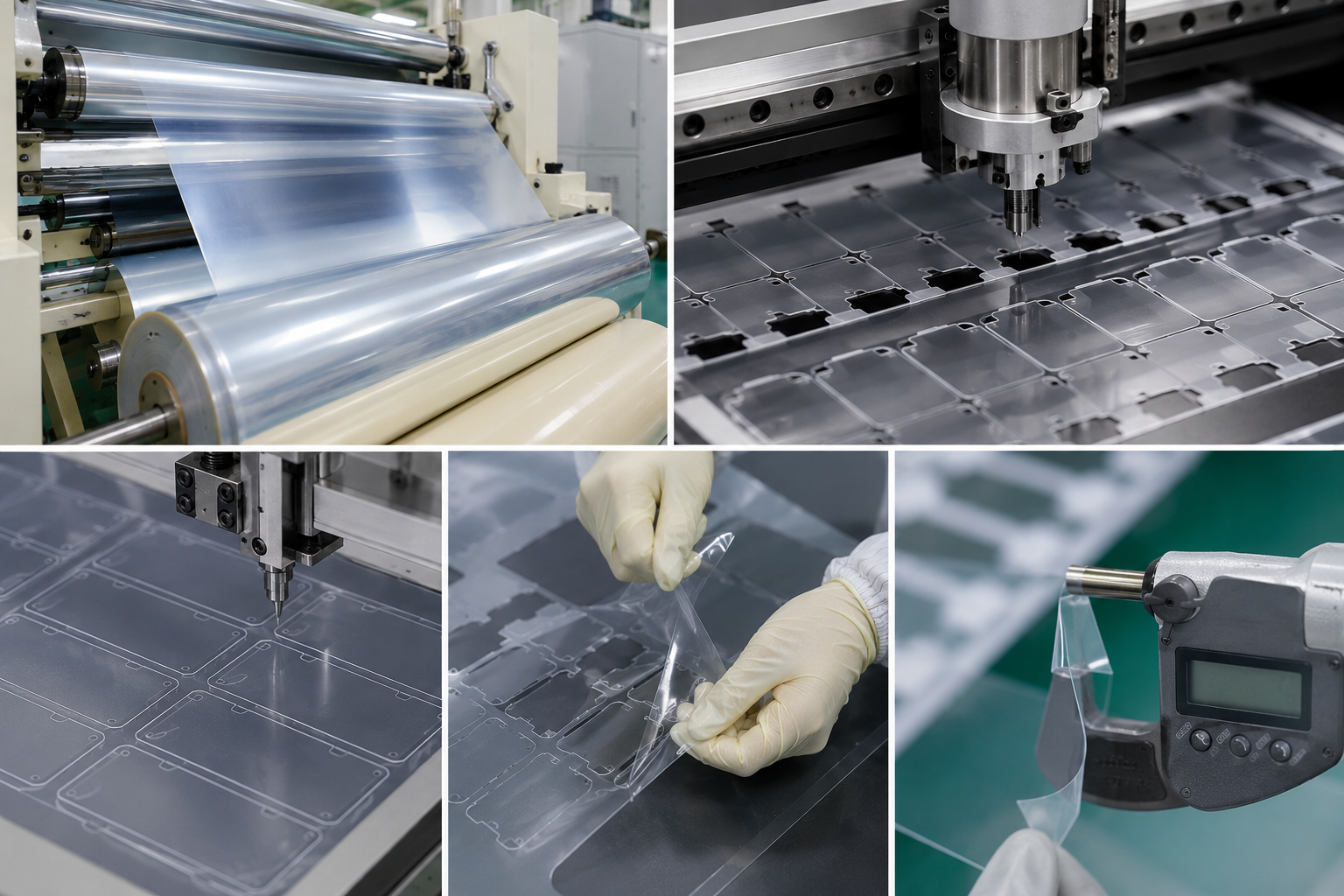
PET Film Protects Displays and Optical Surfaces
Displays and optical components are sensitive to scratches, dust, bubbles, pressure marks, and misalignment.
PET film is often used as:
- Display protective film
- Touch panel support film
- Optical spacer film
- Temporary process protection layer
- Anti-scratch surface film
- Release liner for adhesive films
- Camera window protection film
- Display module auxiliary layer
In display-related applications, PET film must often meet stricter requirements for clarity, cleanliness, thickness tolerance, surface quality, and adhesive compatibility.
A poor PET protective film may leave residue.
A poorly die-cut PET film may create particles.
A film with unstable thickness may affect fitting.
A film that curls may slow down assembly.
For high-end screens and optical modules, the PET film component must be treated as a precision part, not a simple plastic sheet.
PET Film Supports Adhesive-Backed Electronic Parts
Many PET film parts are laminated with adhesive.
Adhesive-backed PET film is useful because it allows fast assembly. Workers can peel, position, and bond the part directly.
Common adhesive-backed PET applications include:
- Insulation tapes
- Protective covers
- Mounting films
- Spacer layers
- Bonding support parts
- Battery protection films
- Display auxiliary materials
- Electronic labels and functional tags
However, adhesive is often where problems appear.
If the adhesive is not matched correctly, buyers may see:
- Edge lifting
- Peeling
- Adhesive residue
- Bubbles
- Poor liner release
- Weak bonding
- Difficult manual placement
- Failure after heat aging
A reliable PET film part is not just PET. It is a complete structure:
PET film + adhesive layer + release liner + die-cut design + bonding surface + assembly method
All of these must work together.
PET Film Is Useful for Battery Protection
Battery systems need thin insulation and surface protection.
PET film is commonly used around batteries because it helps protect against electrical contact and surface damage while keeping the structure thin.
Typical battery-related uses include:
- Cell insulation
- Edge protection
- Battery pack insulation layers
- Adhesive insulation patches
- Surface protection films
- Spacer films
- Die-cut protection parts
In battery applications, the cost of a small film error can be high.
If the PET film is too small, it may not cover the risk area.
If it shifts during assembly, protection may fail.
If adhesive lifts after aging, the insulation function may be weakened.
This is why battery PET film parts need accurate cutting, stable adhesive, and reliable placement.
PET Film Reduces Handling and Assembly Damage
Electronics production involves many steps. Components may be moved, pressed, inspected, transported, bonded, and assembled.
PET protective films help reduce scratches and contamination during these steps.
They may protect:
- Glass surfaces
- Display panels
- Plastic housings
- Metal parts
- Camera windows
- Touch panels
- Optical covers
- Coated surfaces
A good protective film reduces rework and improves production yield.
For production teams, this matters because scratches often appear late. By the time a surface defect is found, the product may already have passed through several expensive assembly steps.
PET Film vs Other Film Materials
PET is not the only film used in electronics, but it is one of the most common because it balances performance and cost well.
| Film Material | Main Strength | Common Limitation |
|---|---|---|
| PET film | Stable, insulating, die-cut friendly | May need coating for special surface needs |
| TPU film | Flexible and soft | Can stretch or deform more easily |
| PC film | Strong impact resistance | Higher cost in some applications |
| PI film | High heat resistance | More expensive |
| PE film | Low cost and flexible | Lower dimensional stability |
| PP film | Lightweight and economical | May not match high-precision needs |
PET is often selected when the project needs thin insulation, stable dimensions, clean die cutting, and controlled cost.
For high-temperature electronics, PI may be better. For flexible soft-touch surfaces, TPU may be better. For impact-resistant covers, PC may be considered.
The right material depends on the function, not only the material name.
Common Buyer Mistakes When Choosing PET Film
Choosing Only by Thickness
Thickness matters, but it is not enough. Buyers should also check tolerance, shrinkage, surface quality, adhesive compatibility, and die-cut performance.
Ignoring Static Dust
PET film can attract dust during handling and converting. For display and optical parts, anti-static control may be important.
Treating Adhesive as a Small Detail
Adhesive failure can destroy the value of a good PET film part.
Not Testing After Heat and Humidity
A PET film part may look fine at room temperature but fail after aging, storage, or product operation.
Forgetting the Assembly Method
A part that is difficult to peel, align, or place can slow down production even if the material itself is correct.
How Buyers Should Select PET Film for Electronics
Before ordering PET film components, buyers should define the real problem the part must solve.
Ask these questions:
- Is the PET film used for insulation, protection, spacing, bonding, or display support?
- What thickness and thickness tolerance are needed?
- Does the part need adhesive backing?
- What surface will it bond to?
- Will it face heat, humidity, pressure, or bending?
- Does it need optical clarity or low haze?
- Does it need anti-static performance?
- Will it be applied manually or automatically?
- Does the part include small holes, windows, or narrow strips?
- Can the supplier support die cutting, lamination, liner control, and packaging?
These questions help avoid a common problem: choosing a material that works as a sample but fails in production.
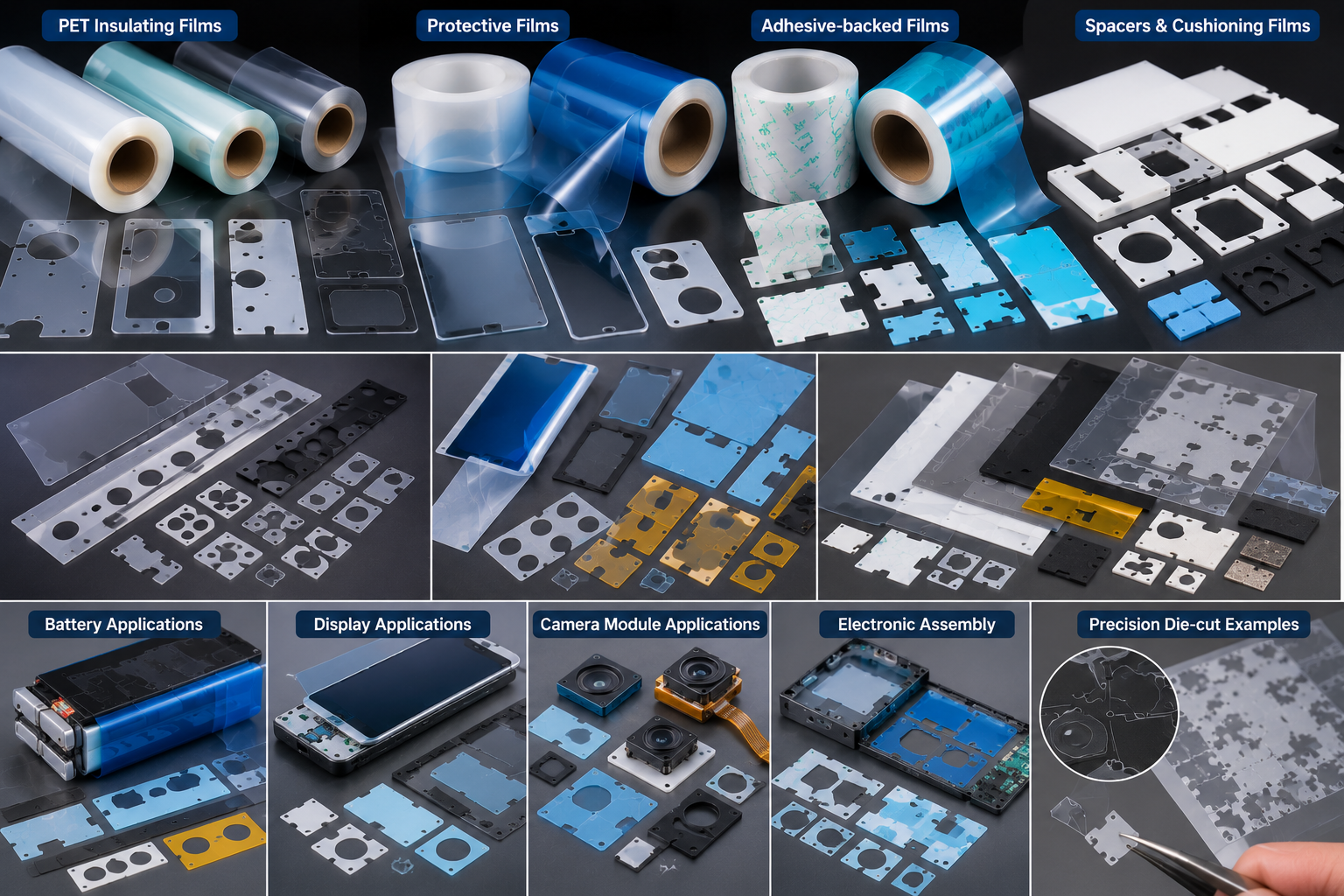
Why Converting Quality Decides Final Performance
PET film performance is not only decided by the raw material.
The converting process can decide whether the final part works well.
Key converting steps may include:
- Slitting
- Adhesive lamination
- Die cutting
- Kiss cutting
- Waste stripping
- Liner control
- Dimensional inspection
- Clean packaging
Poor converting can cause problems even when the PET film itself is good.
A rough edge can create particles.
A deep kiss cut can damage the liner.
A weak liner release can deform the part during peeling.
A poorly packed film can collect dust or scratches.
For electronics buyers, PET film should be evaluated as a finished component, not only as raw material.
Where Sanken Fits Into PET Film Electronic Components
For electronic projects, customers usually do not need a roll of PET film. They need a part that fits, peels cleanly, bonds reliably, protects the right area, and stays stable after assembly.
Sanken Manufacturing supports PET film projects through material review, adhesive lamination, precision die cutting, kiss cutting, protective film processing, insulation film converting, and prototype-to-mass-production support.
The focus is practical: reduce misalignment, edge lifting, dust contamination, film curling, adhesive failure, and assembly delays.
Conclusion
PET film is commonly used in electronics because it is thin, strong, electrically insulating, dimensionally stable, protective, and suitable for precision die cutting. It helps protect batteries, displays, camera modules, sensors, circuits, and other compact electronic assemblies.
For OEM buyers, the best PET film solution is not always the thinnest or cheapest film. It is the film structure that matches the application, converts cleanly, bonds reliably, and supports stable production.
When PET film is selected and processed correctly, it can reduce assembly risk, improve product reliability, and help electronic products perform consistently in real use.