
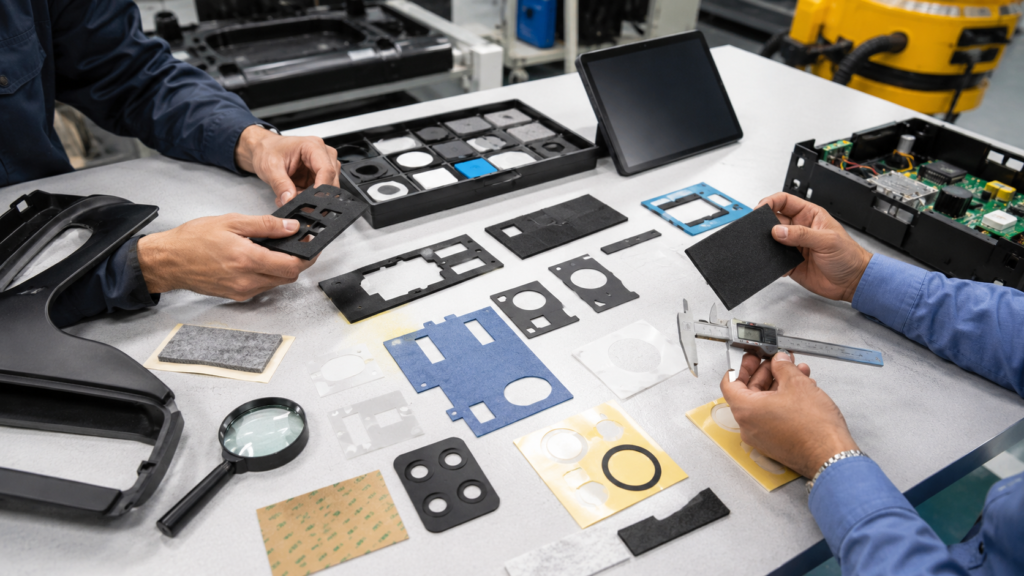
OEM assembly lines often lose time on small parts. Operators peel tape by hand, trim foam manually, align insulation films slowly, or install several materials one by one. These small steps create labor waste, placement errors, contamination, and inconsistent product quality.
Die cut components help OEMs simplify assembly steps by turning foam, rubber, non-woven felt, PET film, TPU, adhesive tape, and sealing materials into ready-to-install parts. Instead of cutting, trimming, aligning, or layering materials on the production line, OEMs can receive custom die cut parts in sheets, rolls, or kits for faster and more consistent assembly.
For automotive, consumer electronics, wearable devices, and sealing applications, precision die cutting can reduce manual work without changing the main product design.
Why Assembly Steps Become Too Complicated
Many products require several small functional materials:
- Foam pads for cushioning
- PET or PI films for insulation
- Non-woven felt for NVH noise reduction
- Rubber seals for waterproofing
- Double-sided adhesive for bonding
- Protective films for surface protection
If each material is installed separately, assembly becomes slow and unstable.
Operators may place parts slightly off-position.
Adhesive surfaces may collect dust.
Trimmed parts may vary in size.
Manual cutting may create waste.
These issues increase rework and make quality control harder.
Theme: Precision Die Cut Components
How Die Cut Components Reduce Manual Cutting
One major advantage of die cut components is that they arrive in the final shape.
OEM operators no longer need to:
- Cut tape to length
- Trim foam edges
- Punch holes manually
- Adjust oversized parts
- Remove extra material on the line
This improves speed and consistency.
For example, a custom foam gasket can be produced with exact holes, slots, adhesive backing, and liner design. The operator only needs to peel and apply it.
This is especially useful in high-volume automotive and electronics production.
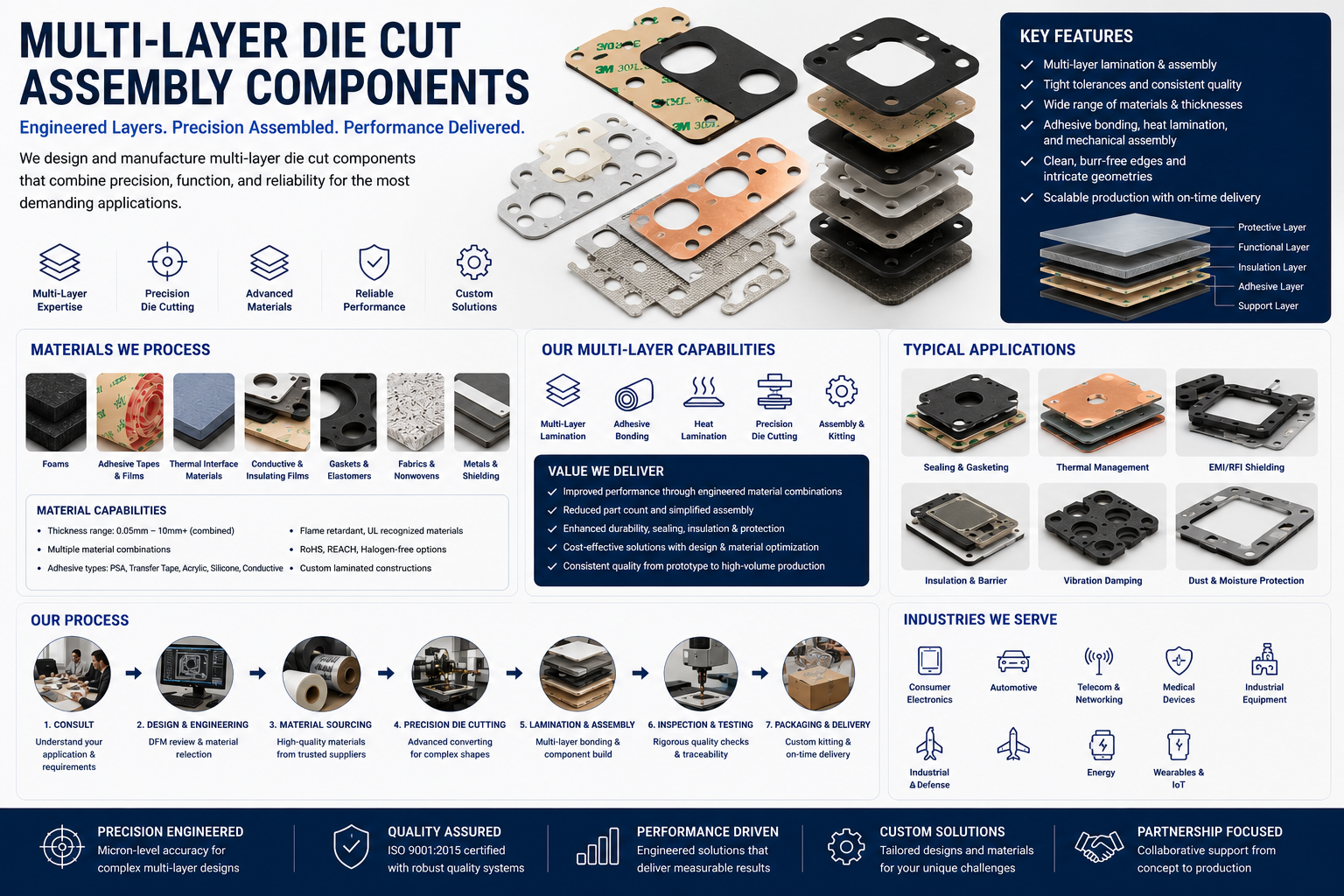
How Multi-Layer Die Cut Parts Combine Several Steps
Many OEM parts are not single-layer materials. They may combine:
- Foam + adhesive
- PET film + adhesive
- Non-woven felt + pressure-sensitive tape
- Rubber seal + liner
- TPU film + protective layer
Instead of asking operators to assemble these layers manually, a converter can laminate them before die cutting.
This creates one integrated component.
The result is fewer assembly steps, lower labor cost, and better repeatability.
Improving Placement Accuracy
Small parts are easy to misplace during manual assembly.
Die cut components can include:
- Alignment holes
- Pull tabs
- Positioning notches
- Kiss-cut liners
- Carrier films
These features help operators install parts quickly and correctly.
For automated assembly, roll-supplied die cut parts can support stable feeding, consistent pitch, and repeatable placement.
This is important for consumer electronics, wearable sensors, optical modules, and battery components.
Theme: Electronic Die Cut Materials
Reducing Contamination During Assembly
Adhesive parts are sensitive to dust, fibers, and fingerprints.
Manual handling increases contamination risk.
Die cut parts supplied on liners help protect adhesive surfaces until the moment of application. Cleanroom die cutting can further reduce particles for optical and electronic components.
This helps prevent:
- Bubbles
- Edge lift
- Poor adhesion
- Optical defects
- Cosmetic rejects
For display modules, camera parts, battery insulation, and protective films, clean handling is critical.
Automotive Applications
In automotive interiors, die cut components simplify the installation of NVH and sealing materials.
Common parts include:
- Needle-punched felt pads
- Non-woven acoustic insulation
- Anti-rattle strips
- Foam seals
- Rubber gaskets
- Adhesive-backed cushioning parts
These components help reduce noise, vibration, squeaks, and rattles while keeping assembly efficient.
Dongguan Sanken Electronics Manufacturing Co., Ltd. supports automotive OEM and ODM projects with custom die cut felt, foam, and sealing components produced from drawings or samples.
Consumer Electronics and Wearable Applications
Consumer electronics require thinner, cleaner, and more precise materials.
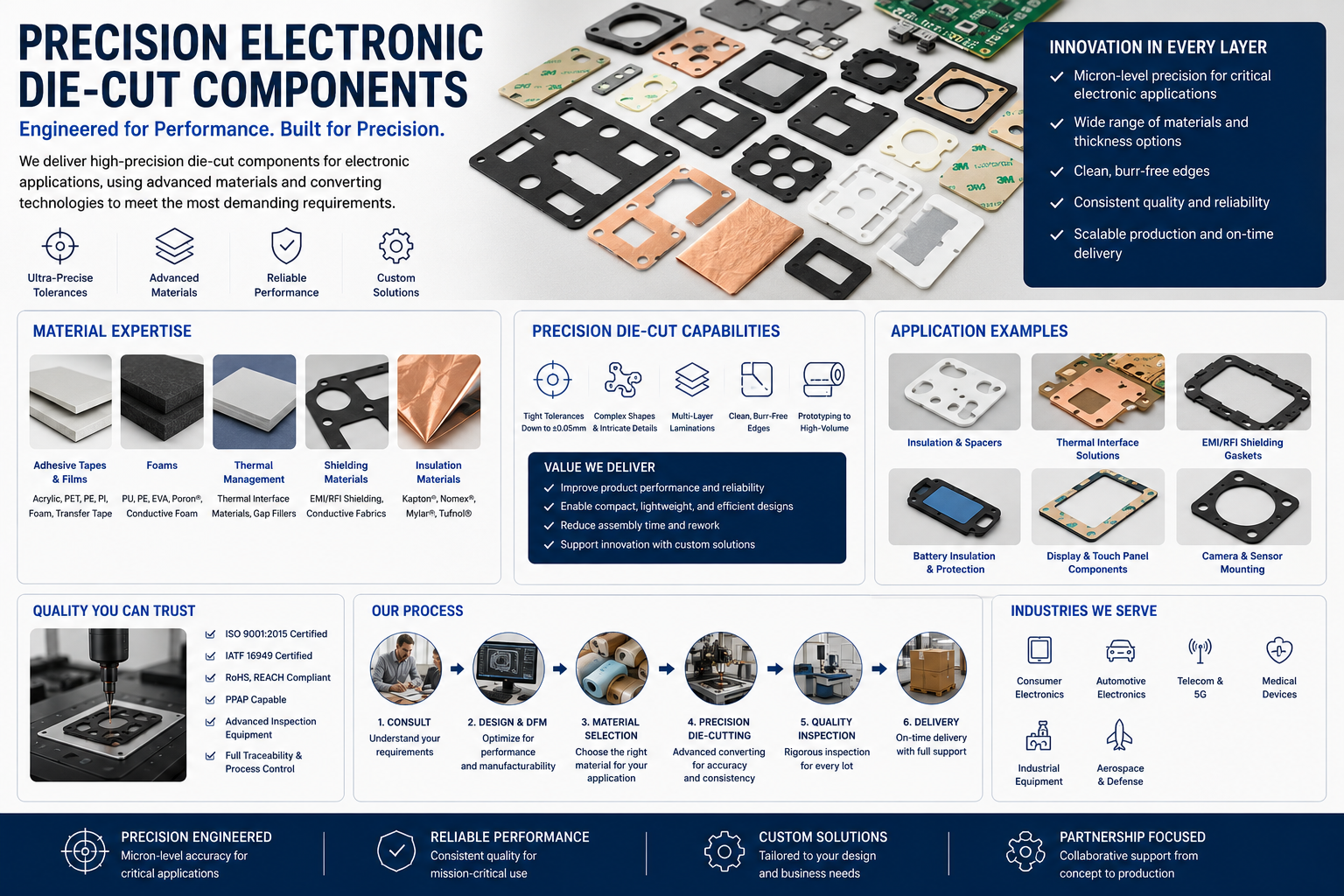
Die cut components are used for:
- PET insulation films
- TPU protective layers
- Foam adhesive gaskets
- Battery insulation pads
- Light-blocking materials
- Display cushioning parts
For wearable devices, custom die cut materials also support sealing, skin-contact comfort, sensor protection, and compact assembly design.
Precision die cutting helps reduce manual alignment work and improves product reliability.
Custom Rubber and Plastic Sealing Applications
Die cut sealing parts can replace manual gasket cutting or liquid sealant application.
Common solutions include:
- Silicone gaskets
- EPDM seals
- Rubber pads
- Foam sealing rings
- Waterproof adhesive structures
These parts help OEMs improve sealing consistency while reducing messy or time-consuming assembly steps.
Theme: Custom OEM Assembly Solutions
How Sanken Supports OEM Assembly Simplification
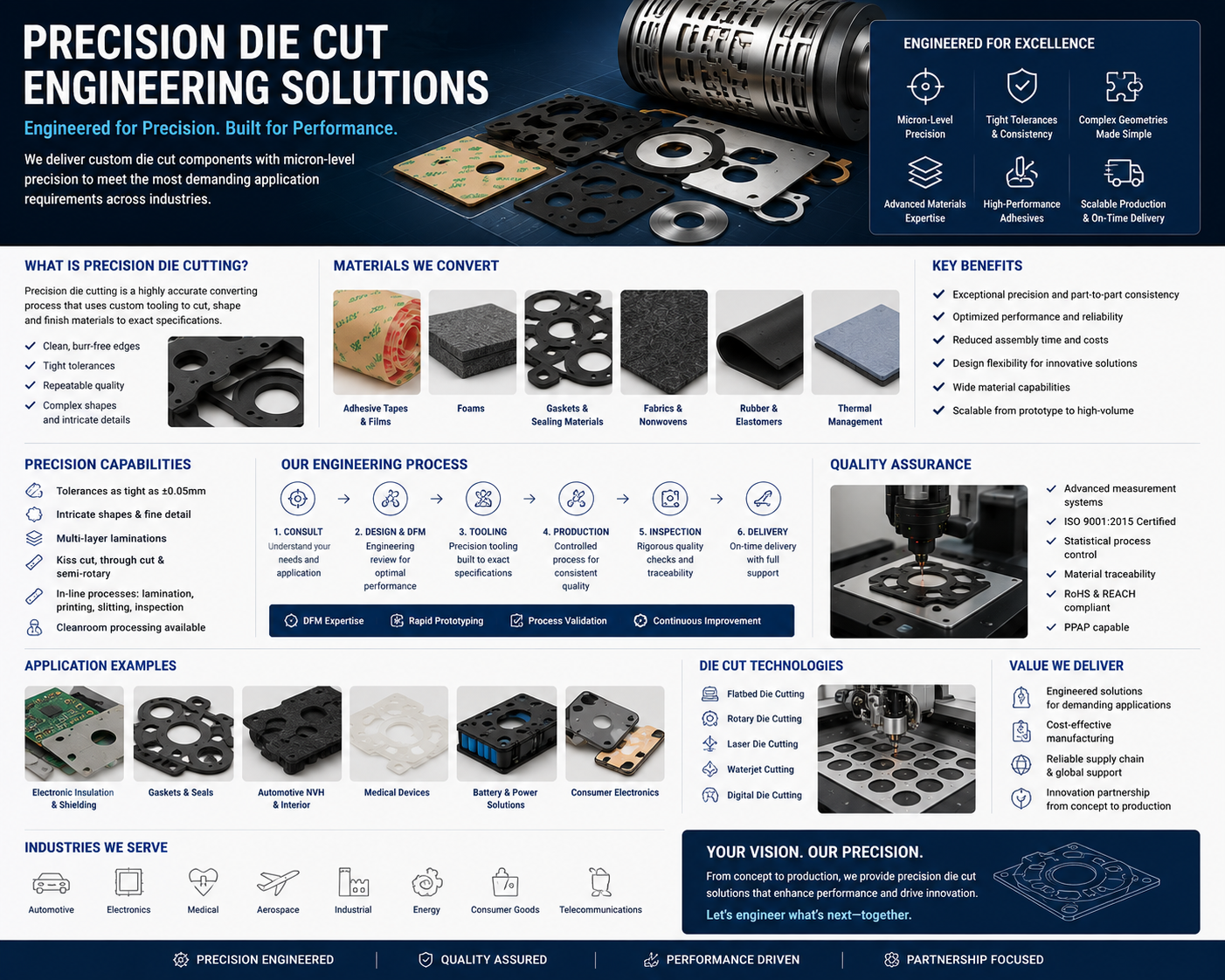
Dongguan Sanken Electronics Manufacturing Co., Ltd. provides custom precision converting and die cutting solutions for OEM customers.
Our capabilities include:
- Precision die cutting
- Foam and rubber converting
- Non-woven felt processing
- PET and TPU film converting
- Adhesive laminating
- Cleanroom precision production
- Custom mold development from drawings or samples
Key advantages include:
- OEM/ODM customization
- ISO 9001 quality management
- RoHS and REACH compliant materials
- Domestic and overseas production bases
- Cleanroom manufacturing for precision parts
By supplying ready-to-install components, Sanken helps customers reduce assembly steps, improve consistency, and simplify supply chain management.
Selection Tips for OEM Buyers
When choosing die cut components, consider:
- Material function: sealing, insulation, cushioning, bonding, or NVH control
- Assembly method: manual, semi-automatic, or automated
- Delivery format: sheets, rolls, or kits
- Adhesive requirements
- Temperature and humidity exposure
- Cleanliness requirements
- Tolerance and positioning needs
The best die cut solution is not only the correct material. It is the material, structure, adhesive, and supply format designed around the assembly process.
Conclusion
Die cut components help OEMs simplify assembly by reducing manual operations, improving placement accuracy, lowering contamination risk, and combining multiple materials into one finished part.
For automotive NVH systems, consumer electronics, wearable devices, and custom sealing applications, precision die cutting provides a practical way to improve assembly efficiency without changing the main product design.