How Die Cut Parts Can Be Supplied in Sheets, Rolls or Kits?
Many OEM buyers focus heavily on material selection, adhesive performance, and dimensional tolerances when sourcing die-cut components. However, one factor that often has an even greater impact on assembly efficiency is the delivery format. A perfectly designed die-cut part can still create production bottlenecks if it arrives in the wrong format.
Die-cut parts can be supplied in sheets, rolls, or kits depending on the customer's assembly process, production volume, automation requirements, and logistics needs. Selecting the right delivery format can reduce labor costs, improve placement accuracy, minimize waste, and increase overall manufacturing efficiency.
For industries such as automotive, consumer electronics, medical devices, and industrial equipment, optimizing the delivery format is often one of the easiest ways to improve productivity without changing the product itself.
Why Delivery Format Matters
Many assembly issues are not caused by the die-cut part itself.
Instead, problems occur because operators struggle with:
- Part handling
- Liner removal
- Positioning accuracy
- Part counting
- Inventory management
A properly designed supply format can significantly improve production speed and consistency.
Theme: Precision Die Cut Components
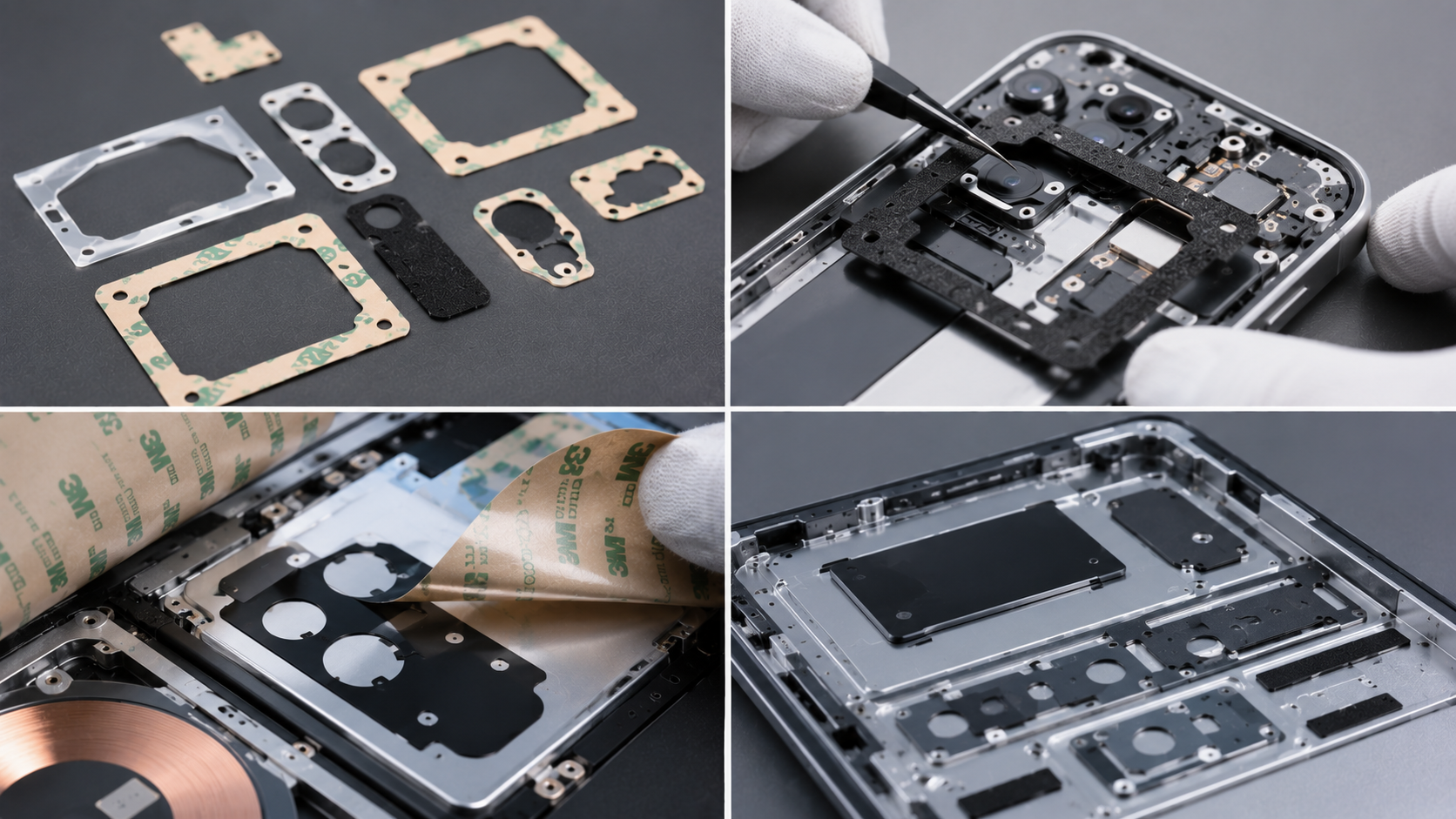
What Are Sheeted Die Cut Parts?
Sheeted parts are supplied on flat sheets containing multiple die-cut components.
The parts remain attached to the release liner until removed by the operator.
Typical Characteristics
- Flat format
- Easy visual inspection
- Suitable for manual assembly
- Convenient for storage
Advantages
- Low packaging complexity
- Easy counting
- Suitable for medium-volume production
- Good dimensional stability
Common Applications
- Foam gaskets
- Insulation components
- Rubber seals
- Medical device parts
- Industrial labels
Sheeted formats are often used when operators manually remove and install components.
When Are Sheets the Best Choice?
Sheets are typically preferred when:
- Production volumes are moderate
- Manual assembly is used
- Part sizes are relatively large
- Frequent design changes occur
For prototype and pilot production, sheet formats are often the simplest solution.
What Are Roll-Supplied Die Cut Parts?
Roll-supplied parts remain attached to a continuous release liner and are wound onto a core.
This format is widely used in automated assembly environments.
Typical Characteristics
- Continuous web structure
- Automated dispensing compatibility
- High-volume production support
Advantages
- Faster assembly
- Reduced operator handling
- Better automation integration
- Lower labor costs
Theme: Roll-to-Roll Die Cutting Production
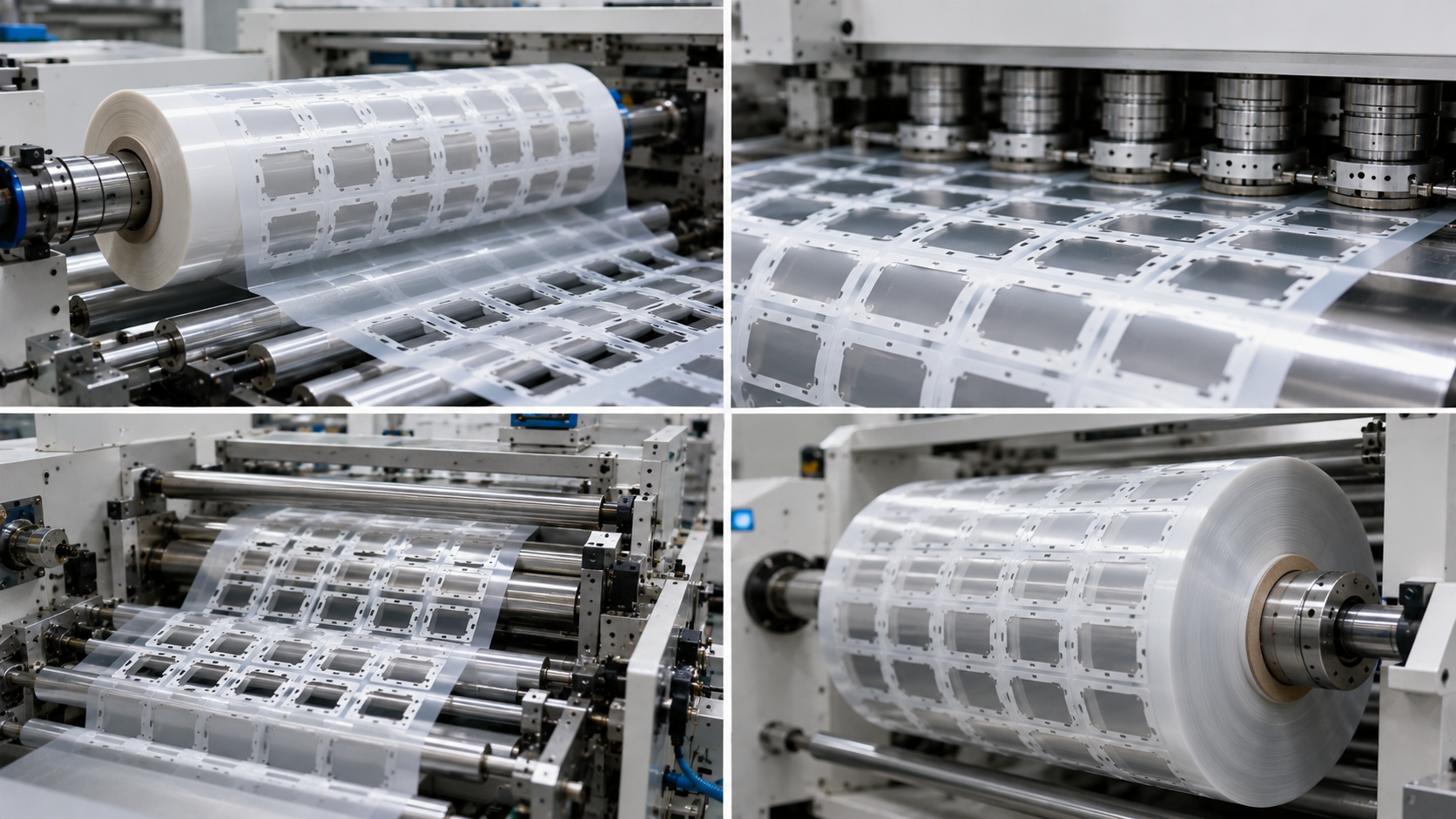
Why Rolls Are Popular in Electronics Manufacturing
Roll formats are especially common for:
- Smartphone components
- Battery insulation materials
- Foam pads
- Adhesive assemblies
- Optical films
Automated equipment can:
- Peel liners
- Pick components
- Place parts automatically
This significantly increases production efficiency.
Benefits
- Consistent placement
- Higher throughput
- Reduced contamination risk
- Better process control
For high-volume consumer electronics manufacturing, roll formats are often the preferred choice.
Important Roll Format Considerations
Successful roll supply requires careful planning.
Factors include:
Core Size
Common core diameters vary depending on assembly equipment.
Roll Diameter
Must match machine capabilities.
Splice Requirements
Many automated systems require:
- Controlled splice locations
- Limited splice quantities
- Clearly marked splices
Web Direction
Incorrect web orientation can cause automation failures.
These requirements should be discussed during product development.
What Are Die Cut Kits?
A kit combines multiple components into a single package or assembly set.
Instead of shipping individual parts separately, manufacturers group all required items together.
Typical Kit Contents
- Foam gaskets
- Adhesive tapes
- PET films
- Rubber seals
- Insulation components
Advantages
- Reduced inventory management
- Faster assembly
- Lower picking errors
- Simplified logistics
Theme: Adhesive Component Assembly Kits
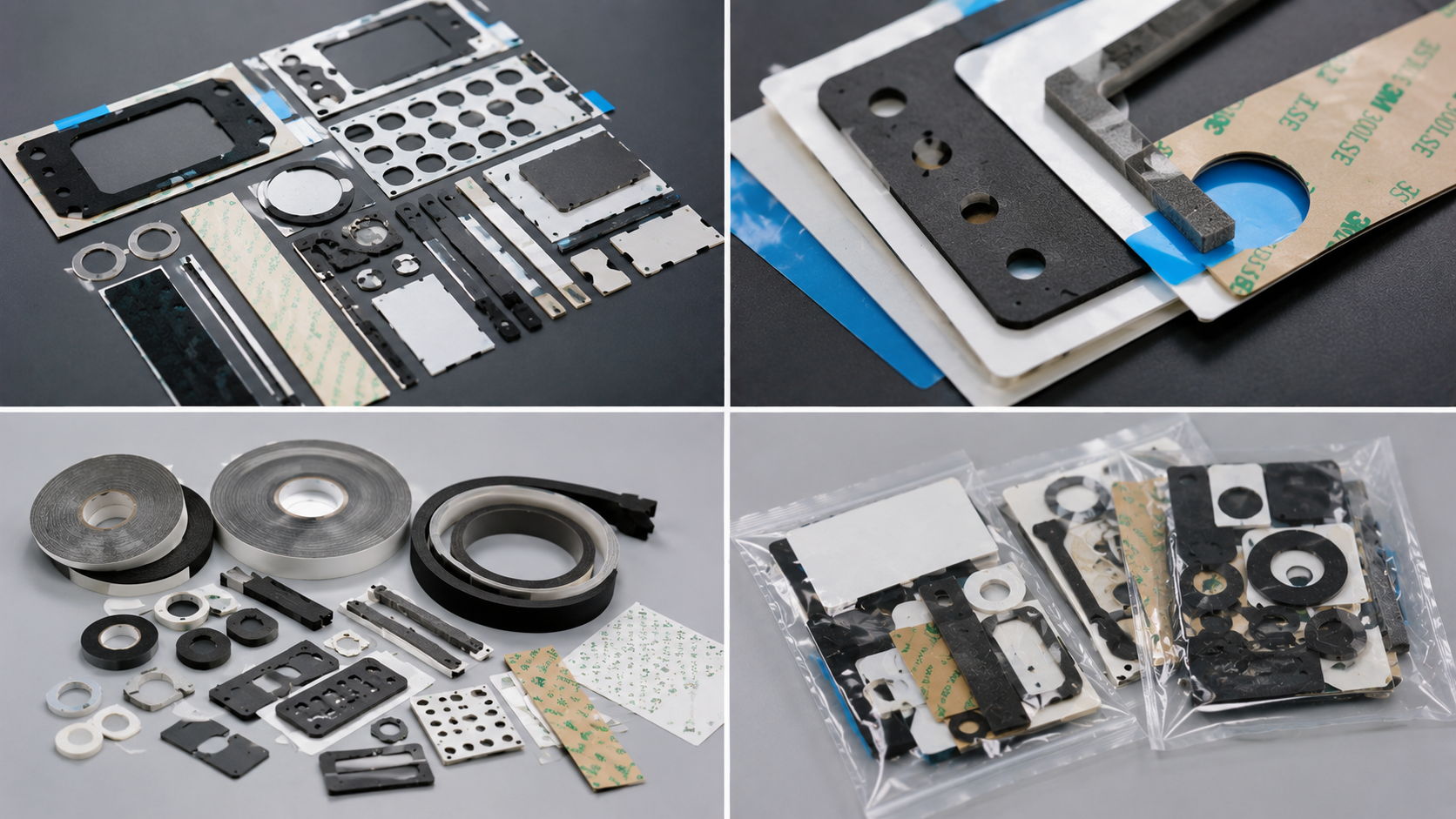
When Are Kits the Best Option?
Kitting is often used when:
- Multiple components are installed together
- Assembly errors are costly
- Production involves low-to-medium volumes
- Product variants require different component combinations
Examples include:
Automotive Assemblies
Multiple NVH components packaged together.
Medical Devices
Complete assembly kits for production operators.
Industrial Equipment
Pre-sorted component sets for installation.
By reducing part handling and picking activities, kits improve overall assembly efficiency.
Comparing Sheets, Rolls, and Kits
| Feature | Sheets | Rolls | Kits |
|---|---|---|---|
| Manual Assembly | Excellent | Moderate | Excellent |
| Automated Assembly | Limited | Excellent | Limited |
| High-Volume Production | Moderate | Excellent | Moderate |
| Inventory Simplicity | Good | Good | Excellent |
| Operator Efficiency | Good | Excellent | Excellent |
| Design Flexibility | Excellent | Good | Excellent |
No single format is ideal for every application.
The best choice depends on production requirements.
How to Choose the Right Delivery Format
Consider the following questions:
Is Assembly Manual or Automated?
Automated assembly generally favors roll formats.
How Many Parts Are Installed?
Multiple components may benefit from kitting.
What Is the Production Volume?
High-volume programs often justify roll-fed automation.
How Critical Is Placement Accuracy?
Roll formats often provide the most consistent positioning.
What Are the Logistics Requirements?
Kitting can simplify inventory management and reduce handling errors.
How Sanken Manufacturing Supports Custom Supply Formats
Dongguan Sanken Electronics Manufacturing Co., Ltd. provides complete converting and packaging solutions for OEM manufacturers worldwide.
Our capabilities include:
- Precision die cutting
- Roll-to-roll converting
- Sheeted component production
- Custom kitting services
- Adhesive laminating
- Foam converting
- PET film processing
Key Advantages
- OEM and ODM customization
- ISO 9001 certified quality management
- RoHS and REACH compliant materials
- Domestic and overseas production bases
- Cleanroom precision manufacturing
- Tool development from drawings or samples
We support automotive NVH components, consumer electronics assemblies, wearable devices, industrial equipment, and medical products.
Featured Snippet Summary
Die-cut parts can be supplied in sheets, rolls, or kits depending on assembly requirements. Sheets are ideal for manual assembly and flexibility, rolls support automated high-volume production, and kits simplify inventory management by grouping multiple components together for efficient installation.
Conclusion
The performance of a die-cut component depends not only on the material and design but also on how it is delivered to the assembly line. Sheets, rolls, and kits each offer unique advantages depending on production volume, automation level, and logistics requirements.
By selecting the right supply format early in product development, manufacturers can improve assembly efficiency, reduce labor costs, minimize errors, and achieve a more reliable production process.