
How Does Die Cutting Work? (Complete Guide for Manufacturers)
Die cutting is one of the most important converting processes in modern manufacturing. It transforms raw roll or sheet materials into precise, repeatable shapes used in packaging, automotive components, electronics, medical products, insulation parts, labels, and adhesive assemblies.
For OEM buyers, die cutting is not just about cutting material. It is about achieving consistency, speed, and reliability in mass production.
This article explains how die cutting works, the main processes involved, the equipment types, and how to specify a project correctly.
What Is Die Cutting?
Die cutting is a precision manufacturing process that uses a specially designed tool called a die to cut specific shapes from materials.
The die applies controlled pressure to:
- Cut outer outlines
- Create internal holes or windows
- Form perforation lines
- Produce kiss-cut adhesive parts
- Separate components for assembly
Because the die is fixed and engineered to exact specifications, every part produced is identical in shape and size.
The Basic Principle of Die Cutting
The process relies on three core elements:
- A custom cutting tool (die)
- Controlled pressure
- Accurate material positioning
When pressure is applied, the die presses into the material against an anvil or cutting surface. The material is cleanly separated along the designed geometry.
This controlled system ensures:
- High repeatability
- Tight tolerances
- Clean edges
- Stable production at scale
Step-by-Step Die Cutting Process
1. Material Preparation
Materials are typically supplied as:
- Rolls (for high-volume production)
- Sheets (for flatbed applications)
Common materials include:
- Foam
- Rubber
- Non-woven fabrics
- Adhesive tapes
- Films
- Paper and cardboard
- Laminated constructions
Proper tension control is critical to prevent stretching or distortion.
2. Lamination (If Required)
Some products require multiple layers.
For example:
- Foam + adhesive
- Film + adhesive
- Multi-layer insulation materials
These layers are bonded together before cutting. Proper lamination prevents bubbles, shifting, or delamination during production.
3. Die Cutting (Rotary or Flatbed)
There are two primary methods:
Rotary Die Cutting
- Uses a cylindrical rotating die
- Operates in a continuous roll-to-roll process
- Ideal for high-volume production
- Common for labels, adhesive parts, and thin films
Advantages:
- High speed
- Excellent for automation
- Consistent pitch control
Flatbed Die Cutting
- Uses a press with vertical pressure
- Suitable for thicker materials
- Often used for foam, rubber, and complex shapes
- Good for medium or short production runs
Advantages:
- Strong cutting force
- Flexible for thick or layered materials
- Suitable for intricate designs
4. Kiss-Cut vs Through-Cut
Kiss-Cut
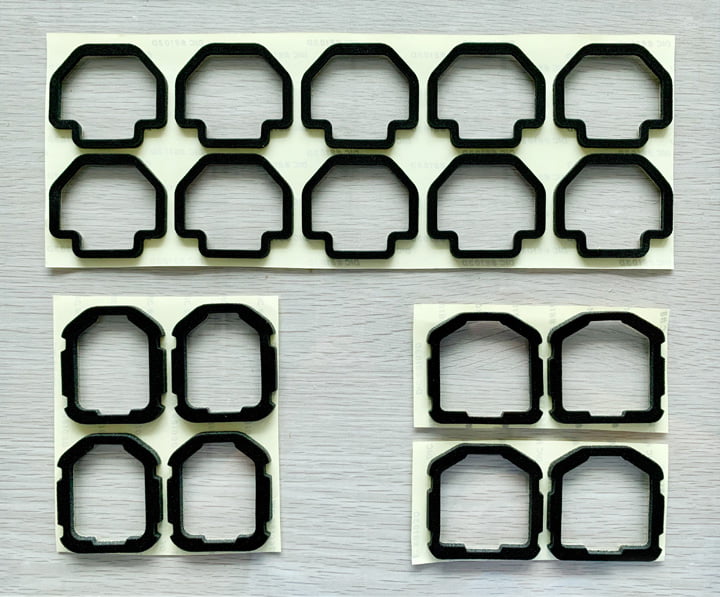
The die cuts only the top material layer while keeping the liner intact.
Used for:
- Adhesive labels
- Die-cut stickers
- Peel-and-place components
This format improves application speed and keeps parts organized on a liner.
Through-Cut
The die cuts completely through all layers.
Used for:
- Non-adhesive components
- Packaging inserts
- Separate parts
Selection depends on application requirements.
5. Waste Matrix Removal
After cutting, the unused material (called the matrix) is removed.
Stable waste stripping is essential for:
- Smooth production
- Avoiding machine jams
- Maintaining part alignment
Poor matrix design can slow down the entire process.
6. Finishing and Delivery
Finished parts can be delivered in different formats:
- Rolled
- Sheet stacked
- Individually packed
- Kitted sets
- Automation-ready rolls
The delivery format directly affects assembly speed and labor cost.
Materials Commonly Used in Die Cutting
Die cutting works with many industrial materials:
- Closed-cell foam
- Open-cell foam
- Rubber sheets
- Adhesive tapes
- Protective films
- Non-woven materials
- Insulation materials
- Packaging board
Each material behaves differently under pressure. Material selection is critical to performance.
Why Die Cutting Is Important in Manufacturing
Die cutting provides:
1. Repeatability
Every part matches the design exactly.
2. Efficiency
High-volume production with minimal variation.
3. Reduced Labor
Kiss-cut formats enable fast peel-and-place application.
4. Better Quality Control
Tighter tolerances and stable geometry reduce defects.
5. Automation Compatibility
Roll formats support automated dispensing systems.
For OEM industries such as automotive, electronics, medical, and industrial manufacturing, these advantages are essential.
Common Problems Die Cutting Helps Prevent
Without precision converting, manufacturers may experience:
- Edge lifting
- Dimensional inconsistency
- Poor fit during assembly
- Adhesive failure
- Waste during manual trimming
- Slow production speed
Proper die design and process control prevent these issues.
How to Specify a Die Cutting Project
To ensure accurate production, provide:
- Material type and thickness
- Adhesive requirements
- Tolerance requirements
- Application environment (temperature, humidity, exposure)
- Annual volume
- Delivery format (roll, sheet, kit)
- Technical drawing or cut file
Clear specifications help ensure stable mass production.
Conclusion
Die cutting is a precision converting process that uses controlled pressure and engineered tools to produce repeatable shapes from roll or sheet materials. It supports high-volume manufacturing by improving consistency, reducing labor, and enabling automation.
When properly designed, die-cut components deliver stable performance, clean edges, and efficient assembly across industries.
For best results, define your material, tolerance, environment, and delivery requirements before starting production.