
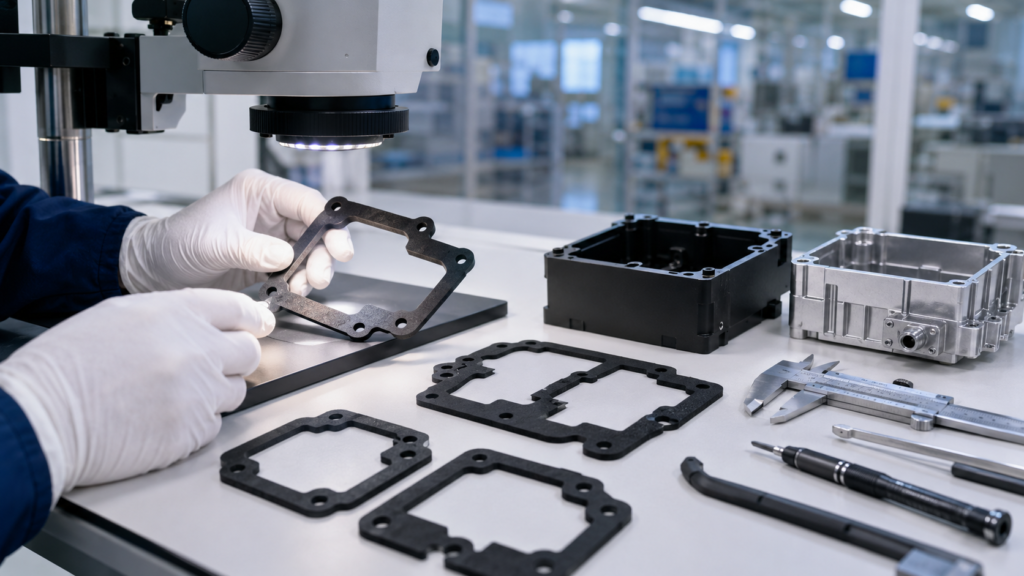
Foam gasket sealing can fail even when the material looks correct. I have seen projects where the foam type was suitable, the adhesive was acceptable, and the sample looked clean, but the gasket still leaked after assembly. The reason was simple: tolerance was not controlled tightly enough in the areas that actually affected sealing.
Tolerance is extremely important in foam gasket sealing because it controls fit, compression, rebound, hole alignment, sealing wall width, adhesive position, and assembly pressure. A foam gasket does not seal only because it is soft. It seals because the right foam is cut to the right size, placed in the right position, and compressed evenly against the sealing surface. At Sanken, we treat tolerance as a functional sealing requirement, not just a drawing number.
A gasket may look small, but it often protects the whole product from dust, water, vibration, air leakage, and noise. If tolerance fails, the gasket fails.
Why Does Tolerance Matter in Foam Gasket Sealing?
Foam gaskets usually seal through compression.
When the gasket is installed between two surfaces, it must fill the gap and maintain contact pressure. If the gasket is too small, too large, too thin, too thick, or misaligned, the compression will not be even.
Uneven compression creates weak areas.
Weak areas become leakage paths.
This is why tolerance control is important in automotive electronics, battery housings, appliance panels, lighting modules, industrial enclosures, and medical equipment. These products need stable sealing performance, not just a gasket that looks good during sample approval.
Which Tolerance Points Affect Sealing Most?
Not every dimension has the same importance.
For foam gasket sealing, some dimensions directly affect performance.
| Tolerance Item | Why It Matters | Possible Failure |
|---|---|---|
| Outer dimension | Controls gasket fitting position | Interference or poor placement |
| Inner opening | Protects airflow, sensors, or clearance | Blocked functional area |
| Hole position | Supports screw or pin alignment | Assembly mismatch |
| Thickness | Controls compression force | Leakage or over-compression |
| Sealing wall width | Maintains contact area | Weak sealing path |
| Adhesive position | Keeps gasket stable | Lifting, shifting, or peeling |
| Edge quality | Affects surface contact | Rough edge leakage |
At Sanken, we do not only check whether the overall shape is correct. We identify which dimensions affect the sealing function first, then build the inspection plan around those points.
Why Is Thickness Tolerance So Critical?
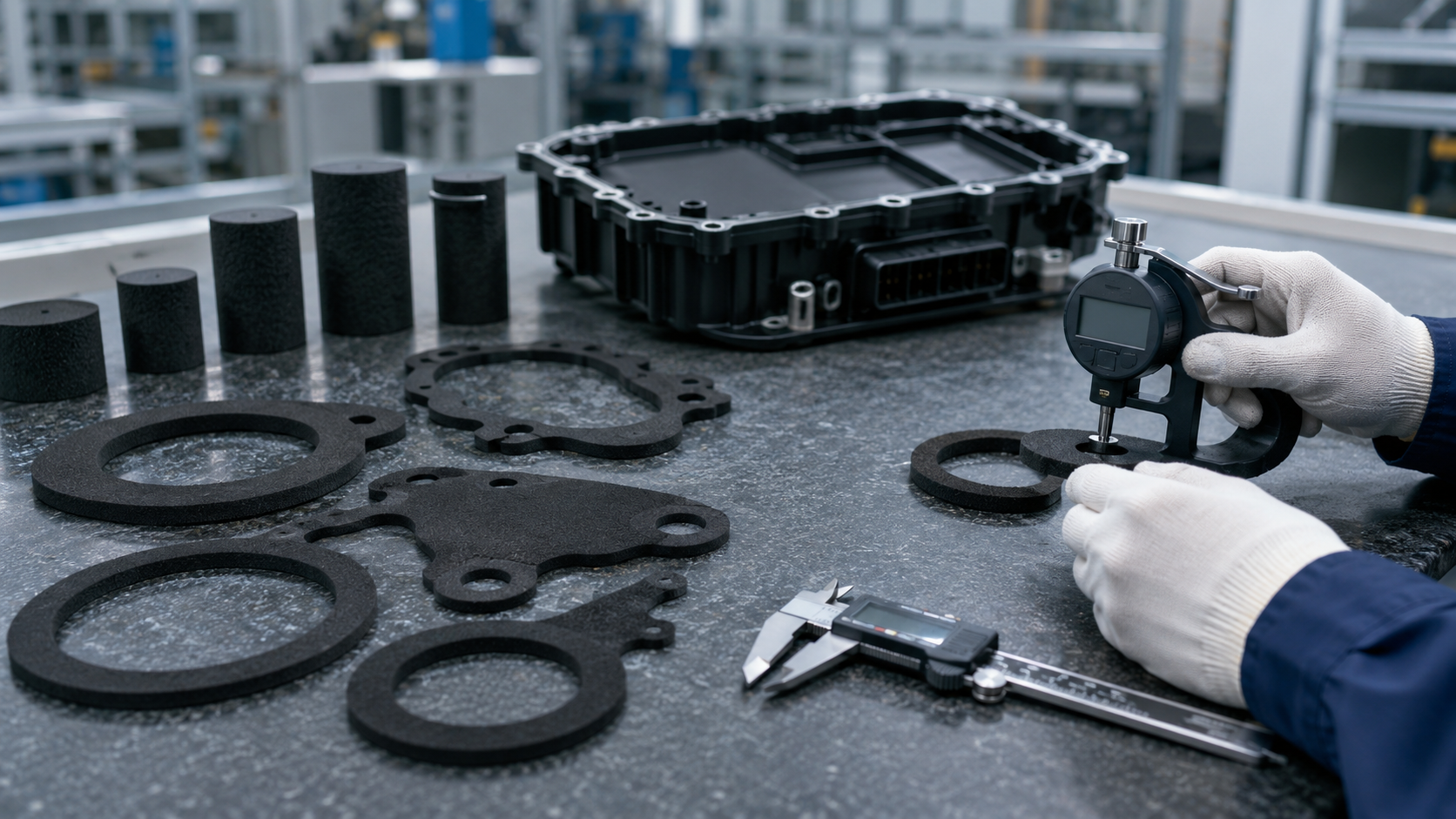
Thickness tolerance directly affects compression.
If the foam gasket is too thin, it may not fill the gap between two surfaces. That creates leakage.
If the gasket is too thick, it may create excessive assembly pressure. That can crush the foam, deform the housing, or reduce long-term rebound.
Both problems are costly.
For sealing, the goal is not simply to choose a thicker foam. The goal is to match the foam thickness with the housing gap, compression ratio, material density, and service environment.
For example, a PU foam gasket used for dust sealing in electronics may need a different thickness tolerance from an EPDM foam gasket used for outdoor waterproof sealing. A silicone foam gasket used near heat may need another approach again.
At Sanken, we review thickness, density, compression range, and rebound behavior before mass production. This helps prevent the common problem where a gasket passes the first sample review but loses sealing performance after long-term use.
How Does Hole Position Tolerance Affect Assembly?
Hole position is a common hidden problem.
Many foam gaskets include screw holes, locating holes, cable openings, sensor windows, air vents, or inner cutouts. If these holes shift, the gasket may not align with the housing.
The operator may need to stretch the gasket during assembly.
That creates stress.
Stress causes deformation.
Deformation causes sealing failure.
In automotive electronics, this can be especially serious. A small hole position error can create uneven screw pressure. Once pressure is uneven, some areas of the gasket compress too much while other areas do not compress enough.
That can lead to dust ingress, water leakage, vibration noise, or failed assembly inspection.
A good supplier must control hole position during repeat production, not only during sample making.
Why Does Sealing Wall Width Matter?
The sealing wall is the area that actually contacts the mating surface.
If the sealing wall is too narrow, the gasket may not have enough contact area to maintain sealing pressure.
This risk becomes higher when tolerance variation reduces the wall even further.
This problem often appears in complex foam gasket designs with narrow bridges, sharp corners, thin ribs, small holes, or dense cut patterns.
A narrow foam wall can tear during cutting.
It can deform during waste removal.
It can compress unevenly during assembly.
It can also lose sealing force faster over time.
This is why minimum width and tolerance should be reviewed together. A design may look perfect in CAD, but if the foam wall is too narrow for stable die cutting and assembly, the gasket will become risky in mass production.
At Sanken, we check whether the gasket design is not only drawable, but also manufacturable.
How Does Foam Material Behavior Affect Tolerance?
Foam is not a rigid material.
It compresses, rebounds, stretches, and sometimes deforms during cutting and handling.
Different foam materials behave differently.
| Foam Material | Tolerance Challenge | Common Application |
|---|---|---|
| PU foam | Easy to compress | Dust sealing and cushioning |
| EVA foam | Moderate deformation | General sealing and shock absorption |
| PE foam | Good stability | Moisture-resistant sealing |
| EPDM foam | Good weather resistance | Automotive and outdoor sealing |
| CR foam | Medium cutting difficulty | Industrial sealing |
| Silicone foam | Elastic recovery | Heat-resistant sealing |
This is why tolerance cannot be decided only by the drawing.
The same dimension may be easy to hold in PET film but difficult in soft foam. A narrow adhesive-backed foam strip may shift more than a plain foam part. A thick foam gasket may require different tooling pressure from a thin gasket.
At Sanken, we review the material behavior before confirming the production process. This reduces trial failures and improves batch stability.
Do Adhesive-Backed Foam Gaskets Need Tighter Control?
Yes.
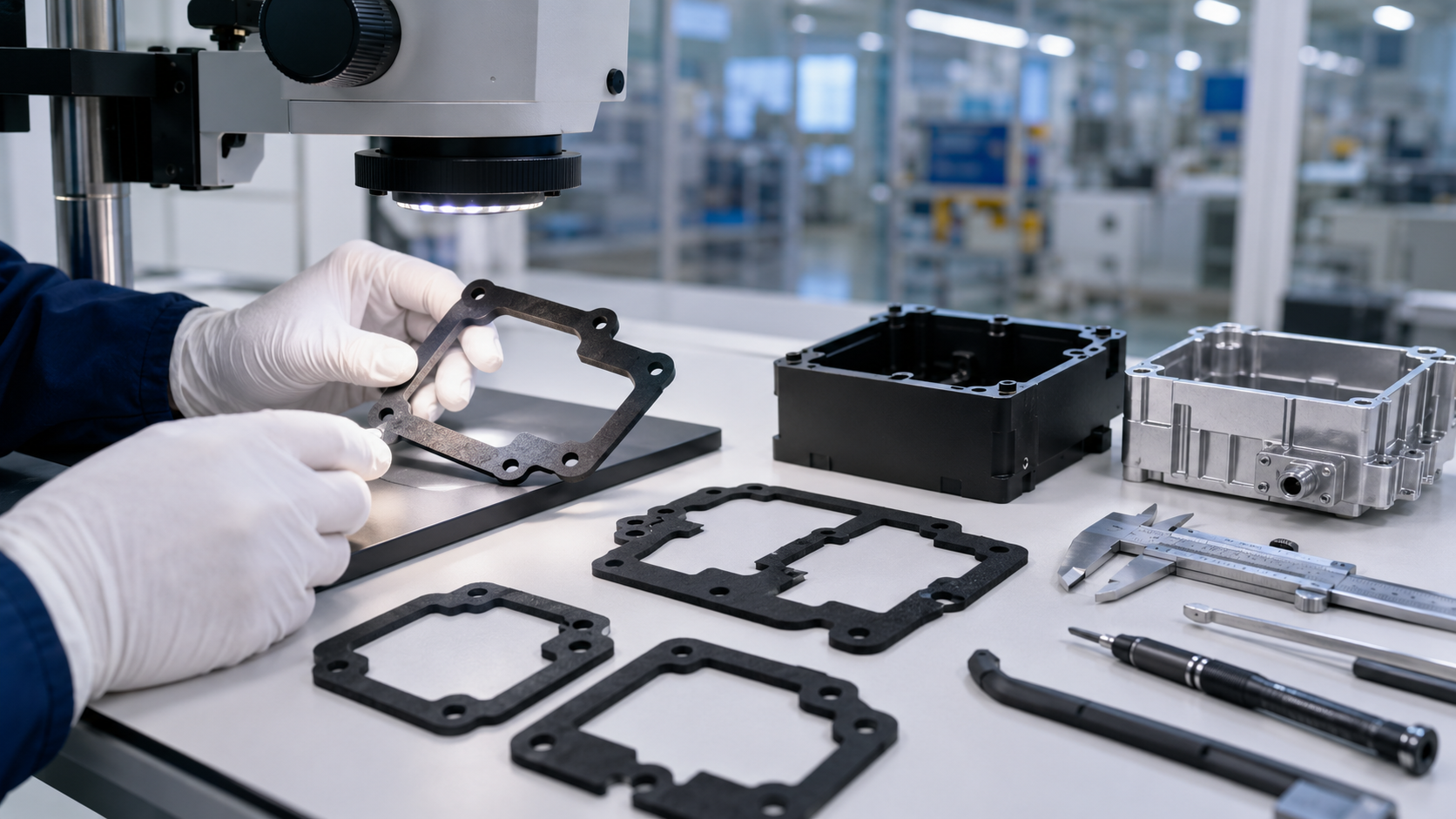
Adhesive-backed foam gaskets are more complex than plain foam gaskets.
The adhesive layer affects thickness, flatness, edge quality, liner release, and final assembly position.
If the adhesive shifts during lamination, the gasket may not sit correctly.
If cutting pressure is too high, adhesive overflow may appear.
If kiss cutting is too deep, the release liner may be damaged.
If the liner release is unstable, the gasket may stretch during peeling and installation.
All of these issues affect sealing.
For adhesive-backed foam gaskets, tolerance control must include the foam, adhesive, liner, cutting depth, and packaging format.
At Sanken, we combine foam converting, adhesive lamination, kiss cutting, and precision die cutting in one controlled process. This helps reduce lifting, shifting, peeling, adhesive overflow, and dimensional instability.
Why Do Samples Pass but Mass Production Fails?
One good sample does not prove stable production.
Samples are often made slowly and carefully. Mass production is different.
Longer production runs introduce more variables:
- Tool wear
- Foam batch variation
- Cutting pressure change
- Roll tension change
- Adhesive lamination variation
- Temperature and humidity change
- Waste removal instability
- Operator setup difference
A supplier may make several good samples but still fail when the order volume increases.
For OEM buyers, the real question is not “Can this supplier make one good part?”
The real question is “Can this supplier make the same part consistently across repeated batches?”
At Sanken, we focus on repeatability. We review tooling, material behavior, inspection points, packaging method, and production control before scaling from sample to mass production.
What Happens When Tolerance Is Too Loose?
Loose tolerance can create problems that are not obvious at first.
The gasket may look acceptable before assembly.
But once it is installed, the problems appear.
Common risks include:
- Uneven sealing pressure
- Water or dust leakage
- Poor gasket fit
- Screw hole mismatch
- Gasket shifting
- Adhesive overflow
- Higher rejection rate
- Poor long-term rebound
The worst part is that many of these problems appear after the customer has already received the parts.
That means the buyer pays for the gasket first, then pays again for rework, delay, and replacement.
A low-cost gasket with poor tolerance is not really cheap. It only hides the cost until later.
Can Tolerance Be Too Tight?
Yes.
Tighter tolerance is not always better.
If the tolerance is tighter than the foam material can realistically hold, production cost may increase quickly. It may require slower cutting speed, more inspection, more tooling adjustment, and higher scrap rate.
The smart approach is to define critical tolerances.
A screw hole may need tight control.
A sealing wall may need tight control.
A non-functional outer edge may allow more flexibility.
This is how we help customers balance sealing performance and cost.
Good engineering does not mean making every dimension extremely tight. Good engineering means knowing which dimensions truly affect function.
What Should Engineers Confirm Before Ordering Foam Gaskets?
Before ordering die cut foam gaskets, engineers and buyers should confirm the key sealing conditions.
| Check Point | Why It Matters |
|---|---|
| Housing gap | Determines gasket thickness |
| Compression range | Affects sealing force |
| Foam material | Controls rebound and aging |
| Critical dimensions | Protects function and fit |
| Hole position | Supports assembly alignment |
| Sealing wall width | Maintains contact area |
| Adhesive structure | Prevents shifting or peeling |
| Inspection method | Confirms production stability |
| Packaging format | Prevents deformation |
These details help the supplier build the right process from the beginning.
If a supplier only asks for the drawing and quantity, the risk is higher.
Why Sanken Pays Attention to Foam Gasket Tolerance
At Sanken, we understand that foam gasket sealing depends on more than the cutting shape.
For foam gasket projects, we focus on material selection, compression behavior, thickness control, hole position, sealing wall width, adhesive lamination, edge quality, and production verification.
This is especially important for automotive, electronics, appliance, medical, and industrial OEM applications.
Our goal is practical: help customers avoid leakage, repeated sampling, assembly delays, and unstable mass production.
We prefer solving tolerance risks before production starts, not after the customer finds the failure.
Conclusion
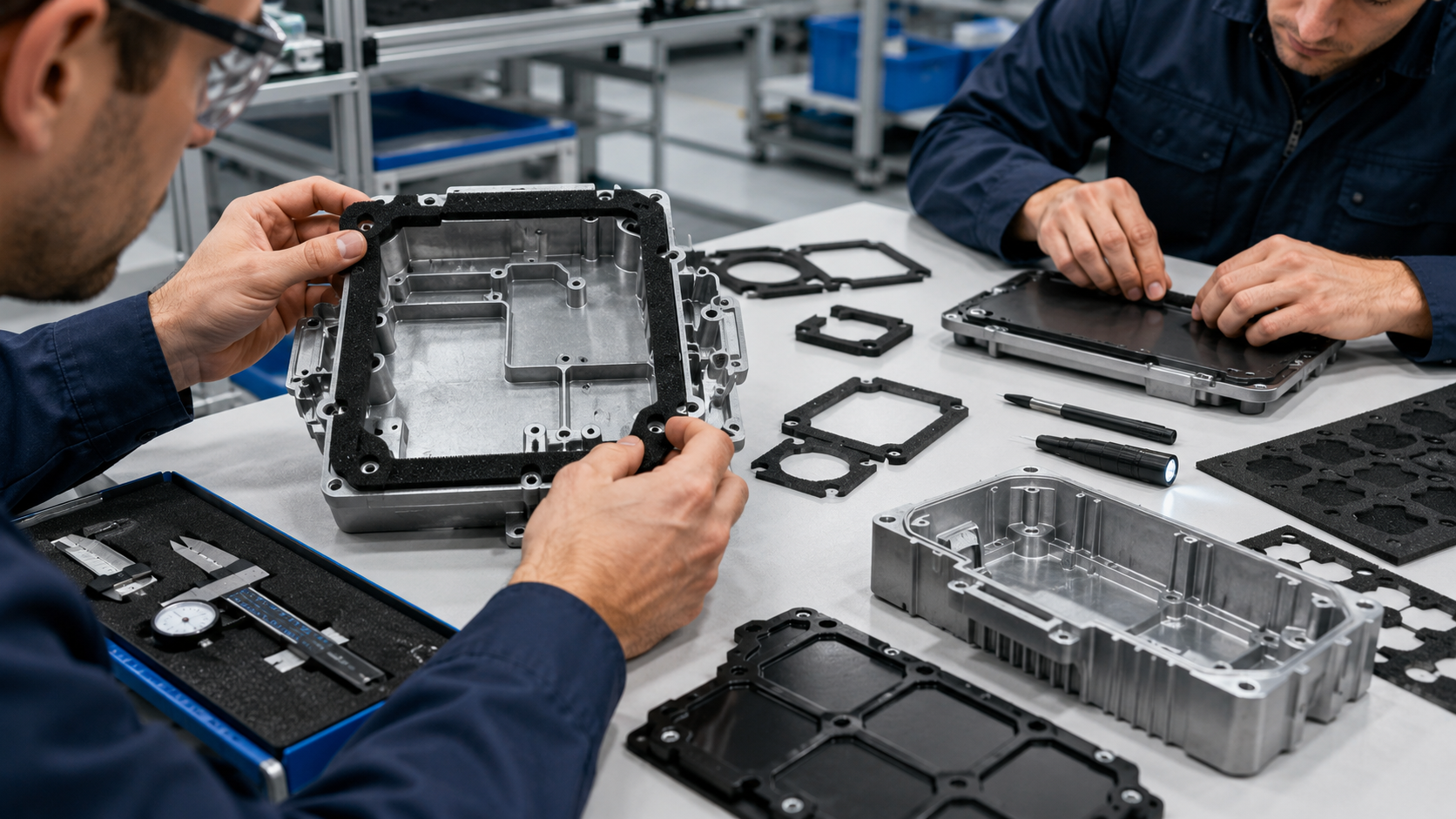
Tolerance is very important in foam gasket sealing because it affects compression, hole alignment, sealing wall width, adhesive position, assembly pressure, and long-term performance. At Sanken, we help OEM buyers control the dimensions that truly matter, so foam gaskets can seal reliably from sample approval to mass production.