
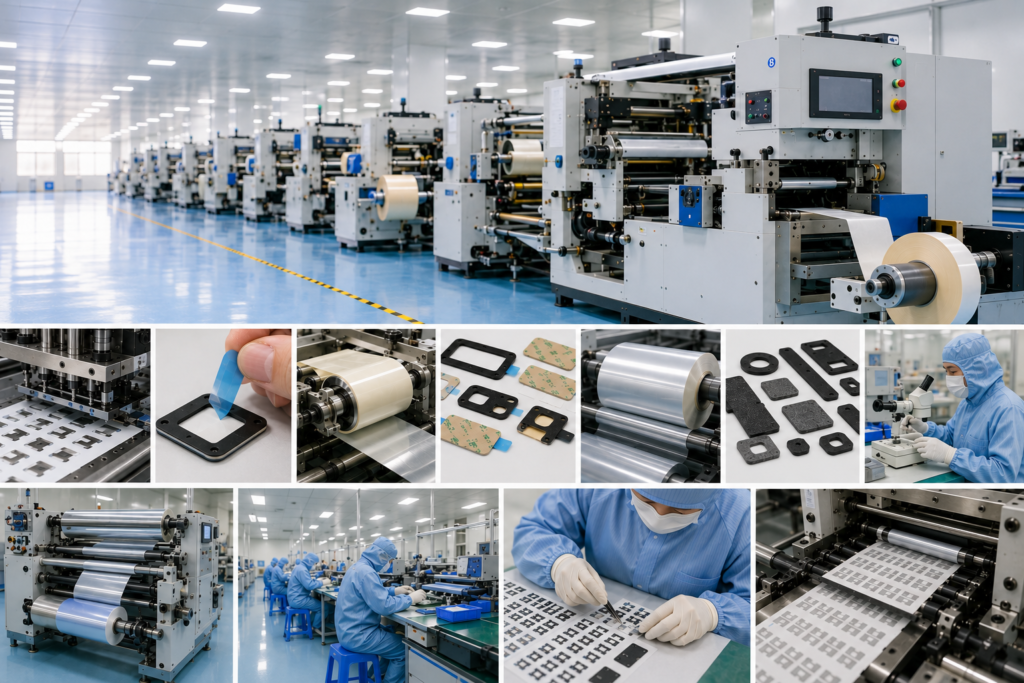
Applying small adhesive components may seem straightforward, but in high-volume manufacturing, it often becomes a bottleneck. Operators may struggle to separate adhesive parts from the release liner, accidentally touch the adhesive surface, or misalign the component during installation. These seemingly minor issues can reduce production efficiency, increase scrap rates, and affect product quality.
Pull tabs make die cut adhesive parts easier to apply by providing a dedicated gripping area that allows operators or automated equipment to peel, position, and install adhesive components quickly and accurately. They reduce liner removal time, prevent adhesive contamination, improve positioning accuracy, and support faster assembly processes.
Today, pull tabs are widely incorporated into die-cut adhesive parts used in automotive electronics, consumer electronics, wearable devices, medical equipment, and industrial products.
What Are Pull Tabs?
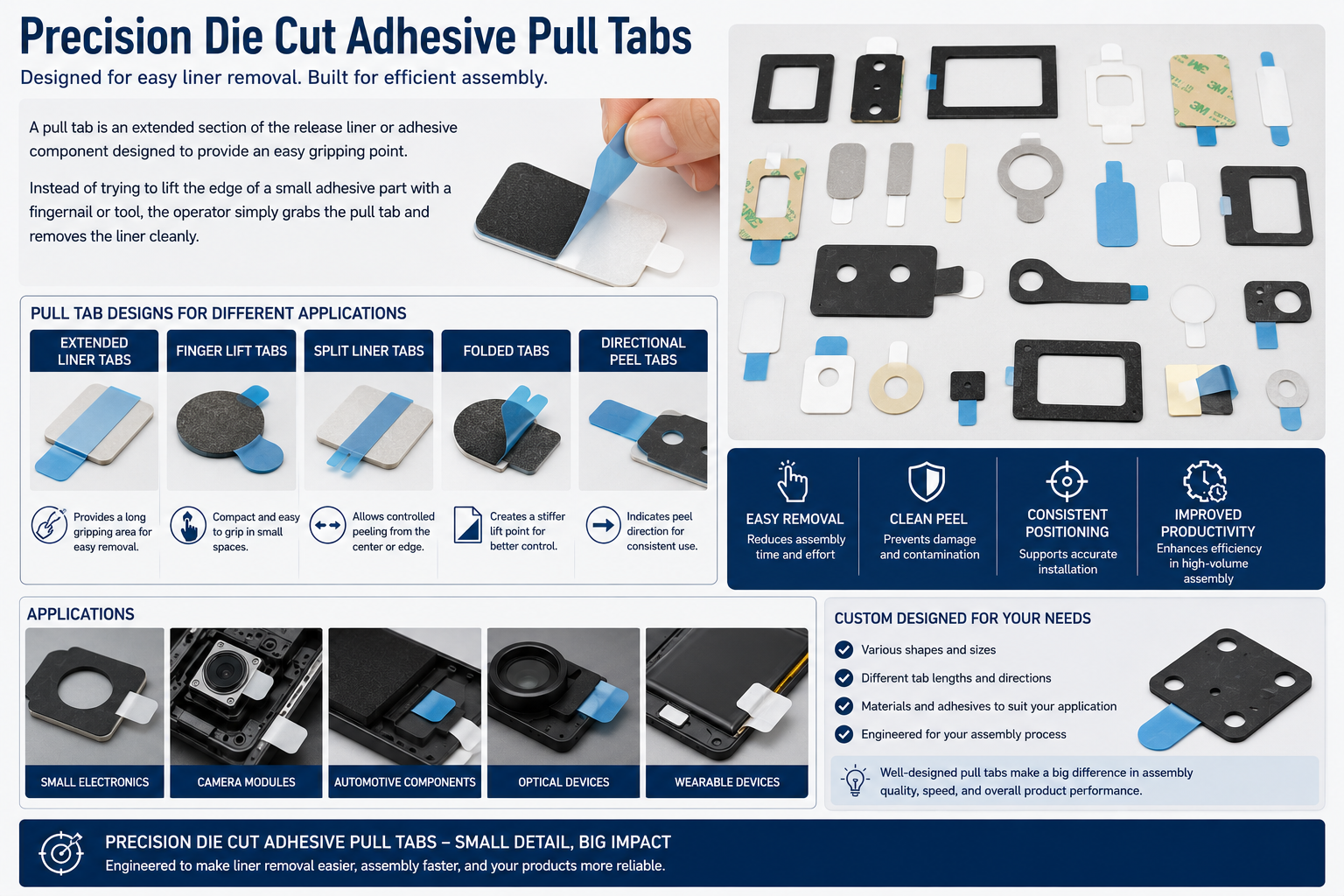
A pull tab is an extended section of the release liner or adhesive component designed to provide an easy gripping point.
Instead of trying to lift the edge of a small adhesive part with a fingernail or tool, the operator simply grabs the pull tab and removes the liner cleanly.
Pull tabs can be designed in various forms, including:
- Extended liner tabs
- Finger lift tabs
- Split liner tabs
- Folded tabs
- Directional peel tabs
Each design is optimized for different assembly methods and product sizes.
Theme: Precision Die Cut Adhesive Pull Tabs
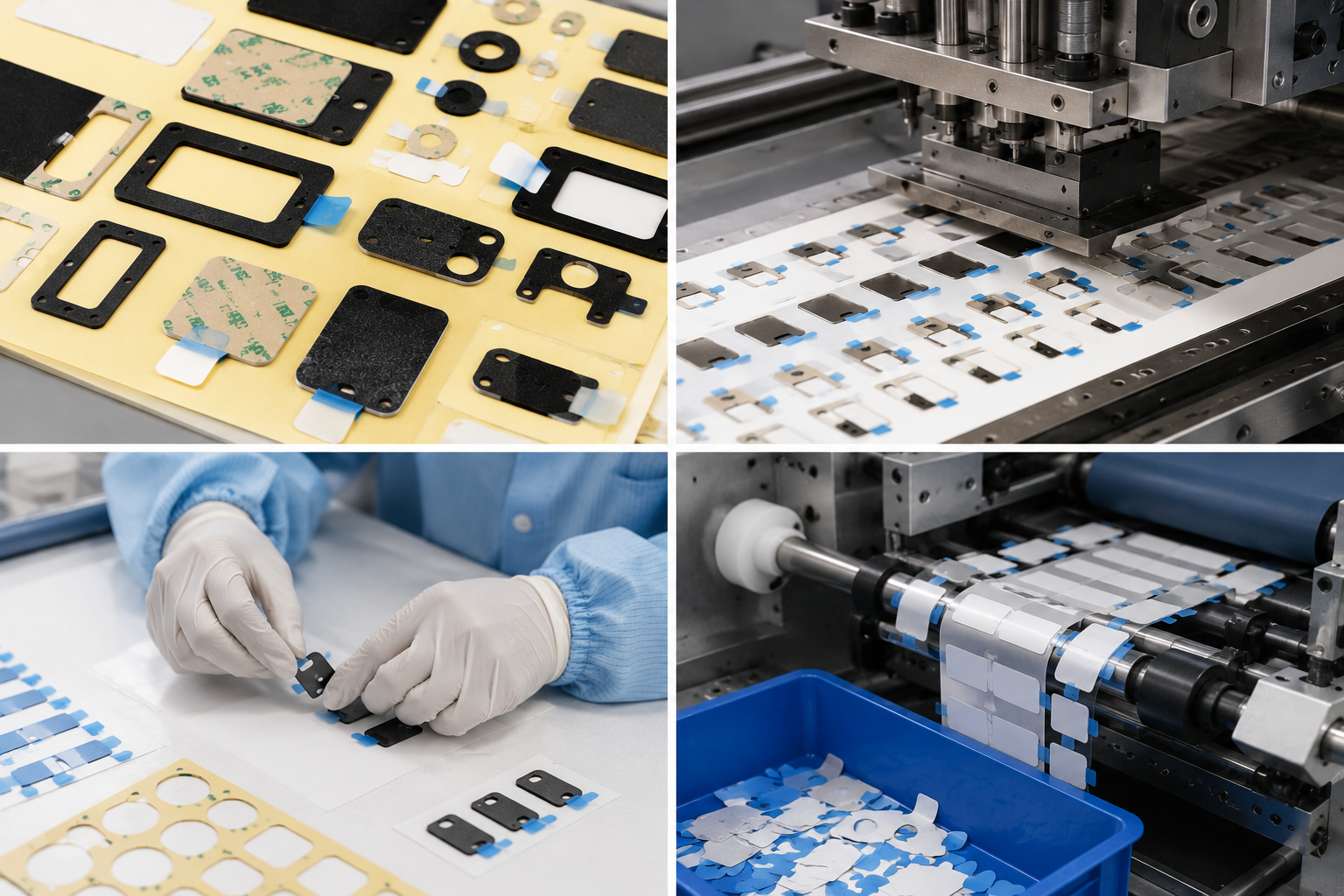
Why Small Adhesive Parts Are Difficult to Handle
As electronic products become smaller, adhesive components become increasingly challenging to install.
Common problems include:
- Liners difficult to remove
- Adhesive sticking to fingers
- Component deformation
- Incorrect positioning
- Longer assembly time
These issues become even more significant when operators repeat the process thousands of times each day.
Proper pull-tab design helps eliminate these inefficiencies.
Faster Liner Removal
One of the biggest advantages of pull tabs is reducing liner removal time.
Without a pull tab, operators often need to:
- Search for the liner edge
- Use fingernails or tweezers
- Bend the adhesive component
- Repeat failed attempts
With a pull tab, the release liner can be removed in one smooth motion.
Benefits include:
- Faster assembly
- Less operator fatigue
- Higher production efficiency
Even saving one or two seconds per product can generate significant labor savings in mass production.
Preventing Adhesive Contamination
Pressure-sensitive adhesives perform best when their surfaces remain clean.
Direct contact with fingers may introduce:
- Skin oils
- Dust
- Fibers
- Moisture
These contaminants can reduce adhesive performance.
Pull tabs allow operators to handle only the liner while leaving the adhesive untouched.
This improves:
- Bond strength
- Product reliability
- Cosmetic appearance
Theme: Easy Peel Adhesive Assembly
Improving Positioning Accuracy
Small adhesive parts often require extremely accurate placement.
Applications include:
- Camera modules
- Display assemblies
- Battery insulation
- Optical sensors
- Waterproof seals
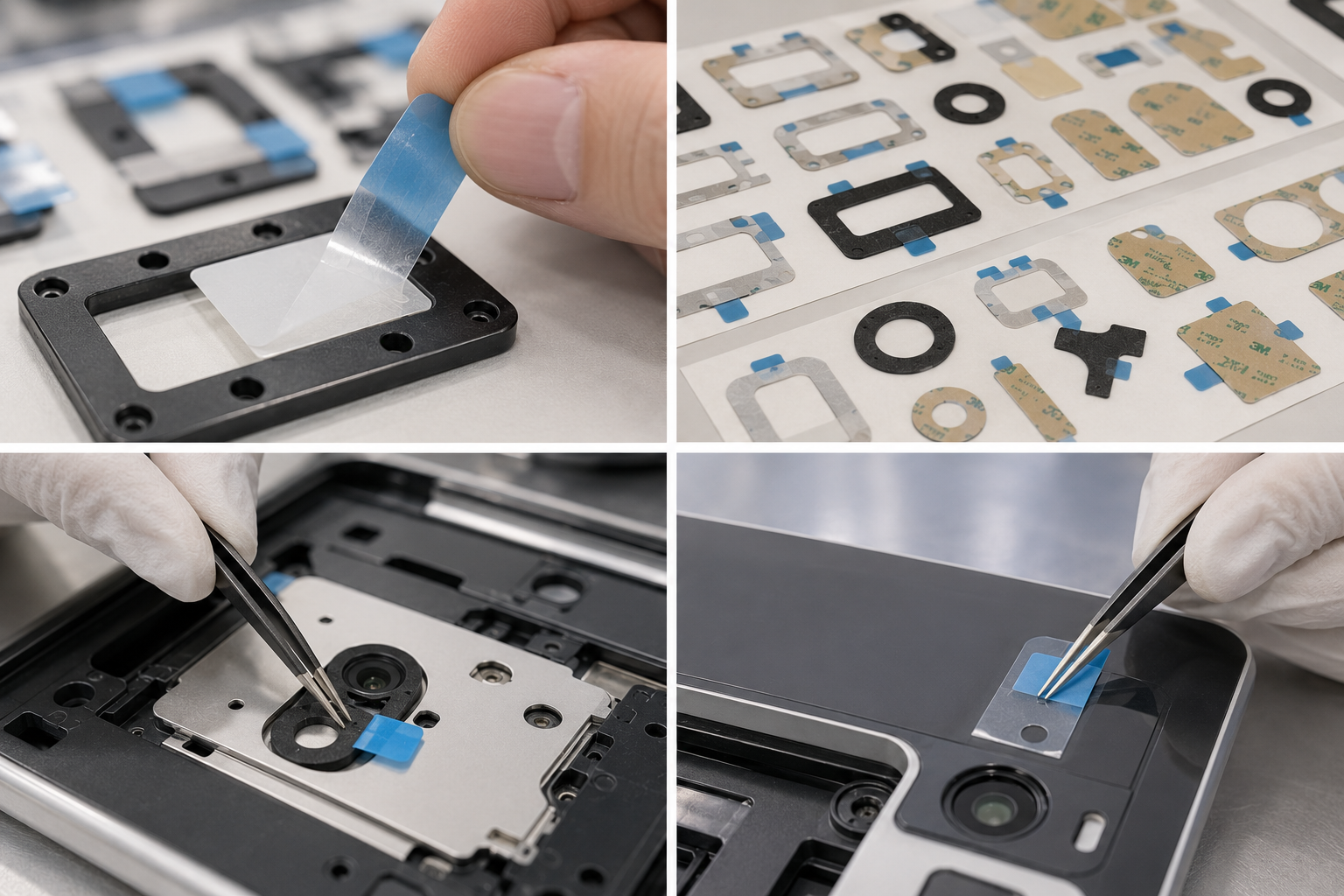
Pull tabs provide better control during installation.
Operators can:
- Hold the component securely
- Align the part accurately
- Apply the adhesive smoothly
- Reduce positioning errors
This is particularly important for components with tolerances below one millimeter.
Supporting Automated Assembly
Pull tabs are not only useful for manual assembly.
They can also improve automated manufacturing.
Properly designed pull tabs help automated equipment:
- Grip release liners
- Control peel direction
- Separate liners consistently
- Increase cycle speed
For robotic assembly systems, repeatable liner removal is essential.
Reducing Component Damage
Very small adhesive components can easily bend or wrinkle during installation.
Examples include:
- Thin PET films
- Foam gaskets
- Light-blocking materials
- Double-sided adhesive tapes
Pull tabs reduce unnecessary handling and help maintain component shape throughout installation.
This improves both appearance and functional performance.
Theme: Precision Adhesive Installation
Applications Across Industries
Consumer Electronics
Used for:
- Battery adhesives
- Display bonding
- Camera gaskets
- Speaker sealing
Wearable Devices
Applications include:
- Sensor positioning
- Waterproof sealing
- Foam cushioning
- Optical light blocking
Automotive Electronics
Used for:
- Display modules
- Camera systems
- Sensor assemblies
- Battery components
Medical Devices
Applications include:
- Disposable adhesive pads
- Diagnostic devices
- Monitoring equipment
Easy liner removal improves production efficiency while reducing contamination risks.
Common Pull Tab Designs
Different applications require different pull-tab structures.
Typical designs include:
Finger Lift Tabs
Suitable for manual assembly.
Split Liner Tabs
Allow sequential liner removal for accurate positioning.
Extended Liner Tabs
Provide a larger gripping area for small adhesive parts.
Folded Pull Tabs
Improve accessibility in confined assembly spaces.
Choosing the correct pull-tab design depends on product geometry, assembly sequence, and production volume.
Why Precision Die Cutting Matters
Pull tabs must be manufactured with high accuracy.
Poorly converted pull tabs may:
- Tear during peeling
- Release unevenly
- Cause liner separation issues
- Slow assembly
Precision die cutting ensures:
- Consistent pull-tab geometry
- Clean liner cuts
- Reliable peeling performance
- Stable mass production
Proper tooling design is essential for consistent results.
How Sanken Manufacturing Supports Adhesive Converting Projects
Dongguan Sanken Electronics Manufacturing Co., Ltd. specializes in precision die-cut adhesive components and custom converting solutions.
Our capabilities include:
- Precision die cutting
- Kiss cutting
- Adhesive laminating
- Pull-tab design optimization
- PET film converting
- Foam gasket manufacturing
- Cleanroom precision production
Key Advantages
- OEM and ODM customization
- ISO 9001 certified quality management
- RoHS and REACH compliant materials
- Domestic and overseas production bases
- Cleanroom manufacturing capabilities
- Tool development from drawings or samples
We support consumer electronics, wearable devices, automotive electronics, optical products, medical devices, and industrial assembly applications.
Featured Snippet Summary
Pull tabs make die-cut adhesive parts easier to apply by simplifying liner removal, preventing adhesive contamination, improving positioning accuracy, reducing assembly time, and supporting automated production. They are widely used in consumer electronics, automotive systems, wearable devices, and medical products.
Conclusion
Pull tabs may appear to be a small design feature, but they can significantly improve manufacturing efficiency and assembly quality. By simplifying liner removal and reducing handling errors, they help manufacturers increase production speed while maintaining consistent adhesive performance.
When combined with precision die-cutting technology, well-designed pull tabs provide a practical solution for faster, cleaner, and more reliable adhesive assembly across a wide range of OEM applications.??`