
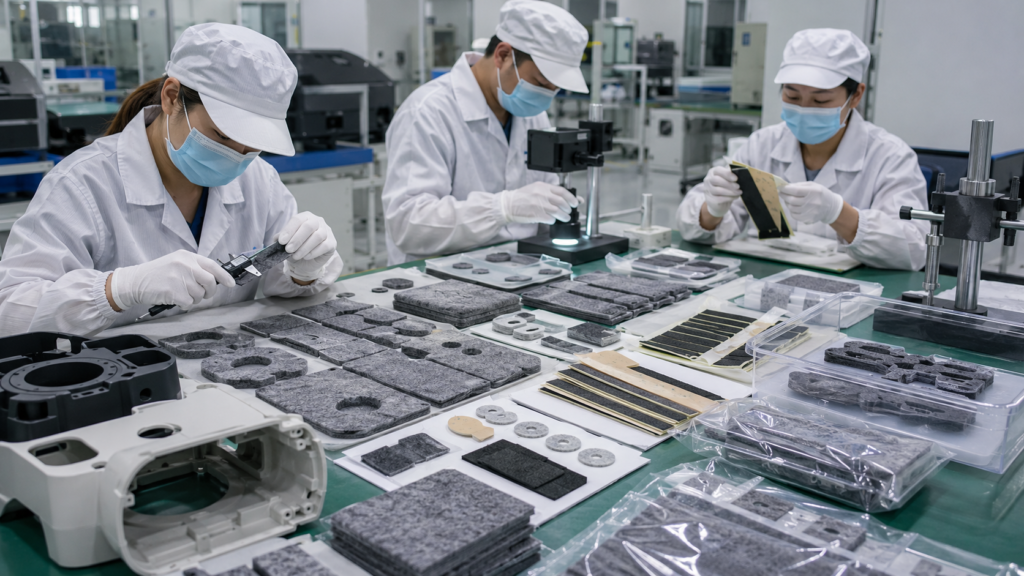
Non-woven materials play an important role in modern OEM manufacturing because they combine lightweight construction, flexibility, cushioning, sound absorption, surface protection, and easy converting. Unlike woven fabrics, non-woven materials are formed by bonding or mechanically interlocking fibers rather than weaving yarns into a traditional textile structure.
For manufacturers, this structure creates practical advantages. Non-woven materials can be converted into custom pads, strips, rings, frames, spacers, anti-rattle components, cushioning layers, and adhesive-backed parts. They are widely used in automotive assemblies, household appliances, electronics, industrial equipment, and other products where soft contact, noise reduction, surface protection, or component separation is required.
The value of a non-woven component depends on more than the base material. Fiber density, thickness, compression, surface condition, adhesive compatibility, dimensional tolerance, cutting quality, and packaging all influence how the finished part performs during assembly and long-term use.
Sanken converts non-woven felt and related flexible materials through precision die cutting services, lamination, adhesive backing, slitting, sheet converting, and assembly-ready packaging for OEM projects.
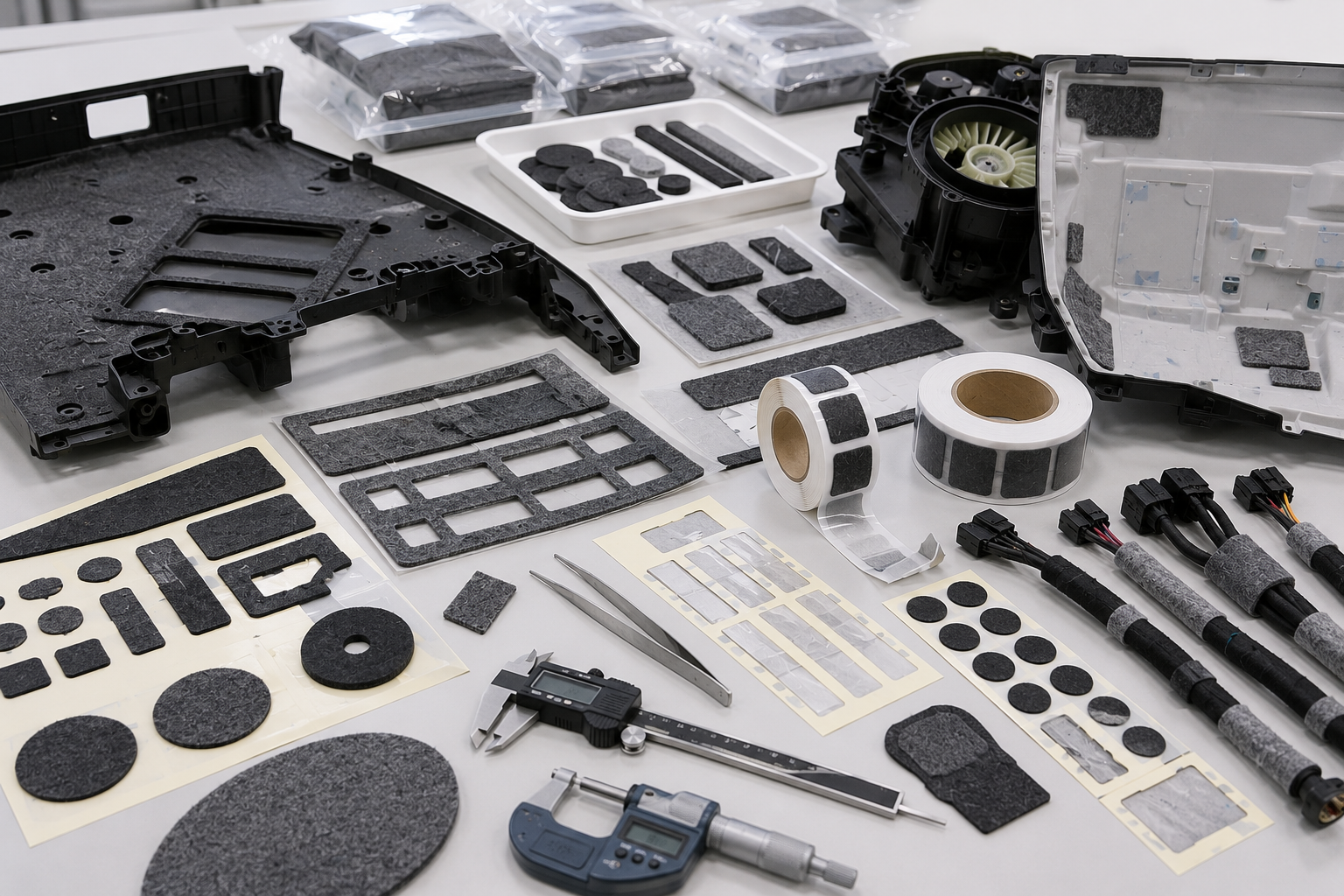
Non-Woven Materials Provide Multiple Functions in One Component
A well-selected non-woven part can perform several functions at the same time. It may reduce noise while preventing surface wear, or provide cushioning while keeping two components separated.
Common functions include:
- Sound absorption
- Anti-rattle protection
- Soft surface contact
- Vibration reduction
- Gap filling
- Cushioning
- Dust control
- Scratch prevention
- Component separation
- Assembly positioning
This multifunctional performance makes non-woven materials useful in assemblies where space and weight are limited.
| Function | How the Non-Woven Part Helps |
|---|---|
| Noise reduction | Absorbs or reduces airborne and contact-generated noise |
| Anti-rattle protection | Prevents hard plastic or metal surfaces from contacting directly |
| Cushioning | Creates a soft layer between assembled components |
| Surface protection | Reduces scratching and wear at contact points |
| Dust control | Supports filtration or dust-blocking areas where suitable |
| Positioning | Helps maintain spacing or contact between components |
OEM engineers can often replace several separate soft materials with one properly designed non-woven component, reducing part count and simplifying assembly.
Needle-Punched Felt Supports Automotive NVH Performance
Needle-punched non-woven felt is widely used in automotive Noise, Vibration, and Harshness applications. Its fibrous structure helps absorb sound and prevent squeaks or rattles between vehicle components.
Typical applications include:
- Door trim contact areas
- Instrument panel components
- Center console assemblies
- Pillar trim
- Trunk trim
- Interior plastic panels
- Wiring harness contact points
- HVAC housings
- Battery cover contact areas
- Under-seat assemblies
In many of these applications, the felt is not acting as a heavy sound barrier. Instead, it improves local contact conditions. A small felt strip between two plastic surfaces can prevent rubbing noise. A die cut felt pad beneath a wire harness can reduce movement and contact noise. A larger felt component can support acoustic absorption in a trim assembly.
For automotive programs, material thickness, density, wear resistance, fiber shedding, moisture exposure, flame requirements, and adhesive performance should be reviewed together. Sanken supports automotive die cut components such as adhesive-backed felt strips, foam pads, rubber cushioning parts, and insulation films for OEM assemblies.
Non-Woven Parts Improve Appliance Noise and Assembly Quality
Household appliances contain motors, fans, pumps, compressors, plastic housings, metal panels, cables, and electronic modules. These parts can generate vibration, movement, or contact noise during normal operation.
Die cut non-woven components may be used in:
- Refrigerators
- Washing machines
- Air conditioners
- Dishwashers
- Vacuum cleaners
- Water purifiers
- Small kitchen appliances
- Smart home equipment
Typical parts include felt strips between plastic housings, soft pads beneath wire harnesses, adhesive-backed anti-rattle components, and cushioning pieces around internal modules.
The material must be selected according to the actual location. A felt component near moving parts may need better wear resistance. A part inside a humid appliance may need suitable moisture stability. A component close to an electronic area should have controlled fiber shedding and clean cut edges.
Non-woven materials are often used together with foam gaskets and sealing components. Felt mainly supports noise reduction and soft contact, while foam may provide compression sealing, gap filling, or cushioning.
Adhesive-Backed Non-Woven Parts Simplify Installation
Many OEM applications require non-woven parts to remain in a precise position during assembly. Pressure-sensitive adhesive can be laminated to the felt so that operators can peel the part from a release liner and apply it directly to the housing or component.
Common adhesive-backed formats include:
- Felt strips
- Circular pads
- Rectangular cushions
- Anti-rattle patches
- Frame-shaped parts
- Cable protection pieces
- Small positioning components
- Liner-supported sheets
Adhesive backing can improve placement consistency and reduce the need for clips, manual glue, or additional fasteners. However, the adhesive must match the surface.
| Bonding Surface | Main Adhesive Consideration |
|---|---|
| ABS or PC plastic | Surface energy and long-term lifting risk |
| Painted metal | Coating compatibility and aging |
| Aluminum | Surface cleanliness and bonding strength |
| Textured plastic | Higher contact challenge |
| Foam or rubber | Material compatibility and movement |
| Fabric or felt | Adhesive penetration and edge stability |
The adhesive is often used for positioning rather than carrying a heavy structural load. The supplier should review surface material, temperature, pressure, assembly time, and expected service conditions before recommending the adhesive structure.
Precision Die Cutting Controls Shape and Edge Quality
Non-woven materials are flexible and fibrous, which makes them different from rigid films or plastics. Poor cutting can cause rough edges, fiber pullout, dimensional variation, or deformation.
Precision die cutting helps produce:
- Consistent outer profiles
- Accurate holes and slots
- Clean internal windows
- Stable strip widths
- Repeatable part spacing
- Adhesive-backed liner sheets
- Custom roll or sheet formats
Several factors influence cutting quality:
- Material thickness
- Fiber density
- Felt hardness
- Adhesive backing
- Tool sharpness
- Cutting pressure
- Part geometry
- Waste removal method
Narrow strips and small holes can be more difficult to produce than simple pads. Sharp internal corners may weaken the felt or create fiber pullout. Engineers can often improve manufacturability by using practical corner radii and avoiding unnecessarily narrow walls.
Sanken can supply die cut parts in sheets, rolls, or individual formats according to the customer’s handling and assembly process.
Material Selection Depends on the Application
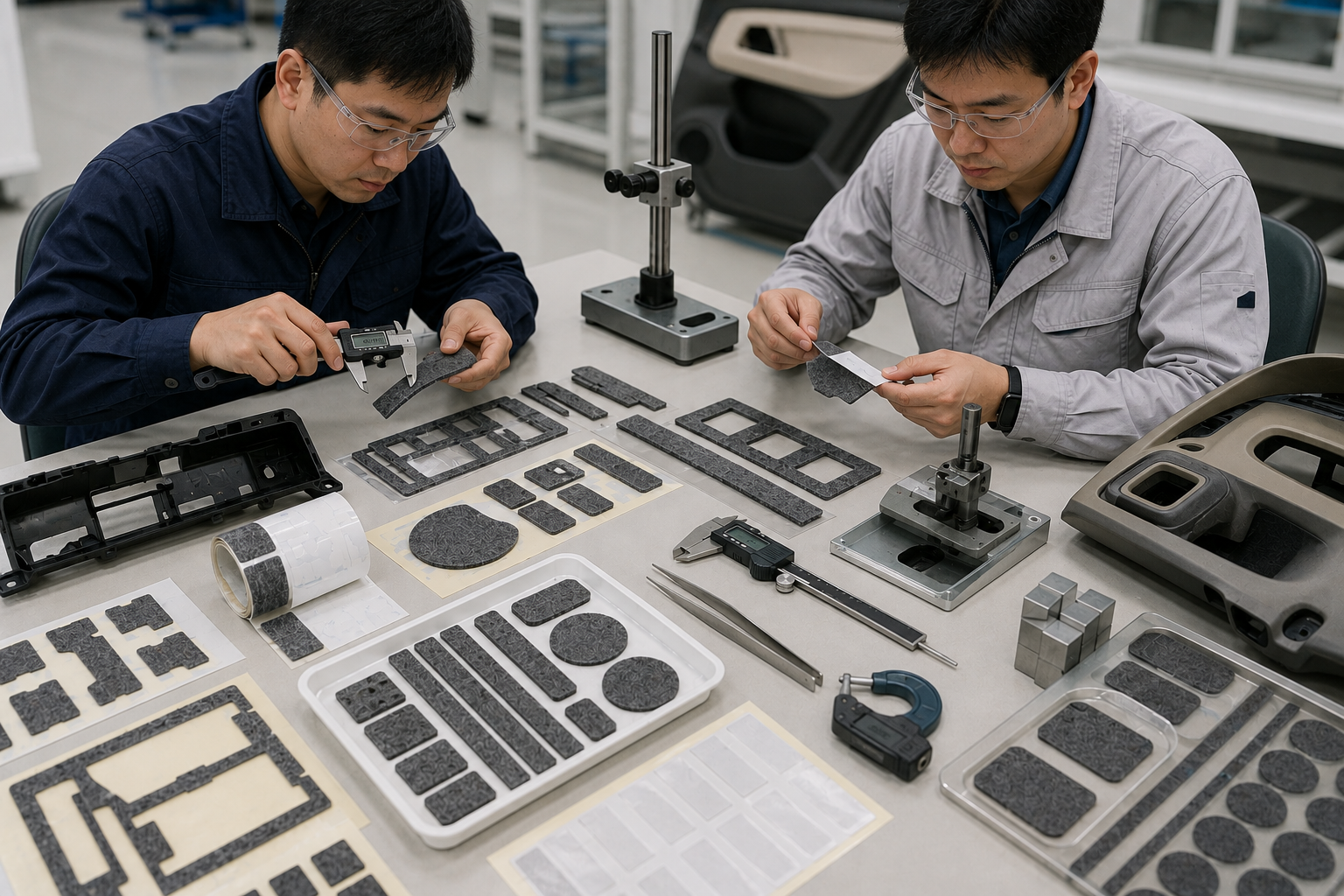
There is no single non-woven material that fits every OEM application. The correct choice depends on function, installation location, environment, and assembly requirements.
| Selection Factor | Why It Matters |
|---|---|
| Thickness | Affects spacing, cushioning, and contact pressure |
| Density | Influences stiffness, sound absorption, and durability |
| Fiber structure | Affects softness, wear, and shedding |
| Compression behavior | Determines how the material reacts under load |
| Moisture resistance | Important in automotive and appliance environments |
| Temperature exposure | Influences long-term stability |
| Flame requirement | May be specified by the OEM application |
| Adhesive compatibility | Affects placement and long-term bonding |
| Surface appearance | Important for visible or semi-visible areas |
| Edge cleanliness | Reduces loose fibers during assembly |
A thicker or denser material is not automatically better. A dense felt may provide stronger support but may not absorb the same sound frequencies as a softer structure. A very soft felt may provide good contact protection but compress too easily in a tightly controlled assembly.
The material should be tested in the actual installation position whenever possible.
Non-Woven, Foam, and Rubber Serve Different Purposes
Non-woven felt, foam, and rubber are sometimes considered interchangeable, but they perform differently.
| Material | Main Strength | Typical Use |
|---|---|---|
| Non-woven felt | Sound absorption and anti-rattle contact | Interior panels, wire harnesses, soft contact points |
| Foam | Compression, cushioning, and gap filling | Gaskets, spacers, housing support |
| Rubber | Durability, rebound, and damping | Vibration pads, seals, high-wear contact areas |
| Adhesive tape | Bonding and positioning | Mounting and assembly support |
Non-woven materials are usually preferred when soft contact, low weight, acoustic absorption, or anti-rattle performance is required. Foam is more suitable when the part must compress and fill a gap. Rubber is used when stronger durability, rebound, or environmental resistance is needed.
Some OEM parts combine these materials. A felt layer may be laminated with adhesive for positioning. A felt-and-foam structure may provide both acoustic absorption and cushioning. These multilayer parts can reduce assembly steps but require accurate lamination and layer registration.
Clean Handling and Packaging Protect Finished Parts
Non-woven materials can attract dust or release fibers if they are handled poorly. This is particularly important near displays, sensors, connectors, electronic modules, or visible surfaces.
Production and packaging controls may include:
- Clean material storage
- Controlled cutting tools
- Stable waste removal
- Surface inspection
- Fiber shedding checks
- Clean trays or bags
- Layer separation
- Flat packaging
- Batch identification
- Assembly-ready part orientation
Adhesive-backed felt parts also require liner protection. If the liner shifts, bends, or releases too easily, the parts may become contaminated or move during shipment.
Packaging should match the part geometry. Large soft parts may need flat support, while small adhesive components can be supplied on organized liner sheets for easier peeling and application.
Quality Control Supports Stable OEM Production
Dimensional inspection alone is not enough for die cut non-woven parts. OEM buyers should also evaluate material condition and real assembly performance.
Important inspection items include:
- Material type and thickness
- Outer dimensions
- Hole and slot positions
- Edge cleanliness
- Fiber shedding
- Surface defects
- Adhesive position
- Liner release
- Part flatness
- Compression behavior
- Packaging condition
- Assembly fit
For adhesive-backed components, peel trials should be completed using the actual customer surface. For anti-rattle parts, fit and compression should be reviewed in the final assembly. For acoustic components, the OEM may also evaluate performance at the system level.
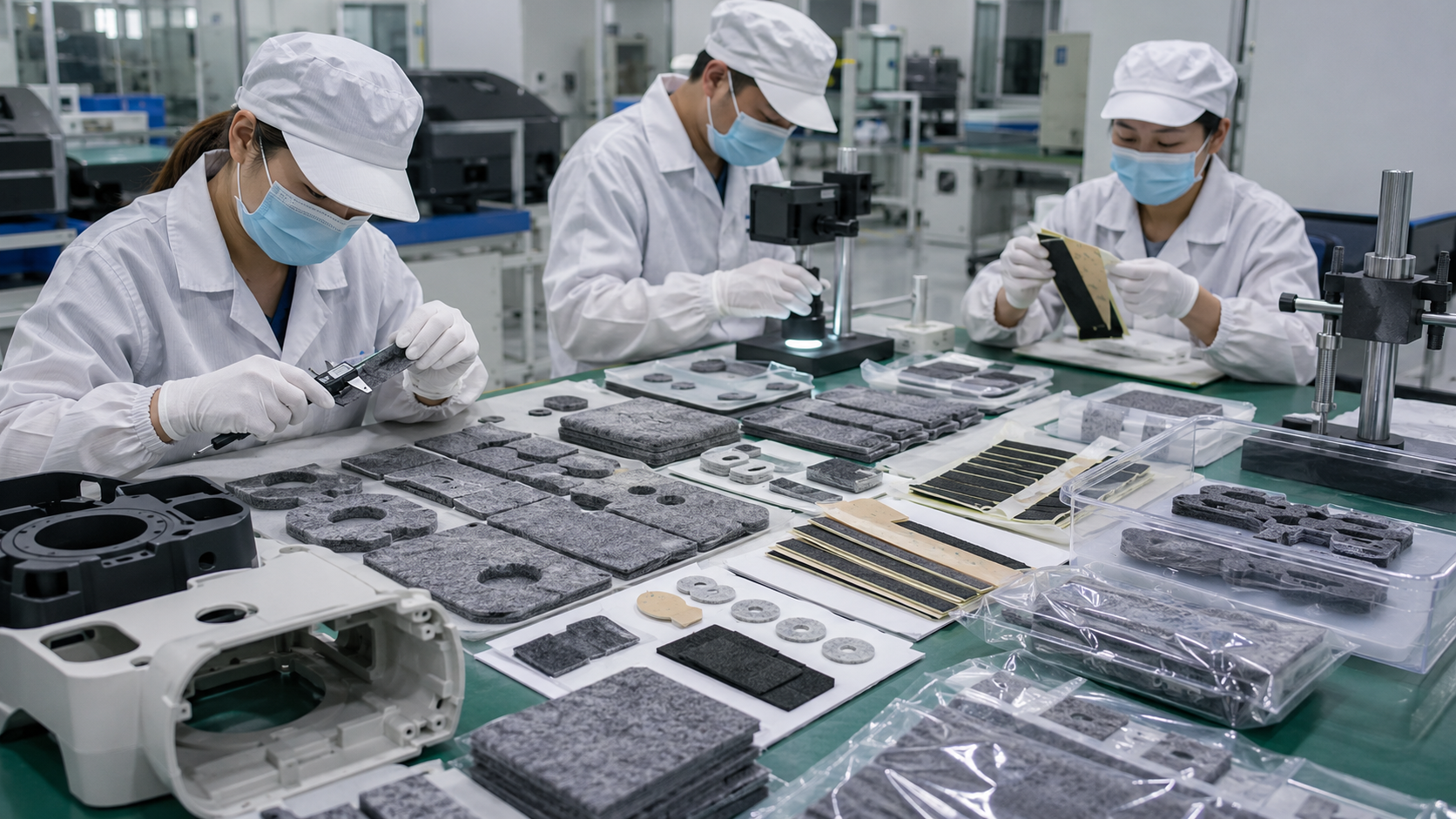
How Sanken Supports Non-Woven OEM Projects
Sanken supports non-woven material projects from drawing review and sample development through stable production.
Relevant capabilities include:
- Needle-punched non-woven felt converting
- Precision die cutting
- Adhesive lamination
- Kiss cutting
- Through cutting
- Slitting
- Sheet-form components
- Liner-supported adhesive parts
- Multilayer lamination
- Sample development
- Dimensional inspection
- Assembly-ready packaging
For each project, we review the part function, felt thickness, density, adhesive structure, tolerance, edge quality, fiber shedding risk, packaging, and assembly method.
The goal is to provide components that fit accurately, install easily, and perform consistently in the customer’s production environment.
You May Also Be Interested In
- How to Choose Non-Woven Fabric for Precision Die Cutting Applications
- Can Non-Woven Fabric Be Die Cut? Materials, Tolerances and Design Considerations
- Non-Woven vs Foam Materials: Which Is Better for Industrial Gaskets?
- Why OEM Manufacturers Rely on Die Cutting Every Day
- How Die Cutting Transforms Raw Materials Into Precision Components
Conclusion
Non-woven materials are important in modern OEM manufacturing because they provide noise reduction, anti-rattle protection, cushioning, surface protection, dust control, and assembly support without adding excessive weight or complexity.
Their performance depends on selecting the right fiber structure, thickness, density, adhesive, geometry, cutting process, and packaging format. Precision die cutting converts flexible non-woven material into consistent, assembly-ready parts that can be integrated into automotive, appliance, electronics, and industrial products.
Sanken helps OEM customers develop custom die cut non-woven felt components, adhesive-backed parts, and multilayer structures from sampling through mass production.