

Non-Woven vs Foam Materials: Which Is Better for Industrial Gaskets?
Industrial gaskets may look simple, but they often decide whether an assembly stays sealed, quiet, protected, and easy to build. A poor material choice can create air gaps, dust leakage, vibration noise, adhesive failure, compression collapse, slow installation, and expensive rework.
Non-woven and foam materials are both used for industrial gaskets, but they solve different problems.
Non-woven materials are usually better for filtration, breathability, dust protection, acoustic absorption, and lightweight separation. Foam materials are usually better for cushioning, gap filling, compression sealing, vibration reduction, and impact protection.
For OEM buyers, the real question is not only “Which material is better?” The better question is: “Which gasket material can solve my application problem with stable die-cut quality and low production risk?”
At Sanken Manufacturing, we help customers select, laminate, die cut, and convert non-woven fabrics, EVA foam, PE foam, PU foam, EPDM foam, rubber foam, adhesive tapes, films, and composite materials into custom gasket components for automotive, electronics, medical, packaging, and industrial applications.
What Are Industrial Gaskets Used For?
Industrial gaskets are placed between two surfaces to improve sealing, cushioning, insulation, vibration control, dust protection, or assembly fit.
They are used in many products, including:
- Automotive interior assemblies
- Electronic housings
- Battery systems
- HVAC equipment
- Medical devices
- Industrial machinery
- Control panels
- Packaging equipment
- Appliances
- Mechanical enclosures
A gasket may need to block dust, absorb vibration, fill an uneven gap, reduce rattling, protect a surface, or support a clean assembly process.
That is why gasket material selection should begin with function, not material name.
What Is Non-Woven Material?
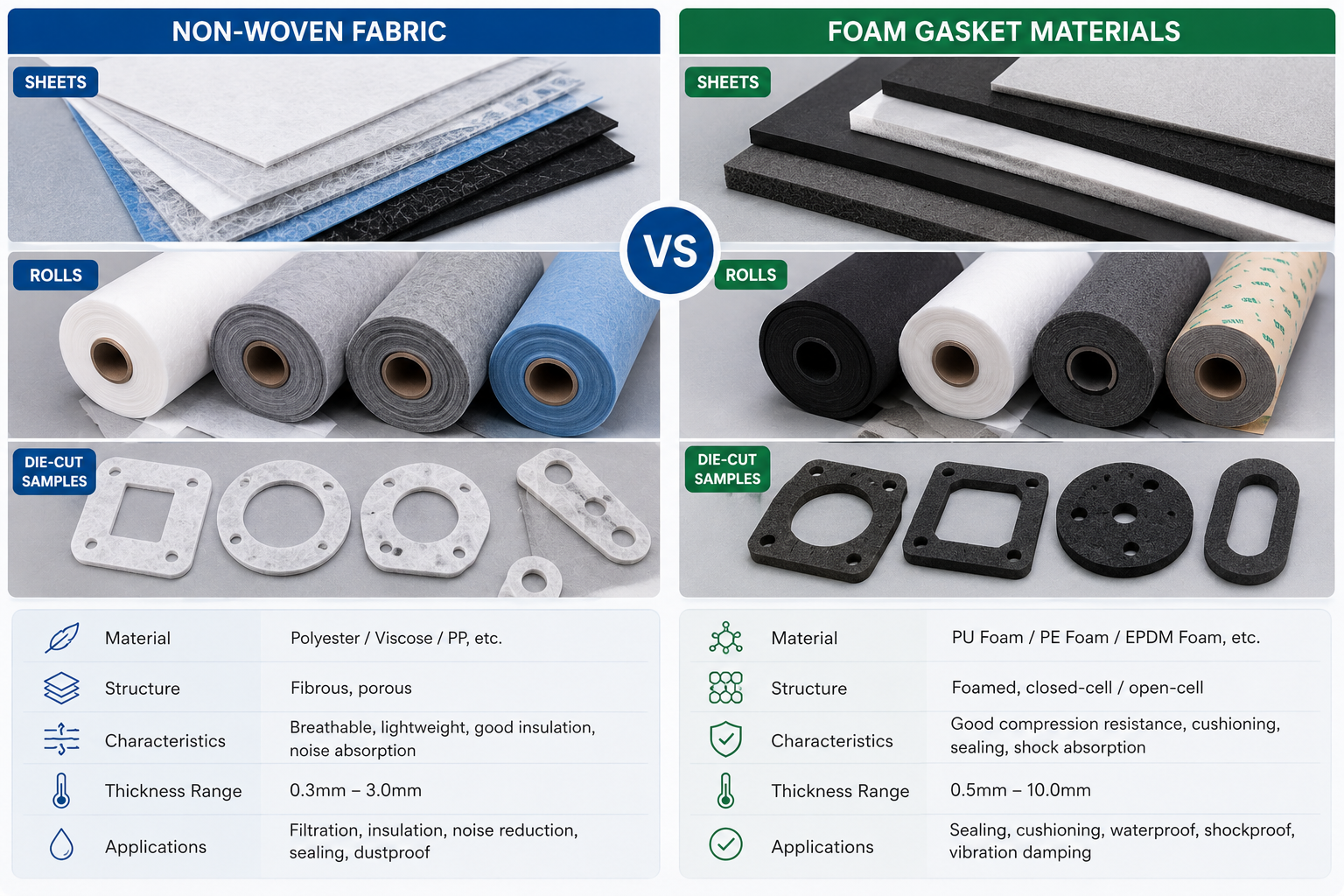
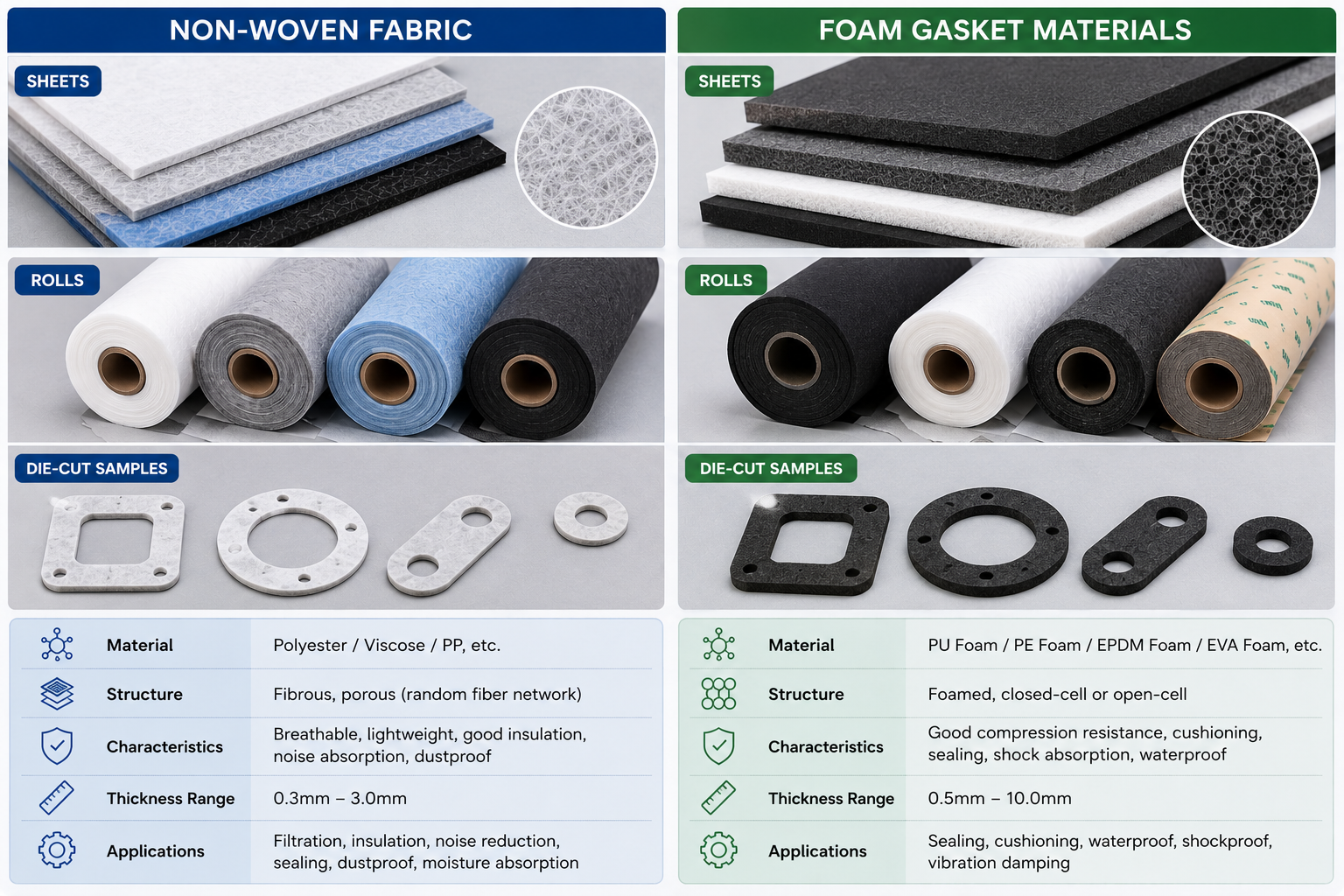
Non-woven material is made by bonding fibers together without weaving or knitting. The fiber structure gives non-woven materials useful properties such as breathability, filtration, sound absorption, softness, and lightweight protection.
Common non-woven materials include:
| Non-Woven Type | Main Strength | Common Gasket Use |
|---|---|---|
| PET non-woven | Durable and dimensionally stable | Automotive and industrial pads |
| PP non-woven | Lightweight and cost-effective | Dust barriers and protection layers |
| Needle-punched felt | Thick and sound absorbing | Acoustic and insulation gaskets |
| Meltblown non-woven | Fine fiber structure | Filtration and airflow control |
| Laminated non-woven | Multi-function performance | Adhesive-backed functional parts |
Non-woven gaskets are often chosen when the part needs airflow, filtration, soft contact, acoustic absorption, or dust protection.
What Is Foam Material?
Foam is a cellular material with many small air pockets inside its structure. This makes foam lightweight, compressible, and effective for cushioning.
Common foam materials include:
| Foam Type | Main Strength | Common Gasket Use |
|---|---|---|
| EVA foam | Flexible and easy to die cut | Pads, spacers, light seals |
| PE foam | Lightweight and moisture resistant | Protective gaskets and packaging |
| PU foam | Soft and compressible | Acoustic and cushioning layers |
| EPDM foam | Weather resistant | Automotive and outdoor gaskets |
| Rubber foam | Elastic and durable | Sealing and vibration support |
Foam gaskets are often selected when the part must compress, fill gaps, reduce vibration, absorb impact, or support light sealing.
Non-Woven vs Foam: The Core Difference
The main difference is structure.
Non-woven material is fiber-based. Foam material is cell-based.
This difference changes how each material performs.
| Requirement | Non-Woven Material | Foam Material |
|---|---|---|
| Dust protection | Strong | Good, depending on structure |
| Filtration | Strong | Limited |
| Breathability | Strong | Lower |
| Sound absorption | Strong in thick fiber structures | Good in selected foam types |
| Cushioning | Moderate | Strong |
| Gap filling | Moderate | Strong |
| Compression sealing | Limited to moderate | Stronger |
| Vibration reduction | Moderate | Strong |
| Fiber shedding risk | Possible | Lower |
| Adhesive backing | Possible | Common |
| Precision die cutting | Possible | Common |
Neither material is always better. The best choice depends on the working environment, gasket function, compression load, assembly method, and long-term reliability requirements.
When Is Non-Woven Better for Industrial Gaskets?
Non-woven material is often better when the gasket needs to control airflow, filter particles, reduce sound, or protect surfaces without creating a strong compression seal.
Dust Protection and Filtration
Non-woven material can block particles while still allowing air to pass through.
This makes it useful for:
- Electronics vents
- Speaker covers
- Airflow channels
- HVAC filters
- Battery protection areas
- Industrial control panels
If the gasket must protect against dust but should not fully block airflow, non-woven material may be the better option.
Acoustic Absorption
Thicker needle-punched non-woven felt can absorb sound and reduce noise inside assemblies.
This is useful in:
- Automotive interiors
- Appliance panels
- HVAC units
- Machinery covers
- Electronic housings
Foam can also reduce sound, but non-woven fiber structures are often effective for absorbing airborne noise.
Lightweight Separation
Non-woven gaskets can provide soft separation between surfaces without adding much weight or thickness.
They are useful when the application needs:
- Surface protection
- Light insulation
- Soft contact
- Breathable barrier function
- Low-profile spacing
For applications where strong sealing force is not required, non-woven can offer practical performance at controlled cost.
When Is Foam Better for Industrial Gaskets?
Foam is often better when the gasket must compress, recover, fill space, reduce vibration, or absorb shock.
Gap Filling
Industrial assemblies often have uneven surfaces or tolerance variation.
Foam can compress and fill those gaps.
This helps reduce:
- Air gaps
- Loose contact
- Panel movement
- Rattling
- Surface impact
- Assembly instability
For this reason, foam gaskets are widely used in automotive, electronics, and industrial equipment.
Cushioning and Impact Protection
Foam absorbs shock better than most non-woven materials.
It is suitable for:
- Protective pads
- Battery cushioning
- Equipment liners
- Electronics spacers
- Packaging gaskets
- Mechanical support pads
If the gasket needs to protect a component from pressure, impact, or movement, foam is often the stronger choice.
Vibration and Noise Reduction
Foam can reduce contact noise between hard surfaces.
It helps control:
- Rattling
- Squeaking
- Buzzing
- Light vibration
- Panel contact noise
This is especially important in automotive interiors and electric vehicle assemblies, where small noises are easier for users to notice.
Light Sealing
Closed-cell foam can support light sealing against dust, air, and limited moisture.
For stronger sealing, EPDM foam, rubber foam, or solid rubber may be required.
When a Composite Gasket Is the Better Answer
Some applications cannot be solved by one material alone.
A customer may need dust protection and cushioning.
Another project may need acoustic absorption and adhesive installation.
A battery assembly may need insulation, compression control, and clean die-cut edges.
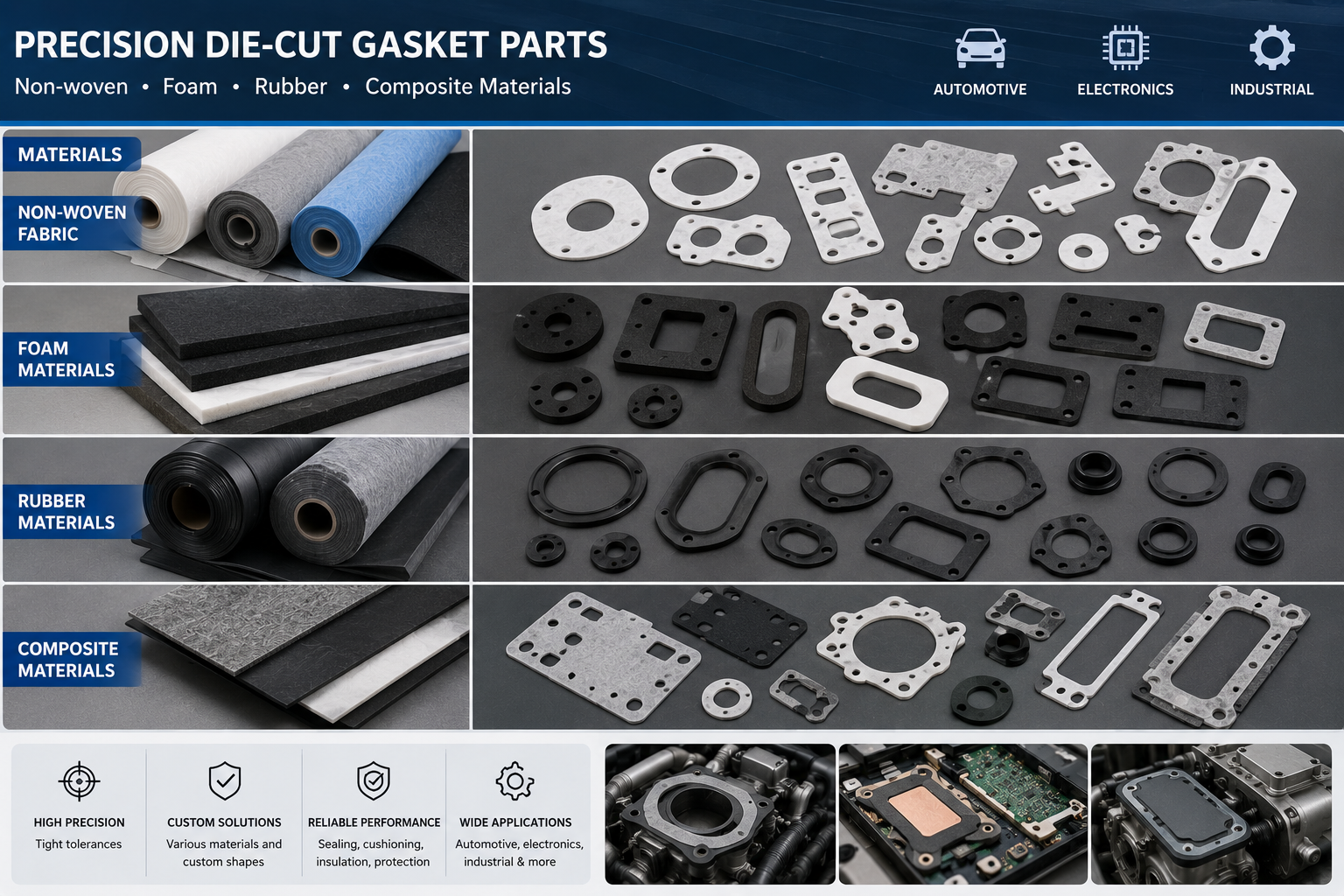
In these cases, a composite gasket may perform better.
Common structures include:
| Composite Structure | Purpose |
|---|---|
| Non-woven + adhesive | Easy installation and dust protection |
| Foam + adhesive | Cushioning and fast assembly |
| Non-woven + foam | Acoustic absorption and cushioning |
| Foam + film | Surface protection and dimensional stability |
| Foam + rubber | Better sealing and vibration control |
| Non-woven + film + adhesive | Barrier function and assembly efficiency |
At Sanken Manufacturing, we often help customers design laminated gasket structures when one material alone cannot meet the full requirement.
Key Design Considerations for Industrial Gaskets
Compression Requirement
The first question is simple: does the gasket need to compress and recover?
If yes, foam is usually stronger.
If the gasket only needs soft contact, dust protection, or acoustic function, non-woven may be enough.
Sealing Target
Different sealing problems need different materials.
A gasket may need to block:
- Dust
- Air
- Water
- Oil
- Noise
- Light
- Heat
- Vibration
Foam can support light sealing. Rubber or EPDM foam may be better for demanding sealing. Non-woven is better when airflow must remain open.
Thickness and Space
Assembly space affects material choice.
Foam may need enough thickness to compress properly. Non-woven may work better in thin, low-profile designs.
Adhesive Backing
Many industrial gaskets need adhesive backing for easy installation.
But adhesive selection is critical.
Poor adhesive matching may cause:
- Edge lifting
- Peeling
- Delamination
- Liner separation
- Poor positioning
- Assembly failure
The complete structure should be reviewed: gasket material, adhesive, release liner, bonding surface, temperature, and compression load.
Die-Cutting Tolerance
Both non-woven and foam can be die cut, but they behave differently.
Non-woven may stretch, fray, or shed fibers. Foam may compress during cutting and rebound after processing.
Tolerance depends on:
- Material type
- Thickness
- Density
- Part size
- Hole design
- Adhesive backing
- Cutting method
- Tooling design
A good supplier should review the drawing and explain what tolerance is practical before production.
Common Buyer Mistakes
Choosing Only by Unit Price
A low-cost gasket material can become expensive if it causes scrap, rework, leakage, poor assembly, or customer complaints.
Ignoring Compression Set
Some foam gaskets may flatten over time if the density or formulation is wrong.
Using Non-Woven for Strong Sealing
Non-woven materials are useful for dust, filtration, and acoustic functions, but they may not provide enough sealing force for demanding applications.
Ignoring Fiber Shedding
Some non-woven materials release fibers during cutting. This can be a problem in electronics, medical, and clean assembly environments.
Selecting Adhesive Too Late
Adhesive should be considered early. Even the right gasket material can fail if the adhesive does not match the surface or environment.
How to Choose Between Non-Woven and Foam
Use non-woven material when the gasket needs:
- Dust protection
- Breathability
- Filtration
- Acoustic absorption
- Lightweight separation
- Soft surface contact
- Low-profile material structure
Use foam material when the gasket needs:
- Cushioning
- Gap filling
- Compression sealing
- Vibration reduction
- Impact protection
- Anti-rattle function
- Adhesive-backed assembly support
Use a composite structure when the gasket needs multiple functions at the same time.
What Buyers Should Confirm Before Ordering
Before choosing a gasket material, buyers should confirm:
- What is the gasket’s main function?
- Does it need sealing, cushioning, filtration, or acoustic control?
- Will it face long-term compression?
- What thickness and density are required?
- Does it need adhesive backing?
- What surface will it bond to?
- Will it face heat, humidity, oil, dust, or vibration?
- What tolerance is required?
- Will the part be applied manually or automatically?
- Is the project for prototype testing or mass production?
These questions help prevent wrong material selection and reduce production risk.
How Sanken Helps Customers With Industrial Gasket Materials
At Sanken Manufacturing, we help customers move from material selection to finished gasket production.
Our capabilities include:
- Precision die cutting
- Non-woven fabric converting
- Foam converting
- Rubber processing
- Adhesive lamination
- Film lamination
- Kiss cutting
- Hot pressing
- Slitting
- Custom assembly
- Prototype and mass production support
We help customers evaluate material behavior, adhesive performance, die-cut tolerance, edge quality, and assembly needs.
Our goal is not simply to cut a gasket shape. Our goal is to help customers receive stable, ready-to-assemble gasket components that solve real manufacturing problems.
Conclusion
Non-woven and foam materials can both be used for industrial gaskets, but they solve different problems. Non-woven is often better for dust protection, filtration, breathability, acoustic absorption, and lightweight separation. Foam is usually better for cushioning, gap filling, compression sealing, vibration reduction, and impact protection.
For many OEM projects, the best gasket is not a single material but a converted structure that combines foam, non-woven, adhesive, film, or rubber. At Sanken Manufacturing, we help customers select, laminate, die cut, and convert gasket materials into reliable components for automotive, electronics, medical, packaging, and industrial applications.