
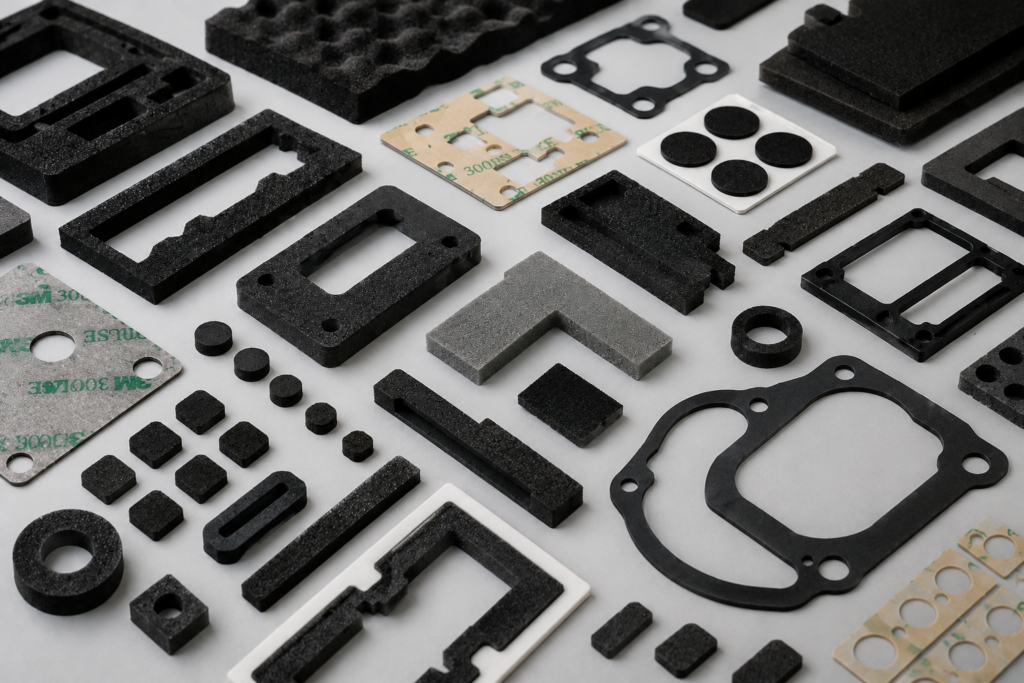
Die cutting transforms raw materials into precision OEM components by converting foam, rubber, PET film, adhesive tape, non-woven felt, silicone foam and laminated materials into custom parts for sealing, bonding, insulation, cushioning, protection and assembly support.
For OEM buyers and engineers, the value is not only cutting a shape. The real value is turning a flexible material into a repeatable production-ready component with stable tolerance, clean edges, reliable adhesive performance, correct compression and suitable delivery format.
For OEM projects, precision die cutting services help convert flexible raw materials into stable components for automotive, electronics, appliance and industrial applications.
Why This Topic Matters for OEM Manufacturing
OEM products rely on many small hidden components.
A foam gasket inside an automotive electronic housing may help control dust, moisture, vibration and noise. A PET insulation film inside an electronic device may prevent short circuits. A double-sided adhesive part may support fast assembly. A non-woven felt pad may reduce rattling in an automotive interior.
These parts are usually not visible to the end user, but they affect reliability.
If the raw material is not converted correctly, the final part may fail during assembly or after use. Common results include poor sealing, weak bonding, hole misalignment, adhesive overflow, rough edges, material deformation, or unstable batch quality.
That is why die cutting is important for OEM manufacturing. It helps convert raw material into a repeatable precision component that matches the final product structure.
From Raw Material to Functional Component
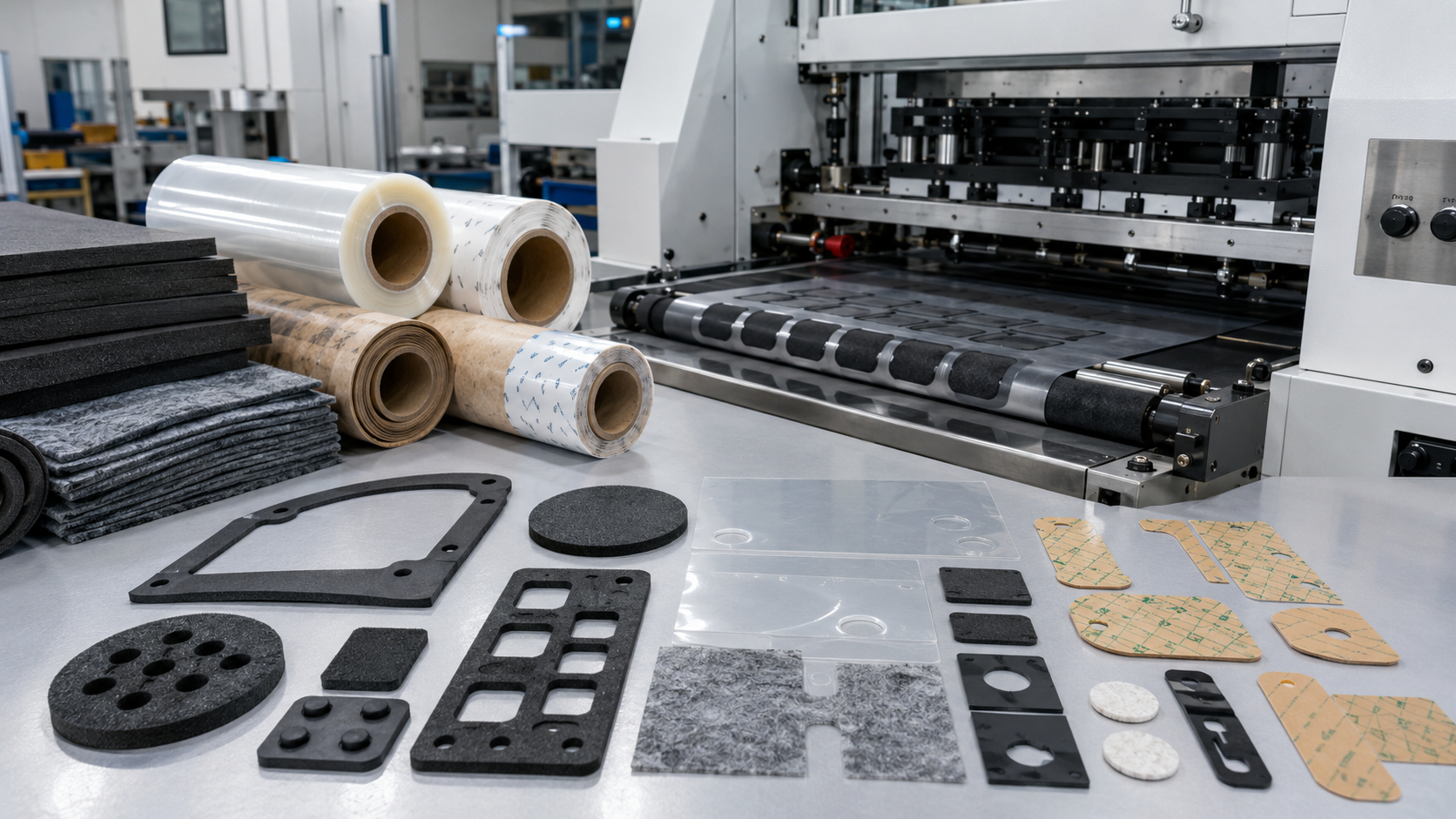
Die cutting usually starts with a flexible raw material.
This material may arrive as a roll, sheet, block, film, laminate, or foam sheet. Before cutting begins, the supplier must understand the material behavior and the final application.
A good die cutting process should answer several questions:
- What function must the component perform?
- Which material is suitable for that function?
- What thickness and tolerance are required?
- Does the part need adhesive backing?
- Are there holes, narrow walls, or complex cutouts?
- How will the part be assembled?
- Will it be supplied in rolls, sheets, individual pieces, or kits?
Without these answers, the supplier may cut the correct shape but fail to produce reliable custom die cut parts for the real assembly.
For example, a foam gasket may have the correct outer size, but if the compression is wrong, it will not seal. A PET film may have the correct profile, but if the hole position is unstable, it may not fit the electronic housing. An adhesive tape part may look clean, but if the liner release is poor, assembly will slow down.
Common Materials Used in Precision Die Cutting
Different raw materials require different die cutting strategies.
| Raw Material | Common Die Cut Component | Key Engineering Concern |
|---|---|---|
| PU, EVA and PE foam | Sealing gaskets, cushioning pads, spacers | Compression, rebound and tearing risk |
| EPDM or CR foam | Automotive and industrial seals | Weather resistance and sealing wall stability |
| Rubber | Pads, seals and anti-slip parts | Rebound, thickness and edge quality |
| PET film | Insulation films and protective layers | Dimensional stability and clean holes |
| PI film | Heat-resistant insulation parts | Temperature resistance and precision |
| Adhesive tape | Bonding parts and mounting pads | Adhesive overflow and liner release |
| Non-woven felt | NVH pads, acoustic parts and anti-rattle parts | Fiber control and thickness variation |
| Silicone foam | Heat-resistant gaskets and pads | Elastic recovery and handling |
Material selection affects every part of the process.
A soft foam may need lower cutting pressure and better support. A thin PET film may need tension control to avoid curling. A strong adhesive may need careful kiss cutting to prevent liner damage. Non-woven felt may need clean cutting to reduce fiber pulling.
At Sanken, we review material behavior before production because many die cutting problems begin before the blade touches the material.
Common Problems and Production Risks
Raw material conversion looks simple from the outside, but many risks appear during sampling and mass production.
| Problem | Common Cause | OEM Risk |
|---|---|---|
| Material deformation | Wrong cutting pressure or weak material support | Poor assembly fit |
| Rough or torn edges | Unsuitable tooling or dull blade | Weak sealing or particles |
| Hole position deviation | Poor tolerance control | Assembly mismatch |
| Adhesive overflow | Excessive pressure or soft adhesive | Contamination and rejected parts |
| Liner damage | Incorrect kiss cutting depth | Peeling difficulty |
| Foam compression loss | Wrong density or thickness | Long-term sealing failure |
| Film curling | Poor tension control | Difficult handling |
| Waste removal failure | Complex shape or narrow features | Low yield and higher cost |
These risks show why die cutting is not only a production step. It is a quality and design control process.
The goal is not only to make one sample. The goal is to make repeatable parts that work in the customer’s assembly line.
What Buyers or Engineers Should Check First
Before starting a die cutting project, engineers should define the functional requirements clearly.
| Checklist Item | What to Confirm | Why It Matters |
|---|---|---|
| Part function | Sealing, bonding, insulation, cushioning or protection | Guides material and process choice |
| Raw material | Foam, rubber, PET, adhesive tape, felt or silicone | Controls cutting behavior |
| Thickness | Nominal thickness and tolerance | Affects fit and performance |
| Critical dimensions | Holes, edges, sealing walls and inner windows | Protects assembly accuracy |
| Adhesive structure | Adhesive type, liner and bonding surface | Prevents peeling or overflow |
| Tolerance level | Critical vs non-critical dimensions | Balances quality and cost |
| Assembly method | Manual, fixture, automated or screw compression | Affects part design and packaging |
| Testing needs | Compression, peel, aging, insulation or sealing | Confirms real performance |
| Delivery format | Roll, sheet, individual part or kit | Supports efficient assembly |
This checklist helps the supplier understand the component as a working part, not just a flat shape.
It also reduces repeated trials.
A small design review before tooling can prevent many problems later.
Main Steps in the Die Cutting Process
The die cutting process usually includes drawing review, material preparation, lamination, tooling, cutting, waste removal, inspection, and packaging.
First, the supplier reviews the drawing and application. Critical dimensions, hole positions, tolerances, minimum widths, material thickness, and adhesive areas should be checked before tooling.
Second, the raw material is prepared. Some materials may need lamination, slitting, backing, or protective film before cutting.
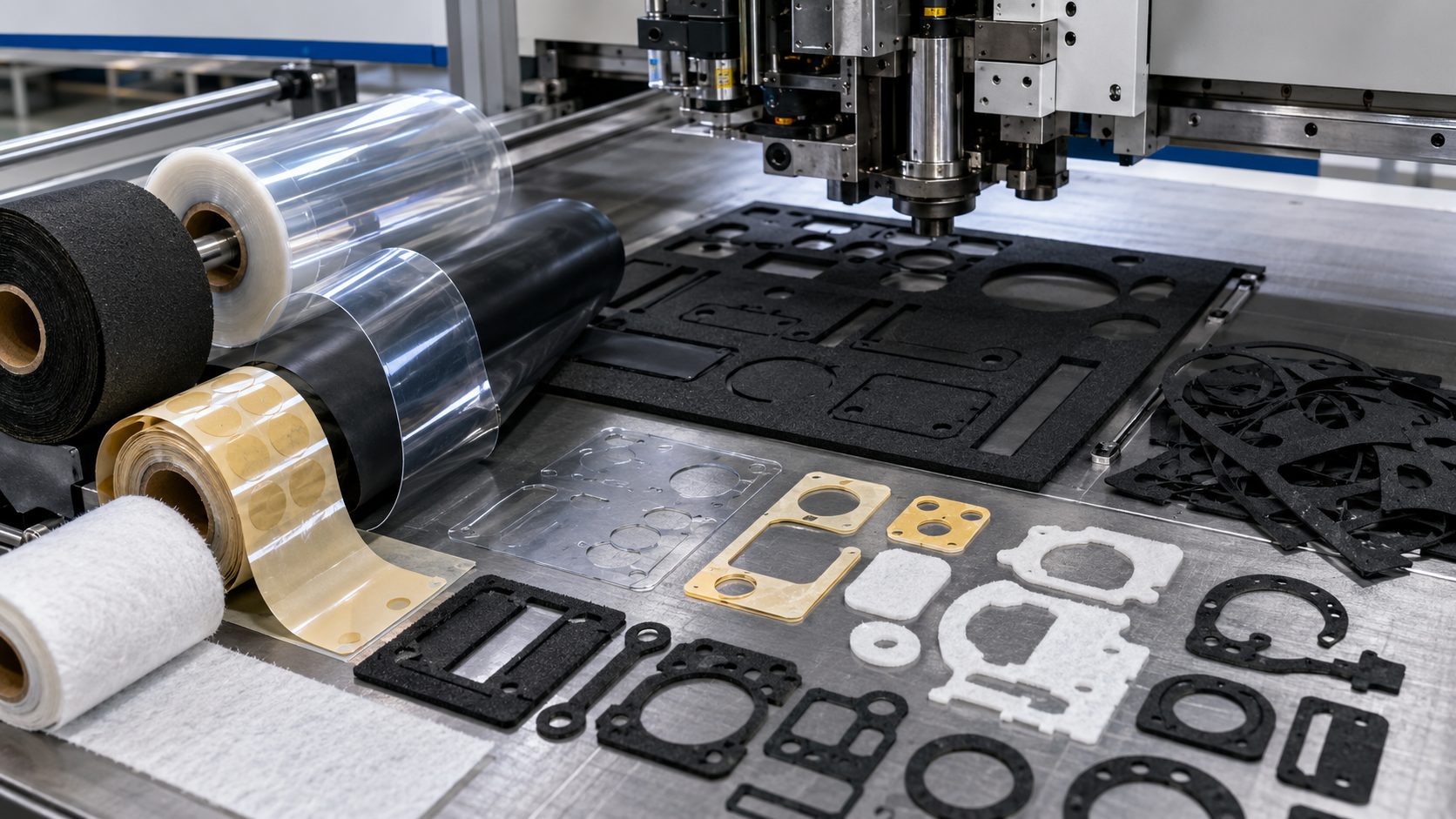
Third, the correct cutting method is selected. Flatbed die cutting may be suitable for thicker foam, rubber, and lower-volume custom parts. Rotary die cutting may be better for roll materials, adhesive tapes, films, and high-volume production. Kiss cutting is used when adhesive-backed materials must stay on the release liner.
Fourth, the part is cut and stripped. Waste removal is especially important for small holes, narrow gasket walls, adhesive parts, and soft foam.
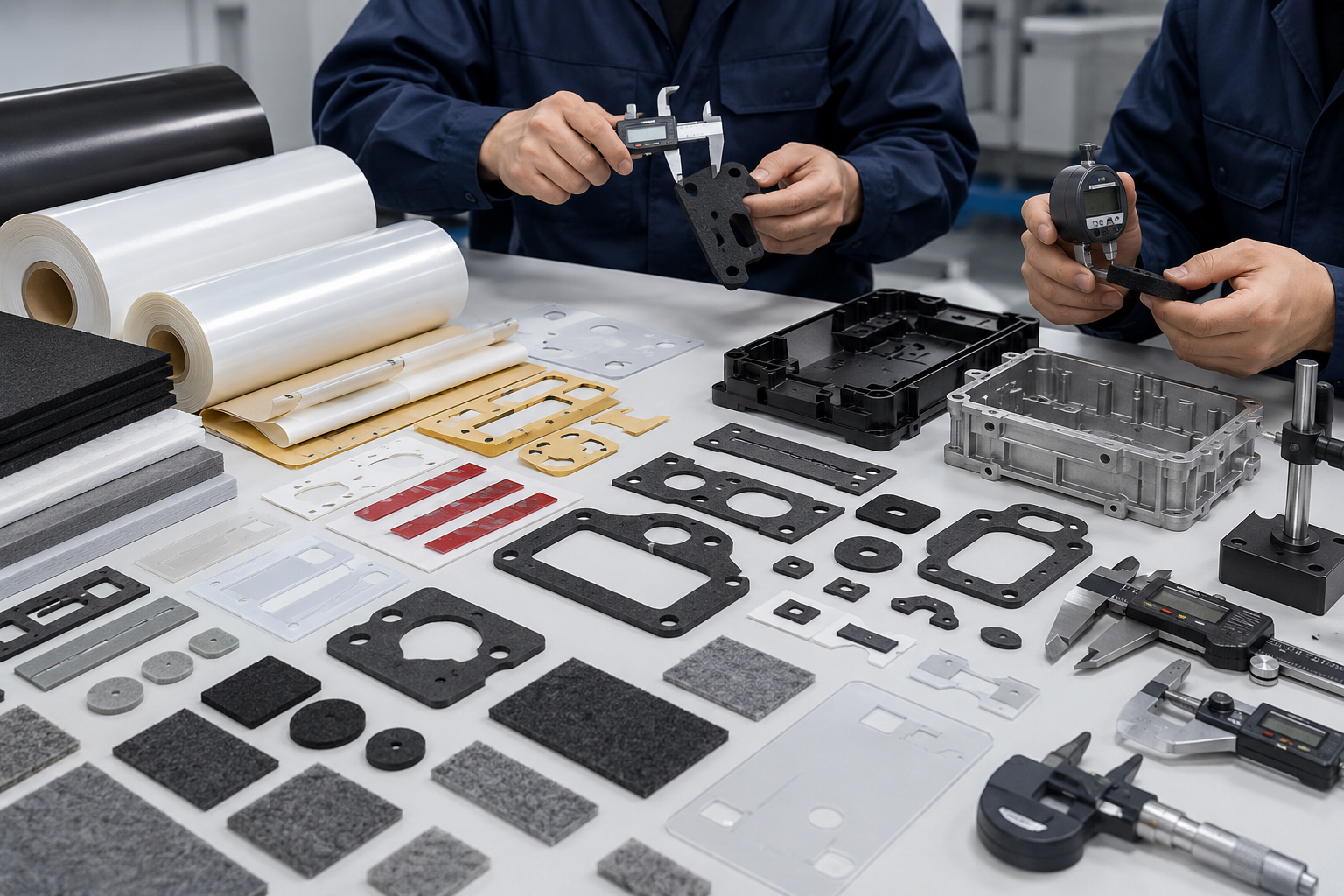
Finally, the parts are inspected and packed. Packaging may include rolls, sheets, trays, liner-backed formats or custom kits.
Material and Process Considerations
The die cutting process must match the raw material.
Foam components need attention to density, thickness, compression range, rebound, and minimum wall width. If the foam is too soft or too narrow, it may tear during cutting or waste removal.
Rubber parts need stable thickness and clean edges. If the cutting pressure is wrong, edges may deform or produce poor fit.
PET films need dimensional stability. Thin films may shift, curl, or deform if tension and tooling are not controlled. Thin films may shift, curl, or deform if tension and tooling are not controlled.
Adhesive-backed components need lamination control, liner selection, kiss cutting depth and adhesive edge management. If the adhesive is too soft or the pressure is too high, overflow may occur.
Non-woven felt parts need attention to thickness variation, edge condition, and fiber behavior. This is especially important in automotive NVH and anti-rattle applications.
A professional supplier should not use one process for every material. The process should be selected based on material structure, part geometry, tolerance, quantity, and final assembly requirement.
How Die Cutting Supports Different Applications
Die cutting transforms raw materials into components for many industries.
In automotive applications, die cut foam, felt, rubber and adhesive parts are used for sealing, cushioning, NVH reduction, anti-rattle protection and insulation.
In electronics, die cut PET films, adhesive tapes, foam pads, protective films and insulation layers support displays, sensors, speakers, cameras, housings and electronic assemblies.
In precision devices and industrial assemblies, die cut adhesive pads, protective films, foam parts and insulation materials require clean edges, stable bonding and consistent release performance.
In industrial equipment, die cut gaskets, rubber pads, insulation films, and felt parts help protect against vibration, dust, heat, and electrical contact.
The same die cutting process can produce many types of parts, but the engineering requirements are different in each industry.
This is why application knowledge matters.
How Sanken Helps Reduce Risk Before Mass Production
Sanken Manufacturing Co., Ltd. supports OEM customers with precision die cutting, material converting, adhesive lamination, foam and rubber components, PET insulation films, non-woven felt parts, automotive electronics components, sealing gaskets, and custom industrial parts.
Our work starts before cutting.
We review the raw material, application, drawing, tolerance, adhesive structure, hole position, minimum width, cutting process, waste removal method, and packaging format.
For foam gaskets, we focus on compression, sealing wall width, density, thickness, and rebound.
For PET insulation films, we focus on clean edges, hole accuracy, dimensional stability, and assembly fit.
For adhesive-backed parts, we focus on lamination quality, kiss cutting depth, liner release, and adhesive overflow control.
For non-woven felt parts, we focus on thickness, fiber condition, edge quality, and acoustic or cushioning function.
This helps customers reduce sampling failures, tooling changes, scrap, assembly delay, and unstable mass production.
Conclusion
Die cutting transforms raw materials into precision components by combining material selection, tooling, cutting control, adhesive lamination, waste removal, inspection and packaging. For OEM buyers, the value is not only a clean shape. The value is a component that fits, seals, bonds, insulates, cushions, protects and performs reliably in mass production.
At Sanken, we help customers convert foam, rubber, PET film, adhesive tape, non-woven felt and other flexible materials into custom die cut components with fewer sampling risks and more stable production results.
Need raw materials converted into precision die cut components?
Send us your drawing, sample, material requirement, adhesive structure, tolerance, application environment, annual volume and packaging preference. Sanken can help review material selection, die cutting method, lamination structure, inspection points and delivery format before sampling and mass production.