
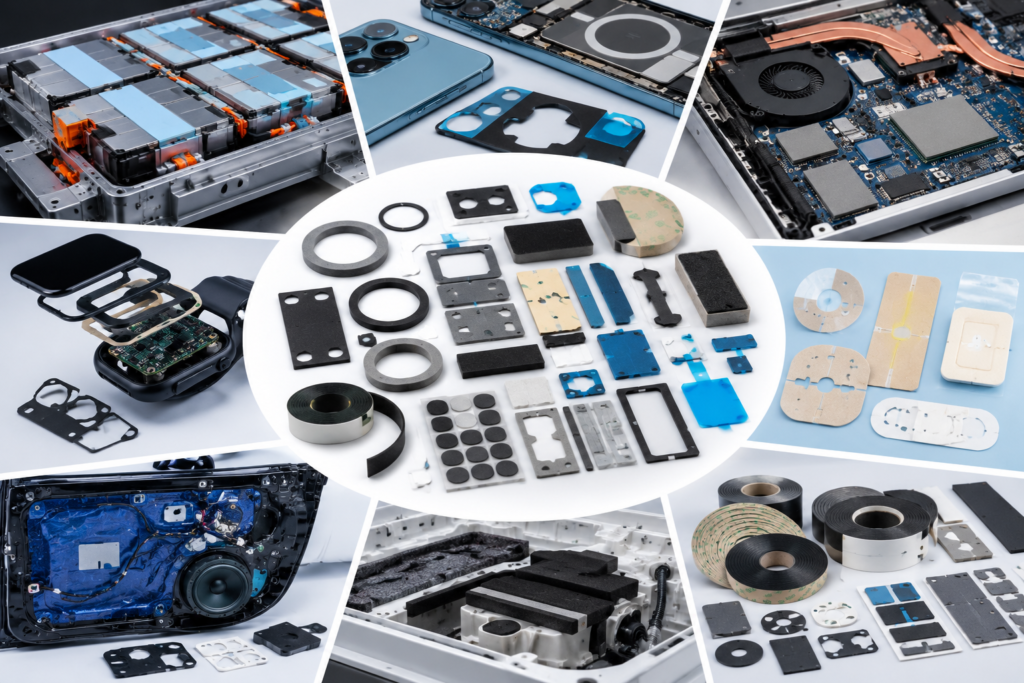
Adhesive-backed die cut components are widely used in OEM assembly for bonding, sealing, insulation, cushioning, positioning and production efficiency. These parts may include foam gaskets, PET insulation films, rubber pads, non-woven felt parts, double-sided tape components and custom laminated materials.
However, adhesive-backed parts are more complex than ordinary die cut parts. Adhesive type, release liner, material thickness, kiss cutting depth, tolerance, peeling behavior and packaging format can all affect assembly performance and long-term reliability.
At Sanken, we support OEM customers with precision die cutting services, adhesive lamination, foam and rubber components, PET insulation films, non-woven felt parts, sealing gaskets and custom adhesive-backed components for automotive, electronics, appliance and industrial applications.
Why This Topic Matters for OEM Manufacturing
OEM assembly lines depend on repeatability.
Operators need parts that peel smoothly, align quickly, bond reliably, and stay stable after installation. Adhesive-backed die cut components support this need because they can be supplied on release liner in sheets, rolls, individual pieces, or assembly-friendly formats.
These components are widely used in:
- Automotive electronics housings
- Electronic assemblies
- Sensors and lighting assemblies
- Consumer electronics
- Appliances
- Industrial enclosures
- Display modules
- Control panels
A foam gasket with adhesive backing can stay in place during assembly. A PET insulation film with adhesive can protect a circuit area. A double-sided tape part can bond two surfaces without liquid glue. A non-woven felt pad with adhesive can reduce noise and rattling in automotive interiors.
But adhesive-backed parts must be designed carefully.
If the adhesive is too soft, it may overflow during cutting. If the liner is too tight, operators may damage the part when peeling. If kiss cutting is too deep, the liner may break. If the adhesive does not match the bonding surface, the part may lift after assembly.
This is why adhesive-backed die cutting requires material knowledge, converting experience, and process control.
Common Problems and Production Risks
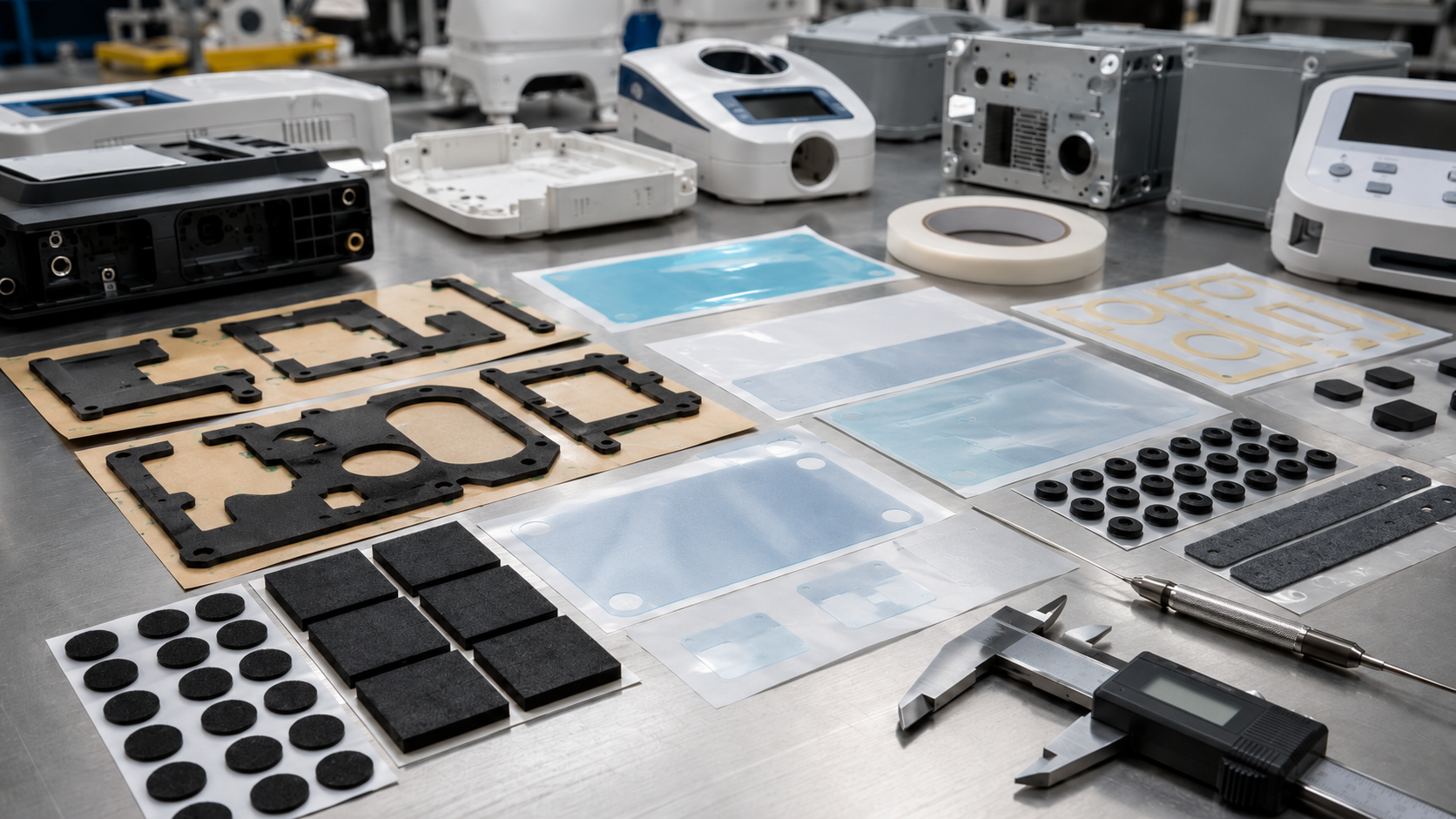
Adhesive-backed die cut components are more complex than plain die cut parts because they include multiple layers. The finished part may include foam, rubber, PET film, felt, adhesive, and release liner.
Each layer can affect cutting and assembly.
| Problem | Common Cause | OEM Assembly Risk |
|---|---|---|
| Adhesive overflow | Soft adhesive or excessive cutting pressure | Contamination and poor appearance |
| Liner tearing | Kiss cutting depth too deep | Slow peeling and assembly disruption |
| Poor release | Wrong liner or adhesive combination | Damaged parts during peeling |
| Part stretching | Soft foam or weak narrow features | Poor alignment and deformation |
| Adhesive lifting | Wrong adhesive for bonding surface | Gasket shifting or bonding failure |
| Hole misalignment | Weak tolerance control | Assembly mismatch |
| Rough cut edges | Unsuitable tooling or pressure | Poor fit and edge contamination |
| Batch inconsistency | No stable process control | Unreliable mass production |
These issues often appear after sample approval.
A sample may look flat and clean on a table, but the real test happens on the assembly line. Can the operator peel it quickly? Does the part hold its shape? Does it align with holes and edges? Does the adhesive stay where it should? Does the bond survive heat, vibration, humidity, or compression?
For OEM manufacturing, these questions matter more than appearance alone.
What Buyers or Engineers Should Check First
Before ordering adhesive-backed die cut components, engineers should define both the part function and the assembly condition.
| Checklist Item | What to Confirm | Why It Matters |
|---|---|---|
| Component function | Bonding, sealing, insulation, cushioning or spacing | Defines material and adhesive choice |
| Base material | Foam, rubber, PET, tape, felt or silicone | Affects cutting and handling |
| Adhesive type | Acrylic, rubber-based, silicone or transfer adhesive | Controls bonding performance |
| Bonding surface | Plastic, metal, coating, glass, rubber or painted surface | Prevents lifting or weak adhesion |
| Thickness | Material and adhesive layer thickness | Affects fit and compression |
| Release liner | Paper, film, easy-release or high-release liner | Controls peeling and assembly speed |
| Critical dimensions | Holes, edges, windows and adhesive areas | Protects assembly accuracy |
| Kiss cutting depth | Cut through top layers, not liner | Prevents liner damage |
| Packaging format | Roll, sheet, individual piece or kit | Supports production efficiency |
| Application environment | Heat, humidity, vibration, compression or chemicals | Confirms long-term stability |
The adhesive should not be selected only by bond strength.
A very strong adhesive may create peeling difficulty from the liner. A soft adhesive may flow at the edge. A low-tack adhesive may be easy to handle but may not hold after assembly.
The right adhesive depends on the surface, temperature, pressure, assembly method, and final application.
Material and Process Considerations
Adhesive-backed components can be made with many base materials.
Foam gaskets and sealing components are often used for sealing, cushioning, vibration reduction, and gap filling. When foam has adhesive backing, engineers should check compression, density, minimum wall width, and liner release. Soft foam can stretch during peeling if the part is narrow.
Adhesive-laminated PET film is used for insulation, spacing, and protection in electronic assemblies. Adhesive-backed PET parts need clean edges, accurate holes, stable liner release, and good flatness.
Rubber is used for sealing, anti-slip pads, shock absorption, and protective parts. Adhesive bonding to rubber may require careful adhesive selection and surface review.
Non-woven felt is used for automotive NVH, anti-rattle pads, cushioning, and acoustic parts. Adhesive backing can help assembly, but fiber condition and edge quality must be controlled.
Double-sided adhesive tape and transfer adhesive are used for direct bonding applications. These parts often require kiss cutting, precise liner control, and clean waste removal.
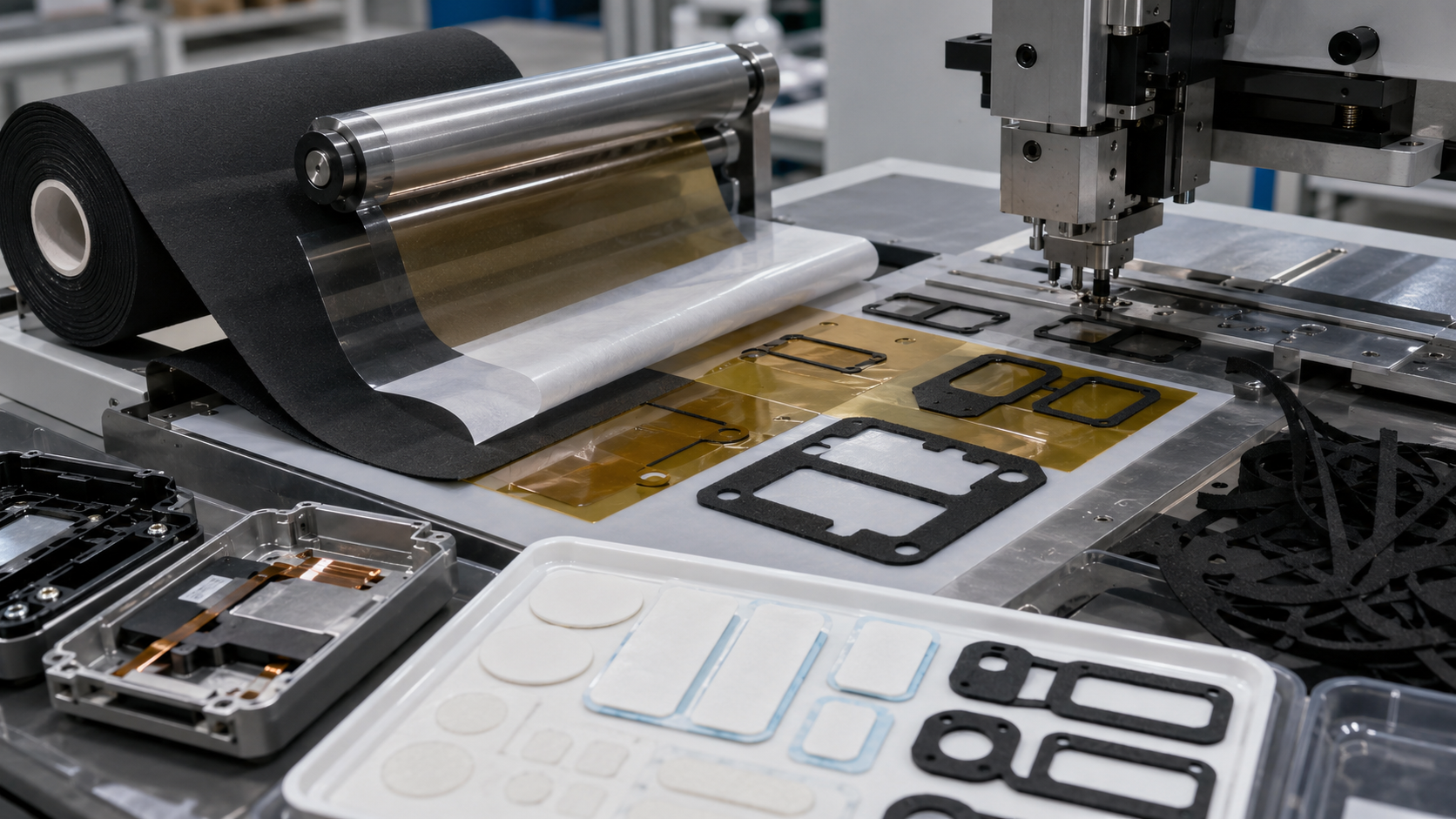
The process is just as important as the material.
Adhesive lamination must be flat and stable. Wrinkles, bubbles, shifting, or uneven pressure can create defects before die cutting even starts.
Kiss cutting must be controlled carefully. The blade must cut the top material and adhesive layer without damaging the release liner. If the cut is too shallow, the part may not release cleanly. If the cut is too deep, the liner may tear during peeling.
Waste removal must also be planned. Small holes, narrow strips, complex shapes, and soft adhesive can make stripping difficult. A part may cut correctly but deform during waste removal.
At Sanken, we review lamination, kiss cutting depth, liner behavior, waste removal, adhesive overflow, and packaging before mass production.
Why Adhesive-Backed Parts Fail During Assembly
Many failures happen because the supplier focuses on cutting but not assembly.
OEM assembly conditions should be reviewed before tooling.
A part used in manual assembly needs easy peeling and clear positioning. A part used in fixture assembly may need stable liner presentation. A part used in automated assembly may need roll format, consistent spacing, and controlled release force.
Common assembly failures include:
- Operators stretching the part during peeling
- Adhesive edge sticking to the liner
- Part shifting before final bonding
- Holes not aligning with screws or pins
- Foam gasket lifting after compression
- PET film curling during placement
- Adhesive residue contaminating the product
- Parts sticking together due to poor packaging
These problems increase assembly time and rejection rate.
A good adhesive-backed component should make assembly easier, not harder.
This is why delivery format matters. Parts can be supplied in sheets, rolls, liner-backed strips, individual pieces, or custom kits depending on the customer’s production method.
Tolerance Control for Adhesive-Backed Die Cut Components
Tolerance control is especially important for adhesive-backed parts because multiple layers can shift.
The base material, adhesive layer, and release liner must remain stable during lamination and cutting.
Important tolerance areas include:
- Outer profile
- Hole position
- Inner openings
- Adhesive coverage
- Liner position
- Thickness
- Cut depth
- Part spacing on liner
For foam gaskets, thickness and sealing wall width affect compression and sealing performance.
For PET insulation films, hole position and edge accuracy affect assembly and electrical clearance.
For adhesive tape parts, adhesive position and liner release affect bonding and placement.
Not every dimension requires the tightest tolerance. But functional dimensions must be controlled clearly.
A professional supplier should help the buyer identify which dimensions are critical and which can remain more flexible to control cost.
How Sanken Helps Reduce Risk Before Mass Production
Sanken Manufacturing Co., Ltd. helps OEM customers develop adhesive-backed die cut components by reviewing the full structure of the part.
We do not look only at the shape.
We review the base material, adhesive type, bonding surface, release liner, lamination method, cutting depth, tolerance, waste removal, packaging, and final assembly condition.
For automotive electronics, we help develop adhesive-backed foam gaskets, insulation films, anti-rattle pads, and sealing components that support dustproofing, vibration control, and assembly stability.
For electronics and industrial assemblies, we support adhesive-backed PET films, protective films, spacers, and bonding components with clean edges and accurate dimensions.
For industrial applications, we focus on stable release, clean cutting, material consistency, and controlled packaging.
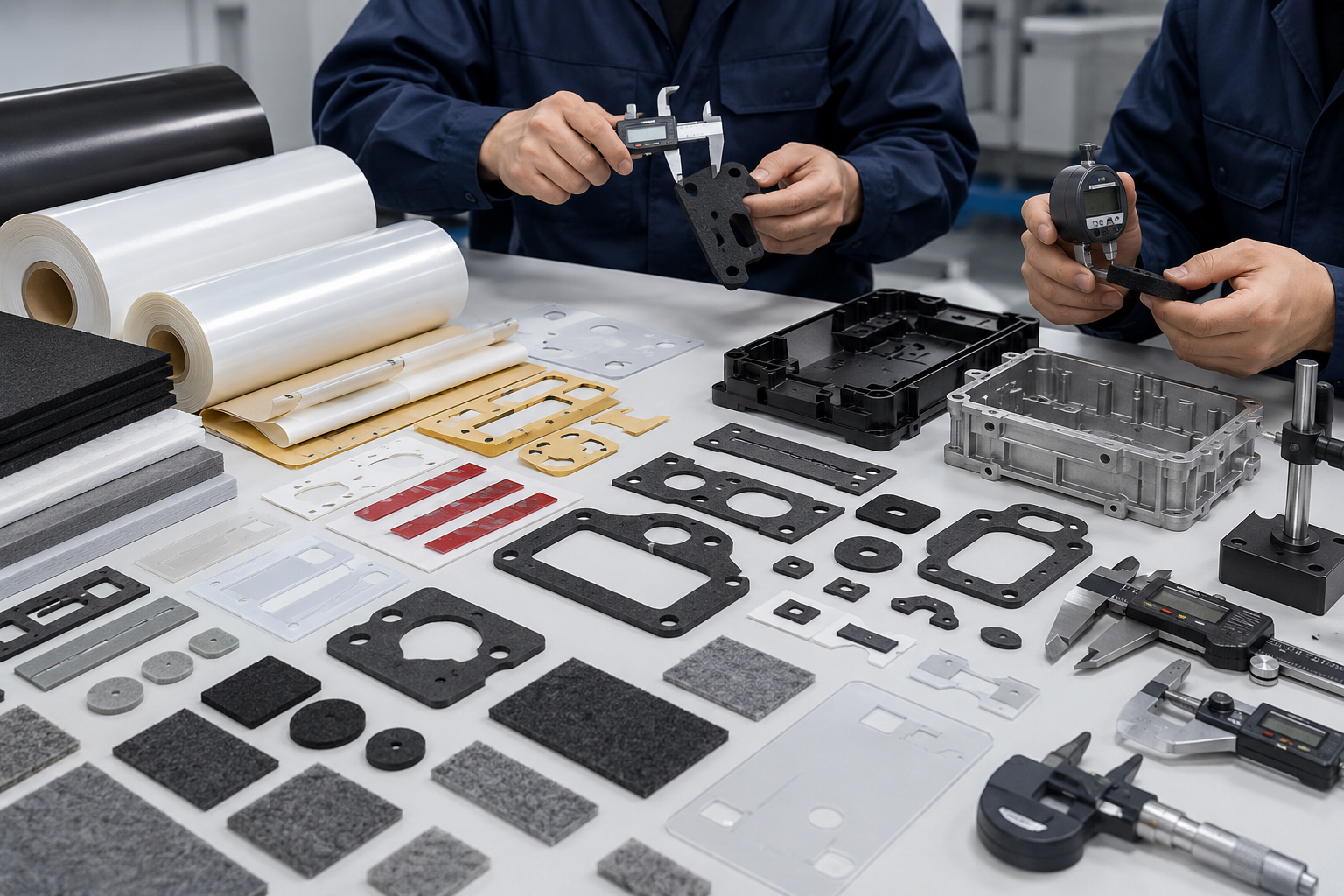
Our goal is to help customers reduce repeated sampling, adhesive overflow, liner problems, tearing, poor bonding, assembly delays, and unstable batch quality.
A good adhesive-backed component should be easy to peel, easy to place, stable after bonding, and reliable in mass production.
Conclusion
Adhesive-backed die cut components for OEM assembly must be designed with the full material structure in mind. The base material, adhesive, liner, tolerance, kiss cutting depth, waste removal, packaging, and assembly method all affect final performance.
At Sanken, we help OEM buyers and engineers develop adhesive-backed foam, rubber, PET film, felt, tape, and custom industrial components that are easier to assemble and more stable in mass production.
Need adhesive-backed die cut components for an OEM assembly project?
Send us your drawing, sample, material requirement, adhesive structure, liner type, bonding surface, tolerance, assembly method, annual volume and packaging preference. Sanken can help review material selection, lamination, kiss cutting, liner release, tolerance control and delivery format before mass production.