
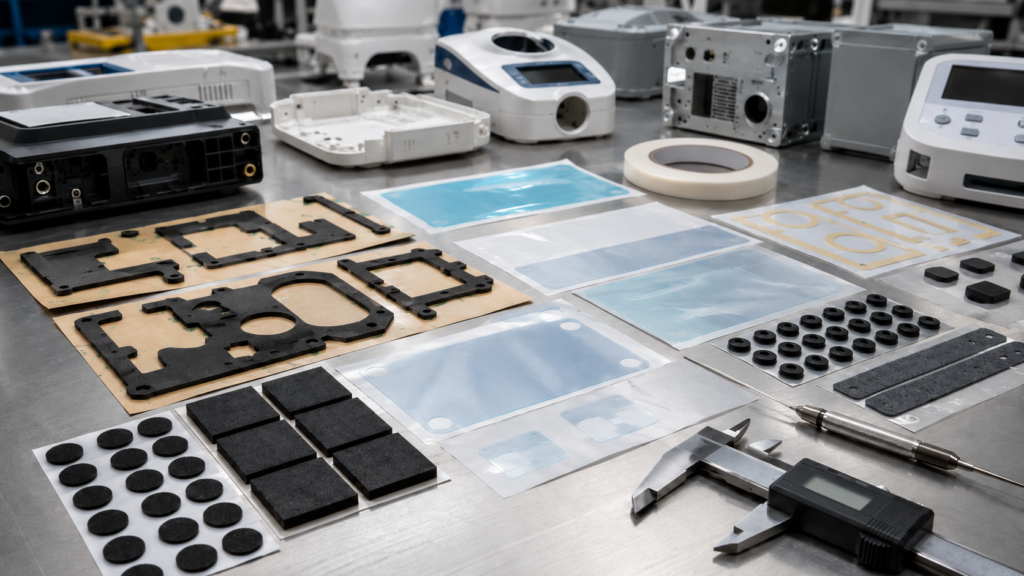
Precision Die Cut Parts Manufacturer for Automotive, Electronics and Medical OEMs
Choosing a precision die cut parts manufacturer for automotive, electronics and medical OEMs is not only about finding a supplier that can cut foam, rubber, PET film, adhesive tape or non-woven felt into shape. The real challenge is finding a manufacturing partner that understands material behavior, tolerance control, adhesive lamination, clean cutting, sampling risk and mass production repeatability.
At Sanken, we support OEM buyers and engineers with custom die cut components used for sealing, bonding, insulation, cushioning, vibration control, sound absorption and assembly support. These parts may be small, but they often protect the reliability of the entire product.
Why This Topic Matters for OEM Manufacturing
Automotive, electronics and medical OEMs all rely on custom flexible components, but each industry has different risks.
Automotive parts may need to resist heat, vibration, dust, moisture, compression and long service life. A foam gasket inside an electronic control unit or sensor housing must stay stable after assembly.
Electronics parts may need thin materials, accurate holes, clean edges and stable adhesive performance. A PET insulation film or adhesive spacer must fit tightly into compact devices without shifting or curling.
Medical OEM parts may require clean cutting, consistent adhesive release, reliable material behavior and controlled packaging. A small adhesive pad or protective film can affect assembly speed and product reliability.
This is why precision die cutting should be treated as an engineering process, not only a cutting service.
A good manufacturer should help customers reduce risk before tooling, sampling and mass production.
Common Problems and Production Risks
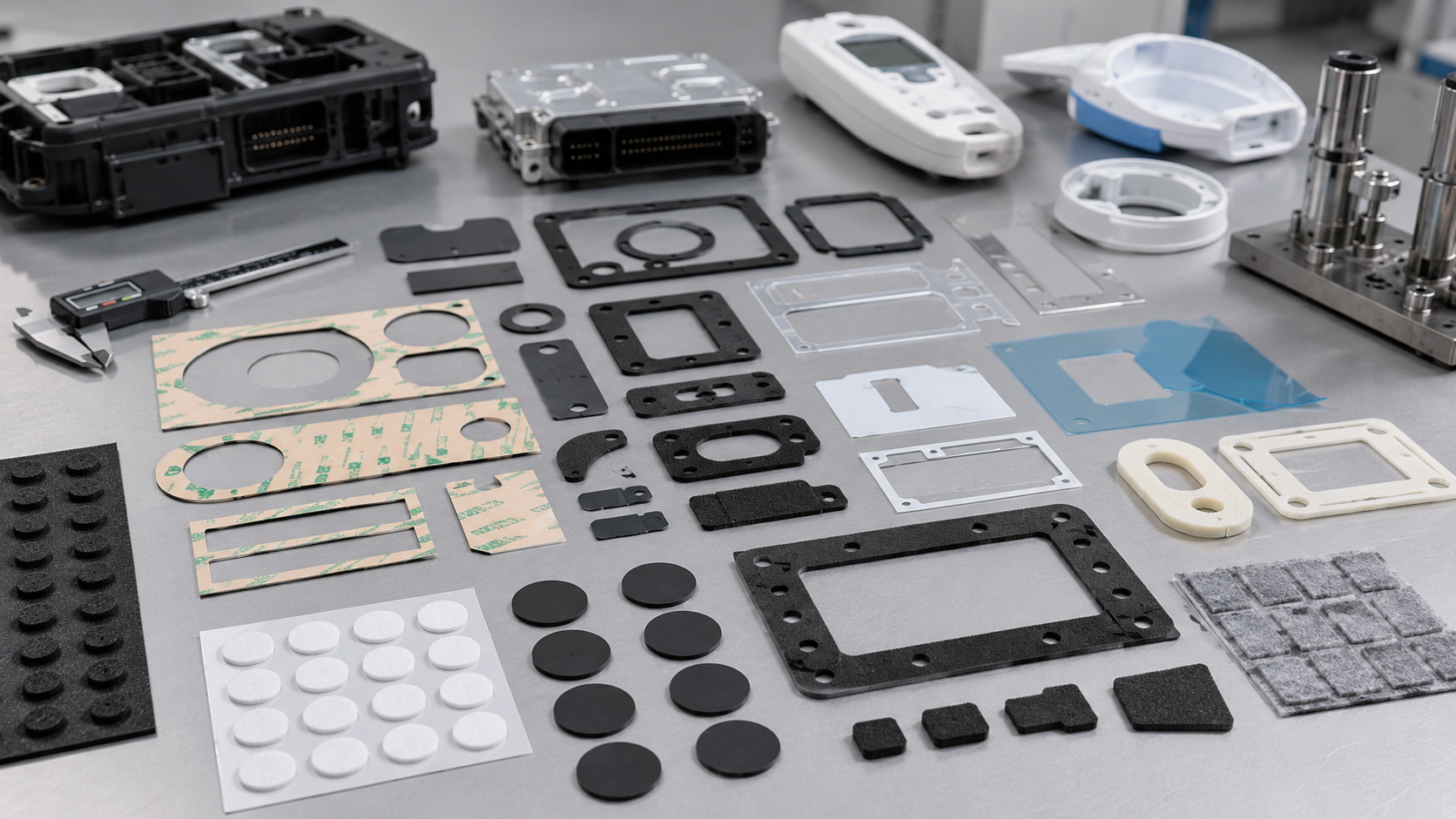
Many die cut part failures happen because the supplier focuses only on shape, while the customer’s real need is function.
A drawing may show the outline, holes and dimensions. But it may not fully explain compression load, bonding surface, insulation clearance, assembly pressure, surface cleanliness or packaging requirements.
| Problem | Common Cause | OEM Risk |
|---|---|---|
| Poor sealing | Wrong foam density, thickness or compression | Dust, water, air or noise leakage |
| Hole misalignment | Weak tolerance control or material movement | Assembly delay and rejected parts |
| Adhesive overflow | Soft adhesive or excessive cutting pressure | Contamination near components |
| Film curling | Thin film, poor tension or packaging issue | Difficult assembly |
| Foam tearing | Narrow wall, soft foam or poor waste removal | Low yield and unstable parts |
| Rough edges | Unsuitable tooling or dull blade | Poor fit, particles or weak appearance |
| Liner release failure | Wrong liner or kiss cutting depth | Slow peeling and damaged parts |
| Batch inconsistency | No stable process control plan | Mass production quality risk |
These problems can be expensive because they often appear after sample approval.
A sample may look acceptable on an inspection table. But mass production introduces tool wear, roll tension changes, adhesive behavior changes, material batch variation and operator handling differences.
For OEM buyers, the supplier must prove more than sample-making ability. The supplier must prove production stability.
What Buyers or Engineers Should Check First
Before selecting a precision die cut parts manufacturer, buyers should check whether the supplier can support the full project from material review to final delivery.
| Checklist Item | What to Confirm | Why It Matters |
|---|---|---|
| Application | Automotive, electronics, medical or industrial | Defines quality and material requirements |
| Part function | Sealing, bonding, insulation, cushioning, protection | Guides material and process selection |
| Material type | Foam, rubber, PET, adhesive tape, felt, silicone | Affects cutting and performance |
| Thickness | Nominal thickness and tolerance | Controls fit, compression and function |
| Critical dimensions | Holes, slots, edges, sealing walls | Protects assembly accuracy |
| Adhesive structure | Adhesive type, liner, bonding surface | Prevents peeling, shifting and overflow |
| Tolerance priority | Critical and non-critical dimensions | Balances performance and cost |
| Assembly method | Manual, fixture, automated or compression | Affects delivery format |
| Testing needs | Peel, compression, aging, insulation, sealing | Confirms real performance |
| Packaging format | Roll, sheet, tray, kit or individual piece | Supports efficient OEM assembly |
The most important point is to define critical dimensions.
Not every dimension needs the tightest tolerance. But holes, sealing walls, adhesive areas, insulation clearances and assembly reference points should be controlled carefully.
A professional manufacturer should help the customer identify these areas before tooling starts.
Material and Process Considerations
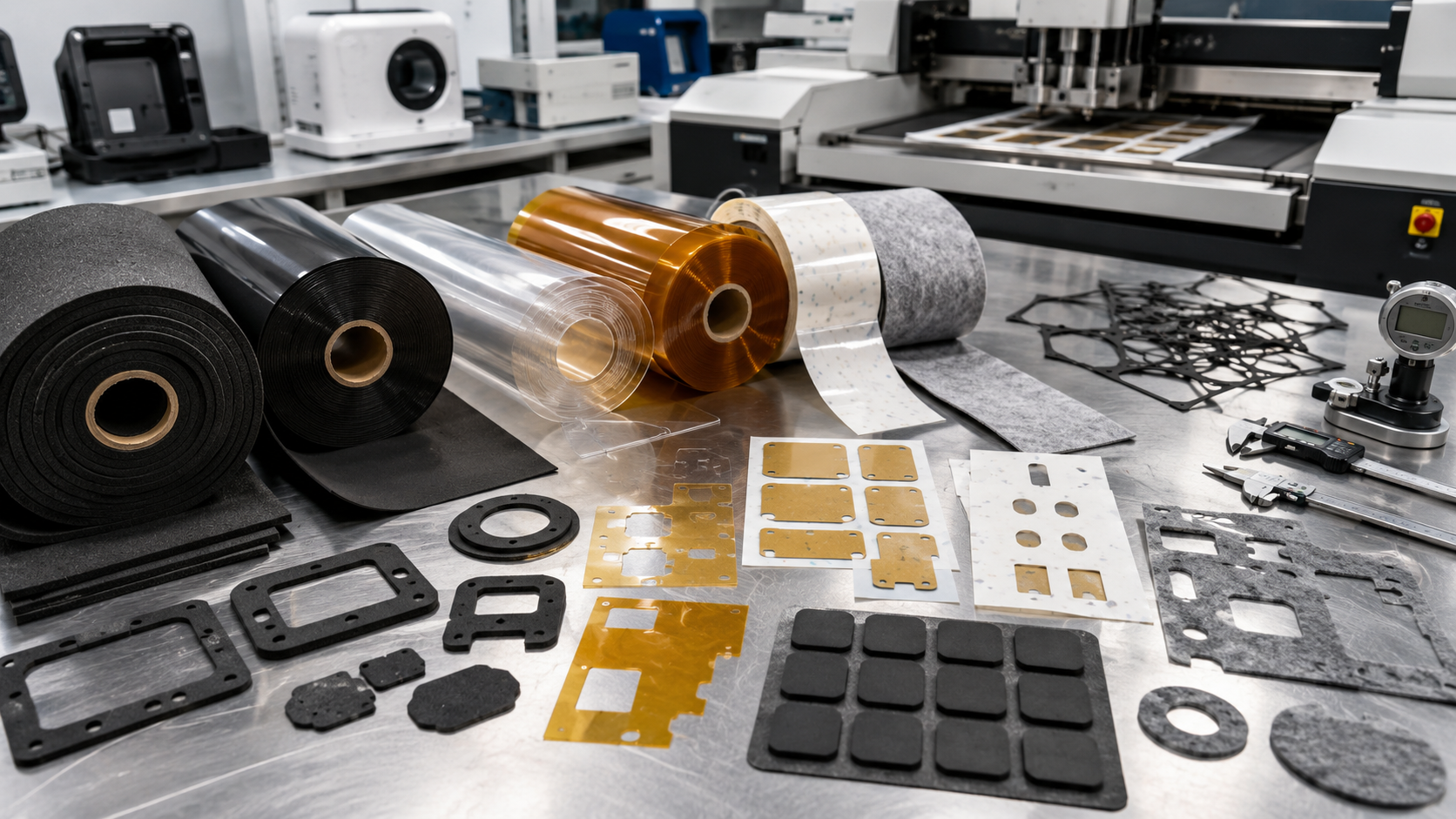
Precision die cut parts can be made from many flexible materials, but each material requires a different process strategy.
Foam is often used for sealing, cushioning, dust protection, vibration reduction and gap filling. Engineers should review foam density, thickness, compression recovery, sealing wall width and tearing risk.
Rubber is used for sealing, anti-slip pads, vibration control and protective parts. It needs clean cutting, stable thickness and good rebound.
PET film is widely used for insulation, protection, spacing and electronic assemblies. It needs accurate hole alignment, clean edges, flatness and stable packaging.
Adhesive tape materials are used for bonding, mounting, assembly positioning and fastening support. They often require adhesive lamination, kiss cutting, liner control and overflow prevention.
Non-woven felt is used in automotive NVH, anti-rattle pads, acoustic insulation, cushioning and filtration. It requires attention to thickness variation, fiber condition and edge quality.
Silicone foam or silicone rubber may be used when heat resistance, elasticity or long-term recovery is important.
The right process also matters.
Flatbed die cutting may be suitable for thicker foam, rubber and custom lower-volume parts. Rotary die cutting may support roll materials, adhesive tapes, films and higher-volume production. Kiss cutting is important for adhesive-backed parts supplied on release liner.
A reliable manufacturer should select the process based on material behavior, part geometry, tolerance, quantity and assembly format.
Automotive, Electronics and Medical Applications
Automotive OEMs use die cut parts in electronic control units, sensors, lighting modules, battery systems, interiors, displays and connector housings. Common parts include foam gaskets, rubber pads, PET insulation films, non-woven felt pads and adhesive-backed sealing components.
Electronics OEMs use die cut components in batteries, speakers, cameras, displays, circuit boards, sensors, wearable devices and compact housings. These projects often require thin materials, small holes, stable adhesive and clean edges.
Medical OEMs may use adhesive pads, protective films, foam cushioning parts, sealing layers and non-woven components. These parts require consistent cutting, clean handling, reliable liner release and stable material performance.
The same die cutting method may serve different industries, but the engineering priorities are not the same.
Automotive projects often focus on vibration, sealing and aging.
Electronics projects often focus on precision, insulation and clean assembly.
Medical projects often focus on consistency, cleanliness and controlled adhesive behavior.
This is why choosing a manufacturer with application experience is important.
What a Reliable Manufacturer Should Control
A precision die cut parts manufacturer should control the full production chain, not only the cutting machine.
The supplier should review incoming material, lamination quality, tooling condition, cutting pressure, kiss cutting depth, waste removal, inspection points and packaging.
For adhesive-backed parts, liner release must be stable. If the liner is too tight, operators may stretch or damage the part during peeling. If the liner is too loose, parts may lift during transport.
For foam gaskets, compression behavior must be checked. If the gasket is too thin, it may leak. If it is too thick, it may create excessive assembly pressure.
For PET insulation films, edge cleanliness and hole accuracy matter. Poor cutting can create particles, poor fit or electrical clearance risks.
For non-woven felt parts, fiber control and thickness consistency are important for acoustic and anti-rattle applications.
Good manufacturing control reduces repeated samples, scrap, assembly delays and quality complaints.
How Sanken Helps Reduce Risk Before Mass Production
Sanken Manufacturing Co., Ltd. helps OEM customers develop precision die cut parts by reviewing the component as a functional part, not just a flat shape.
For automotive applications, we focus on sealing reliability, compression behavior, vibration resistance, adhesive stability and assembly fit.
For electronics applications, we focus on dimensional accuracy, insulation performance, clean cutting, adhesive control and compact assembly needs.
For medical-related applications, we focus on clean edges, material consistency, controlled adhesive release and packaging stability.
Our capabilities include precision die cutting, material converting, adhesive lamination, foam and rubber converting, PET insulation film cutting, non-woven felt processing, kiss cutting, inspection and custom packaging.
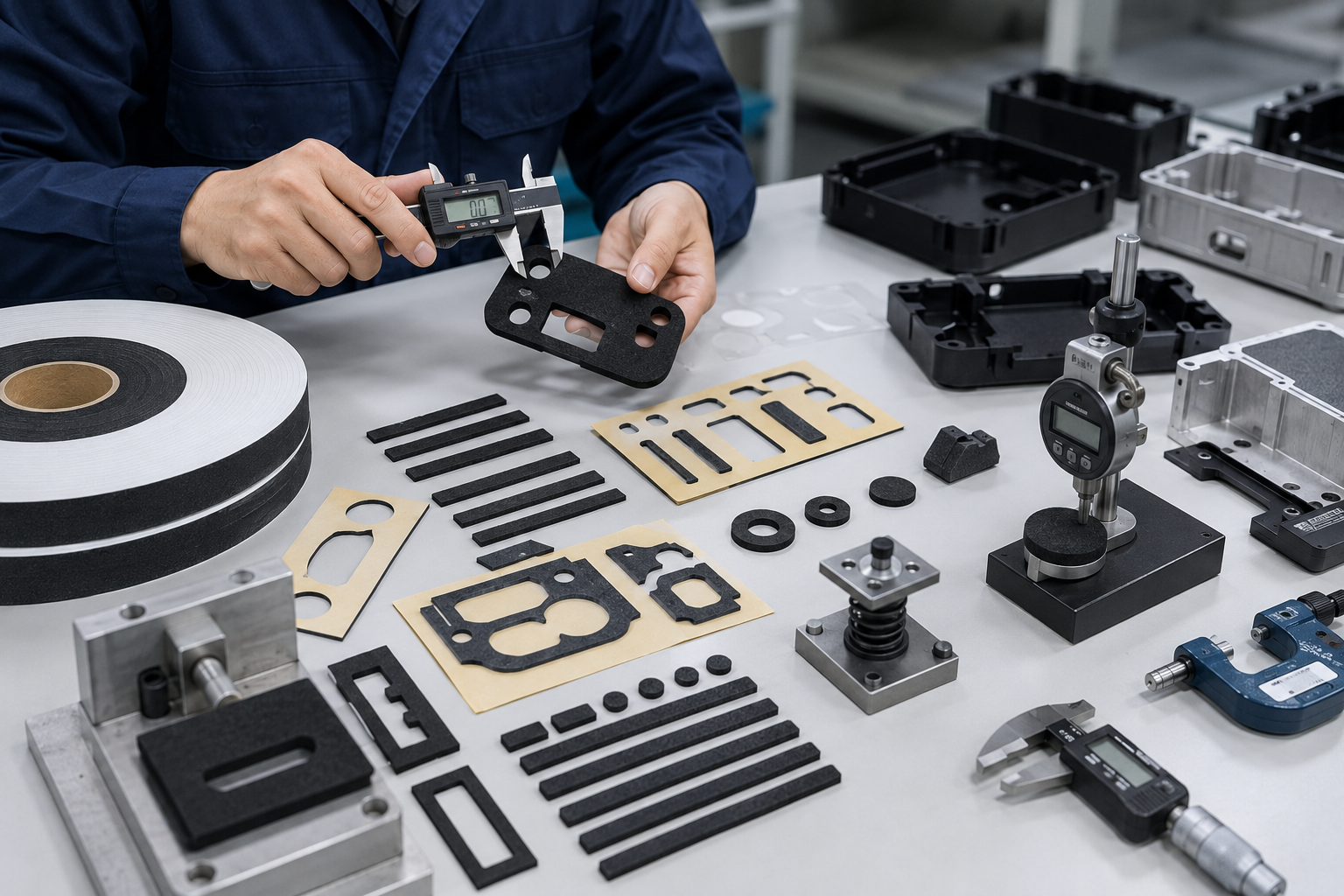
Before production, we help customers review key risk areas such as minimum wall width, hole-to-edge distance, foam density, adhesive type, liner release, tolerance feasibility, waste removal and delivery format.
This helps customers move from drawing to sample and from sample to mass production with fewer unexpected failures.
FAQ
What does a precision die cut parts manufacturer do?
A precision die cut parts manufacturer converts flexible materials such as foam, rubber, PET film, adhesive tape, silicone and non-woven felt into custom-shaped components for sealing, bonding, insulation, cushioning, protection and assembly support.
What industries use precision die cut parts?
Automotive, electronics, medical, appliances, industrial equipment, battery systems, optical devices and consumer products all use precision die cut parts in functional assemblies.
What materials can be die cut for OEM parts?
Common materials include PU foam, EVA foam, PE foam, EPDM foam, CR foam, rubber, silicone foam, PET film, PI film, PC film, double-sided tape, protective film, non-woven felt and laminated materials.
Why is tolerance important in die cut components?
Tolerance affects hole alignment, assembly fit, sealing wall width, adhesive position, insulation clearance and final product performance. Critical dimensions should be reviewed before tooling.
How can buyers reduce sampling failures?
Buyers can reduce sampling failures by sharing drawings, application details, material requirements, adhesive needs, tolerance priorities, testing requirements, assembly method and packaging expectations before sampling.
Why should OEMs choose a manufacturer with material converting experience?
Material converting experience helps reduce risks related to foam deformation, adhesive overflow, film curling, liner release, waste removal and batch inconsistency.
Conclusion
A precision die cut parts manufacturer for automotive, electronics and medical OEMs should provide more than cutting service. The supplier should understand material behavior, tolerance control, adhesive lamination, tooling, waste removal, inspection, packaging and mass production stability.
At Sanken, we help OEM buyers and engineers develop custom die cut components that are easier to assemble, more reliable in use and more stable in mass production.