
How Die Cut Parts Help Reduce Assembly Errors in Small Electronics?
As electronic devices become smaller and more complex, assembly tolerances continue to shrink. A battery insulation film positioned slightly off-center, a foam gasket installed incorrectly, or an adhesive component misaligned by less than a millimeter can cause performance issues, cosmetic defects, or product failure. For manufacturers of smartphones, wearable devices, tablets, cameras, and other compact electronics, reducing assembly errors is critical to maintaining production efficiency and product quality.
Die cut parts help reduce assembly errors in small electronics by providing precise dimensions, repeatable positioning, simplified installation, controlled adhesive placement, and compatibility with automated assembly systems. By supplying materials in ready-to-install formats, manufacturers can improve assembly accuracy, reduce operator variation, and increase production yields.
For modern electronics manufacturing, precision die-cut components have become an essential part of achieving consistent assembly performance.
Why Small Electronics Are Difficult to Assemble
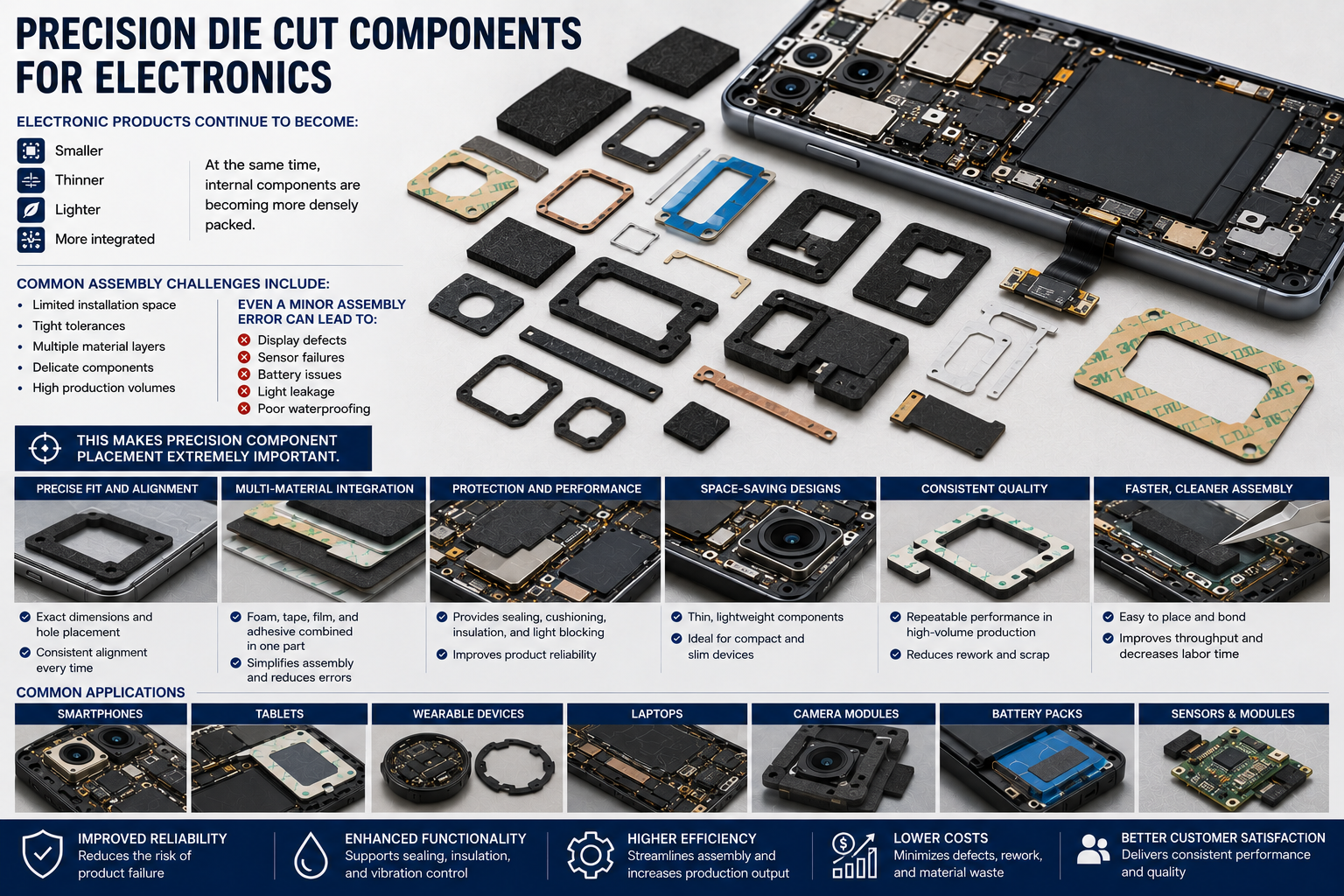
Electronic products continue to become:
- Smaller
- Thinner
- Lighter
- More integrated
At the same time, internal components are becoming more densely packed.
Common assembly challenges include:
- Limited installation space
- Tight tolerances
- Multiple material layers
- Delicate components
- High production volumes
Even a minor assembly error can lead to:
- Display defects
- Sensor failures
- Battery issues
- Light leakage
- Poor waterproofing
This makes precision component placement extremely important.
Theme: Precision Die Cut Components for Electronics
Eliminating Manual Cutting and Trimming
Manual material preparation introduces inconsistency.
Operators may:
- Cut adhesive tapes differently
- Trim foam materials unevenly
- Create dimensional variation
- Position materials inconsistently
Die-cut components arrive in the exact required shape.
Benefits include:
- Consistent dimensions
- Reduced labor
- Faster assembly
- Improved repeatability
Every component is manufactured using the same tooling and process.
Improving Positioning Accuracy
One of the most common causes of assembly errors is incorrect part placement.
Custom die-cut parts can include:
- Alignment holes
- Registration features
- Positioning tabs
- Precision openings
- Installation guides
These features help ensure components are installed correctly every time.
Examples include:
- Battery insulation films
- Camera gaskets
- Display cushioning pads
- Light-blocking materials
Precise positioning reduces both defects and rework.
Reducing Adhesive Placement Errors
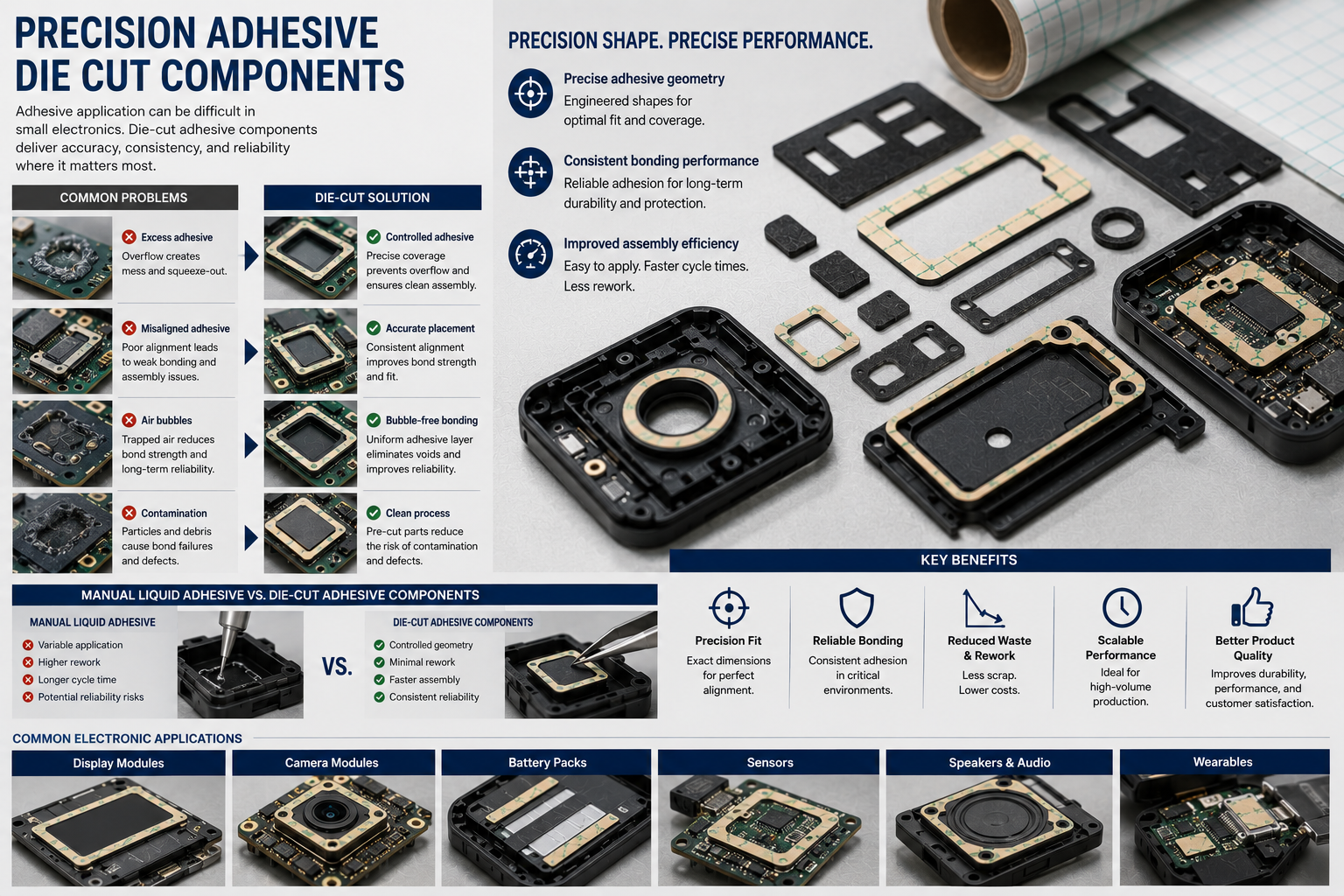
Adhesive application can be difficult in small electronics.
Common problems include:
- Excess adhesive
- Misaligned adhesive
- Air bubbles
- Contamination
Die-cut adhesive components provide:
- Controlled adhesive geometry
- Accurate placement
- Consistent bonding performance
This improves both assembly efficiency and product reliability.
Theme: Precision Adhesive Die Cut Components
Supporting Automated Assembly
Most high-volume electronics manufacturing relies on automation.
Automated systems require:
- Consistent dimensions
- Stable part presentation
- Predictable release characteristics
Die-cut parts supplied in roll format can support:
- Pick-and-place systems
- Robotic assembly
- Automated dispensing equipment
Benefits include:
- Faster throughput
- Reduced operator dependence
- Improved process control
Automation-friendly die-cut components help maintain consistency across millions of units.
Preventing Component Movement
Small electronic devices often contain components that must remain precisely positioned.
Examples include:
- Battery packs
- Cameras
- Sensors
- Displays
- Speakers
Die-cut foam and adhesive components help:
- Fill gaps
- Maintain compression
- Absorb vibration
- Prevent shifting
This improves both assembly consistency and long-term reliability.
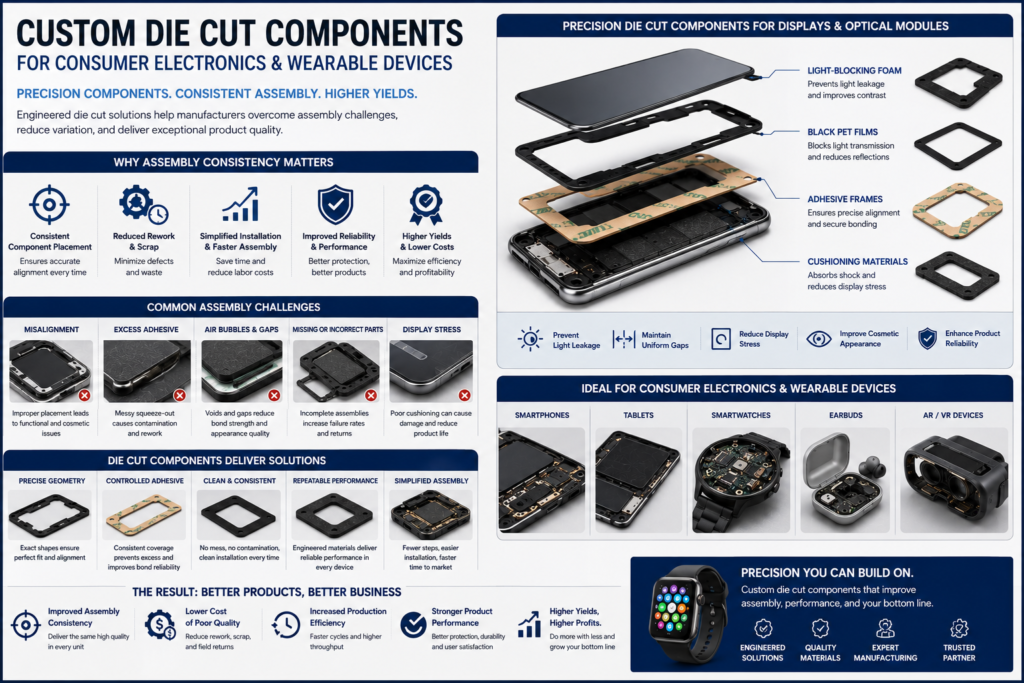
Improving Display Assembly Accuracy
Display modules are particularly sensitive to assembly variation.
Potential problems include:
- Light leakage
- Uneven gaps
- Display stress
- Cosmetic defects
Die-cut components used around displays include:
- Light-blocking foam
- Black PET films
- Adhesive frames
- Cushioning materials
These components help ensure accurate alignment while reducing assembly complexity.
Theme: Display and Optical Die Cut Components
Reducing Errors in Wearable Devices
Wearable devices have extremely limited internal space.
Applications include:
- Smart watches
- Fitness trackers
- Health monitoring devices
Die-cut components help control:
- Sensor positioning
- Waterproof sealing
- Battery insulation
- Optical isolation
Because tolerances are so tight, even small improvements in assembly accuracy can significantly improve product performance.
Supporting Multi-Layer Assemblies
Many electronic components combine multiple materials.
Examples include:
- Foam + adhesive
- PET film + adhesive
- Light-blocking film + foam
- Insulation film + carrier layer
Instead of assembling these materials individually, manufacturers can use pre-laminated die-cut assemblies.
Benefits include:
- Fewer assembly steps
- Better alignment
- Reduced handling
- Improved repeatability
This reduces opportunities for operator error.
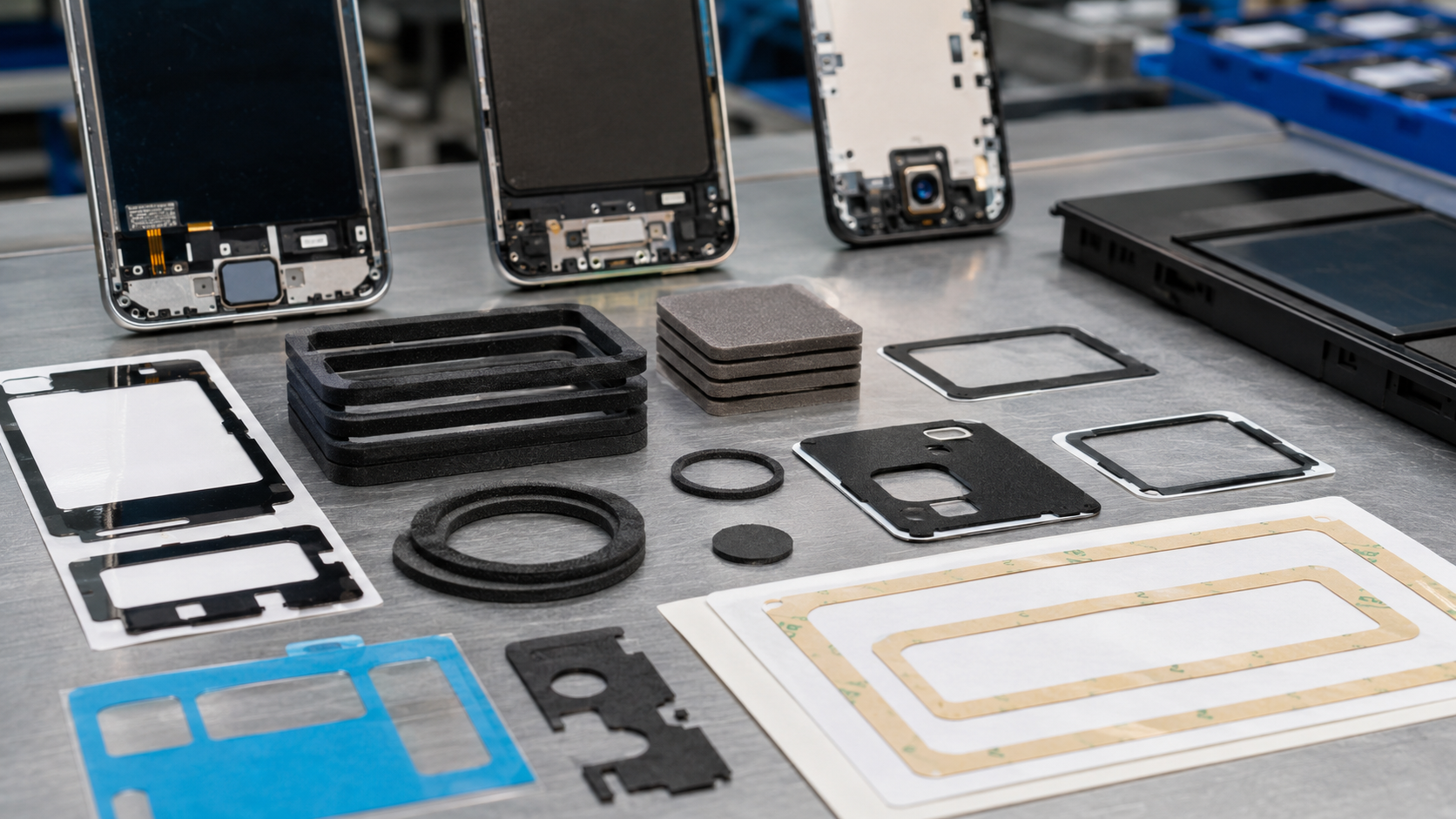
Common Die Cut Components Used in Electronics
Typical applications include:
- Battery insulation films
- Foam cushioning pads
- Light-blocking components
- Waterproof gaskets
- EMI shielding materials
- Display adhesives
- Sensor isolation components
- Thermal management materials
Each component contributes to both assembly efficiency and product reliability.
Quality Benefits of Die-Cut Components
Improved assembly consistency leads to:
Higher Production Yield
Fewer assembly defects increase output.
Reduced Rework
Operators spend less time correcting errors.
Better Reliability
Products perform more consistently in the field.
Lower Manufacturing Costs
Reduced scrap and higher yields improve profitability.
For high-volume electronics production, these benefits can be substantial.
How Sanken Manufacturing Supports Electronics Assembly
Dongguan Sanken Electronics Manufacturing Co., Ltd. specializes in precision die-cut solutions for consumer electronics, wearable devices, optical products, and electronic assemblies.
Our capabilities include:
- Precision die cutting
- PET insulation film converting
- Foam gasket manufacturing
- Light-blocking material processing
- Adhesive laminating
- EMI shielding solutions
- Cleanroom precision production
Key Advantages
- OEM and ODM customization
- ISO 9001 certified quality management
- RoHS and REACH compliant materials
- Domestic and overseas production bases
- Cleanroom manufacturing environment
- Tool development from drawings or samples
We support smartphones, wearable devices, display modules, battery systems, sensors, and other precision electronic applications.
Featured Snippet Summary
Die-cut parts help reduce assembly errors in small electronics by providing precise dimensions, accurate positioning, controlled adhesive placement, and compatibility with automated assembly systems. These advantages improve assembly consistency, increase manufacturing yields, and enhance product reliability.
Conclusion
As electronic devices continue to shrink in size and increase in complexity, assembly accuracy becomes increasingly important. Precision die-cut components help eliminate many common sources of assembly variation by providing ready-to-install parts with consistent dimensions and repeatable performance.
By integrating custom die-cut materials into electronic products, manufacturers can reduce assembly errors, improve quality, increase yields, and deliver more reliable products to the market.