
How Die Cut Parts Can Improve Product Assembly Consistency?
Manufacturers often focus on product design, materials, and production equipment when trying to improve quality. However, assembly consistency is frequently affected by something much simpler: small components that are difficult to position, align, or install correctly. A foam pad placed slightly off-center, a gasket installed at an angle, or an insulation film positioned incorrectly can create quality issues that are difficult to detect until final testing.
Die cut parts improve product assembly consistency by providing precise dimensions, repeatable positioning, simplified installation, controlled adhesive placement, and reduced operator variation. By converting materials into ready-to-install components, manufacturers can achieve more stable assembly processes, higher production yields, and better product reliability.
For automotive, consumer electronics, wearable devices, industrial equipment, and medical products, precision die-cut components often play a critical role in maintaining assembly quality.
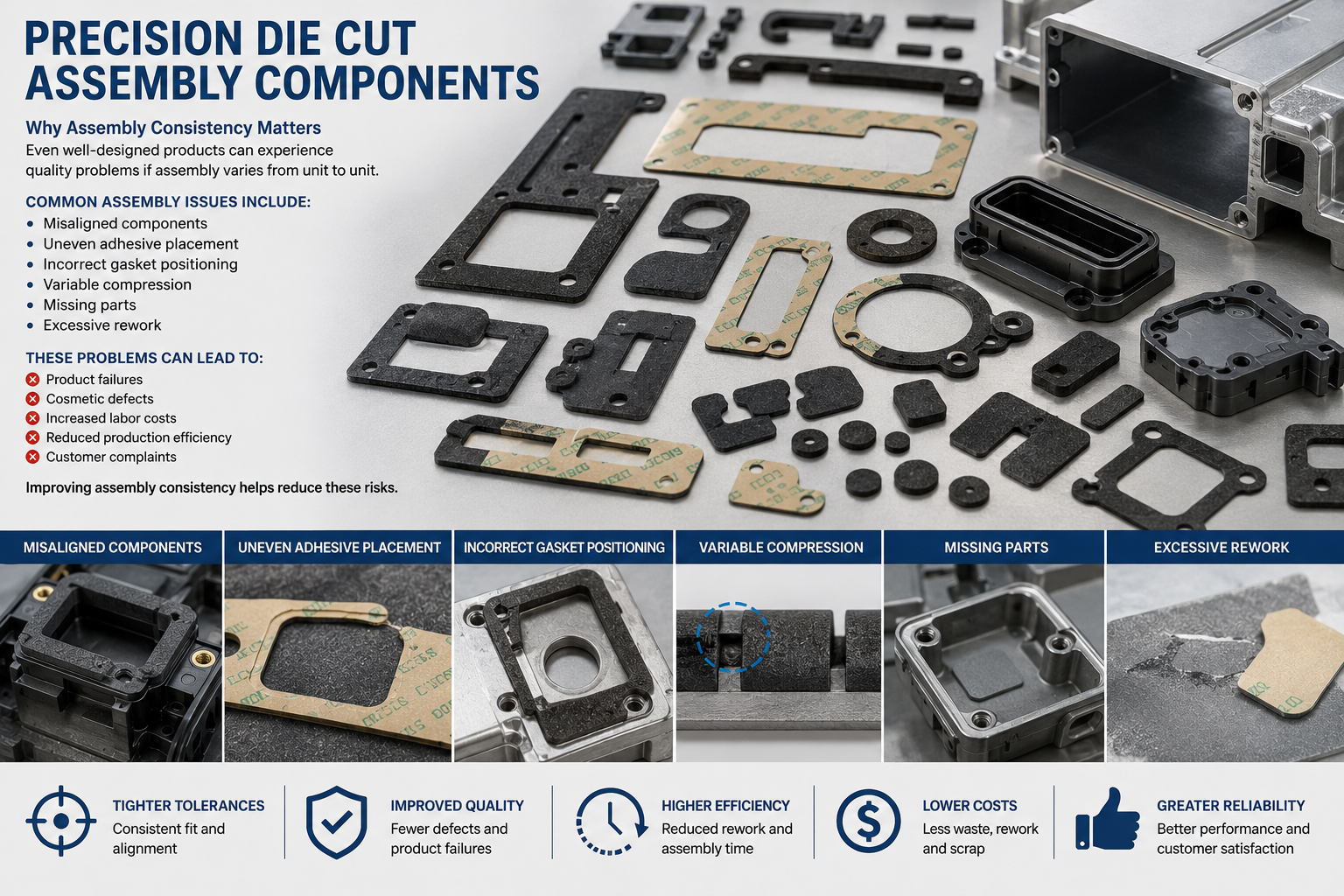
Why Assembly Consistency Matters
Even well-designed products can experience quality problems if assembly varies from unit to unit.
Common assembly issues include:
- Misaligned components
- Uneven adhesive placement
- Incorrect gasket positioning
- Variable compression
- Missing parts
- Excessive rework
These problems can lead to:
- Product failures
- Cosmetic defects
- Increased labor costs
- Reduced production efficiency
- Customer complaints
Improving assembly consistency helps reduce these risks.
Theme: Precision Die Cut Assembly Components
Eliminating Manual Cutting and Trimming
Manual material preparation introduces variation.
Operators may:
- Cut tape to different lengths
- Trim foam unevenly
- Create inconsistent shapes
- Position materials differently
Die-cut parts eliminate these variables by arriving in the final required shape.
Benefits include:
- Consistent dimensions
- Reduced labor
- Faster assembly
- Improved repeatability
Every part is produced using the same tooling and process.
Improving Positioning Accuracy
Many assembly defects occur because components are installed in slightly different locations.
Custom die-cut parts can include:
- Alignment holes
- Registration features
- Positioning tabs
- Installation guides
- Locator cutouts
These features help ensure components are installed in the correct position every time.
This is especially important for:
- Electronic modules
- Optical assemblies
- Battery systems
- Automotive components
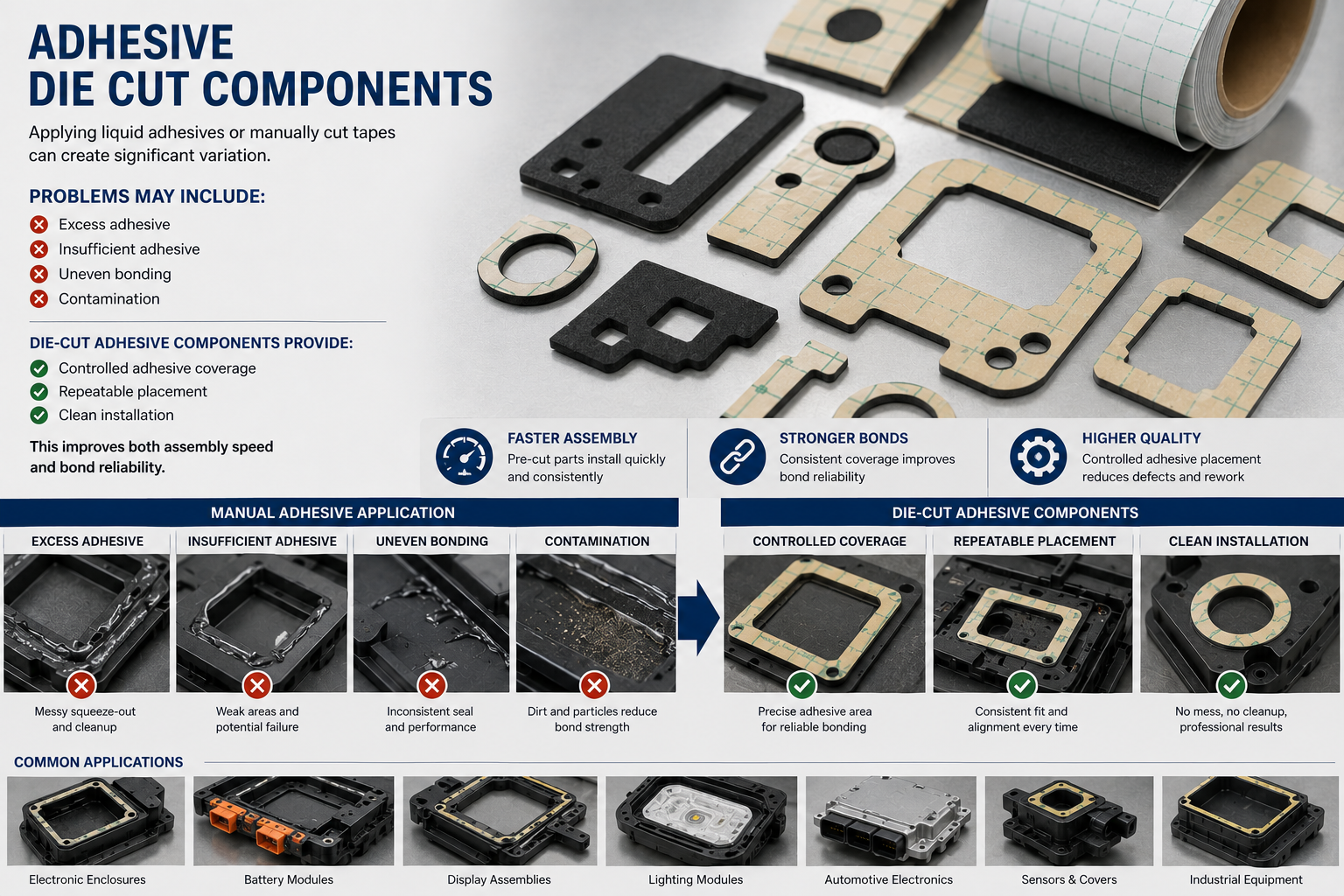
Simplifying Adhesive Application
Applying liquid adhesives or manually cut tapes can create significant variation.
Problems may include:
- Excess adhesive
- Insufficient adhesive
- Uneven bonding
- Contamination
Die-cut adhesive components provide:
- Controlled adhesive coverage
- Repeatable placement
- Clean installation
This improves both assembly speed and bond reliability.
Theme: Adhesive Die Cut Components
Supporting Automated Assembly
Modern manufacturing increasingly relies on automation.
Automated systems require:
- Consistent dimensions
- Stable part presentation
- Predictable release characteristics
Die-cut components supplied in roll format can be designed for:
- Pick-and-place equipment
- Automated dispensing
- Robotic assembly
Benefits include:
- Faster throughput
- Reduced operator dependence
- Improved process control
Automation-friendly die-cut parts help maintain consistency across large production volumes.
Reducing Component Movement During Assembly
Some components may shift during installation if they are not properly supported.
Examples include:
- Foam gaskets
- Insulation films
- Cushioning pads
- Sealing components
Custom die-cut parts can be engineered to:
- Fit precisely
- Maintain compression
- Prevent movement
- Improve stability
This reduces variation between assembled products.
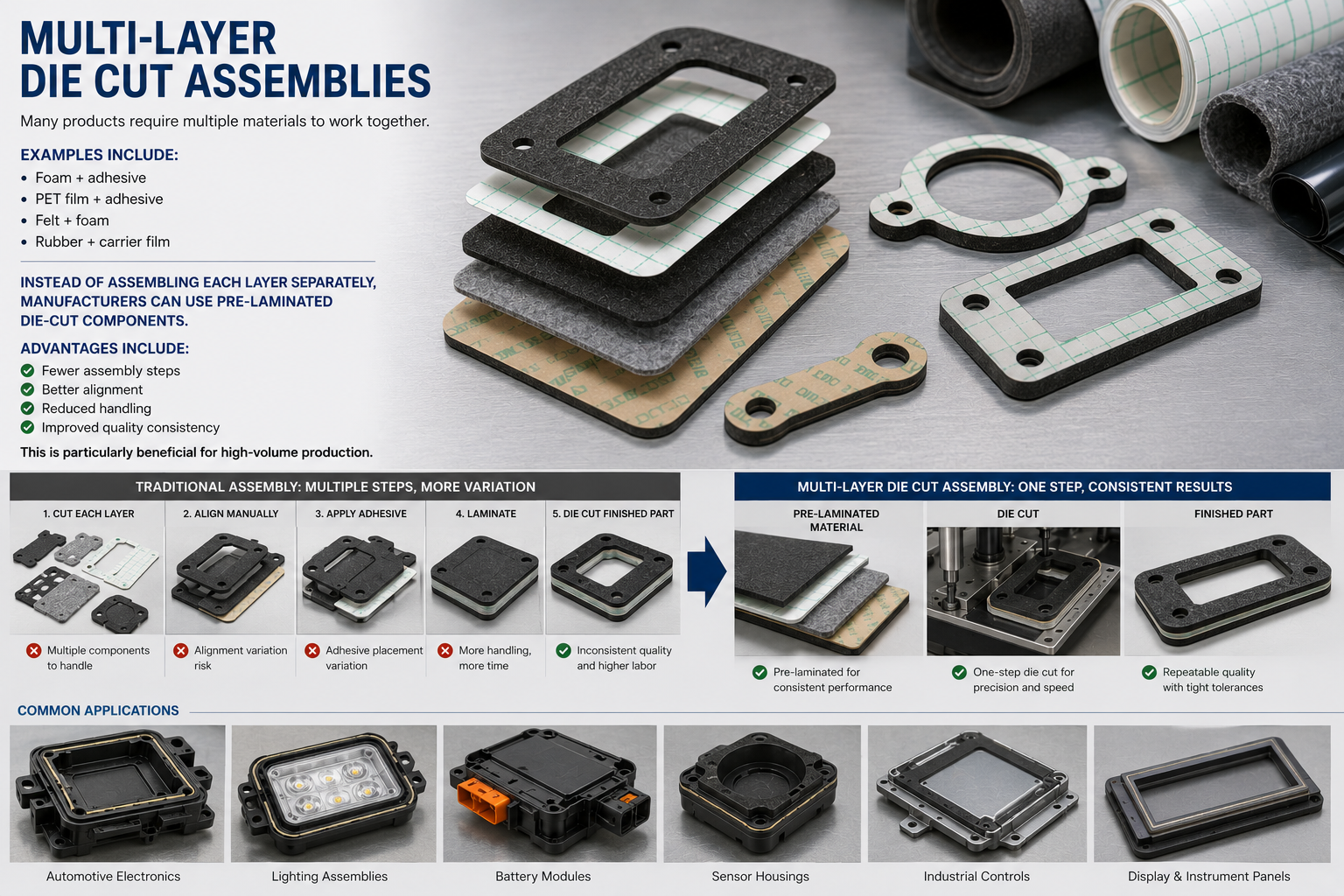
Improving Multi-Layer Assembly Accuracy
Many products require multiple materials to work together.
Examples include:
- Foam + adhesive
- PET film + adhesive
- Felt + foam
- Rubber + carrier film
Instead of assembling each layer separately, manufacturers can use pre-laminated die-cut components.
Advantages include:
- Fewer assembly steps
- Better alignment
- Reduced handling
- Improved quality consistency
This is particularly beneficial for high-volume production.
Theme: Multi-Layer Die Cut Assemblies
Enhancing Automotive Assembly Consistency
Automotive manufacturers use die-cut parts extensively to improve repeatability.
Applications include:
- NVH felt components
- Foam seals
- Wire harness protection
- Battery insulation materials
- Interior trim cushioning
Benefits include:
- Consistent fit
- Reduced rattles
- Faster installation
- Improved vehicle quality
Because automotive production volumes are high, even small improvements in assembly consistency can create significant savings.
Improving Consumer Electronics Production
Consumer electronics require extremely tight tolerances.
Die-cut components help ensure consistent assembly of:
- Display modules
- Battery packs
- Camera systems
- Optical sensors
- Wearable devices
Accurate positioning improves both product appearance and functionality.
Quality Benefits of Die-Cut Components
Improved assembly consistency often leads to:
Higher Yield
Fewer assembly errors result in more acceptable products.
Reduced Rework
Operators spend less time correcting mistakes.
Better Reliability
Products perform more consistently over time.
Lower Manufacturing Costs
Less waste and fewer defects reduce overall production expenses.
How Sanken Manufacturing Supports Consistent Assembly
Dongguan Sanken Electronics Manufacturing Co., Ltd. specializes in precision die-cut solutions that help OEM manufacturers improve assembly efficiency and consistency.
Our capabilities include:
- Precision die cutting
- Foam converting
- PET insulation film processing
- Non-woven felt manufacturing
- Adhesive laminating
- Multi-layer assembly solutions
- Rubber sealing products
Key Advantages
- OEM and ODM customization
- ISO 9001 certified quality management
- RoHS and REACH compliant materials
- Domestic and overseas production bases
- Cleanroom precision manufacturing
- Tool development from drawings or samples
We support automotive, consumer electronics, wearable devices, industrial equipment, medical products, and custom sealing applications.
Featured Snippet Summary
Die-cut parts improve product assembly consistency by providing precise dimensions, accurate positioning, controlled adhesive placement, simplified installation, and compatibility with automated assembly systems. These advantages help reduce assembly variation, improve quality, and increase manufacturing efficiency.
Conclusion
Assembly consistency is essential for product quality, manufacturing efficiency, and customer satisfaction. Custom die-cut components help eliminate many of the variables that cause assembly errors by providing ready-to-install parts with precise dimensions and repeatable performance.
By integrating precision die-cut materials into product designs, OEM manufacturers can achieve higher yields, lower costs, improved reliability, and more consistent production results without major changes to existing assembly processes.