
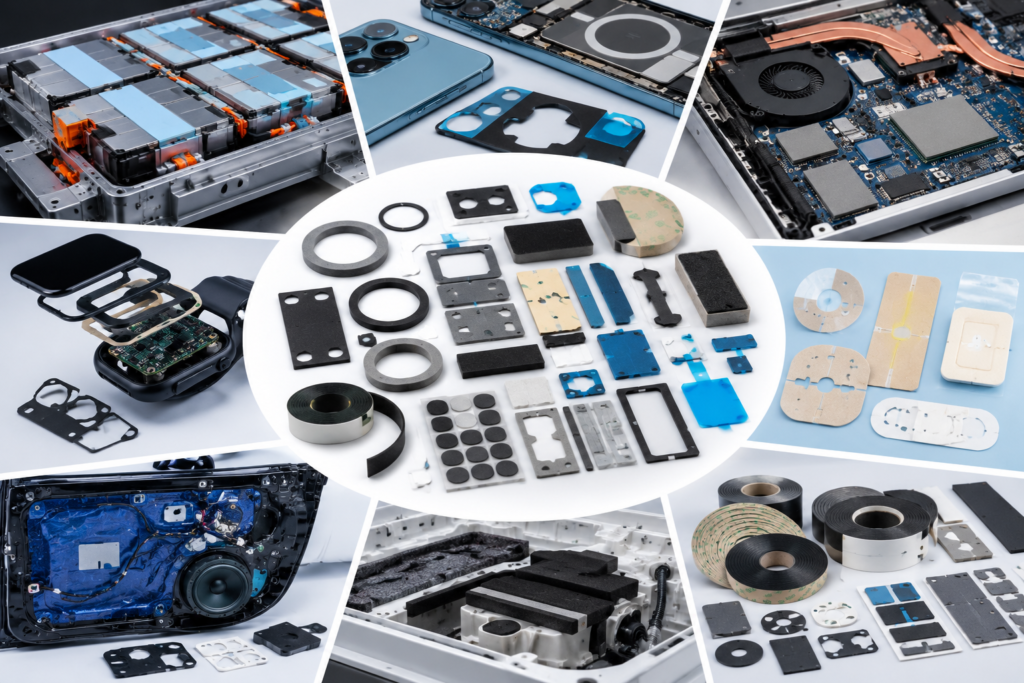
Reducing die-cut component cost without sacrificing quality is not simply about asking for a lower unit price. For OEM buyers and engineers, real cost reduction comes from better material selection, smarter tolerance control, manufacturable design, stable adhesive structure, efficient packaging, and fewer failed trials before mass production.
A die-cut part may look small, but it can create hidden costs if it causes assembly delay, high scrap rate, adhesive failure, poor sealing, or repeated tooling changes. At Sanken, we help OEM customers reduce cost by improving the full die-cut component design and production process, not by cutting corners on quality.
Why This Topic Matters for OEM Manufacturing
OEM manufacturers often use die-cut components in automotive electronics, consumer electronics, medical devices, appliances, battery modules, industrial equipment, and sealing systems.
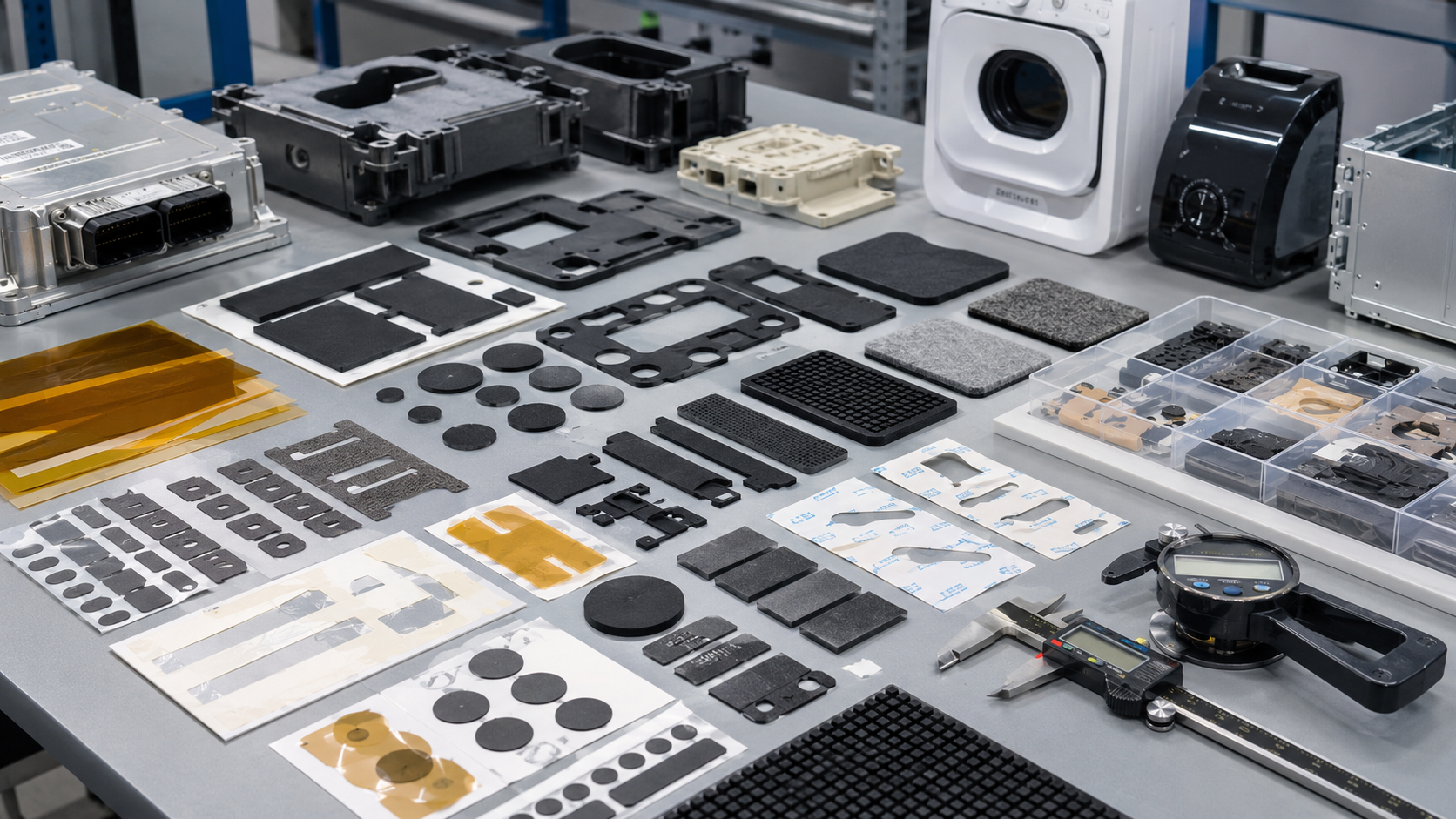
These parts may include foam gaskets, PET insulation films, rubber pads, adhesive-backed tapes, non-woven felt parts, protective films, cushioning spacers, and custom industrial components.
When buyers compare suppliers, it is tempting to focus only on the price per piece.
But the lowest piece price can become expensive if the part creates production problems.
For example, a foam gasket with poor tolerance may cause leakage or assembly rejection. A PET insulation film with poor hole alignment may slow down installation. An adhesive-backed tape part with bad liner release may waste operator time. A narrow foam part that tears during waste removal may increase scrap before the parts even reach the customer.
That is why cost reduction should be treated as an engineering decision.
The goal is not to make the cheapest part.
The goal is to make the right part at the lowest stable total cost.
Common Cost Problems and Production Risks
Many die-cut component costs are hidden inside the production process. Buyers may not see them in the quotation, but they appear later during sampling, assembly, inspection, or mass production.
| Cost Problem | Common Cause | Quality or Production Risk |
|---|---|---|
| High scrap rate | Narrow design, poor waste removal, unstable material | Higher real production cost |
| Repeated samples | Wrong material or unclear tolerance | Longer project timeline |
| Tooling changes | Design not reviewed before trial | Extra tooling cost |
| Slow assembly | Poor liner release or difficult peeling | Higher labor cost |
| Adhesive failure | Wrong adhesive or bonding surface mismatch | Rework and product failure |
| Over-tight tolerance | Tolerance stricter than function requires | Higher unit price |
| Poor packaging | Parts deform during shipping or storage | Assembly rejection |
| Low-cost material failure | Material not suitable for environment | Long-term reliability risk |
A professional die-cutting supplier should help buyers identify these costs early.
If a supplier only reduces cost by using cheaper material or loosening process control, quality risk increases.
Better cost reduction comes from design optimization, process planning, and stable production repeatability.
What Buyers or Engineers Should Check First
Before trying to reduce die-cut component cost, buyers should first understand which requirements are truly critical and which can be optimized.
| Checklist Item | What to Check | Cost Reduction Opportunity |
|---|---|---|
| Part function | Sealing, bonding, insulation, cushioning, protection | Avoid over-specifying material |
| Critical dimensions | Holes, slots, sealing walls, adhesive areas | Tighten only where needed |
| Material grade | Foam, rubber, PET, tape, felt, silicone | Match material to real application |
| Thickness | Required fit, compression, insulation, spacing | Avoid unnecessary thickness |
| Adhesive structure | Adhesive type, liner, bonding surface | Prevent peeling and overflow |
| Part layout | Nesting, scrap area, roll width | Improve material utilization |
| Tooling method | Flatbed, rotary, kiss cutting | Match process to volume |
| Packaging format | Roll, sheet, tray, kit, liner-backed | Reduce assembly and handling cost |
| Testing needs | Peel, compression, aging, insulation, sealing | Test what affects performance |
The key is to protect function while removing unnecessary cost.
For example, not every dimension needs the tightest tolerance. A screw hole or sealing wall may need strict control, but a non-functional outer edge may allow a wider tolerance.
This helps reduce production difficulty without weakening product performance.
Material Selection: Do Not Overpay or Under-Specify
Material selection is one of the biggest cost drivers in die-cut components.
A buyer may overpay by choosing a material that is stronger than the application requires. But choosing a material that is too cheap can create tearing, deformation, poor bonding, or early failure.
Foam materials should be selected based on compression, density, rebound, sealing needs, and environment. A high-cost foam is not always necessary, but a very soft low-cost foam may tear or lose compression too quickly.
PET insulation films should be selected based on thickness, dielectric requirement, dimensional stability, and assembly method. If the film is too thin, it may curl or become difficult to handle. If it is too thick, it may increase cost and create fit problems.
Adhesive tapes should be selected based on bonding surface, temperature, liner release, and assembly pressure. A stronger adhesive is not always better if it causes poor release or adhesive overflow.
Rubber parts should be selected based on hardness, rebound, heat resistance, oil resistance, and sealing load.
Non-woven felt parts should be selected based on thickness, fiber condition, acoustic performance, and cutting stability.
At Sanken, we help customers compare material options based on application performance, not only material price.
Tolerance Optimization Reduces Cost
Tolerance is another important cost factor.
Over-tight tolerance increases production difficulty, inspection time, tooling adjustment, and scrap rate.
Loose tolerance can reduce cost, but only if it does not affect function.
The best approach is to define critical and non-critical dimensions.
Critical dimensions may include:
- Screw holes
- Locating holes
- Sealing wall width
- Adhesive position
- Inner windows
- Electrical clearance areas
- Compression-related thickness
- Assembly reference edges
Non-critical dimensions may allow more flexibility.
For example, a PET insulation film may need accurate hole position around a connector, but the outer corner radius may not need the same precision. A foam gasket may need stable sealing wall width, but some non-contact areas may allow wider tolerance.
This type of engineering review helps reduce cost without reducing quality.
Design Choices That Reduce Die Cut Part Cost
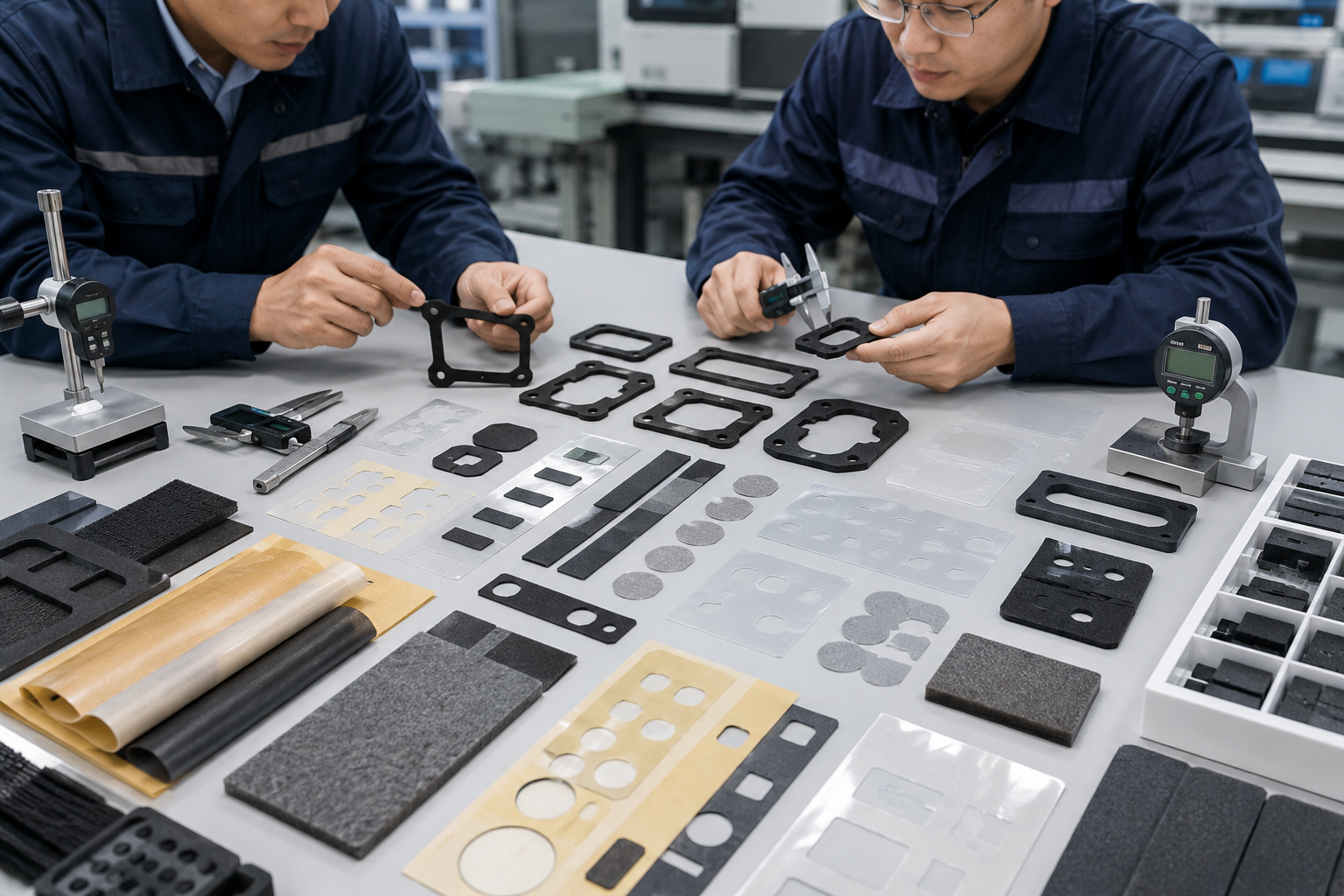
Many die cut part costs are decided before quotation. Part shape, corner radius, hole size, spacing, material width and tolerance all affect production difficulty and material waste.
OEM buyers and engineers can reduce cost by improving design details before tooling starts.
For example, rounded corners are often easier to cut than sharp internal corners. Wider sealing walls are usually more stable than extremely narrow foam strips. Larger holes may be easier to remove cleanly than very small holes. A part layout that matches roll width can reduce material waste.
Design optimization does not mean weakening the part. It means keeping the functional areas strong while removing unnecessary production difficulty.
Before mass production, Sanken can review drawings, samples, adhesive structure, waste removal risk and delivery format to help customers reduce hidden cost early.
Improve Material Utilization Through Better Layout
Material utilization directly affects cost.
If the part layout wastes too much material, the unit price increases. This is especially important for expensive foam, rubber, PET film, specialty adhesive tape, and multilayer laminated materials.
Better nesting can reduce scrap.
Changing the part orientation may improve yield.
Adjusting roll width can reduce waste.
Combining similar parts in one layout may improve production efficiency.
However, material savings should not damage quality.
If parts are placed too close together, waste removal may become difficult. Narrow bridges may tear. Adhesive-backed parts may lift. Holes may deform during stripping.
A good supplier should balance material utilization with stable production.
At Sanken, we review part layout, roll direction, waste removal, adhesive behavior, and handling method before mass production.
Choose the Right Process for the Order Volume
The die-cutting process should match the project volume, material, tolerance, and delivery format.
Flatbed die cutting may be suitable for thicker foam, rubber, sample trials, and lower-volume custom parts.
Rotary die cutting may be more efficient for roll materials, adhesive-backed parts, films, and higher-volume production.
Kiss cutting is useful for adhesive-backed components supplied on release liner.
Lamination may be needed when foam, PET film, rubber, or felt requires adhesive backing.
Choosing the wrong process can increase cost.
A process that is too simple may create poor quality. A process that is too advanced may increase cost unnecessarily.
The right supplier should recommend a process based on real production needs.
Packaging Can Reduce or Increase Total Cost
Packaging is often ignored in cost discussions.
But packaging affects assembly efficiency and part quality.
A low-cost packaging method may deform foam gaskets, bend PET films, contaminate adhesive surfaces, or make parts difficult to peel.
Better packaging can reduce labor cost and rejection rate.
Possible delivery formats include:
- Rolls
- Sheets
- Liner-backed parts
- Individual pieces
- Trays
- Kits
- Stacked sets
- Custom assembly formats
For OEM assembly, the best packaging is the format that protects the part and helps operators install it quickly.
For adhesive-backed parts, liner format and release direction matter.
For foam gaskets, compression during packaging must be avoided.
For PET films, flatness and cleanliness should be protected.
A slightly higher packaging cost may reduce much larger assembly costs later.
How Sanken Helps Reduce Cost Before Mass Production
Sanken Manufacturing Co., Ltd. helps OEM customers reduce die-cut component cost by improving the full project before mass production.
We review material selection, tolerance priorities, adhesive structure, tooling method, part layout, waste removal, inspection points, and packaging format.
For foam gasket projects, we check whether the selected foam density, thickness, compression range, and sealing wall width are suitable.
For PET insulation films, we review thickness, hole accuracy, clean edges, adhesive option, and packaging stability.
For adhesive-backed components, we review adhesive type, liner release, kiss cutting depth, overflow risk, and assembly method.
For rubber and non-woven felt parts, we review material behavior, edge quality, thickness, and final application environment.
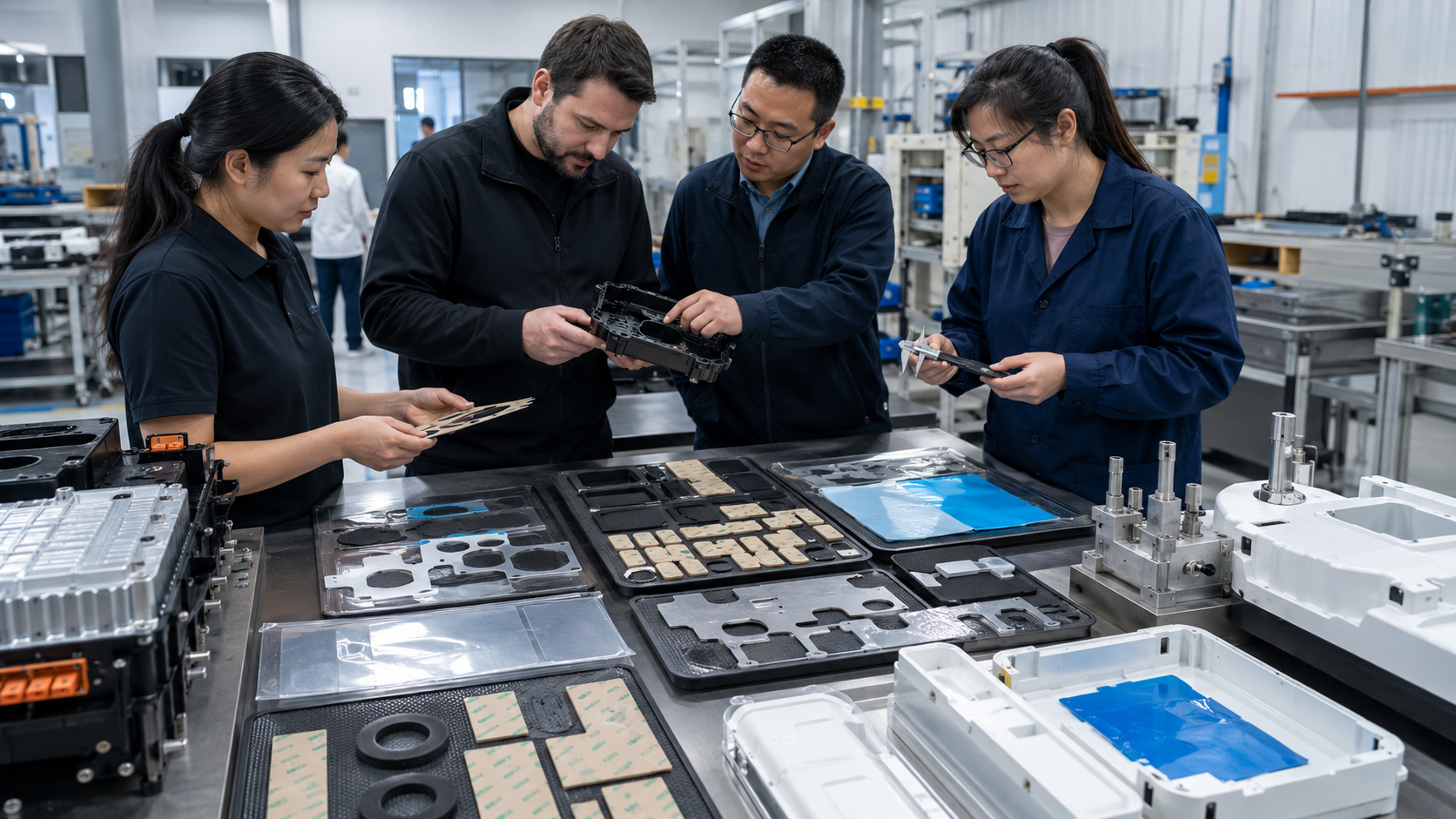
Our goal is to reduce unnecessary cost while protecting the part function.
This helps customers avoid repeated trials, reduce scrap, improve assembly efficiency, and reach stable mass production with better total cost control.
FAQ
How can OEM buyers reduce die-cut component cost?
OEM buyers can reduce cost by optimizing material selection, tolerance requirements, part layout, tooling method, adhesive structure, packaging format, and trial validation before mass production.
Is the cheapest material always the best choice?
No. A cheaper material may increase total cost if it causes tearing, deformation, poor bonding, weak sealing, or high rejection rate. The material should match the real application requirement.
Can tolerance affect die-cut component cost?
Yes. Over-tight tolerance can increase tooling adjustment, inspection time, scrap rate, and production difficulty. Critical dimensions should be tightly controlled, while non-critical dimensions can often be more flexible.
How does part layout reduce cost?
Better part layout can improve material utilization and reduce waste. However, layout must also allow clean cutting, stable waste removal, and safe handling.
Why does packaging affect cost?
Packaging affects whether parts arrive flat, clean, undamaged, and easy to assemble. Poor packaging can create deformation, contamination, slow assembly, or rejected parts.
Can adhesive-backed die cut parts be cost optimized?
Yes. Cost can be optimized by selecting the right adhesive, liner, kiss cutting depth, part spacing, roll or sheet format, and assembly-friendly packaging.
How can Sanken help reduce die-cut component cost?
Sanken helps customers review material, tolerance, adhesive structure, tooling, waste removal, inspection, packaging, and production repeatability before mass production, reducing hidden cost without sacrificing quality.
Conclusion
Reducing die-cut component cost without sacrificing quality requires more than negotiating a lower unit price. It requires better material selection, practical tolerance control, improved layout, suitable tooling, stable adhesive structure, efficient packaging, and early engineering review.
At Sanken, we help OEM buyers and engineers reduce hidden cost while protecting function, reliability, and mass production stability for foam, rubber, PET film, adhesive tape, non-woven felt, and custom precision die-cut components.