
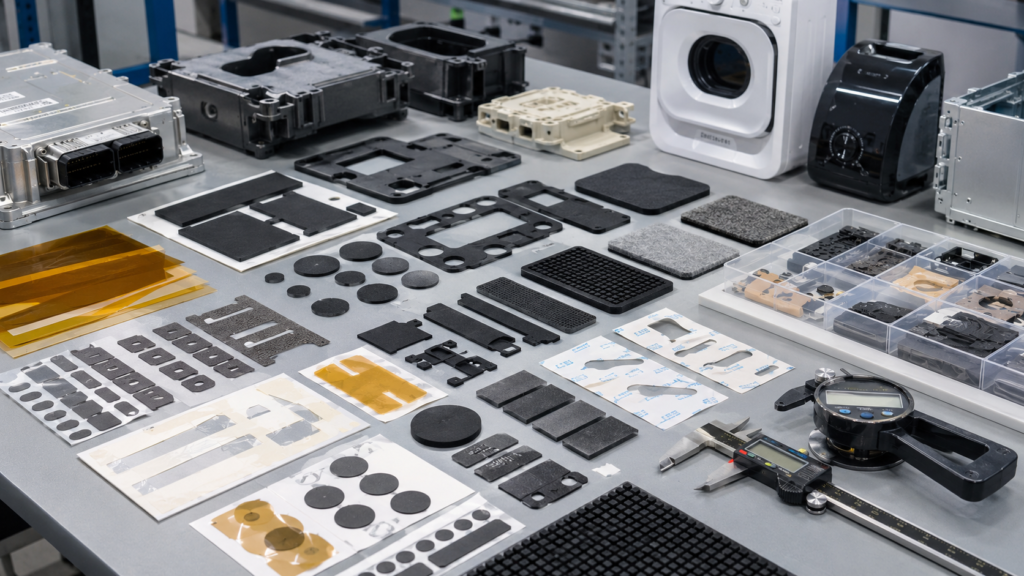
Purchasing managers can qualify a die-cutting supplier by looking beyond the quotation sheet. A low unit price and a clean-looking sample do not always prove that the supplier can control material behavior, tolerance, adhesive lamination, waste removal, inspection, packaging, and batch repeatability.
For OEM buyers, this matters because die-cut components are often hidden inside the final product. A foam gasket may protect automotive electronics from dust and vibration. A PET insulation film may prevent electrical contact. An adhesive-backed tape part may support fast assembly. A non-woven felt pad may reduce noise and rattling. If the supplier is not properly qualified, the risk may appear later as failed samples, rejected batches, assembly delays, or customer complaints.
At Sanken, we believe supplier qualification should focus on real production risk, not only company size, price, or delivery promises.
Why This Topic Matters for OEM Manufacturing
Die-cutting suppliers are not all the same.
Some suppliers only cut simple shapes. Others can support material converting, adhesive lamination, kiss cutting, tolerance review, waste removal planning, inspection, and custom packaging.
For purchasing managers, the difference becomes important when the part is used in automotive, electronics, medical, appliance, battery, or industrial OEM applications.
A die-cut component may need to meet several requirements at the same time:
- Accurate dimensions
- Stable thickness
- Clean edges
- Smooth liner release
- Reliable adhesive bonding
- Good compression behavior
- Consistent batch quality
- Assembly-friendly packaging
If any of these points fail, the buyer may face hidden costs. These costs may include repeated sampling, tooling changes, emergency rework, delayed production, higher scrap rate, or supplier replacement.
That is why a purchasing manager should qualify both the supplier and the process.
Common Supplier Qualification Risks
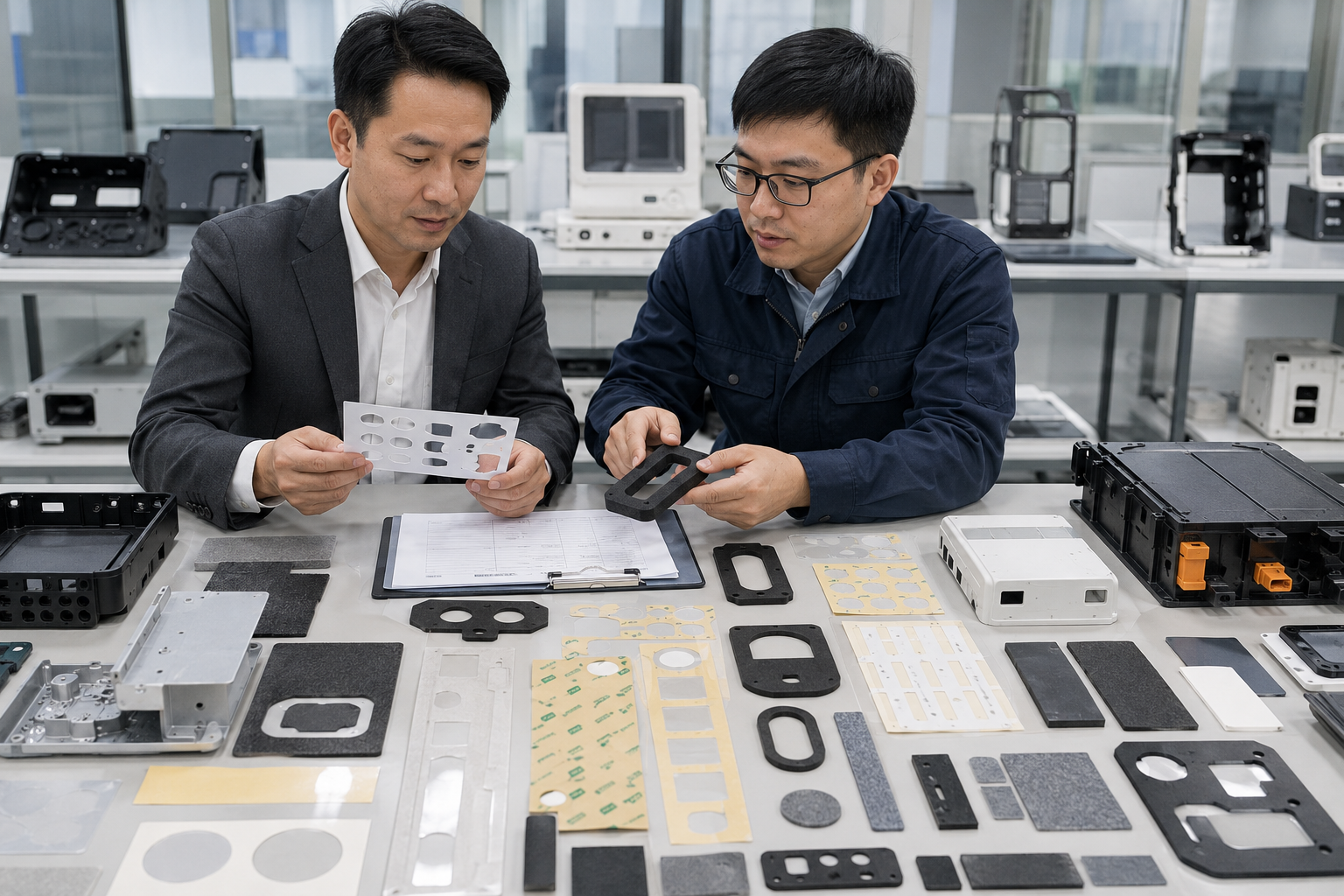
Many sourcing problems happen because the supplier is approved too early. A buyer may see a competitive price and one acceptable sample, but the supplier may still lack the process control needed for mass production.
| Supplier Risk | What It Means | Possible OEM Impact |
|---|---|---|
| Quoting only by drawing | Application details are ignored | Wrong material or unstable function |
| Weak tolerance control | Holes, edges, or sealing areas shift | Assembly mismatch |
| Poor adhesive lamination | Adhesive moves, overflows, or peels | Contamination or bonding failure |
| No waste removal plan | Parts tear or deform after cutting | Low yield and unstable supply |
| Poor sample-to-production transfer | Sample passes but batch fails | Delayed mass production |
| Limited inspection process | Defects are not caught early | Higher rejection rate |
| Poor packaging design | Parts bend, compress, or stick together | Assembly difficulty |
| Slow technical communication | Problems are not solved quickly | Project delay |
The lowest quotation is not always the lowest total cost.
If one rejected batch affects an assembly line, the cost of delay can be much higher than the price difference between suppliers.
What Purchasing Managers Should Check First
A good supplier qualification process should include both purchasing and engineering questions.
| Qualification Item | What to Ask the Supplier | Why It Matters |
|---|---|---|
| Application understanding | Do you ask where and how the part is used? | Confirms the supplier understands function |
| Material capability | Can you process foam, rubber, PET, tape, felt, and silicone? | Shows material converting experience |
| Adhesive lamination | Can you control adhesive, liner, and kiss cutting? | Reduces peeling and overflow risks |
| Tolerance control | Can you identify critical dimensions? | Protects assembly accuracy |
| Tooling method | Which die-cutting process is suitable for this part? | Matches material, tolerance, and volume |
| Sample validation | How do you verify trial parts? | Reduces repeated sample failures |
| Inspection process | What dimensions and defects are checked? | Protects batch consistency |
| Packaging support | Can parts be supplied in rolls, sheets, trays, or kits? | Supports assembly efficiency |
| Mass production repeatability | How do you control batch stability? | Reduces long-term supply risk |
Purchasing managers should not approve a supplier only because the first sample looks clean.
The supplier must show that the sample result can be repeated during production.
Material and Process Considerations
Different die-cut materials require different supplier capabilities.
Foam materials are often used for sealing, cushioning, gap filling, vibration reduction, dust protection, and acoustic control. A supplier should understand foam density, thickness, compression recovery, minimum wall width, and tearing risk.
Rubber materials are used for sealing, anti-slip pads, shock absorption, and protective components. Rubber requires stable thickness, clean edges, suitable cutting pressure, and rebound control.
PET, PI, and PC films are used for insulation, spacing, protection, and electronics assembly. These materials require accurate holes, clean edges, flatness, and dimensional stability.
Adhesive tapes and transfer adhesives are used for bonding and assembly support. The supplier must control adhesive lamination, kiss cutting depth, liner release, adhesive overflow, and part spacing.
Non-woven felt materials are used for automotive NVH, sound absorption, anti-rattle pads, cushioning, and filtration. The supplier should understand thickness variation, fiber condition, cutting cleanliness, and packaging.
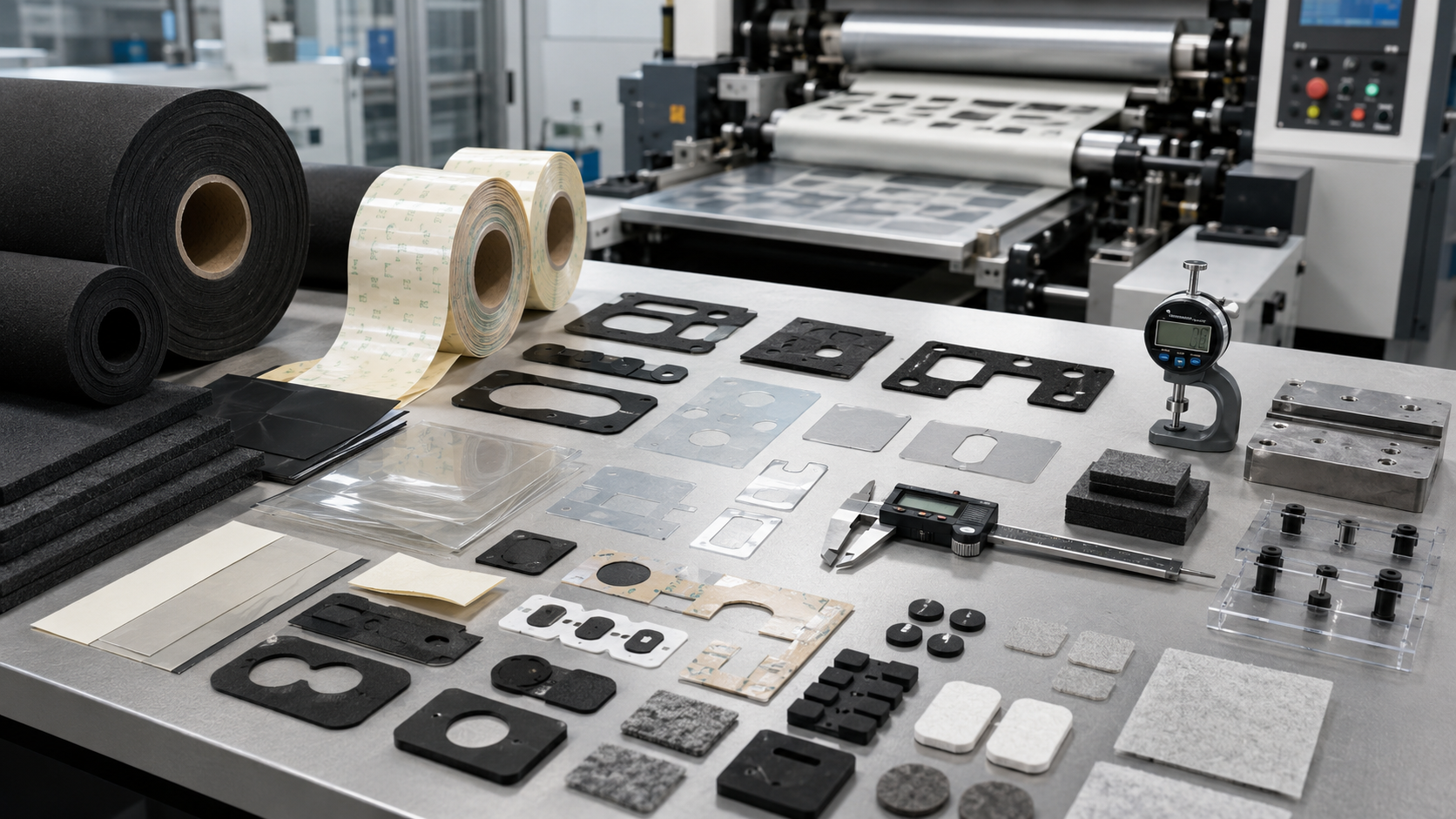
A qualified die-cutting supplier should not use the same process for every material.
Flatbed die cutting may work well for thicker foam, rubber, and low-to-medium volume custom parts. Rotary die cutting may be more suitable for roll materials, adhesive-backed parts, films, and higher-volume production. Kiss cutting is important when adhesive-backed parts must stay on a release liner for easy assembly.
The right process depends on material behavior, part design, tolerance, volume, and delivery format.
How to Evaluate Engineering Support
Engineering support is one of the most important signs of a qualified die-cutting supplier.
A basic supplier may say, “Send us the drawing and quantity.”
A better supplier will ask practical questions before quoting.
For example:
- What is the final application?
- Is the part used for sealing, bonding, insulation, cushioning, or sound absorption?
- Which dimensions are critical?
- Does the part need adhesive backing?
- What is the bonding surface?
- What temperature, humidity, vibration, or compression will the part face?
- How will the customer assemble the part?
- Should the parts be supplied in rolls, sheets, trays, or individual pieces?
- What inspection or testing method will be used?
These questions help prevent trial failures.
A supplier that asks the right questions before quoting is usually more valuable than a supplier that only responds with the lowest price.
How to Review Samples Before Approval
Sample approval should not be based only on appearance.
Purchasing managers should work with engineers to confirm whether the sample can support actual production and assembly.
Key sample checks include:
- Outer dimensions
- Hole alignment
- Thickness consistency
- Edge quality
- Adhesive position
- Liner release
- Compression fit
- Waste removal condition
- Packaging condition
- Assembly trial result
For adhesive-backed parts, peeling behavior is especially important. If operators need too much force to peel the part, the component may stretch or deform.
For foam gaskets, compression fit should be checked in the real housing whenever possible.
For PET insulation films, hole alignment, flatness, and edge cleanliness should be checked carefully.
For non-woven felt parts, thickness consistency and edge fiber condition should be reviewed.
A good sample should be more than clean. It should be repeatable, easy to assemble, and suitable for mass production.
Why Supplier Qualification Should Include Packaging
Packaging is often ignored during supplier qualification, but it can affect part quality and assembly efficiency.
Foam gaskets may deform if they are compressed during packing.
PET insulation films may curl or bend if they are not protected.
Adhesive-backed parts may stick together if the liner or stacking method is wrong.
Small parts may slow assembly if they are not supplied in a convenient format.
A qualified supplier should recommend a packaging method based on the material, shape, adhesive structure, and customer assembly process.
Common delivery formats include:
- Rolls
- Sheets
- Individual pieces
- Liner-backed parts
- Trays
- Kits
- Custom assembly-ready formats
Good packaging protects the part and reduces handling time for the customer.
How Sanken Helps Reduce Supplier Qualification Risk
Sanken Manufacturing Co., Ltd. supports OEM customers with precision die cutting, material converting, adhesive lamination, foam and rubber components, PET insulation films, non-woven felt parts, sealing gaskets, automotive electronics components, and custom industrial parts.
For purchasing managers, our value is not only production capacity.
We help customers review risk before mass production.
For foam gasket projects, we check density, thickness, compression range, sealing wall width, hole position, hole-to-edge distance, and tearing risk.
For adhesive-backed components, we review adhesive type, bonding surface, liner release, lamination stability, kiss cutting depth, and overflow risk.
For PET insulation films, we focus on hole accuracy, edge cleanliness, dimensional stability, adhesive option, and packaging.
For non-woven felt and acoustic parts, we review thickness, fiber condition, cutting edge, and application environment.
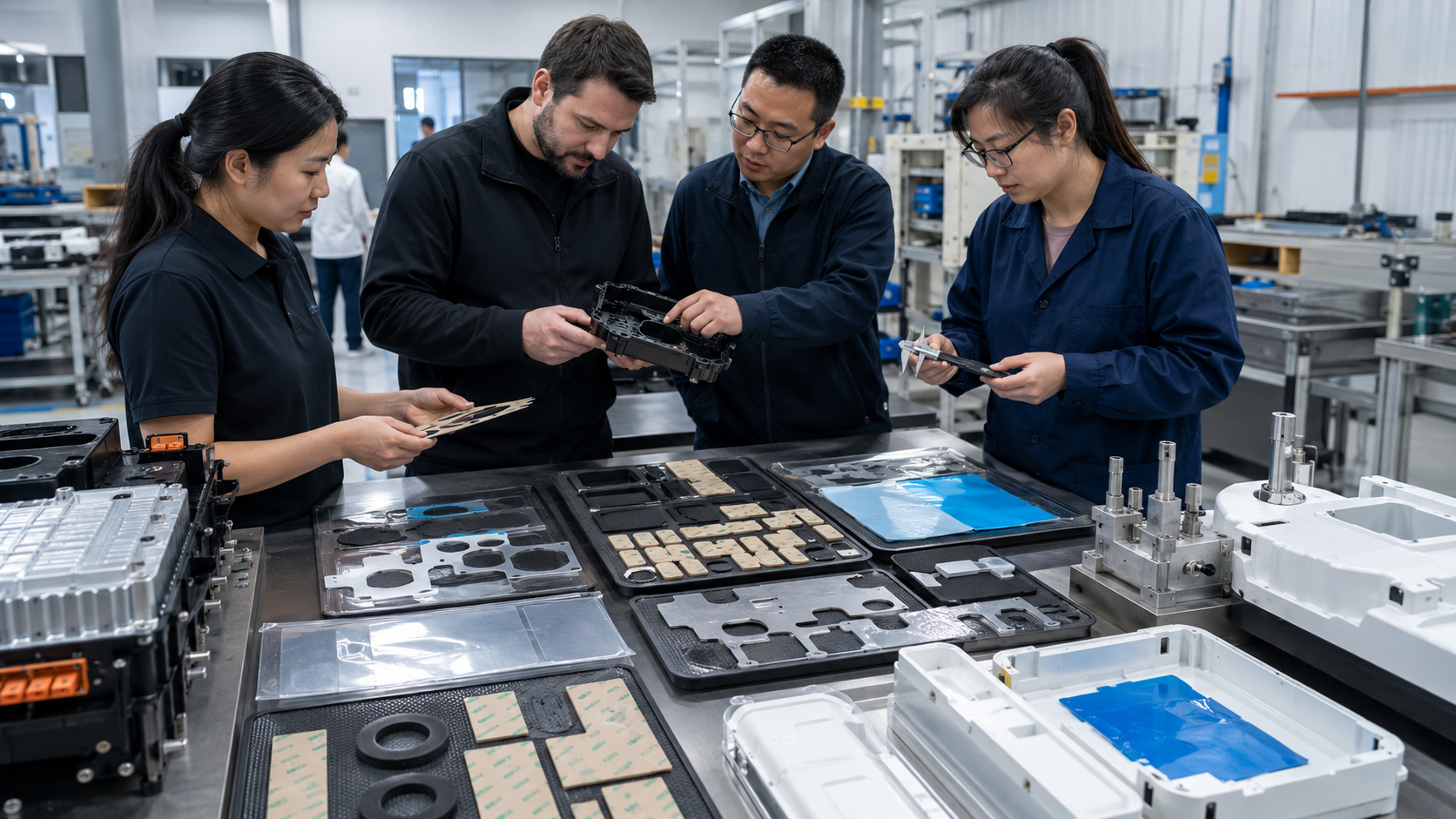
This helps purchasing managers reduce repeated trials, unstable quality, hidden production cost, and supplier communication risk.
A good supplier should help the buyer qualify the part and the process, not only the price.
FAQ
How can purchasing managers qualify a die-cutting supplier?
Purchasing managers can qualify a die-cutting supplier by reviewing material capability, engineering support, adhesive lamination, tolerance control, sample validation, inspection process, packaging options, and mass production repeatability.
Is the lowest quotation the best choice?
Not always. A low quotation may become expensive if the supplier causes repeated samples, poor assembly fit, high scrap rate, adhesive failure, delivery delay, or rejected batches.
What documents should buyers ask from a die-cutting supplier?
Buyers may ask for a company profile, capability overview, material options, sample inspection report, process flow, quality control method, packaging proposal, and production experience related to the target application.
Why is engineering communication important?
Engineering communication helps identify risks before tooling. It can prevent problems such as wrong material selection, unrealistic tolerance, adhesive overflow, foam tearing, liner release failure, and poor assembly performance.
How should buyers evaluate die cut samples?
Buyers should check dimensions, holes, edges, thickness, adhesive position, liner release, compression fit, packaging, and assembly performance. Visual appearance alone is not enough.
What industries need qualified die-cutting suppliers?
Automotive electronics, consumer electronics, medical devices, appliances, battery systems, industrial equipment, optical devices, and automotive interiors all need qualified die-cutting suppliers.
Conclusion
Purchasing managers can qualify a die-cutting supplier by looking beyond price and sample appearance. A reliable supplier should understand materials, adhesive lamination, tolerance control, tooling, waste removal, inspection, packaging, and mass production repeatability.
At Sanken, we help OEM buyers qualify die-cut components before mass production, so sourcing decisions can reduce cost, improve assembly stability, and protect long-term product quality.