
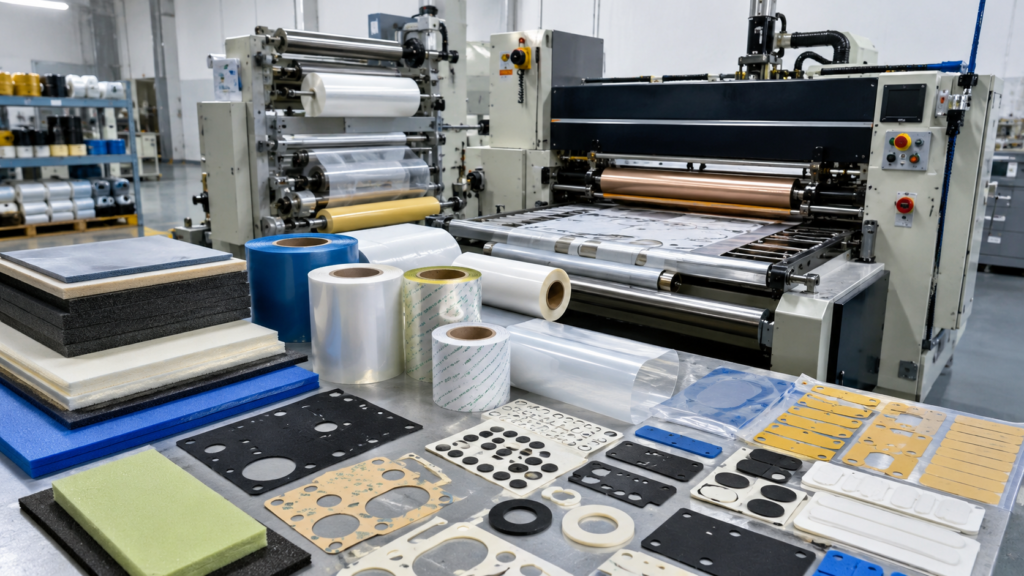
Choosing the right die cutting manufacturer for your OEM project is not only about finding the lowest price. A reliable supplier should understand your material, drawing, tolerance, adhesive structure, assembly method, testing needs and mass production risks.
For OEM buyers and engineers, die cut parts are often small but critical. A foam gasket may control sealing, a PET film may provide insulation, a double-sided tape part may support bonding, and a non-woven felt pad may reduce noise. If these parts fail, the whole product can be affected.
At Sanken, we help OEM customers develop custom die cut foam gaskets, adhesive tape components, PET insulation films, protective films, rubber pads, non-woven felt parts and multilayer converted parts for automotive, electronics, appliance and industrial applications.
Why Choosing the Right Manufacturer Matters
Many die cut components look simple on a drawing. But in real production, foam, rubber, adhesive tape, PET film, PI film, protective film, and non-woven felt all behave differently during cutting, lamination, peeling, packaging, and assembly.
A supplier that only cuts shapes may miss important risks.
For example:
- Foam may compress during cutting.
- Rubber may rebound after cutting.
- Adhesive tape may overflow at the edge.
- PET film may stretch or shift.
- Non-woven felt may shed fibers.
- Release liner may tear if kiss cutting is too deep.
- Narrow gasket walls may deform during waste removal.
- Packaging pressure may bend or curl finished parts.
A qualified die cutting manufacturer should understand these risks before mass production starts.
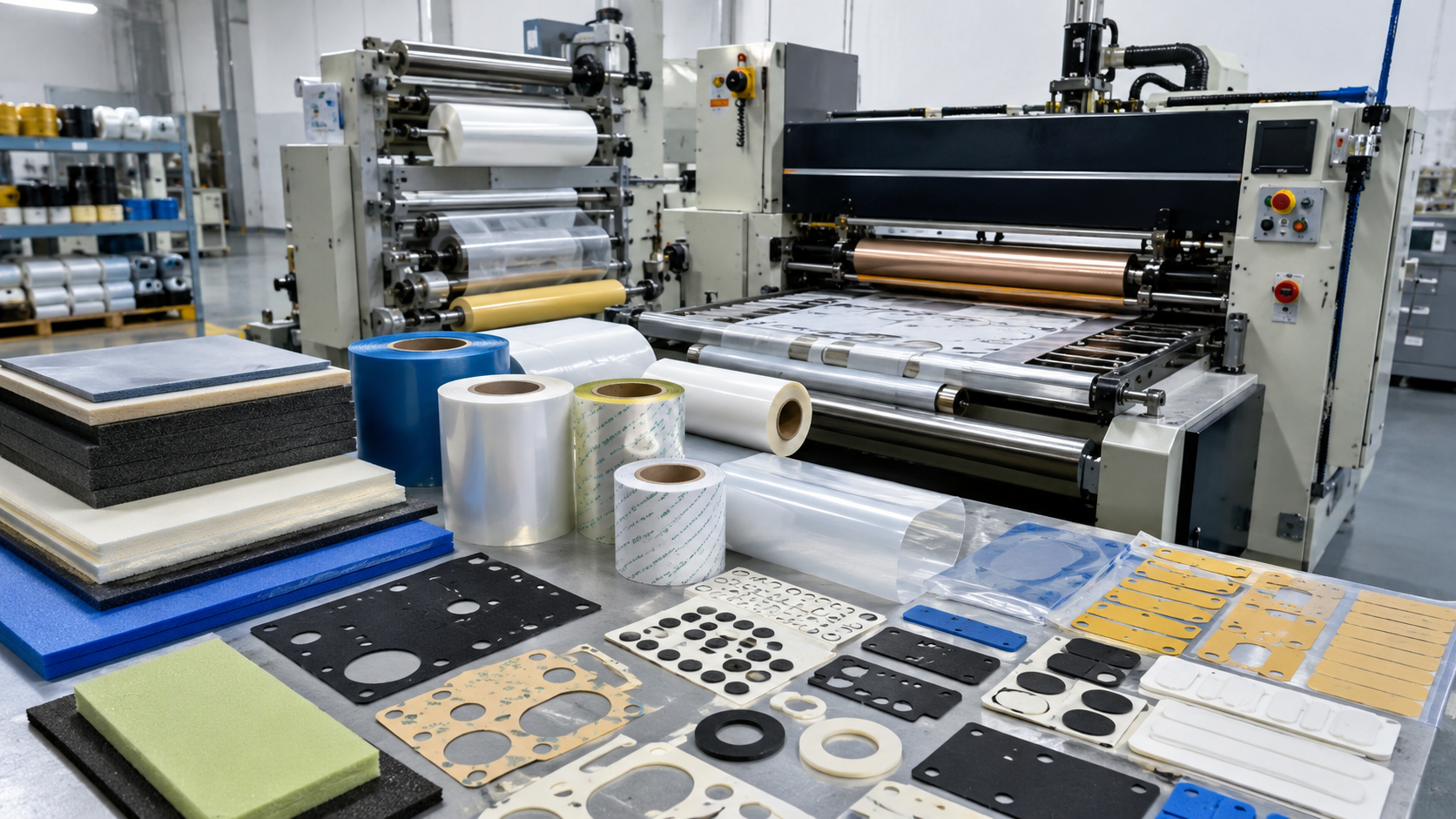
Start With Your Application Requirements
Before comparing suppliers, buyers should define what the die cut part needs to do.
A part used for sealing has different requirements from a part used for bonding, insulation, cushioning, protection, or noise reduction. The supplier cannot choose the right material or process without understanding the final application.
| Application Need | Common Die Cut Materials | Key Requirement |
|---|---|---|
| Sealing | Foam, rubber, EPDM foam, silicone foam | Compression recovery and fit |
| Bonding | Double-sided tape, transfer adhesive, foam tape | Adhesive strength and liner release |
| Electrical insulation | PET film, insulation film | Clean edge and dimensional accuracy |
| Surface protection | Protective film, PET film | Residue-free peeling |
| Cushioning | PU foam, PE foam, EVA foam | Compression and shock absorption |
| NVH noise reduction | Non-woven felt, foam, rubber | Anti-rattle and friction control |
| Light blocking | Black foam, black PET, light-blocking film | Opacity and clean profile |
The best supplier will ask questions about the real product, not only the material name.
Check Material Knowledge
Material knowledge is one of the most important signs of a reliable die cutting manufacturer.
A professional supplier should understand the difference between EVA foam, PE foam, PU foam, EPDM foam, silicone foam, PET film, PI film, rubber, non-woven felt, protective film, transfer adhesive, and double-sided tape.
They should also know how each material behaves during converting.
For foam parts, the supplier should review density, thickness, compression force, cell structure, rebound, and adhesive backing.
For adhesive tape parts, the supplier should review adhesive type, carrier material, liner release, bonding surface, peel strength, and temperature resistance.
For PET and PI films, the supplier should review dimensional stability, hole accuracy, burr control, edge cleanliness, and insulation requirements.
For non-woven felt, the supplier should review fiber shedding, density, thickness, and edge control.
A supplier that cannot explain material risks may not be ready for OEM projects.
Review Die Cutting Process Capability
Different projects require different die cutting processes.
Common processes include rotary die cutting, flatbed die cutting, kiss cutting, through cutting, perforation, slitting, lamination, and waste removal.
| Process | Best For | Main Advantage |
|---|---|---|
| Rotary die cutting | Roll-fed films, tapes and thin foams | High-speed repeatability |
| Flatbed die cutting | Thick foam, rubber and sheet parts | Flexibility and material thickness |
| Kiss cutting | Adhesive-backed parts on liner | Easy peeling and assembly |
| Through cutting | Individual parts | Full material separation |
| Perforation | Tear lines, venting or controlled separation | Functional opening or release |
| Lamination | Multilayer material structures | Combines foam, film, tape and liner |
| Slitting | Roll width conversion | Better material preparation |
The supplier should choose the process based on material, thickness, tolerance, quantity, part shape, adhesive structure, and delivery format.
For example, thin adhesive-backed PET parts may be suitable for rotary kiss cutting. Thick foam pads may be better for flatbed die cutting. Complex multilayer adhesive components may need lamination before cutting.
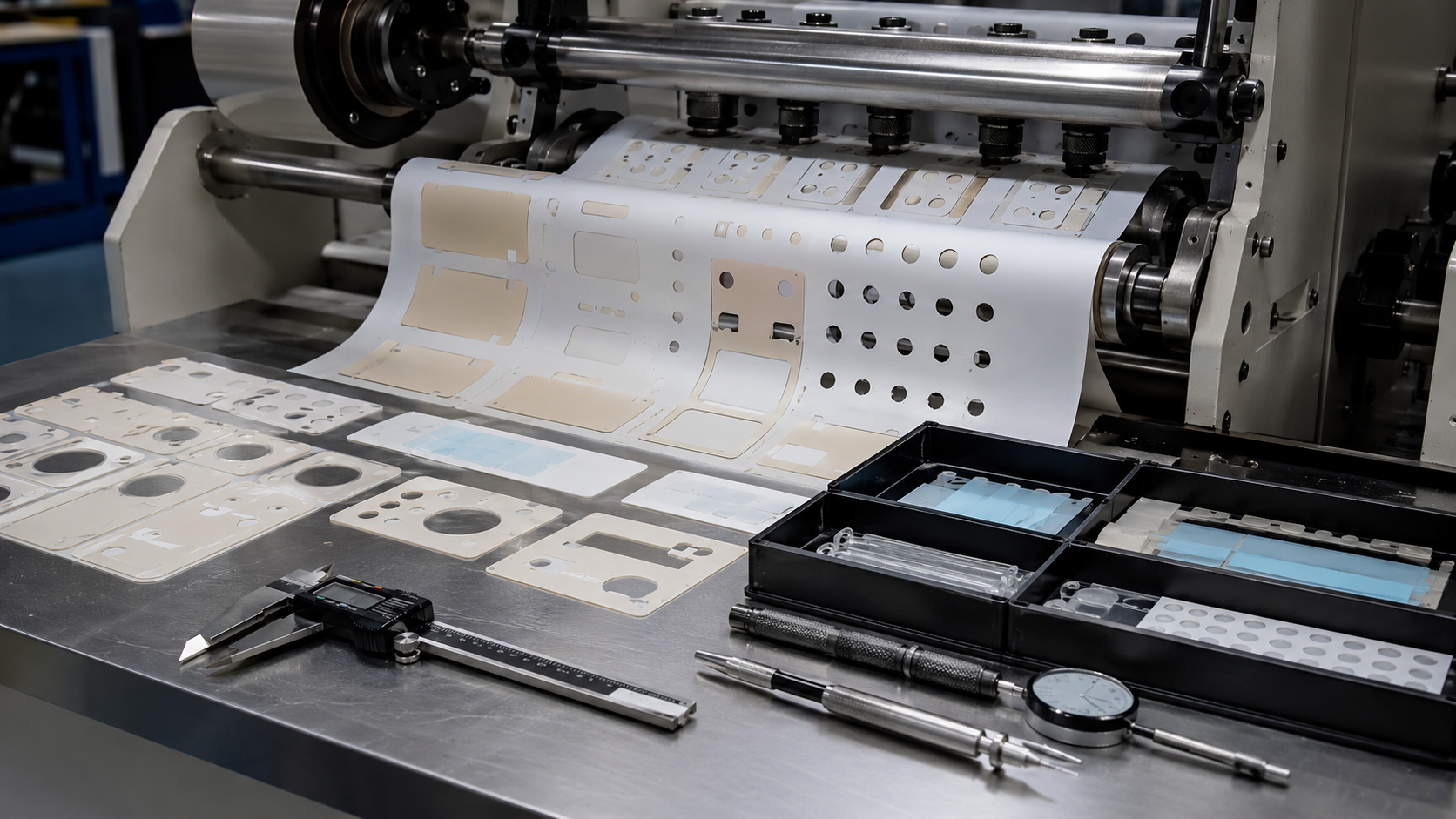
Ask About Tolerance and Drawing Review
Tolerance is not only a number on a drawing. It must match the material and process.
Soft foam cannot always hold the same tolerance as PET film. Rubber may rebound. Thin film may stretch. Adhesive tape may deform during peeling. Thick foam may compress under cutting pressure.
A good die cutting manufacturer should review:
- Outer profile tolerance
- Hole position tolerance
- Material thickness tolerance
- Adhesive position tolerance
- Minimum wall width
- Small hole manufacturability
- Sharp corner risk
- Waste removal difficulty
- Assembly clearance
If a supplier accepts every drawing without review, that may be a warning sign.
A professional manufacturer should point out design risks early and suggest practical improvements when needed.
Check Adhesive and Liner Control
Many OEM die cut parts are adhesive-backed. This means adhesive and liner control are just as important as cutting accuracy.
Common adhesive-backed parts include:
- Foam tape gaskets
- Double-sided tape pads
- PET adhesive films
- Protective film tabs
- Medical adhesive components
- Battery insulation adhesive parts
- Display bonding tapes
- Automotive electronic adhesive pads
Common adhesive risks include edge lifting, adhesive overflow, poor bonding, difficult liner release, liner tearing, residue, and part deformation during peeling.
The supplier should check the bonding surface, adhesive type, liner release force, kiss cutting depth, cutting pressure, and packaging method.
A strong adhesive is not always the best adhesive. The adhesive must match the application surface, assembly pressure, temperature, dwell time, and final environment.
Evaluate Quality Control Before Mass Production
Quality control should start before mass production, not after defects appear.
A qualified die cutting manufacturer should have inspection steps for incoming materials, first article samples, in-process production, final inspection, and packaging.
Important inspection items include:
| Inspection Item | Why It Matters |
|---|---|
| Material thickness | Controls fit and compression |
| Outer dimensions | Protects assembly accuracy |
| Hole alignment | Prevents assembly mismatch |
| Edge quality | Reduces particles and poor appearance |
| Adhesive position | Prevents bonding failure |
| Liner release | Improves assembly speed |
| Cutting depth | Prevents liner damage |
| Compression behavior | Protects sealing and cushioning |
| Surface cleanliness | Reduces contamination |
| Packaging condition | Prevents deformation before use |
For automotive, electronics, battery, medical, and industrial applications, stable repeatability is more important than one perfect sample.
Ask About Sampling and Engineering Support
Sampling is not only for confirming shape. It should also test real assembly performance.
A good sample review should include:
- Material fit
- Thickness and compression
- Adhesive bonding
- Liner release
- Edge cleanliness
- Hole alignment
- Assembly fit
- Packaging format
- Peeling behavior
- Aging or environmental testing if needed
OEM buyers should avoid judging samples only by appearance.
A die cut foam gasket should be tested in the actual housing gap. A PET insulation film should be checked against real screw holes, connectors, and battery parts. An adhesive tape part should be tested on the real bonding surface.
The best supplier will help identify risks during sampling instead of waiting for production failure.
Compare Total Cost, Not Only Unit Price
Low unit price can be attractive, but it may not be the lowest total cost.
A cheaper supplier may create hidden costs through poor material selection, unstable quality, high defect rate, slow response, weak packaging, or repeated sampling.
Total cost includes:
- Tooling cost
- Material waste
- Sampling time
- Rework cost
- Assembly speed
- Defect rate
- Packaging cost
- Inspection cost
- Delivery stability
- Communication efficiency
For OEM projects, the right die cutting manufacturer should help reduce total project risk, not only quote the lowest price.
Check Delivery Format and Packaging
Delivery format affects how easily the customer can use the part in production.
Die cut parts can be supplied as:
- Roll format
- Sheet format
- Individual pieces
- Kiss cut liner sheets
- Tray-packed parts
- Kitted sets
- Protective bag packaging
- Assembly-ready component sets
The best format depends on how operators will handle the parts.
If the part is very small, sheet or tray packaging may reduce loss. If the part is adhesive-backed, liner layout and peel direction matter. If the part is soft foam, packaging must avoid compression. If the part is thin film, packaging should prevent curling.
A good supplier should consider the customer’s assembly process, not only the cutting process.
How Sanken Supports OEM Die Cutting Projects
Sanken Manufacturing Co., Ltd. supports OEM customers with precision die cutting, rotary die cutting, flatbed die cutting, adhesive lamination, material converting, foam and rubber components, PET insulation films, protective films, non-woven felt parts, sealing gaskets, and custom adhesive-backed parts.
For each OEM project, we review:
- Part function
- Drawing and tolerance
- Material type
- Thickness
- Adhesive structure
- Bonding surface
- Liner release
- Cutting method
- Edge quality
- Waste removal
- Packaging format
- Assembly condition
- Testing requirements
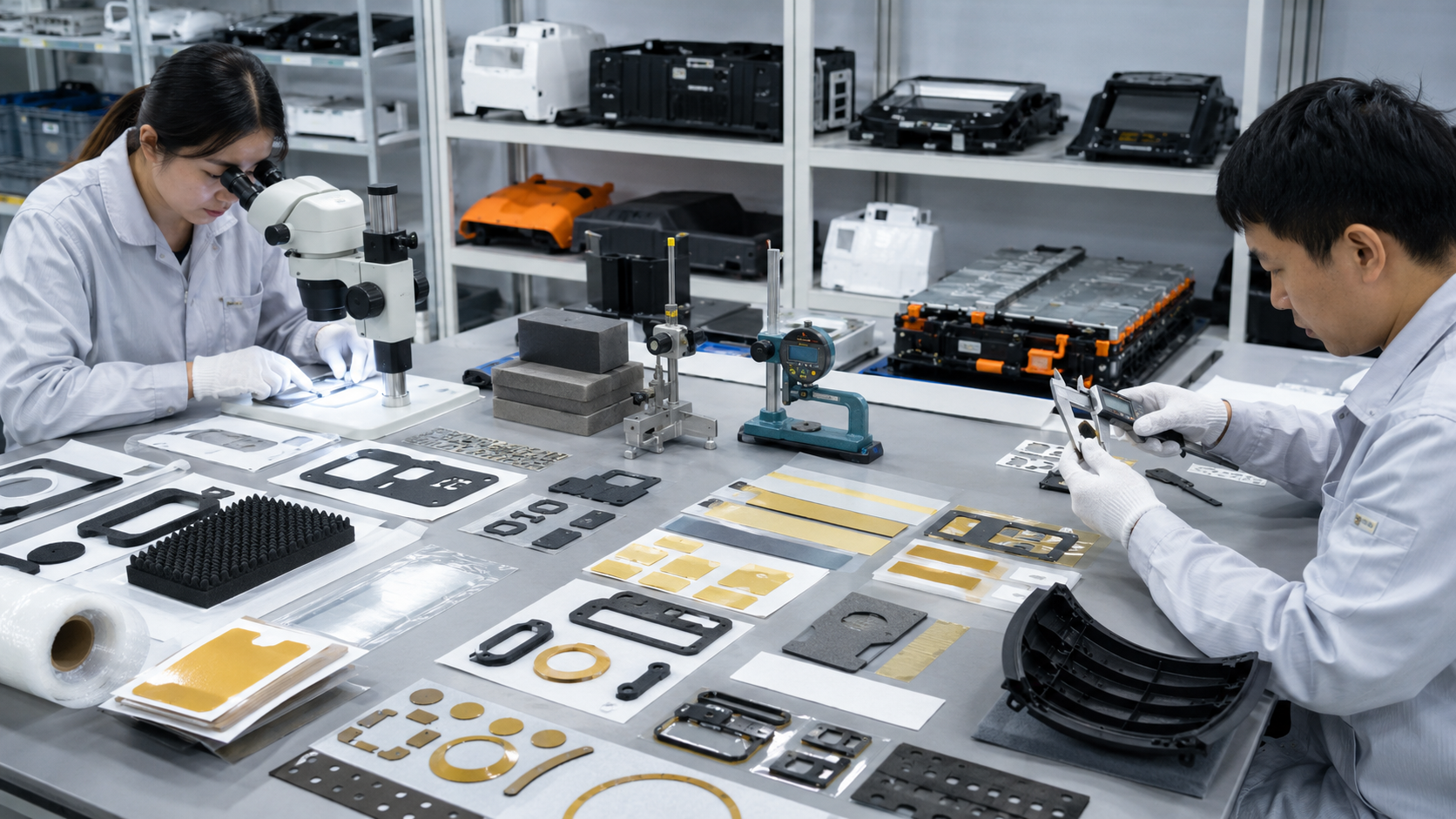
We help customers reduce repeated samples, adhesive lifting, poor liner release, dimensional variation, rough edges, foam deformation, packaging damage, and unstable batch quality.
Our goal is to deliver die cut parts that are clean, accurate, easy to assemble, and stable from sample to mass production.
Red Flags When Choosing a Die Cutting Manufacturer
Be careful if a supplier:
- Quotes without asking about the application
- Cannot explain material options
- Ignores tolerance risks
- Has no experience with adhesive-backed parts
- Does not discuss liner release
- Cannot provide sample review support
- Does not check packaging method
- Avoids talking about quality control
- Only focuses on price
- Cannot support mass production repeatability
A reliable manufacturer should be able to discuss both engineering details and production requirements.
Related Articles
- How to Avoid Costly Mistakes in Custom Die Cut Parts
- Adhesive-Backed Die Cut Components for OEM Assembly
- How Die Cut Parts Are Supplied in Sheets, Rolls, or Kits
- From Foam Rolls to Finished Parts: How Die Cutting Works
- What Is Die Cutting? Process, Materials and Applications
Conclusion
Choosing the right die cutting manufacturer for your OEM project requires more than comparing prices. The supplier must understand your material, part function, tolerance, adhesive structure, liner release, cutting method, packaging format, testing needs and assembly process.
The right manufacturer can help reduce sampling failures, rework, adhesive lifting, poor fit, rough edges and mass production instability.
Need a reliable die cutting manufacturer for an OEM project?
Send us your drawing, sample, material requirement, adhesive structure, tolerance, application environment, annual volume and packaging preference. Sanken can help review material selection, die cutting method, lamination, inspection points and delivery format before sampling and mass production.