
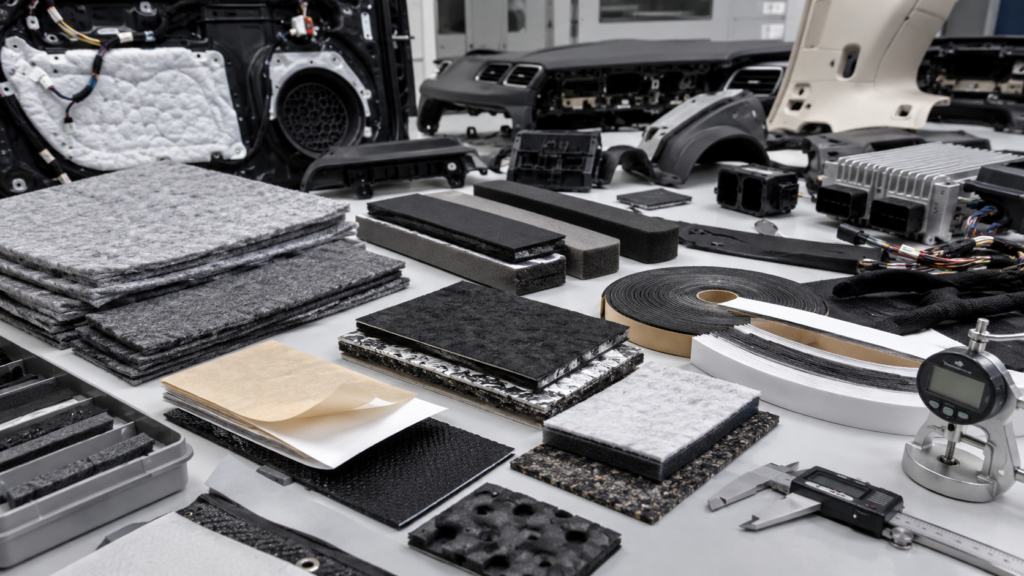
Choosing the right felt, foam, rubber, and tape materials for automotive NVH parts is critical for reducing noise, vibration, harshness, squeaks, rattles, friction, and unwanted movement inside vehicles. These parts may be small and hidden, but they directly affect comfort, durability, assembly quality, and customer perception.
For OEM engineers and purchasing managers, the key is not simply choosing a “soft material.” The right NVH material must match the noise source, assembly gap, compression requirement, bonding surface, temperature exposure, cutting tolerance, adhesive structure, and long-term vehicle environment.
At Sanken, we help automotive customers develop custom die cut NVH components, including non-woven felt pads, foam gaskets, rubber pads, adhesive-backed strips, anti-rattle parts, protective films, and multilayer material structures for automotive interiors, electronics, battery modules, and industrial vehicle applications.
Why Material Selection Matters for Automotive NVH Parts
Automotive NVH problems often come from small contact points between plastic, metal, glass, fabric, rubber, or electronic components. When two surfaces rub, vibrate, shift, or hit each other during driving, the result can be noise.
Common NVH problems include:
- Rattle noise
- Squeak noise
- Buzzing sound
- Friction noise
- Panel vibration
- Loose trim movement
- Impact noise
- Cable or harness noise
- Electronic housing vibration
- Air gap resonance
A good NVH part should control movement, absorb impact, reduce friction, fill gaps, damp vibration, or separate hard surfaces.
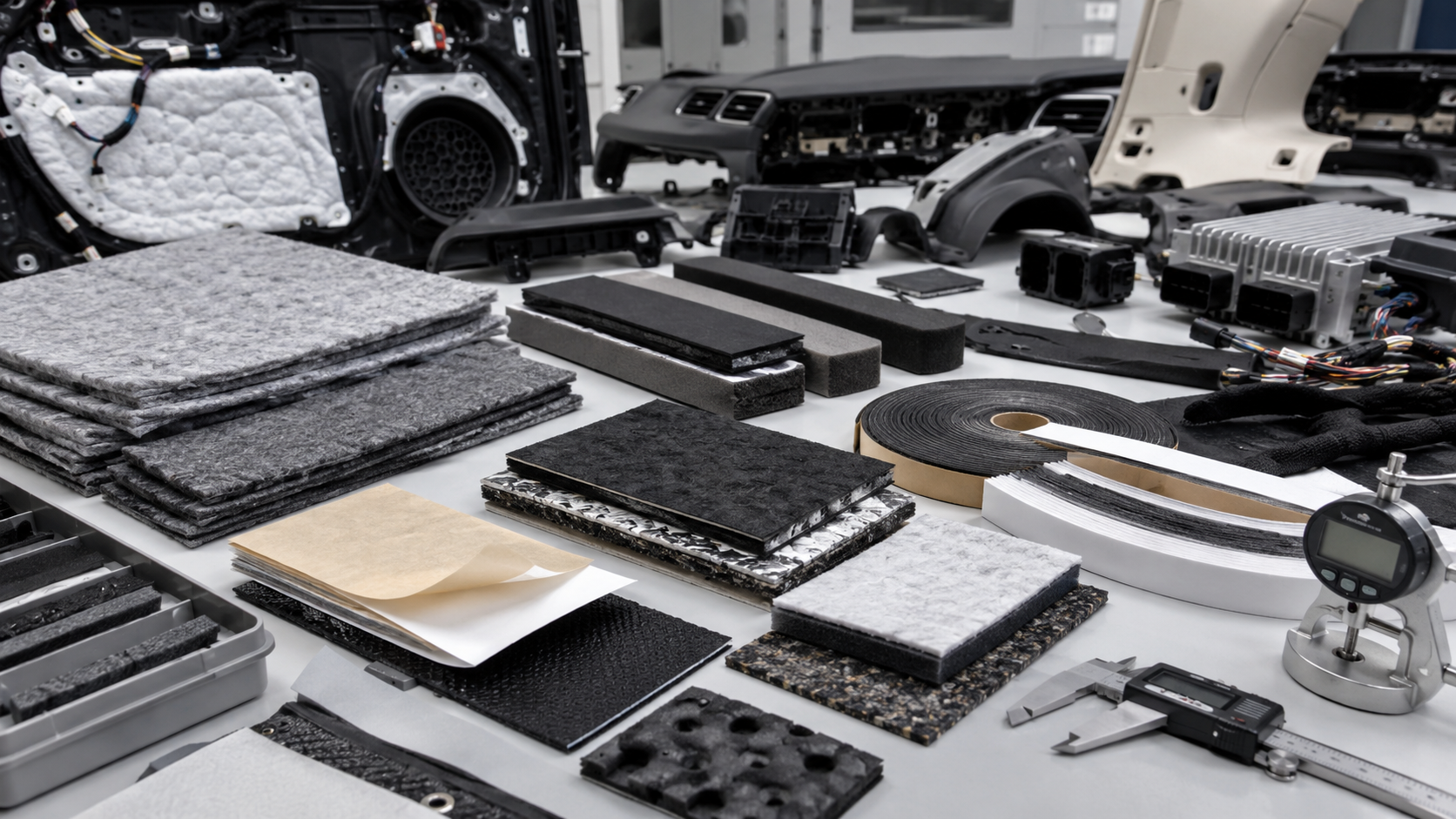
The wrong material may solve one issue but create another. For example, a foam pad may reduce vibration but lose compression after aging. A rubber pad may be durable but too hard for a thin plastic trim. A felt strip may reduce squeak noise but fail if the adhesive does not bond well to the surface.
Main Material Options for Automotive NVH Parts
Felt, foam, rubber, and tape materials each serve different NVH functions.
| Material Type | Main Function | Common Automotive NVH Use |
|---|---|---|
| Non-woven felt | Anti-rattle, friction reduction, acoustic absorption | Door trim, dashboard, pillar trim, wire harness, console parts |
| Foam | Cushioning, gap filling, sealing, vibration reduction | Electronic housings, display modules, interior panels, battery covers |
| Rubber | Durable damping, impact resistance, sealing support | Pads, stops, washers, vibration control points |
| Adhesive tape | Bonding, positioning, lamination support | Felt strips, foam gaskets, protective pads, assembly parts |
The best solution may use one material or a multilayer structure. For example, an automotive anti-rattle part may combine non-woven felt with pressure-sensitive adhesive. A foam gasket may use PE, PU, EPDM, or silicone foam with double-sided tape. A vibration pad may combine rubber with adhesive backing.
When to Choose Non-Woven Felt
Non-woven felt is commonly used for anti-rattle, anti-squeak, friction reduction, and light acoustic absorption applications.
It is often suitable for:
- Door trim contact areas
- Dashboard friction points
- Center console parts
- Pillar trim components
- Seat structure contact areas
- Wire harness wrapping
- Speaker area pads
- Interior panel anti-noise strips
Needle-punched non-woven felt has a fiber structure that can reduce friction between hard surfaces. It can also absorb some sound energy and provide soft separation between components.
Key selection factors include:
- Felt thickness
- Density
- Fiber shedding control
- Compression behavior
- Abrasion resistance
- Adhesive backing
- Edge cleanliness after die cutting
Felt is useful when the main problem is rubbing, squeaking, or light contact noise. It may not be the best choice when strong sealing, water resistance, or high compression recovery is required.
When to Choose Foam
Foam is widely used for cushioning, sealing, gap filling, and vibration reduction.
Common foam options include PE foam, PU foam, EVA foam, EPDM foam, silicone foam, and CR foam. Each foam has different properties.
| Foam Type | Key Feature | Typical NVH Application |
|---|---|---|
| PU foam | Soft and compressible | Interior cushioning, light gap filling |
| PE foam | Lightweight and clean | Protective pads, spacing, cushioning |
| EVA foam | Durable and stable | Inserts, pads, support components |
| EPDM foam | Weather-resistant and closed-cell | Sealing and automotive exterior-related areas |
| Silicone foam | Heat-resistant and stable | Electronics, battery, high-temperature areas |
| CR foam | Balanced sealing and cushioning | General automotive pads and gaskets |
Foam should be selected based on compression force, density, thickness, cell structure, rebound, and aging behavior.
For automotive electronic housings, a foam gasket may need stable compression and adhesive backing. For interior trim, foam may need soft contact and low squeak performance. For battery or high-temperature areas, silicone foam or other heat-resistant materials may be needed.
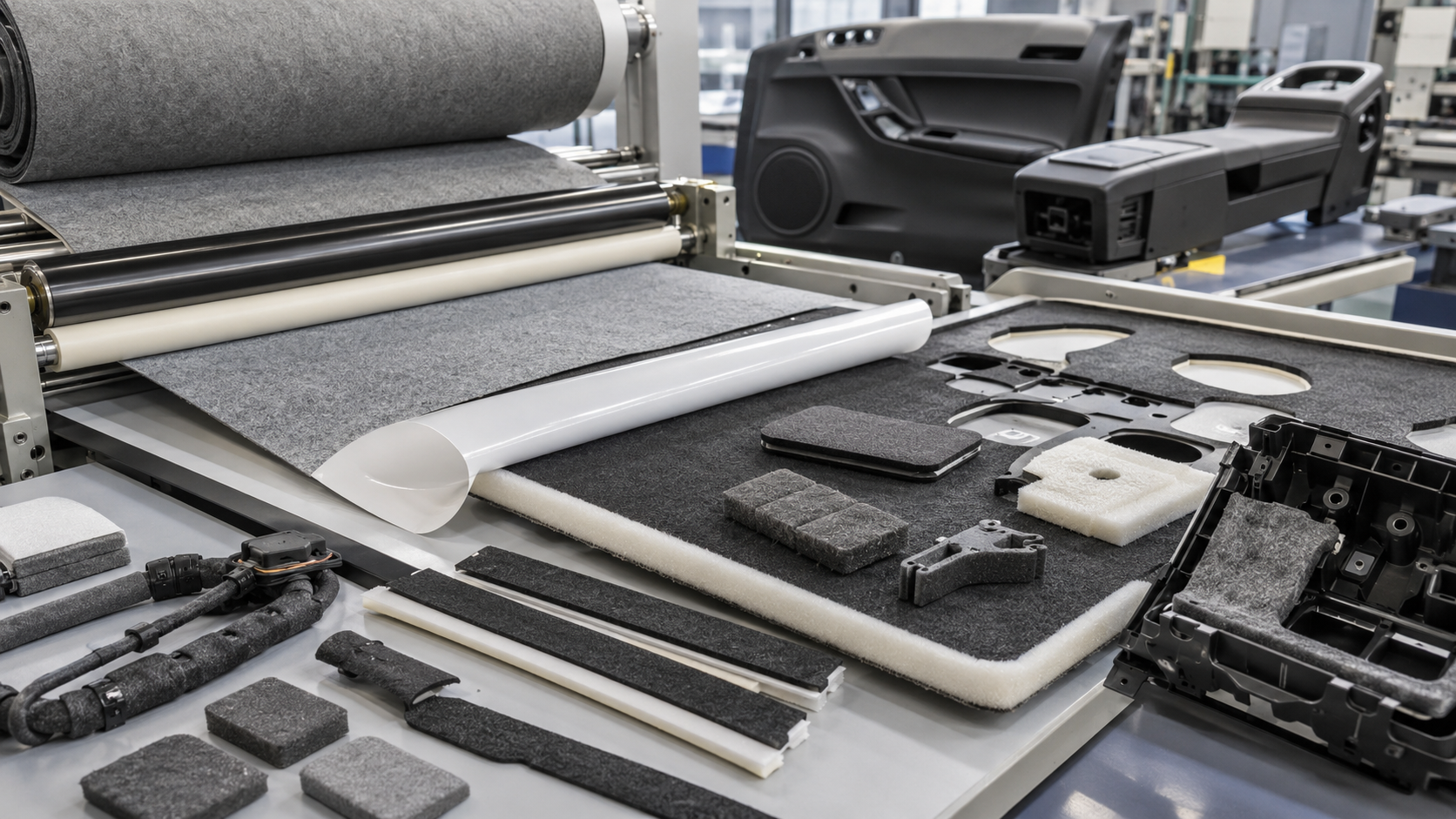
Foam is not always better when it is softer. If the foam is too soft, it may collapse. If it is too hard, it may create stress or assembly interference.
When to Choose Rubber
Rubber is useful when the NVH part requires stronger durability, impact resistance, vibration damping, or sealing support.
Common rubber materials include silicone rubber, EPDM rubber, neoprene rubber, NBR rubber, and natural rubber-based materials.
Rubber can be used for:
- Vibration pads
- Bump stops
- Sealing washers
- Anti-slip pads
- Cushioning spacers
- Housing contact pads
- Mechanical damping parts
Rubber is usually stronger and more durable than many foam materials, but it may require higher compression force. This matters when the part is installed between thin plastic housings or lightweight electronic modules.
Engineers should review rubber hardness, thickness, compression force, rebound, environmental resistance, and bonding method.
Rubber may be the right choice when the part must resist repeated mechanical contact, stronger vibration, or higher wear.
When to Use Adhesive Tape
Many automotive NVH parts need adhesive backing. Tape is not only a bonding material; it is part of the final component structure.
Adhesive tape can be used to attach felt, foam, rubber, protective films, and multilayer pads to automotive surfaces.
Important adhesive selection factors include:
- Bonding surface
- Surface energy
- Temperature exposure
- Humidity exposure
- Initial tack
- Peel strength
- Shear resistance
- Liner release
- Aging stability
- Die cutting behavior
Automotive surfaces may include ABS, PC, PP, painted metal, powder-coated surfaces, fabric, rubber, or coated plastic. A tape that bonds well to one surface may fail on another.
Common adhesive problems include edge lifting, poor liner release, adhesive overflow, residue, difficult peeling, and weak bonding after heat aging.
For adhesive-backed NVH parts, the adhesive and liner must be tested together with the felt, foam, or rubber material.
Common NVH Material Selection Mistakes
| Mistake | Possible Result |
|---|---|
| Choosing only by thickness | Poor compression or poor fit |
| Using foam that is too soft | Collapse, movement, reduced damping |
| Using rubber that is too hard | Assembly stress or poor contact |
| Ignoring bonding surface | Adhesive lifting or part falling off |
| Ignoring fiber shedding | Cleanliness and appearance problems |
| Making walls too narrow | Tearing during die cutting or assembly |
| No aging test | Failure after heat, humidity, or vibration |
| Poor packaging | Parts deform before assembly |
| No real vehicle application test | Noise returns after installation |
A material that passes a simple sample check may still fail in real vehicle use. NVH parts should be tested under the expected compression, vibration, temperature, and assembly conditions.
What Engineers Should Confirm Before Choosing a Material
Before selecting felt, foam, rubber, or tape for automotive NVH parts, engineers should confirm the real function of the part.
| Checklist Item | What to Confirm | Why It Matters |
|---|---|---|
| Noise problem | Rattle, squeak, buzz, vibration, friction | Defines material direction |
| Application area | Door trim, dashboard, console, electronics, battery | Determines environment |
| Gap size | Actual assembly gap and tolerance | Controls thickness and compression |
| Contact surface | Plastic, metal, fabric, rubber, coating | Affects friction and adhesive bonding |
| Compression need | Light contact or firm support | Determines foam or rubber choice |
| Temperature exposure | Interior, exterior, electronics, battery area | Affects material stability |
| Adhesive requirement | With or without PSA backing | Affects assembly efficiency |
| Part shape | Strips, pads, gaskets, holes, tabs | Affects die cutting feasibility |
| Testing method | Compression, aging, peel, vibration, fit | Confirms reliability |
| Delivery format | Roll, sheet, tray, kit, liner-backed | Supports assembly workflow |
This checklist helps reduce repeated samples and prevents choosing a material that looks correct but fails during mass production.
Why Die Cutting Quality Matters
Automotive NVH parts often require custom shapes, narrow strips, small holes, adhesive layers, and clean edges. Die cutting quality directly affects how the part performs.
Poor die cutting can cause:
- Rough edges
- Fiber shedding
- Foam deformation
- Rubber burrs
- Adhesive overflow
- Liner damage
- Poor hole alignment
- Difficult waste removal
- Inconsistent part size
- Poor assembly fit
For adhesive-backed felt or foam parts, kiss cutting depth is especially important. The blade must cut the material and adhesive layer without cutting too deeply into the release liner.
For non-woven felt, edge cleanliness and fiber control are important.
For foam, compression and rebound must be considered.
For rubber, hardness and material recovery affect final dimensions.
A professional die cutting manufacturer should review material behavior before tooling and mass production.
How Sanken Helps Automotive Customers Choose NVH Materials
Sanken Manufacturing Co., Ltd. supports automotive OEM customers with precision die cutting, adhesive lamination, material converting, foam and rubber components, non-woven felt parts, PET insulation films, protective films, and custom NVH components.
For automotive NVH projects, we review:
- Noise source
- Material type
- Thickness and density
- Foam compression
- Rubber hardness
- Felt fiber structure
- Adhesive backing
- Bonding surface
- Die cut shape
- Edge cleanliness
- Liner release
- Packaging format
- Assembly method
- Testing requirements
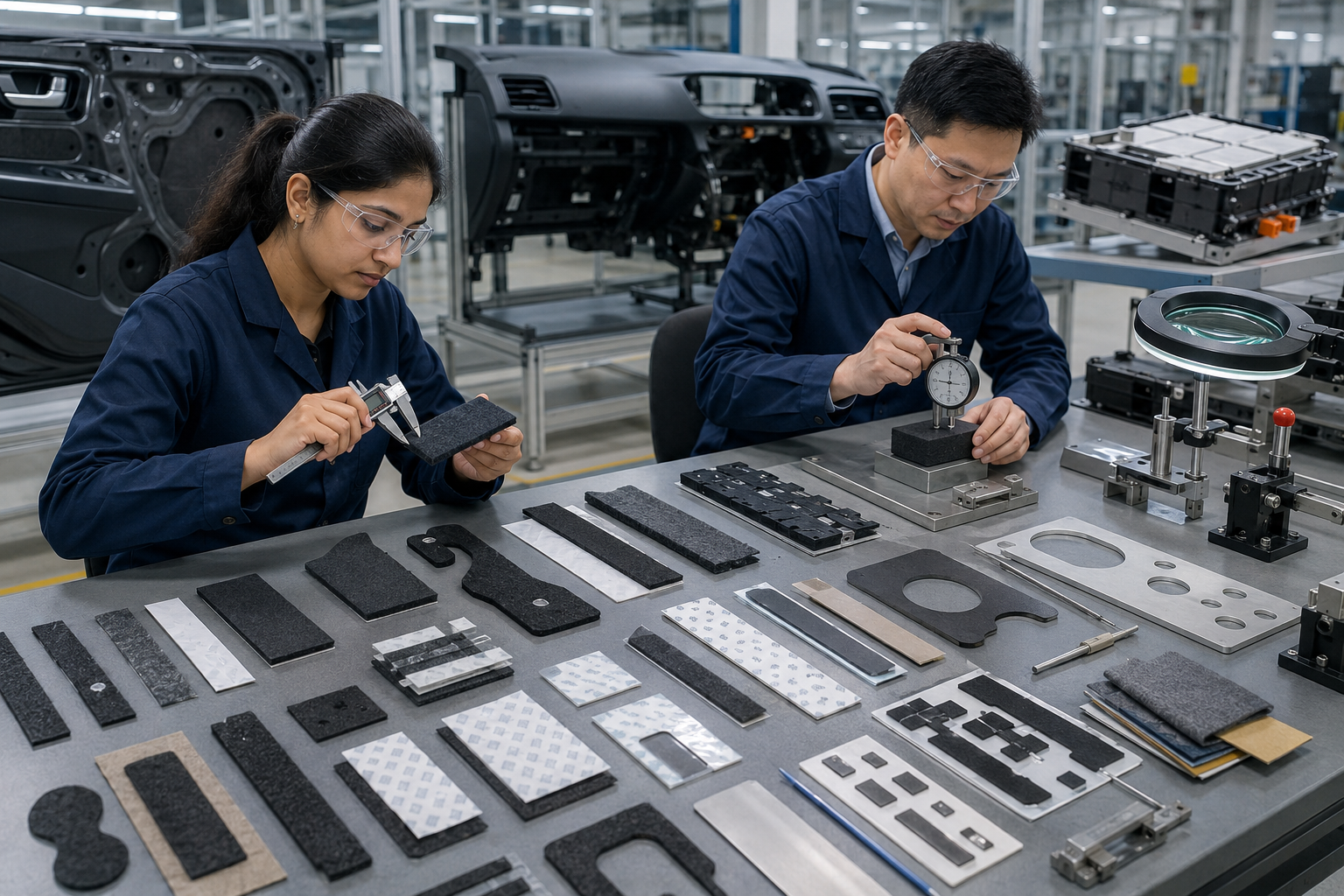
We help customers develop anti-rattle pads, felt strips, foam gaskets, adhesive-backed cushioning parts, rubber pads, protective films, and multilayer NVH components for automotive interiors, electronics, battery areas, and industrial vehicle assemblies.
Our goal is to help customers reduce rattle noise, squeak problems, adhesive lifting, fiber shedding, poor fit, repeated sampling, and unstable mass production.
FAQ
What material is best for automotive NVH parts?
There is no single best material. Felt is good for anti-rattle and friction reduction. Foam is good for cushioning, sealing, and gap filling. Rubber is good for durable damping and impact resistance. Tape is used for bonding and assembly support.
Is felt good for automotive noise reduction?
Yes. Non-woven felt is commonly used for anti-rattle, anti-squeak, friction reduction, and light acoustic absorption in automotive interiors.
What foam is used for automotive NVH?
PU, PE, EVA, EPDM, silicone foam, and CR foam can all be used depending on compression, sealing, temperature, and durability requirements.
When should rubber be used instead of foam?
Rubber is often better when the part needs stronger mechanical durability, impact resistance, vibration damping, or wear resistance. Foam is usually better for softer cushioning and gap filling.
Why is adhesive tape important for NVH parts?
Adhesive tape helps attach felt, foam, rubber, and protective materials to automotive surfaces. The adhesive must match the bonding surface, temperature, pressure, and assembly method.
Can automotive NVH materials be die cut into custom shapes?
Yes. Felt, foam, rubber, tape, and multilayer materials can be die cut into pads, strips, gaskets, spacers, and custom profiles for automotive assembly.
What should buyers provide before ordering automotive NVH die cut parts?
Buyers should provide drawings or samples, application location, noise problem, material preference, thickness, adhesive needs, bonding surface, tolerance, quantity, and testing requirements.
Conclusion
Choosing felt, foam, rubber, and tape materials for automotive NVH parts requires understanding the real noise source, assembly gap, compression condition, bonding surface, temperature exposure, and final vehicle environment.
Felt is useful for anti-rattle and friction reduction. Foam is useful for cushioning, sealing, and gap filling. Rubber provides stronger durability and damping. Adhesive tape supports positioning and assembly. In many automotive projects, the best solution is a custom die cut multilayer structure.
At Sanken, we help automotive customers select and convert NVH materials into reliable die cut components that improve assembly fit, reduce unwanted noise, and support stable mass production.