
Can Non-Woven Fabric Be Die Cut? Materials, Tolerances and Design Considerations
Yes, non-woven fabric can be die cut. In fact, die cutting is one of the most efficient ways to turn non-woven materials into accurate, ready-to-assemble parts for automotive, electronics, medical, filtration, packaging, acoustic insulation, and industrial applications.
However, not every non-woven fabric behaves the same during cutting. Some materials cut cleanly. Some release loose fibers. Some stretch, compress, or deform. Some require adhesive backing before cutting. Some work well for simple shapes but fail when the design includes narrow strips, small holes, or tight tolerances.
For OEM buyers and engineers, the real question is not only “Can non-woven fabric be die cut?” The better question is: “Can this specific non-woven material be die cut consistently for my product design, tolerance requirement, and production volume?”
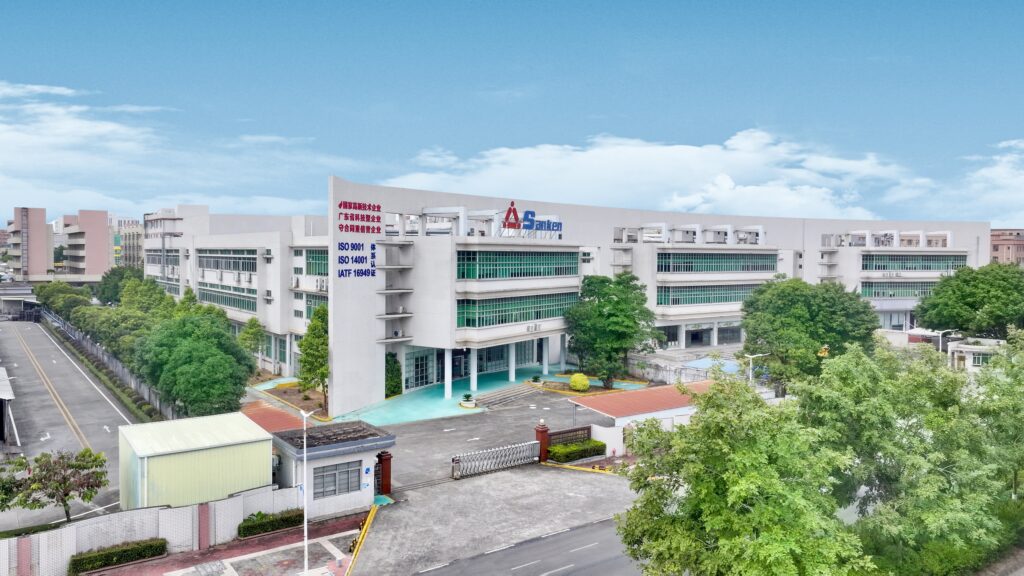
At Sanken Manufacturing, we help customers select, laminate, die cut, and convert non-woven fabrics into precision components used in automotive interiors, electronics protection, medical devices, filtration systems, acoustic pads, insulation layers, adhesive-backed parts, and industrial assemblies.
Why Non-Woven Fabric Is Suitable for Die Cutting
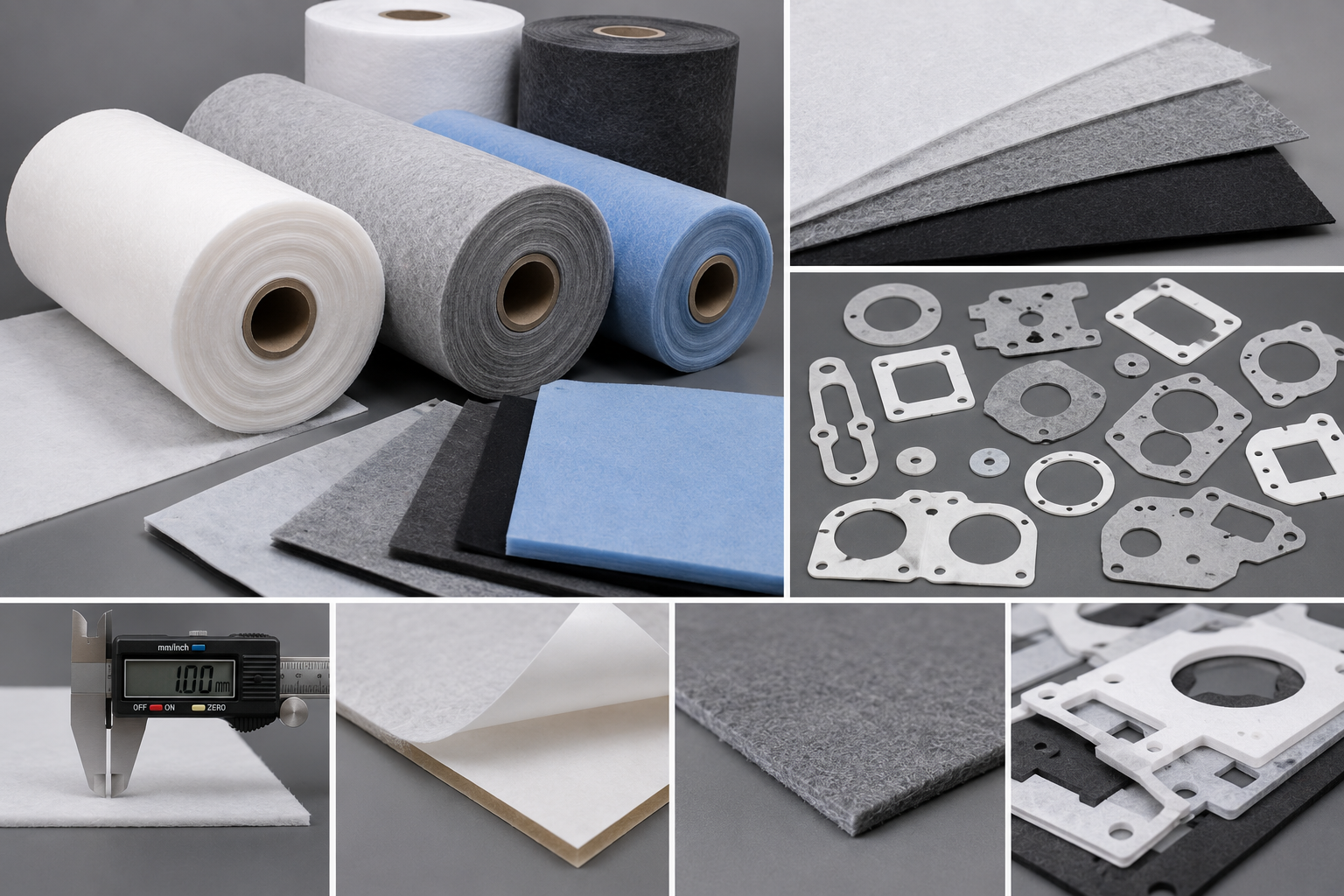
Non-woven fabric is made by bonding fibers together without weaving or knitting. This structure gives the material useful properties such as breathability, softness, filtration, sound absorption, cushioning, liquid absorption, and lightweight protection.
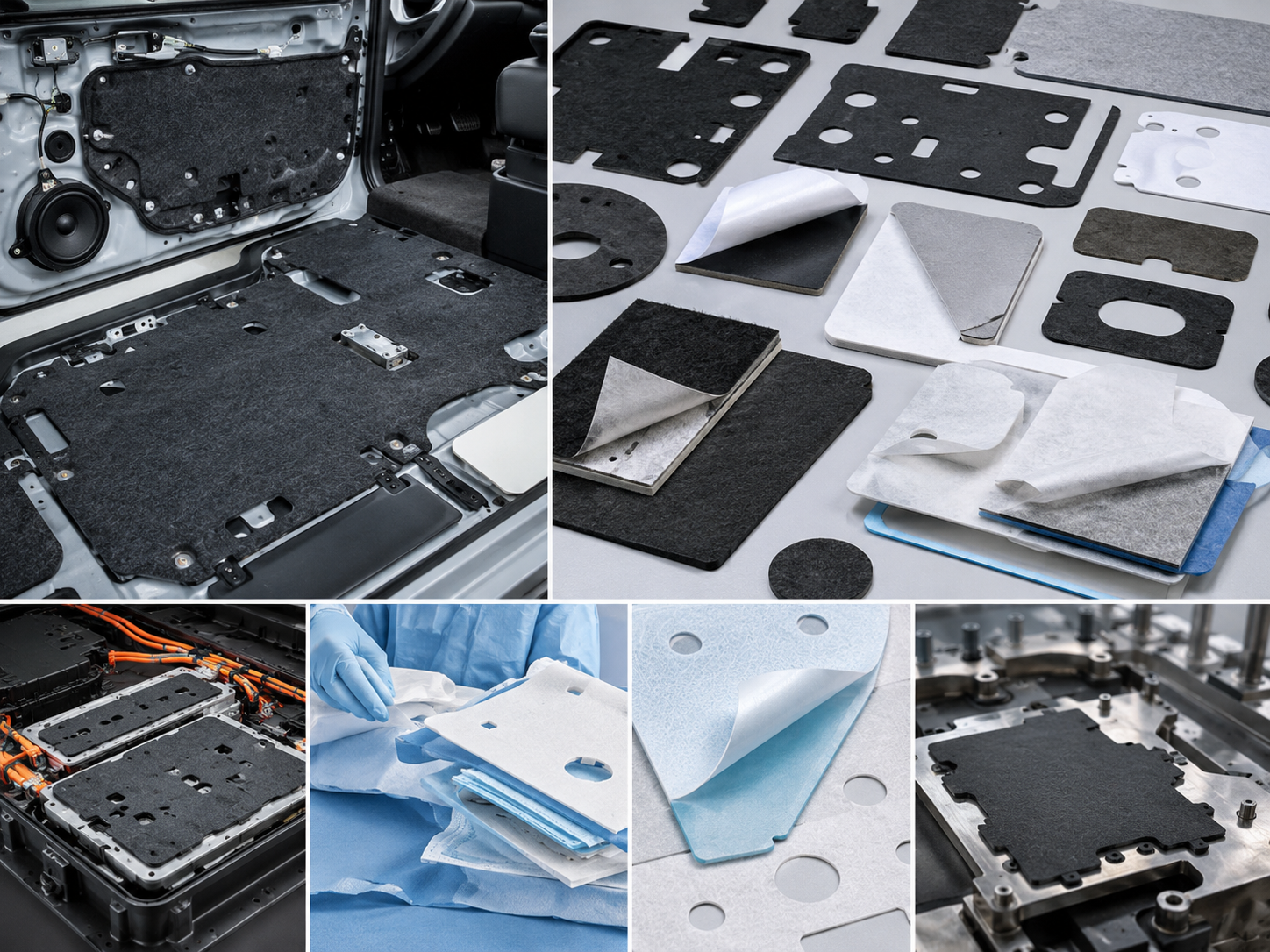
These properties make non-woven fabric suitable for many custom die-cut parts, including:
- Acoustic insulation pads
- Filter media
- Dust protection layers
- Medical device components
- Automotive interior liners
- Electronic cushioning parts
- Adhesive-backed protective materials
- Industrial assembly pads
Die cutting allows these materials to be shaped accurately so they can fit directly into the final product.
But the die cutting result depends on the material structure. A tightly bonded PET non-woven may cut cleanly. A loose, low-density fiber material may fray or shed fibers. This is why material evaluation must happen before mass production.
Common Non-Woven Materials Used for Die Cutting
Different non-woven materials offer different cutting performance.
| Material Type | Key Features | Common Applications |
|---|---|---|
| PET non-woven | Durable, heat resistant, dimensionally stable | Automotive, electronics, insulation |
| PP non-woven | Lightweight, cost-effective, moisture resistant | Medical, packaging, hygiene products |
| Needle-punched non-woven | Thick, cushioning, sound absorbing | Automotive NVH, acoustic pads |
| Spunbond non-woven | Uniform, lightweight, strong | Protection layers, packaging |
| Meltblown non-woven | Fine fibers, filtration performance | Filters, masks, air systems |
| Laminated non-woven | Combined with adhesive, foam, film, or rubber | Functional converted components |
For precision die cutting, buyers should not choose material by name alone. The same “non-woven fabric” can behave very differently depending on fiber type, bonding method, density, thickness, and finishing treatment.
Key Material Factors That Affect Die Cutting
1. Fiber Type
Fiber material affects strength, heat resistance, dimensional stability, and edge quality.
PET non-woven fabric is often preferred for automotive and industrial applications because it provides stronger durability and better dimensional control. PP non-woven fabric is often used when lightweight structure and cost control are more important.
2. Thickness
Thicker materials may provide better cushioning, acoustic absorption, or filtration depth. However, thick materials can be harder to cut cleanly, especially when the design has small holes or narrow walls.
Thin materials are easier to process but may wrinkle, stretch, or shift if tension is not controlled.
3. Density
Density affects both function and processing stability.
Low-density non-woven fabric may be soft and breathable, but it may deform during cutting. High-density non-woven fabric usually holds shape better, but it may require more cutting pressure.
4. Bonding Strength
Bonding strength is critical for clean edges.
If the fibers are weakly bonded, the material may show:
- Edge fraying
- Loose fibers
- Poor handling stability
- Dust contamination
- Weak adhesive bonding
This is especially important for electronics, medical devices, and clean assembly environments.
5. Surface Finish
Some non-woven fabrics are coated, calendered, laminated, or treated. These treatments can improve cutting performance, reduce fiber shedding, or improve adhesive bonding.
For adhesive-backed parts, surface energy and fiber structure must be reviewed carefully.
What Tolerances Can Be Achieved?
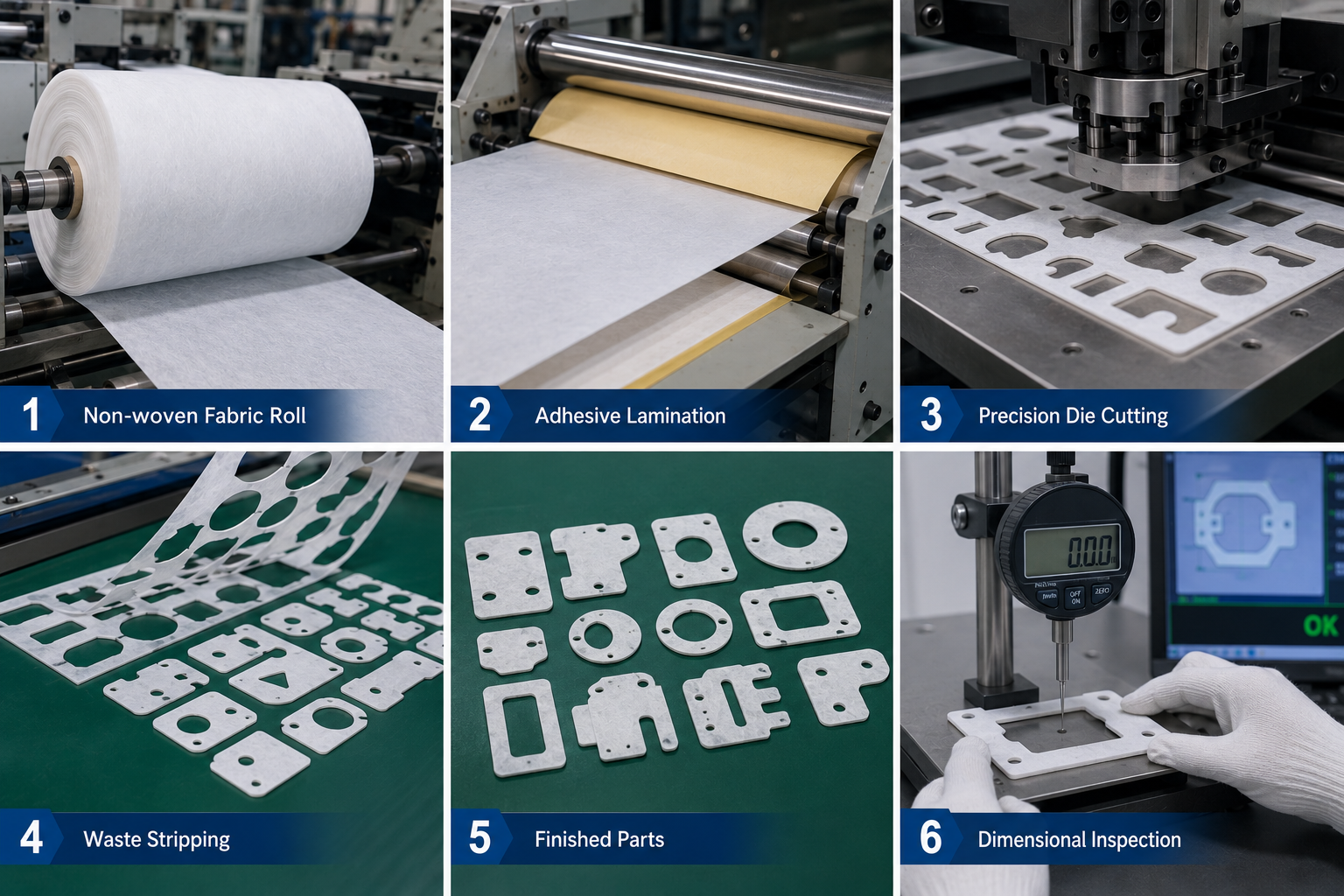
Die-cut tolerance depends on the material and part design.
Non-woven fabric is softer and more flexible than metal, hard plastic, or film. It may stretch, compress, or shift during processing. Because of this, tolerance should be discussed based on real material behavior.
Important tolerance factors include:
- Material thickness
- Material density
- Fiber bonding strength
- Adhesive backing
- Part size
- Hole size
- Shape complexity
- Cutting method
- Tooling design
- Production volume
A simple large pad can usually hold looser tolerances. A small adhesive-backed electronic part with internal holes may require tighter process control.
Buyers should avoid setting unrealistic tolerances without discussing material behavior with the supplier. Overly tight tolerance requirements can increase cost without improving product performance.
At Sanken, we review the drawing, material structure, assembly method, and application environment before recommending practical tolerance targets.
Flatbed Die Cutting vs Rotary Die Cutting
Non-woven fabric can be processed using different die cutting methods.
Flatbed Die Cutting
Flatbed die cutting is suitable for sheet materials, thicker pads, prototypes, and medium-volume production.
It is often used for:
- Thick acoustic pads
- Automotive insulation parts
- Industrial non-woven components
- Custom-shaped sheet materials
Rotary Die Cutting
Rotary die cutting is suitable for roll-to-roll production and higher-volume parts.
It is commonly used for:
- Adhesive-backed non-woven parts
- Filter components
- Protective layers
- Thin precision materials
- Continuous production formats
Kiss Cutting
Kiss cutting is used when non-woven fabric is laminated with adhesive and release liner. The top material is cut while the liner remains intact.
This makes the part easier to peel and apply during assembly.
Kiss cutting is valuable for automotive, electronics, and medical applications where operators need fast, consistent installation.
Design Considerations for Die-Cut Non-Woven Parts
Good die-cut parts start with good design.
Avoid Extremely Thin Walls When Possible
Very narrow strips may stretch, tear, or distort during cutting and handling.
Keep Hole Sizes Practical
Small holes may be difficult to remove cleanly, especially in thick or fibrous materials.
Consider Waste Stripping
Waste stripping is the process of removing unwanted material after cutting.
If the design has many small details, waste removal may become difficult and increase production cost.
Add Assembly-Friendly Features
If the part is applied manually, a larger release liner, pull tab, or kiss-cut format may improve assembly efficiency.
Review Adhesive Positioning
For adhesive-backed non-woven fabric, adhesive alignment is critical. Poor lamination can cause edge lifting, weak bonding, or assembly failure.
Common Problems in Non-Woven Die Cutting
Loose Fibers
Loose fibers can affect cleanliness, bonding, and appearance.
Rough Edges
Rough edges may come from weak bonding, poor tooling, or unsuitable cutting pressure.
Material Deformation
Soft materials may compress during cutting and rebound after processing.
Adhesive Lifting
If the adhesive is not matched to the non-woven surface, peeling may occur.
Dimensional Variation
Stretching, tension changes, or unstable material thickness may cause part variation.
Difficult Waste Removal
Complex shapes may slow production if waste stripping is not considered during design.
A good supplier should identify these risks before mass production.
What Buyers Should Confirm Before Production
Before approving a die-cut non-woven part, buyers should confirm:
- What is the final application?
- What fiber material is required?
- What thickness and density are needed?
- Does the part require adhesive backing?
- What tolerance is functionally necessary?
- Will the part be applied manually or automatically?
- Is fiber shedding acceptable?
- Does the part need heat resistance, flame resistance, or odor control?
- Will the material face compression, humidity, or vibration?
- Is the project for prototype testing or mass production?
These questions help reduce sampling delays, tooling changes, and production failures.
How Sanken Helps Customers With Non-Woven Die Cutting
At Sanken Manufacturing, we help customers move from material selection to finished component production.
Our capabilities include:
- Non-woven fabric converting
- Precision die cutting
- Kiss cutting
- Adhesive lamination
- Foam bonding
- Rubber and film lamination
- Hot pressing
- Slitting
- Custom assembly
- Prototype and mass production support
We support automotive, electronics, medical, filtration, packaging, and industrial customers.
Our value is not only cutting non-woven fabric into shape. We help customers improve edge quality, control tolerance, reduce fiber shedding, solve adhesive issues, and simplify supplier management.
For OEM buyers, this means lower production risk, better assembly efficiency, and more stable mass production.
Conclusion
Non-woven fabric can be die cut into accurate functional components, but successful results depend on material type, fiber bonding strength, thickness, density, adhesive structure, cutting method, tolerance requirements, and part design.
For OEM applications, buyers should not evaluate non-woven fabric only by roll appearance or unit price. The material must cut cleanly, assemble smoothly, and perform reliably in the final product. At Sanken Manufacturing, we help customers select, laminate, die cut, and convert non-woven fabrics into stable components for automotive, electronics, medical, filtration, packaging, and industrial applications.