
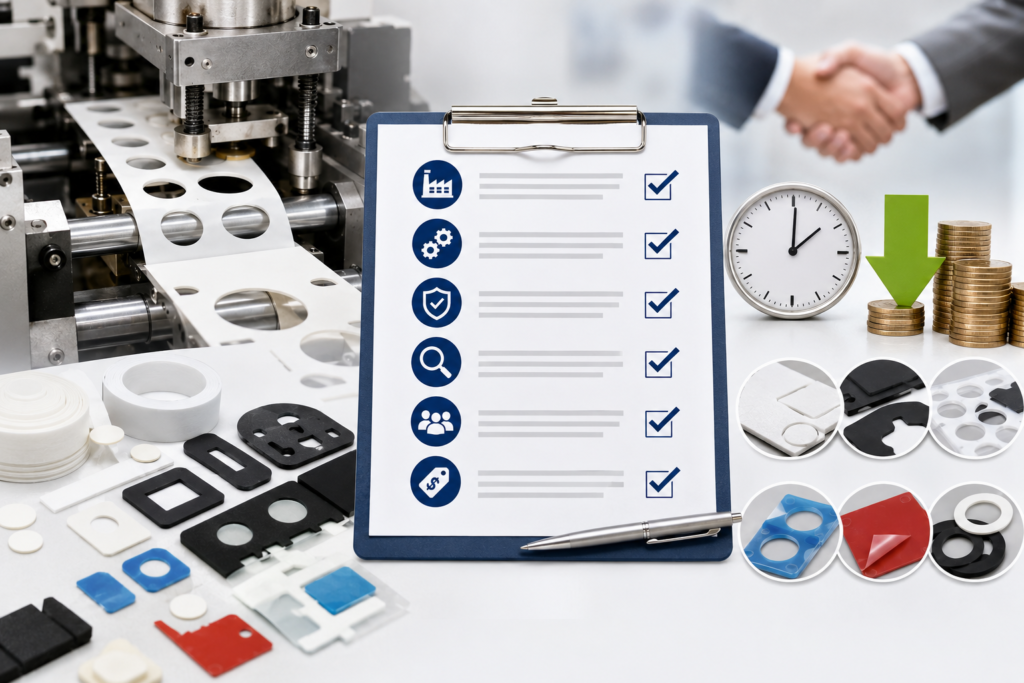
How to Choose a Die Cutting Manufacturer Without Wasting Time or Cost?
Choosing the wrong die cutting manufacturer is expensive. The first samples may look acceptable, but mass production tells the truth. Dimensions drift. Adhesive overflows. Foam compresses badly. Delivery slips. Then the buyer pays twice: once for the parts, and again for fixing the mistake ([supplier selection guide](placeholder link)).
The best way to choose a die cutting manufacturer is to evaluate material knowledge, tolerance control, tooling ability, adhesive converting experience, quality systems, and mass production stability before placing the order. A good supplier does not only cut shapes. It helps you prevent sealing failure, bonding problems, assembly delays, and unnecessary cost. At Sanken, we focus on solving the full manufacturing problem, not just quoting the lowest unit price.
I always tell customers one thing: a cheap quote is not a supplier strategy. It is only a number. The real question is whether that supplier can protect your production line.
Why Is Choosing a Die Cutting Manufacturer So Difficult?
Die cutting looks simple from the outside.
A buyer sends a drawing.
A supplier cuts the material.
Everyone hopes the parts fit.
That is the dangerous part.
In real OEM production, die cut parts must match material behavior, adhesive performance, assembly pressure, tolerance requirements, and long-term working conditions.
If the supplier only understands cutting, the project can still fail.
What Should You Check First?
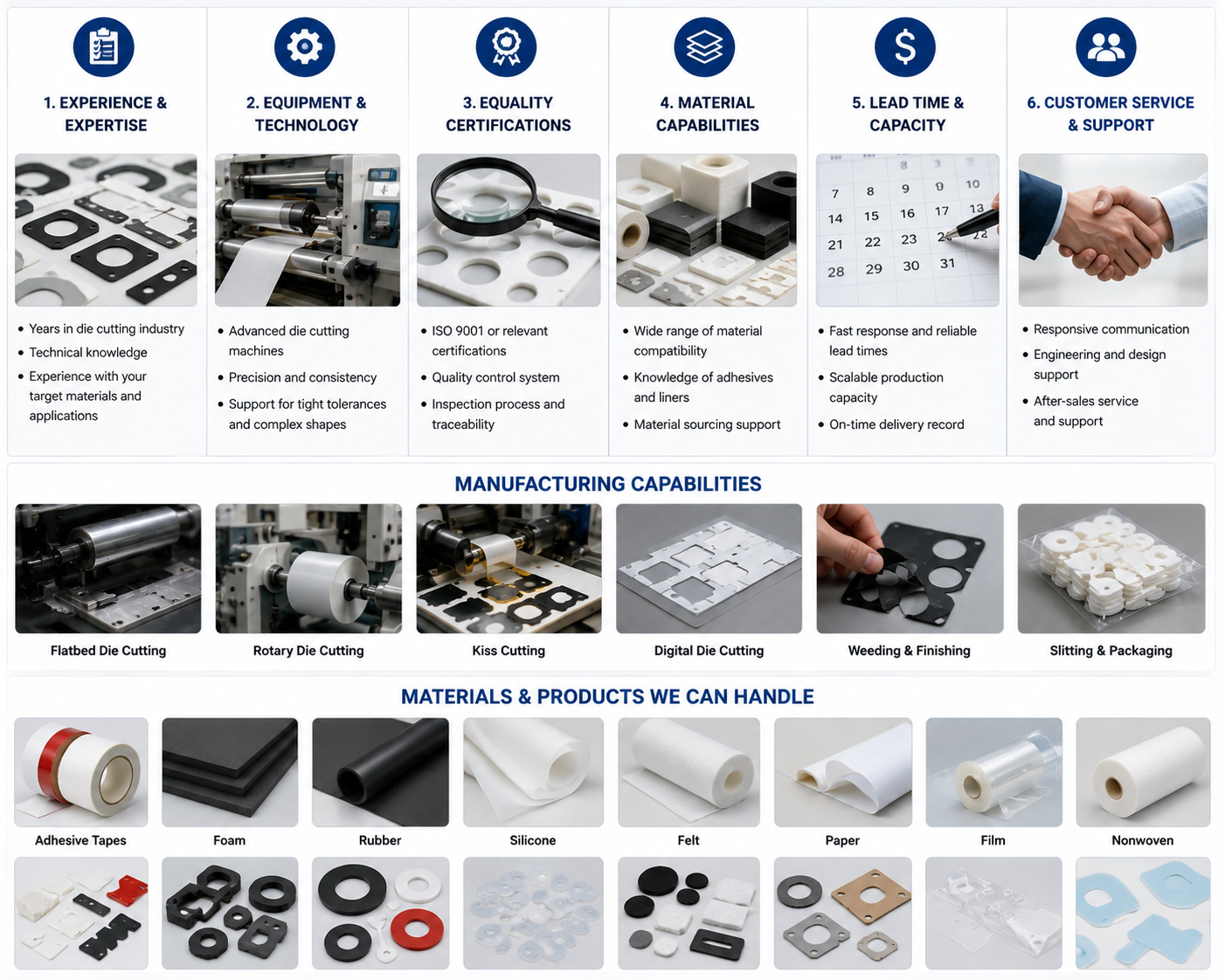
Start with the supplier’s material experience.
This matters more than many buyers realize.
A die cutting manufacturer should understand materials such as:
- Foam
- Rubber
- PET film
- Double-sided tape
- Non-woven fabric
- Silicone
- Conductive materials
- Thermal insulation materials
Different materials behave differently during die cutting.
Foam compresses.
Film stretches.
Adhesive flows.
Rubber may create burrs.
Non-woven material can release fibers.
At Sanken, we evaluate the application before recommending the material. That helps customers avoid problems before tooling begins.
Can the Manufacturer Control Tolerances Consistently?
One good sample does not prove mass production ability.
This is where many suppliers fail.
They can make five nice samples.
Then the first large order arrives, and the dimensions begin to move.
For OEM customers, tolerance control affects:
- Assembly fit
- Hole alignment
- Sealing performance
- Adhesive positioning
- Production efficiency
A professional die cutting manufacturer should explain how it controls tolerance during batch production ([die cutting tolerance reference](placeholder link)).
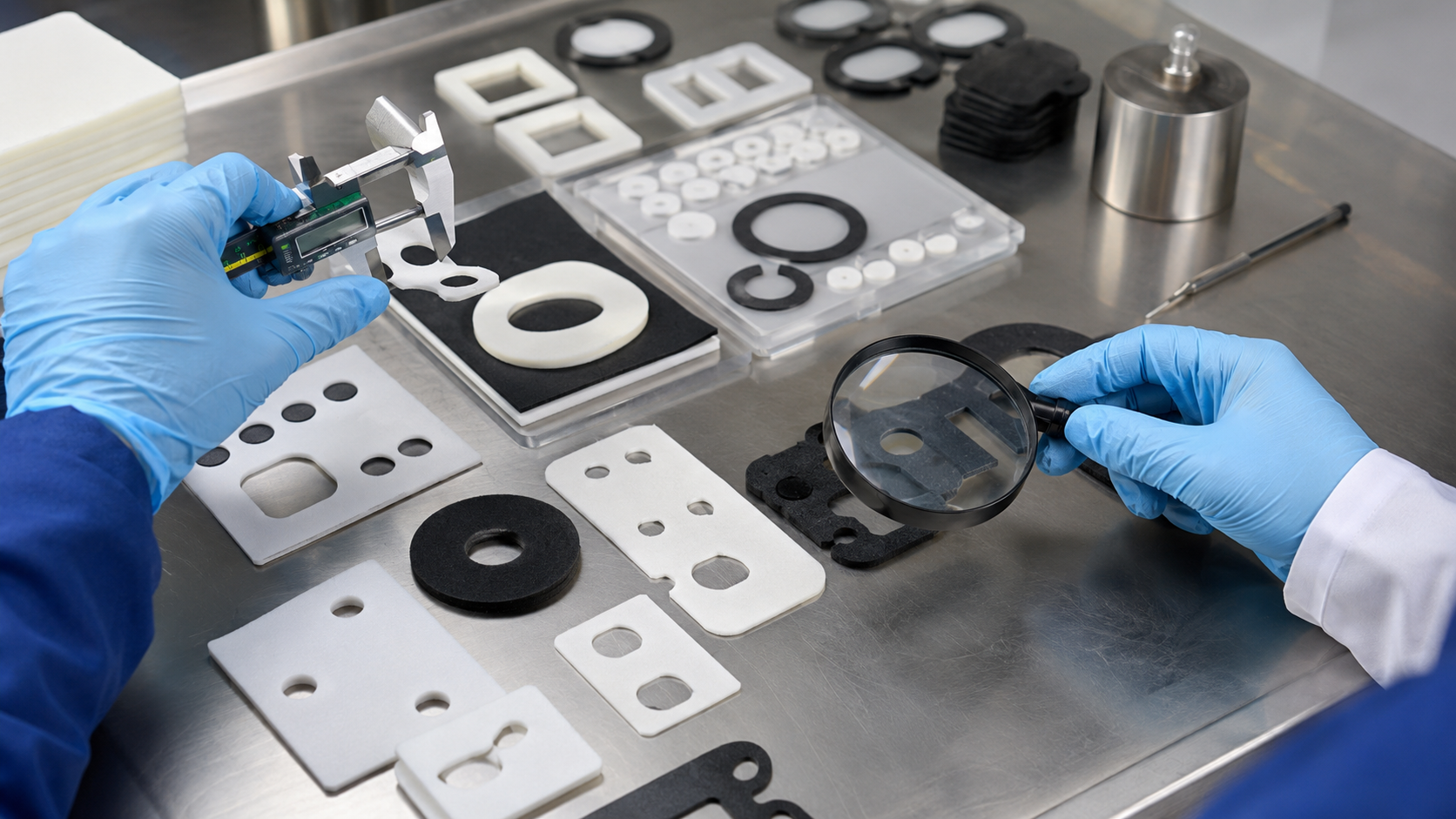
At Sanken, we check dimensions, hole positions, edge quality, thickness, adhesive position, and lamination stability before shipment.
Does the Supplier Understand Adhesive Converting?
Many die cut parts include adhesive.
That means the supplier must understand bonding, not only cutting.
Poor adhesive converting causes:
- Edge lifting
- Adhesive overflow
- Liner damage
- Bubbles
- Wrinkles
- Poor release
- Layer separation
This is especially important for automotive, electronics, medical, and optical applications.
A supplier should know how to choose adhesive based on surface energy, temperature, humidity, peel force, and shear force ([adhesive selection guide](placeholder link)).
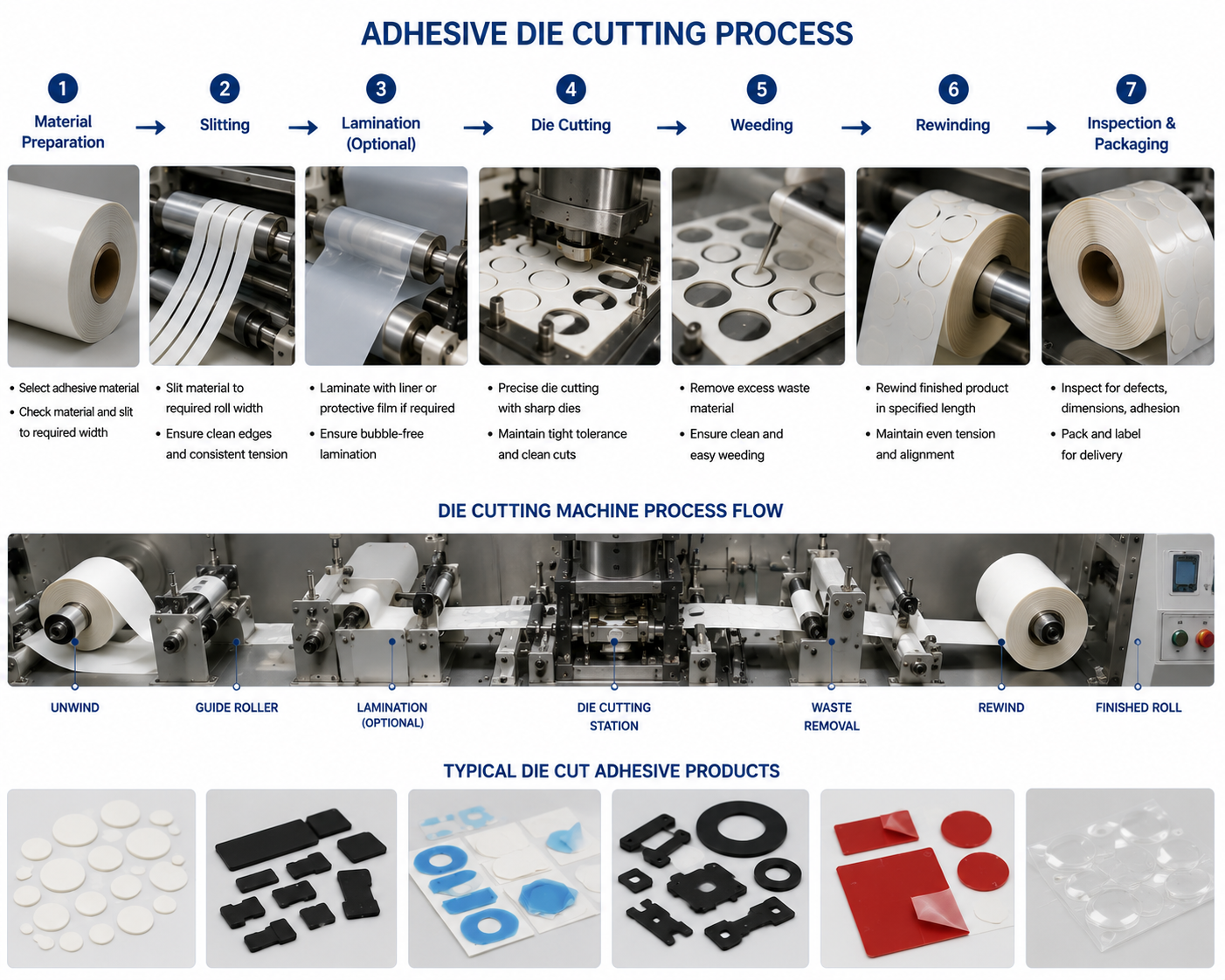
At Sanken, we combine adhesive laminating, kiss cutting, material converting, and inspection in one controlled process.
That is why we can solve problems that basic cutting suppliers often miss.
Can the Manufacturer Support Prototyping Before Mass Production?
A serious die cutting project should not jump directly into mass production.
That is how money disappears.
A good supplier should support:
- Drawing review
- Material recommendation
- Sample making
- Tooling adjustment
- Assembly testing
- Failure analysis
- Pre-production verification
At Sanken, we help customers verify the design before scaling up.
This prevents expensive mistakes such as wrong compression ratio, poor adhesive matching, unstable thickness, or difficult liner removal.
If a supplier only says, “Send drawing, we cut,” be careful.
That is not engineering support.
That is order taking.
What Quality Systems Should a Die Cutting Manufacturer Have?
Quality systems are not decoration.
They show whether the factory can manage process stability.
For OEM customers, useful quality systems may include:
- ISO 9001
- ISO 14001
- IATF 16949
These systems are especially important for automotive and industrial customers who need stable documentation, traceability, inspection control, and continuous improvement ([quality system reference](placeholder link)).
At Sanken, our quality control is built into production.
We do not wait until the end to discover problems.
We control material incoming inspection, process inspection, die cutting inspection, and final verification.
Why Is One-Stop Manufacturing Important?
Many buyers waste time because they manage too many suppliers.
One supplier provides foam.
Another provides adhesive.
Another does lamination.
Another cuts the part.
Another handles printing or molding.
When something fails, everyone blames someone else.
I have seen this movie too many times. The ending is never enjoyable.
At Sanken, we provide one-stop support including:
- Precision die cutting
- Material converting
- Adhesive laminating
- Hot pressing
- Spraying and gluing
- Silk screen printing
- Injection molding support
This reduces communication cost, shortens development time, and improves responsibility control.
For OEM customers, fewer supplier gaps usually means fewer production surprises.
How Can You Tell If a Supplier Is Too Cheap?
A very low price is not always a good sign.
It may mean the supplier is cutting cost in places you cannot see.
For example:
| Hidden Cost Area | Possible Result |
|---|---|
| Low-grade material | Shorter product life |
| Poor tooling | Rough edges and unstable size |
| Weak inspection | Batch quality problems |
| No engineering support | More redesign cost |
| Poor packaging | Deformed or contaminated parts |
| Unstable delivery | Production delays |
The lowest quote can become the most expensive choice if it causes rework, rejection, or customer complaints.
At Sanken, we focus on total cost.
That includes material efficiency, yield rate, inspection stability, assembly success, and delivery reliability.
What Questions Should Buyers Ask Before Choosing a Supplier?
Before choosing a die cutting manufacturer, I recommend asking these questions:
- Do you understand my material and application environment?
- Can you recommend better material options if my drawing is risky?
- What tolerance can you maintain during mass production?
- Can you handle adhesive laminating and kiss cutting?
- How do you inspect dimensions, edges, and adhesive quality?
- Can you support samples before mass production?
- Do you have experience with automotive, electronics, medical, or industrial OEM projects?
- Can you provide stable delivery for repeated orders?
A professional supplier should answer clearly.
If the answer is vague, the risk is high.
Why Do OEM Customers Choose Sanken?
Customers choose Sanken because we do not treat die cutting as a simple cutting job.
We treat it as a manufacturing solution.
Our advantage comes from combining:
- Material selection experience
- Precision die cutting
- Adhesive converting
- Multi-process integration
- Quality inspection
- OEM production support
We serve customers in automotive, electronics, medical, appliance, industrial, and new energy applications.
Our goal is practical.
We help customers reduce supplier risk, avoid repeated sampling, improve production stability, and control long-term cost.
That is the difference between a basic supplier and a real manufacturing partner.
Conclusion
Choosing a die cutting manufacturer is not only about price. It is about reducing risk, saving development time, and protecting mass production. At Sanken, we combine precision die cutting, material converting, adhesive laminating, and quality control to help OEM customers avoid costly mistakes and build more reliable products.