
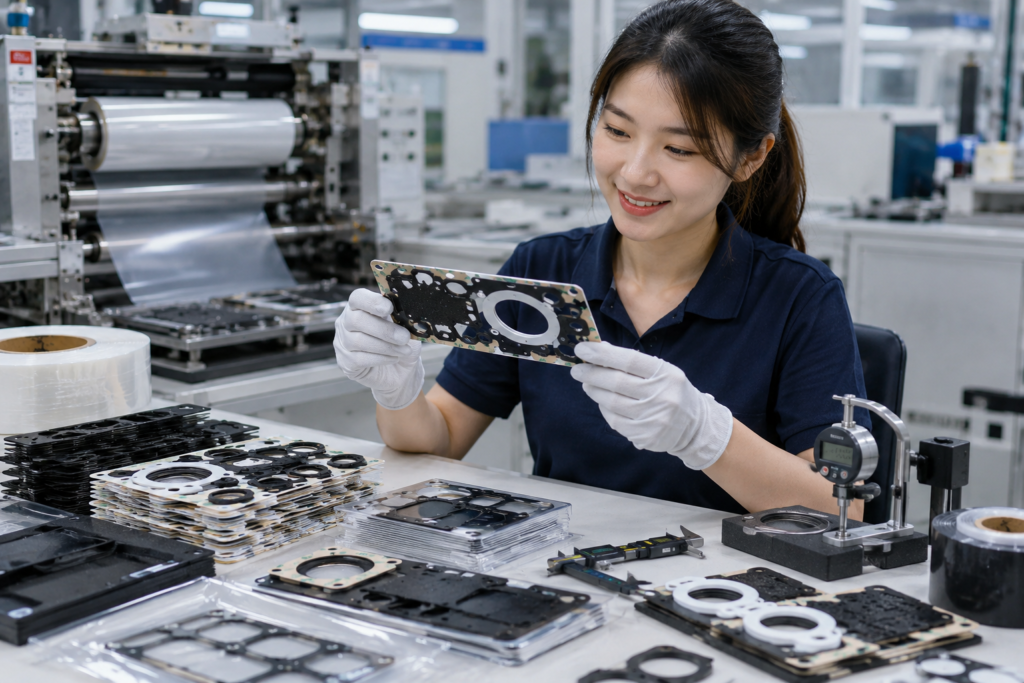
Multi-layer die cut parts are difficult to produce because several materials with different thickness, compression, adhesive behavior, dimensional stability and cutting performance must be laminated, aligned and cut into one functional component.
A multi-layer part may combine PET film, foam, adhesive tape, release liner, rubber, protective film, black light-blocking film or non-woven felt. These layers may look simple after assembly, but small process changes can cause misalignment, curling, delamination, adhesive overflow, liner damage or assembly failure.
For OEM buyers and engineers, the challenge is not only whether one sample looks correct. The real challenge is whether the part can remain stable during repeat production, shipping, peeling, bonding and final assembly.
What Is a Multi-Layer Die Cut Part?
A multi-layer die cut part combines two or more materials into a single functional component.
Common layers include:
- PET films
- Protective films
- Black light-blocking films
- Foam materials
- Double-sided tapes
- Transfer adhesive layers
- Non-woven felt materials
- Rubber sheets
- Release liners
- Insulation films
Instead of assembling these materials individually, manufacturers create one integrated component for faster installation and improved consistency.
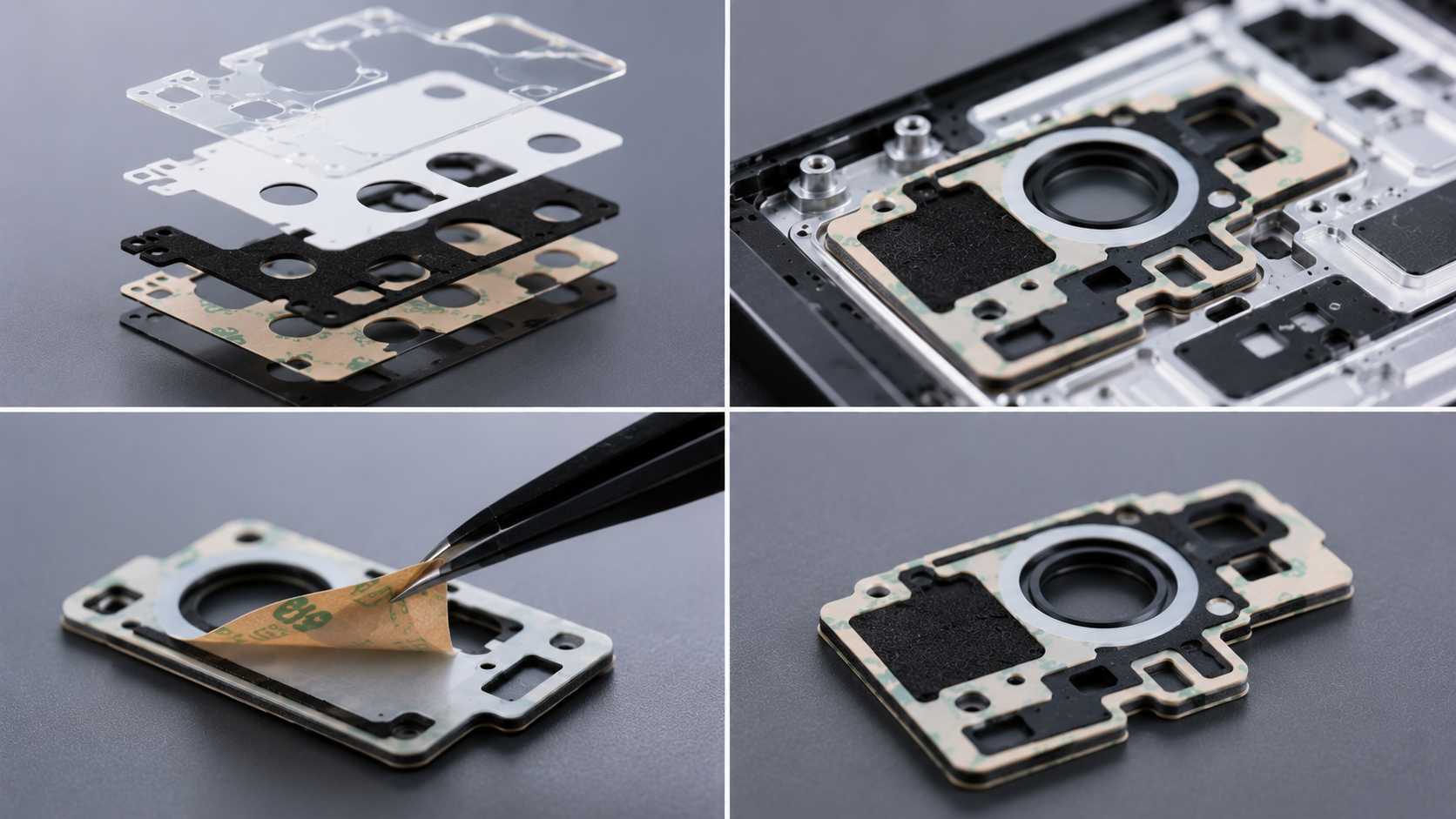
Challenge 1: Material Compatibility
Different materials behave differently during converting.
For example:
- PET films remain dimensionally stable.
- Foam compresses under pressure.
- Non-woven fabrics stretch.
- Rubber materials rebound.
When these materials are laminated together, internal stress can develop.
Potential problems include:
- Curling
- Warping
- Misalignment
- Delamination
Material compatibility should be evaluated before production begins to avoid costly mistakes in custom die cut parts.
Challenge 2: Registration Accuracy
Registration refers to maintaining precise alignment between layers.
As the number of layers increases, alignment becomes more difficult.
Typical registration requirements may involve:
- Hole alignment
- Window alignment
- Edge positioning
- Adhesive placement
A small registration error in one layer may create significant problems in the final assembly.
Common Causes
- Material stretching
- Web tension variation
- Temperature changes
- Poor registration systems
For electronic applications, tolerances are often measured in fractions of a millimeter.
Challenge 3: Lamination Process Control
Lamination appears simple but is often the source of major quality issues.
Factors that must be controlled include:
- Web tension
- Roller pressure
- Lamination speed
- Material flatness
- Adhesive performance
Improper lamination may result in:
- Air bubbles
- Wrinkles
- Poor adhesion
- Layer shifting
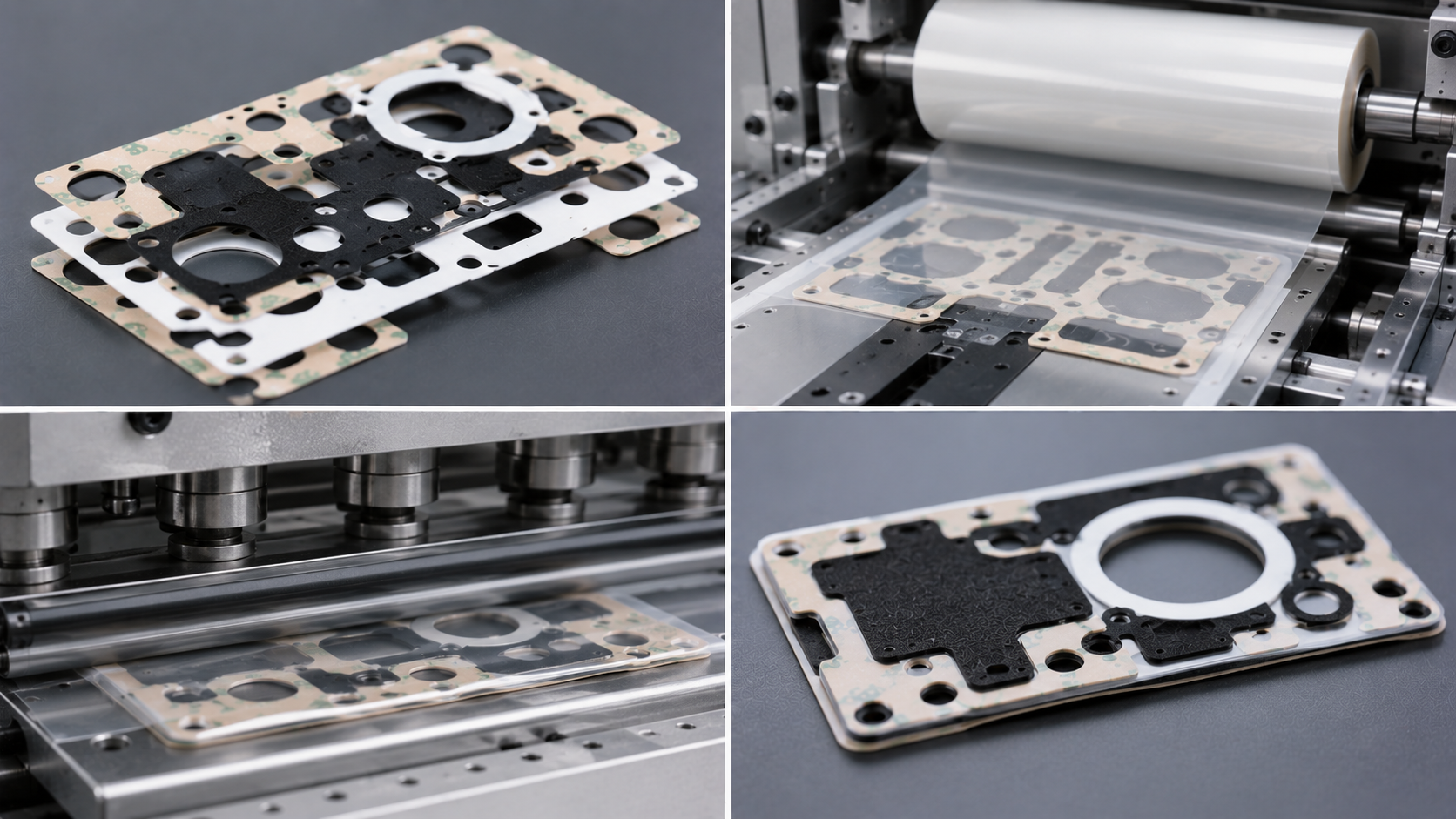
Challenge 4: Thickness Variations
Every material layer contributes to overall thickness variation.
For example:
- Foam thickness tolerances
- Adhesive thickness tolerances
- Film thickness variation
When multiple layers are combined, these variations accumulate.
This can affect:
- Compression performance
- Assembly fit
- Sealing effectiveness
- Product appearance
Tolerance stack-up analysis is critical for multi-layer designs.
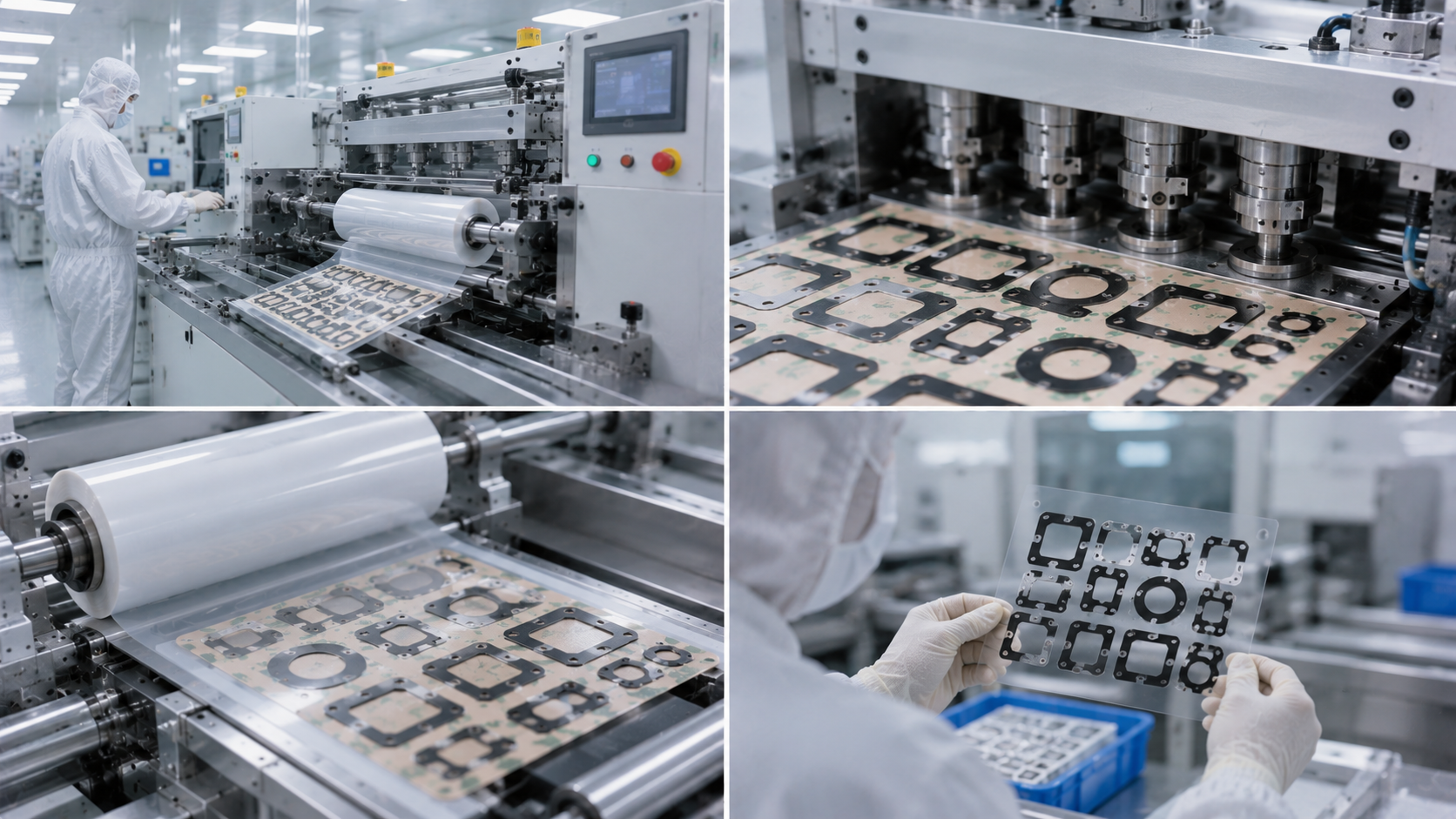
Challenge 5: Die Cutting Different Materials Simultaneously
Each material requires different cutting conditions.
For example:
| Material | Cutting Behavior |
|---|---|
| PET film | Hard and dimensionally stable |
| Foam | Compressible and easy to deform |
| Non-woven felt | Fibrous and sensitive to edge quality |
| Rubber | Elastic and may rebound after cutting |
| Adhesive tape | Sticky and sensitive to pressure and blade condition |
| Release liner | Requires controlled kiss cutting depth |
Cutting all layers with a single tool can be challenging.
Problems may include:
- Incomplete cuts
- Burrs
- Material distortion
- Adhesive contamination
Tool design becomes increasingly important as layer complexity grows.
Challenge 6: Adhesive Management
Many adhesive-backed die cut components contain pressure-sensitive adhesives that must be controlled during lamination, cutting and liner release.
Adhesive-related issues include:
- Edge ooze
- Delamination
- Adhesive transfer
- Bubble formation
- Release liner problems
Improper adhesive selection can cause failures months after production.
Environmental testing is essential.
Challenge 7: Contamination Control
The more layers involved, the greater the risk of contamination.
Potential contaminants include:
- Dust
- Fibers
- Silicone transfer
- Process debris
- Static-attracted particles
This is particularly important for:
- Optical films
- Display assemblies
- Electronic modules
- Automotive electronics
- Protective film components
Many multi-layer components require clean handling, dust control and stable process conditions.
Challenge 8: Curling and Dimensional Stability
Different materials expand and contract at different rates.
Changes in:
- Temperature
- Humidity
- Storage conditions
can cause:
- Curling
- Lifting
- Warping
Thin film constructions are particularly susceptible.
Balanced laminate design helps minimize these risks.
Challenge 9: Automated Assembly Requirements
Modern OEM production increasingly relies on automation.
Multi-layer die-cut parts must be compatible with:
- Pick-and-place systems
- Robotic assembly
- Automated dispensing equipment
Challenges include:
- Release liner performance
- Peel force control
- Registration accuracy
- Part rigidity
A component that works manually may fail during automated assembly if the sheet, roll or kit delivery format does not match the production process.
Quality Control Requirements
Successful production requires monitoring:
- Layer alignment
- Thickness consistency
- Adhesion performance
- Dimensional accuracy
- Peel force
- Environmental durability
Many defects only appear after aging, shipping, or customer assembly.
Validation should include real-world conditions.
How Sanken Supports Multi-Layer Die Cut Parts
Sanken supports OEM customers with multi-layer material review, adhesive lamination, precision die cutting, kiss cutting, waste removal, dimensional inspection and assembly-ready packaging.
Our multi-layer die cut components may include:
- PET film + adhesive structures
- Foam + adhesive + release liner structures
- Rubber + adhesive components
- Protective film + pull tab structures
- Black light-blocking film components
- Non-woven felt + adhesive parts
- Foam + film + adhesive laminated components
For each project, we review material compatibility, layer alignment, adhesive behavior, total thickness, cutting method, liner release, packaging format and mass production stability before tooling and production.
Featured Snippet Summary
Multi-layer die-cut parts are difficult to produce because multiple materials with different physical properties must be laminated, aligned, cut, and assembled with high precision. Key challenges include material compatibility, registration accuracy, lamination control, adhesive management, contamination prevention, and dimensional stability.
Conclusion
Multi-layer die cut parts are difficult to produce because each layer may behave differently during lamination, cutting, peeling, packaging and final assembly. Material compatibility, registration accuracy, adhesive control, thickness stability, contamination control and liner release all affect the final result.
For OEM buyers, one approved sample is not enough. The part must also remain stable during repeat production and match the real assembly process.
Need multi-layer die cut parts for an OEM project?
Send us your drawing, sample, material structure, adhesive requirement, liner type, tolerance, application environment, annual volume and delivery format. Sanken can help review material selection, lamination structure, die cutting method, inspection points and packaging before sampling and mass production.