
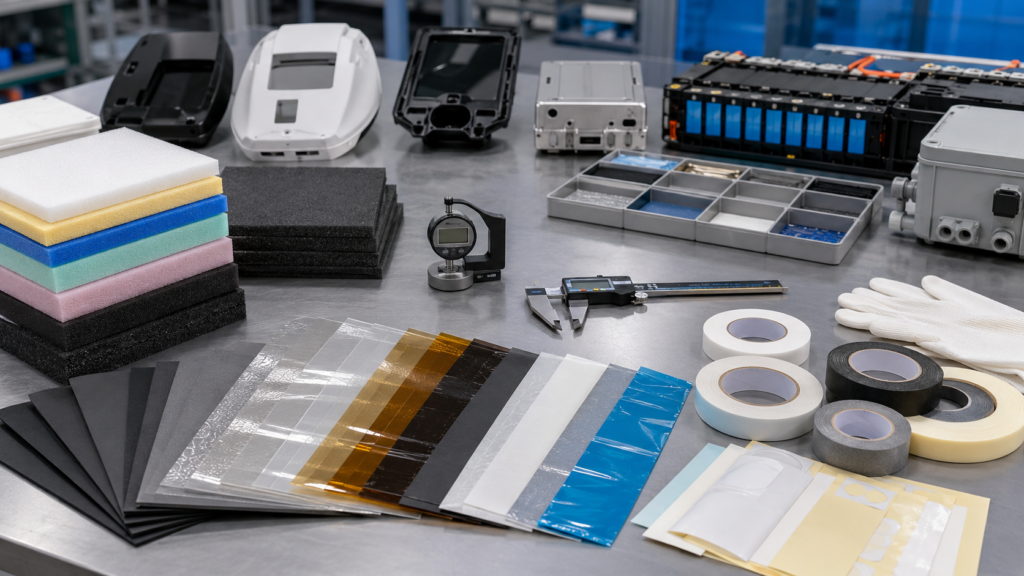
Choosing the right foam, rubber, film, and tape materials for die cut parts is one of the most important steps in OEM product development. A die cut component may look simple, but its performance depends on material thickness, density, hardness, adhesive structure, compression behavior, temperature resistance, edge quality, and assembly method.
For OEM buyers and engineers, the goal is not only to cut a material into a shape. The goal is to create a part that seals, bonds, insulates, cushions, protects, blocks light, reduces vibration, or improves assembly efficiency in the final product.
At Sanken, we help customers develop custom die cut foam gaskets, rubber pads, PET and PI insulation films, protective films, adhesive tape components, non-woven felt parts, and multilayer converting parts for automotive, electronics, battery, medical, appliance, and industrial applications.
Why Material Selection Matters for Die Cut Parts
Many die cut parts are hidden inside a finished product. They may not be visible to the end user, but they can strongly affect product reliability.
A foam gasket may prevent dust or water from entering a housing.
A rubber pad may reduce vibration.
A PET film may provide electrical insulation.
A protective film may prevent scratches during assembly.
A double-sided tape part may hold two components together.
If the material is wrong, the part may fail even if the cutting shape is correct.
Common problems include:
- Poor sealing
- Adhesive lifting
- Foam compression loss
- Rubber deformation
- Film tearing
- Poor insulation
- Edge burrs
- Difficult liner release
- Material curling
- Assembly mismatch
- Rework before production
This is why material selection should happen before tooling and mass production, not after defects appear.
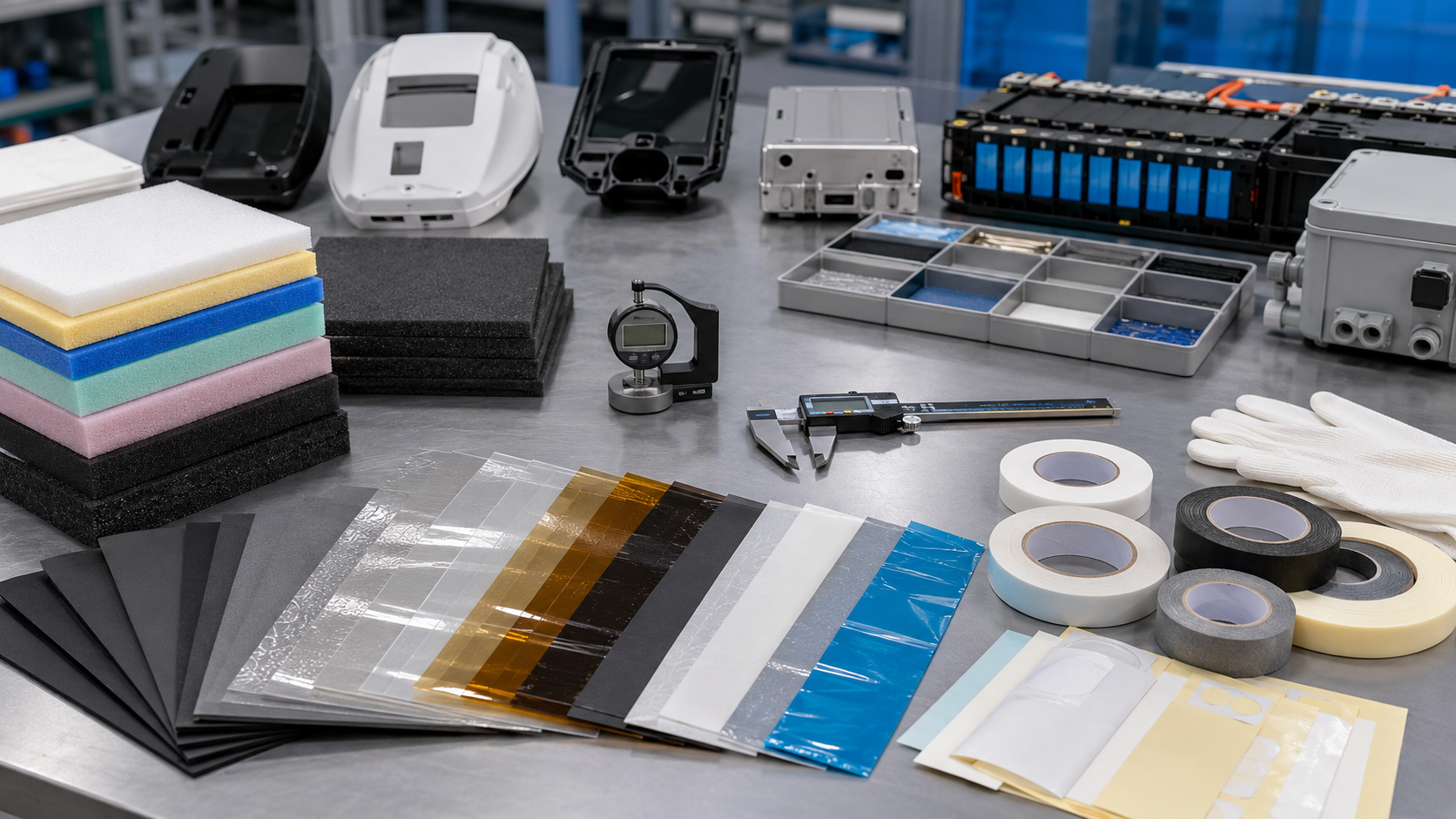
Main Material Groups for Die Cut Parts
Foam, rubber, film, and tape materials each have different strengths.
| Material Type | Main Function | Common Die Cut Applications |
|---|---|---|
| Foam | Sealing, cushioning, gap filling, vibration reduction | Foam gaskets, pads, spacers, inserts |
| Rubber | Sealing, damping, impact resistance, anti-slip support | Rubber pads, washers, seals, vibration parts |
| Film | Insulation, protection, spacing, light control | PET films, PI films, PC films, protective films |
| Tape | Bonding, positioning, lamination, assembly support | Double-sided tape parts, adhesive pads, foam tape gaskets |
In many OEM projects, the best solution is not a single material. It may be a multilayer structure, such as foam with adhesive backing, PET film with double-sided tape, rubber with liner, or protective film with pull tabs.
When to Choose Foam Materials
Foam is often used when the part needs to compress, cushion, seal, fill a gap, absorb shock, or reduce vibration.
Common foam materials include:
| Foam Material | Key Feature | Typical Use |
|---|---|---|
| PE foam | Lightweight, clean, closed-cell structure | Packaging, cushioning, spacing |
| PU foam | Soft and compressible | Cushioning, soft contact, delicate protection |
| EVA foam | Durable, flexible, good shape stability | Inserts, pads, industrial cushioning |
| EPDM foam | Weather-resistant, good sealing support | Automotive sealing, dust and water protection |
| Silicone foam | Heat-resistant, stable compression | Electronics, battery, high-temperature applications |
| CR foam | Balanced sealing and cushioning | Industrial and automotive pads |
Foam selection depends on density, thickness, compression force, cell structure, rebound, and application environment.
A soft foam may protect a delicate surface, but it may collapse if used under high compression. A firm foam may hold shape better, but it may create too much pressure in a tight assembly gap.
For die cut foam gaskets, engineers should confirm the actual gap, compression ratio, sealing width, adhesive requirement, and long-term recovery.
When to Choose Rubber Materials
Rubber is often selected when the part needs stronger sealing, better mechanical durability, vibration damping, impact resistance, or anti-slip performance.
Common rubber materials include silicone rubber, EPDM rubber, neoprene rubber, NBR rubber, natural rubber, and specialty rubber sheets.
Rubber is commonly used for:
- Sealing pads
- Vibration damping pads
- Rubber washers
- Anti-slip feet
- Cushioning spacers
- Industrial gaskets
- Automotive electronic pads
- Appliance support pads
Rubber is usually stronger and more durable than many foam materials, but it may require higher compression force. This is important when the part is installed inside a thin plastic housing, electronic module, or lightweight assembly.
Engineers should review rubber hardness, thickness, compression force, rebound, oil resistance, heat resistance, and bonding method.
For precision die cut rubber parts, material rebound and edge quality must also be considered during production.
When to Choose Film Materials
Film materials are often used when the part must provide electrical insulation, surface protection, spacing, light blocking, heat resistance, or dimensional stability.
Common film materials include PET, PI, PC, PP, PE, protective film, optical film, and specialty insulation film.
| Film Material | Key Feature | Typical Use |
|---|---|---|
| PET film | Stable, clean, good insulation | Electronics, battery, spacers, insulation parts |
| PI film | High heat resistance and insulation | Battery, electronics, high-temperature areas |
| PC film | Tough and impact-resistant | Display, cover, insulation, appearance parts |
| Protective film | Temporary surface protection | Screens, lenses, panels, housings |
| Black film | Light blocking and shielding support | Display modules, sensors, optical areas |
Film die cut parts often require clean edges, accurate holes, stable dimensions, and good surface quality.
For electronics and battery applications, even small edge defects or hole misalignment can create assembly risk. For display or optical applications, dust, scratches, or poor handling may cause visible defects.
Film materials may also curl, stretch, or wrinkle if web tension, cutting pressure, or packaging is not controlled.
When to Choose Tape Materials
Tape materials are used when the die cut part needs bonding, mounting, positioning, lamination, or assembly support.
Common tape materials include double-sided tape, transfer adhesive, foam tape, tissue tape, PET carrier tape, acrylic foam tape, and removable adhesive tape.
Tape is commonly used for:
- Bonding pads
- Mounting strips
- Adhesive-backed gaskets
- Display bonding parts
- Protective film tabs
- Battery insulation adhesive parts
- Sensor assembly components
- Automotive electronic adhesive parts
Adhesive selection is critical.
The adhesive must match the bonding surface, such as ABS, PC, PP, metal, glass, painted surface, rubber, foam, or coated plastic.
A tape that bonds well to metal may not bond well to low surface energy plastic. A tape with strong adhesion may still fail if the surface is dusty, oily, textured, or exposed to heat and humidity.
For die cut tape parts, liner release is also important. If the liner is too tight, operators may damage the part during peeling. If the liner is too loose, the part may shift during handling.
Key Factors Buyers Should Check
Before choosing foam, rubber, film, or tape materials, buyers should define the real function of the part.
| Checklist Item | What to Confirm | Why It Matters |
|---|---|---|
| Part function | Sealing, bonding, insulation, cushioning, protection | Defines material direction |
| Application area | Automotive, electronics, battery, medical, industrial | Determines environment |
| Material thickness | Total thickness and tolerance | Affects fit and assembly |
| Compression need | Light contact or firm pressure | Helps choose foam or rubber |
| Adhesive requirement | With or without PSA backing | Affects bonding and liner release |
| Bonding surface | Plastic, metal, glass, coating, rubber | Determines adhesive selection |
| Temperature exposure | Normal, high heat, outdoor, battery area | Affects aging resistance |
| Part shape | Holes, slots, narrow strips, tabs | Affects die cutting feasibility |
| Delivery format | Roll, sheet, tray, liner-backed, kit | Affects assembly efficiency |
| Testing method | Peel, compression, aging, fit, insulation | Confirms reliability |
A material should not be selected only by name. It should be selected based on final working conditions.
Common Material Selection Mistakes
| Mistake | Possible Result |
|---|---|
| Choosing foam only by thickness | Poor compression or sealing failure |
| Choosing rubber without checking hardness | Assembly stress or poor fit |
| Choosing film without checking edge quality | Insulation or assembly risk |
| Choosing tape without testing bonding surface | Adhesive lifting or peeling |
| Ignoring liner release | Slow assembly and damaged parts |
| Using tight tolerance on soft materials | High rejection rate |
| Ignoring packaging method | Curling, compression, or deformation |
| Skipping real assembly testing | Problems appear during mass production |
Most problems can be prevented with early material review and sample testing.
A clean-looking sample is not enough. The part should be tested under real assembly pressure, temperature, vibration, bonding surface, and handling conditions.
Why Die Cutting Process Matters
Even the right material can fail if the die cutting process is not controlled.
Foam can be crushed by too much cutting pressure.
Rubber can rebound and affect final dimensions.
Thin film can stretch if tension is unstable.
Adhesive tape can overflow if the blade pressure is too high.
Protective film can wrinkle if packaging is poor.
Non-woven or fiber-based materials can shed particles if the edge is not clean.
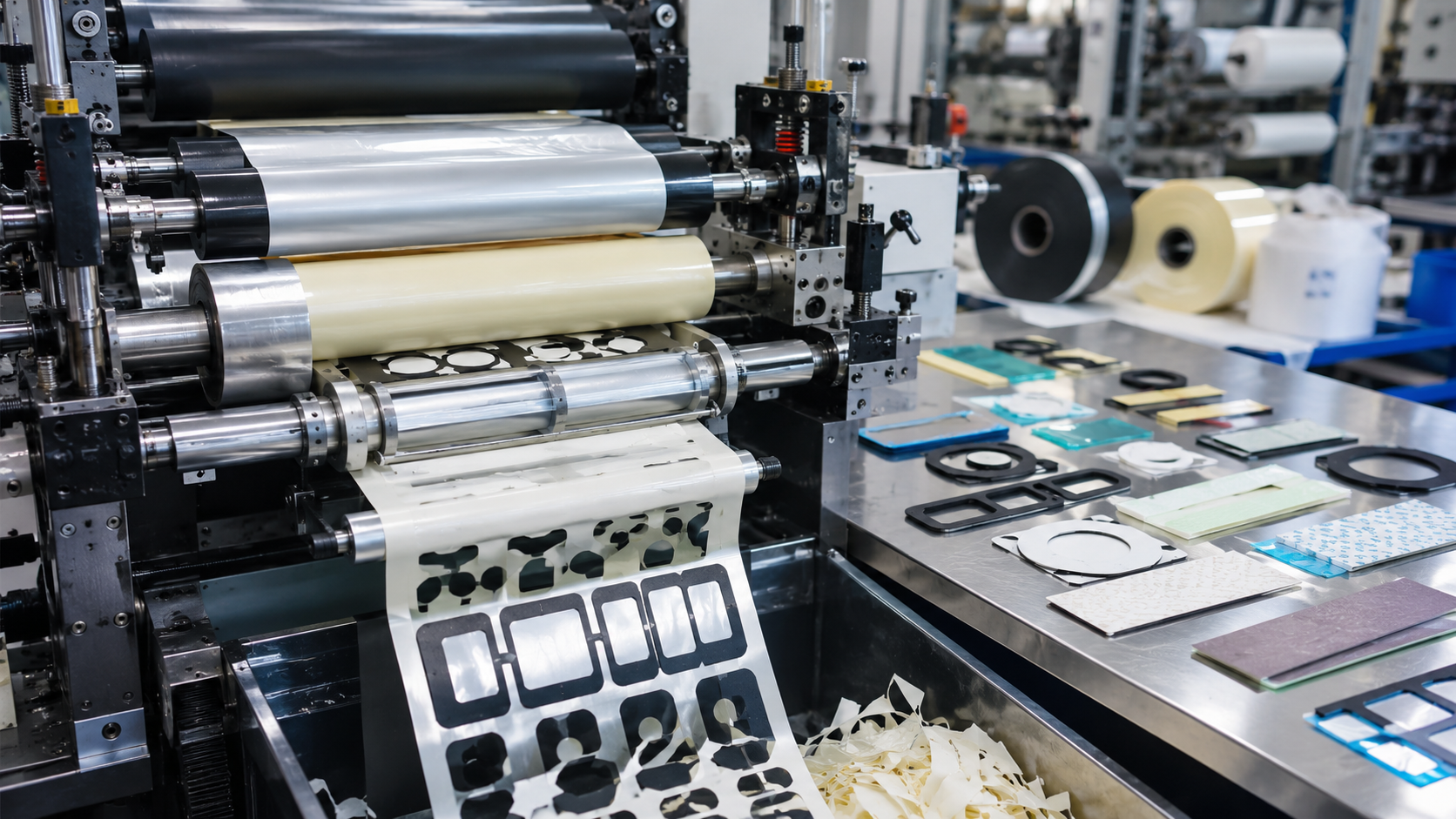
For adhesive-backed parts, kiss cutting depth is especially important. The blade must cut the top material and adhesive layer without damaging the release liner.
For film parts, hole accuracy and edge cleanliness are critical.
For foam and rubber gaskets, wall width, compression behavior, and dimensional stability must be reviewed before tooling.
How Sanken Helps Customers Choose the Right Materials
Sanken Manufacturing Co., Ltd. supports OEM customers with precision die cutting, adhesive lamination, material converting, foam and rubber components, PET and PI insulation films, protective films, non-woven felt parts, sealing gaskets, and custom adhesive-backed components.
For each project, we review:
- Part function
- Material type
- Thickness and density
- Foam compression
- Rubber hardness
- Film stability
- Adhesive structure
- Bonding surface
- Liner release
- Die cut tolerance
- Edge quality
- Waste removal
- Packaging format
- Assembly method
- Testing requirements
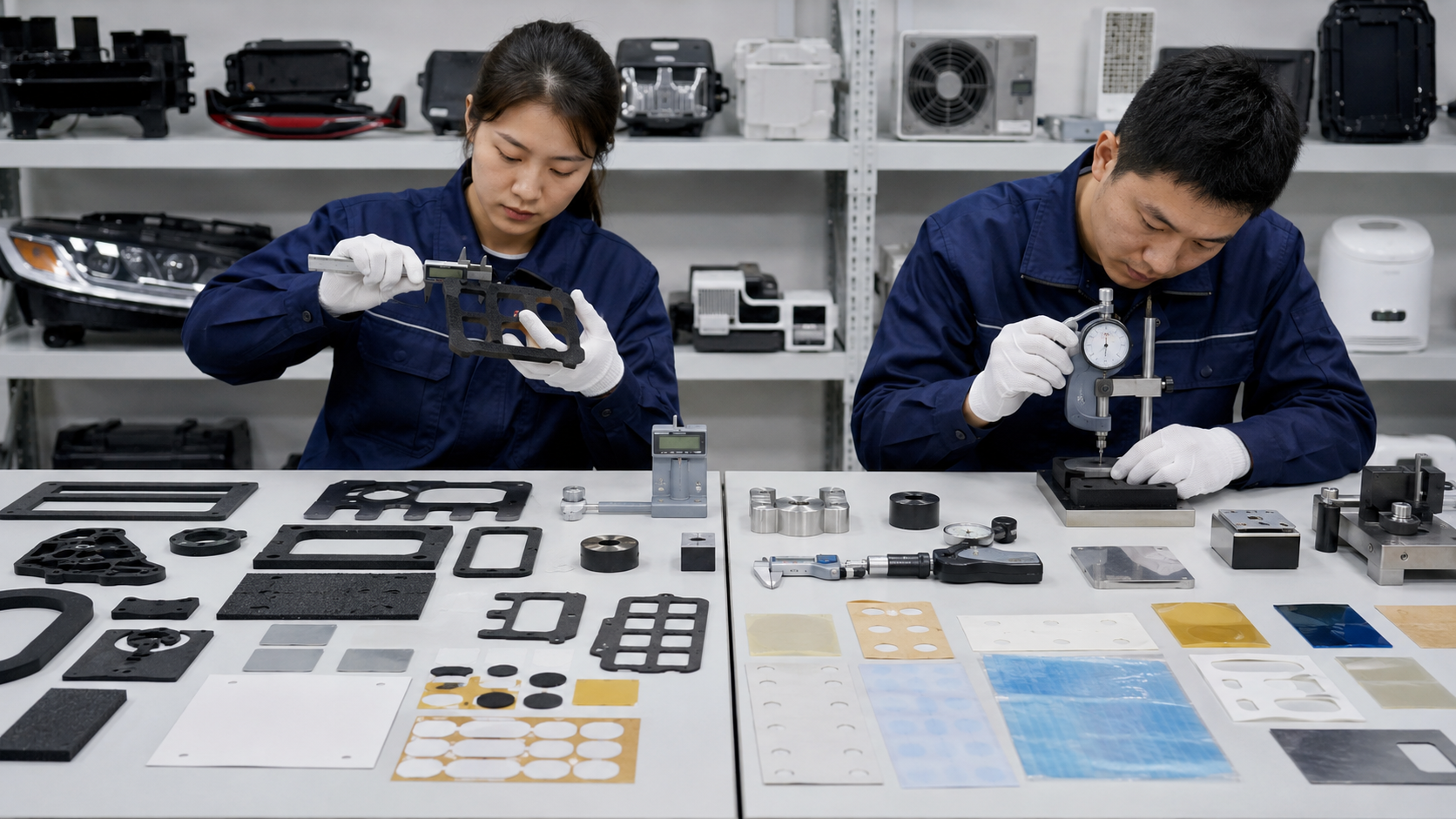
For automotive applications, we support foam gaskets, rubber pads, anti-rattle felt parts, adhesive strips, sealing components, and insulation films.
For electronics and battery applications, we support PET insulation films, PI films, protective films, adhesive spacers, display bonding parts, and masking films.
For medical, appliance, and industrial applications, we focus on clean cutting, stable release, dimensional accuracy, and assembly-friendly delivery formats.
Our goal is to help customers reduce repeated samples, adhesive lifting, poor fit, rough edges, compression failure, material waste, and unstable mass production.
FAQ
What material is best for die cut parts?
There is no single best material. Foam is good for sealing, cushioning, and gap filling. Rubber is good for durability and damping. Film is good for insulation and protection. Tape is good for bonding and assembly support.
When should I choose foam for die cut parts?
Choose foam when the part needs compression, cushioning, sealing, shock absorption, gap filling, or vibration reduction.
When should I choose rubber instead of foam?
Choose rubber when the part needs stronger mechanical durability, sealing pressure, vibration damping, impact resistance, or anti-slip performance.
What film materials are commonly die cut?
PET, PI, PC, protective film, optical film, black film, and insulation films are commonly die cut for electronics, battery, display, and industrial applications.
Why is adhesive tape important in die cut parts?
Adhesive tape helps bond, mount, position, or laminate die cut components. Adhesive selection must match the bonding surface, temperature, pressure, and assembly method.
Can foam, rubber, film, and tape be combined in one part?
Yes. Many OEM parts use multilayer structures, such as foam with adhesive backing, PET film with tape, rubber with liner, or protective film with pull tabs.
What should buyers provide before ordering die cut parts?
Buyers should provide drawings or samples, material requirements, thickness, adhesive needs, bonding surface, tolerance, application environment, quantity, testing requirements, and delivery format.
Conclusion
Choosing foam, rubber, film, and tape materials for die cut parts requires understanding the part’s real function and working environment. Foam supports sealing and cushioning. Rubber provides durability and damping. Film supports insulation and protection. Tape enables bonding and assembly efficiency.
For OEM buyers, the best material is not simply the lowest-cost option. It is the material that fits the application, survives the environment, supports assembly, and remains stable in mass production.
At Sanken, we help customers select and convert foam, rubber, film, tape, and multilayer materials into reliable custom die cut components for automotive, electronics, battery, medical, appliance, and industrial applications.