

Foam gaskets lose sealing performance when they can no longer maintain continuous contact across the intended sealing area. Common causes include an unsuitable compression range, excessive compression set, environmental aging, adhesive failure, unstable gasket geometry, uneven mating surfaces, or poor storage and handling.
A gasket may seal correctly during sample approval but become thinner, harder, loose, or displaced after compression, vibration, temperature changes, shipment, or repeated use. OEM engineers therefore need to confirm whether it can maintain sealing force throughout the expected service conditions.
At Sanken, our precision die cutting services support custom foam gaskets, adhesive-backed foam parts, sealing frames, cushioning pads, and liner-supported components for OEM assembly.
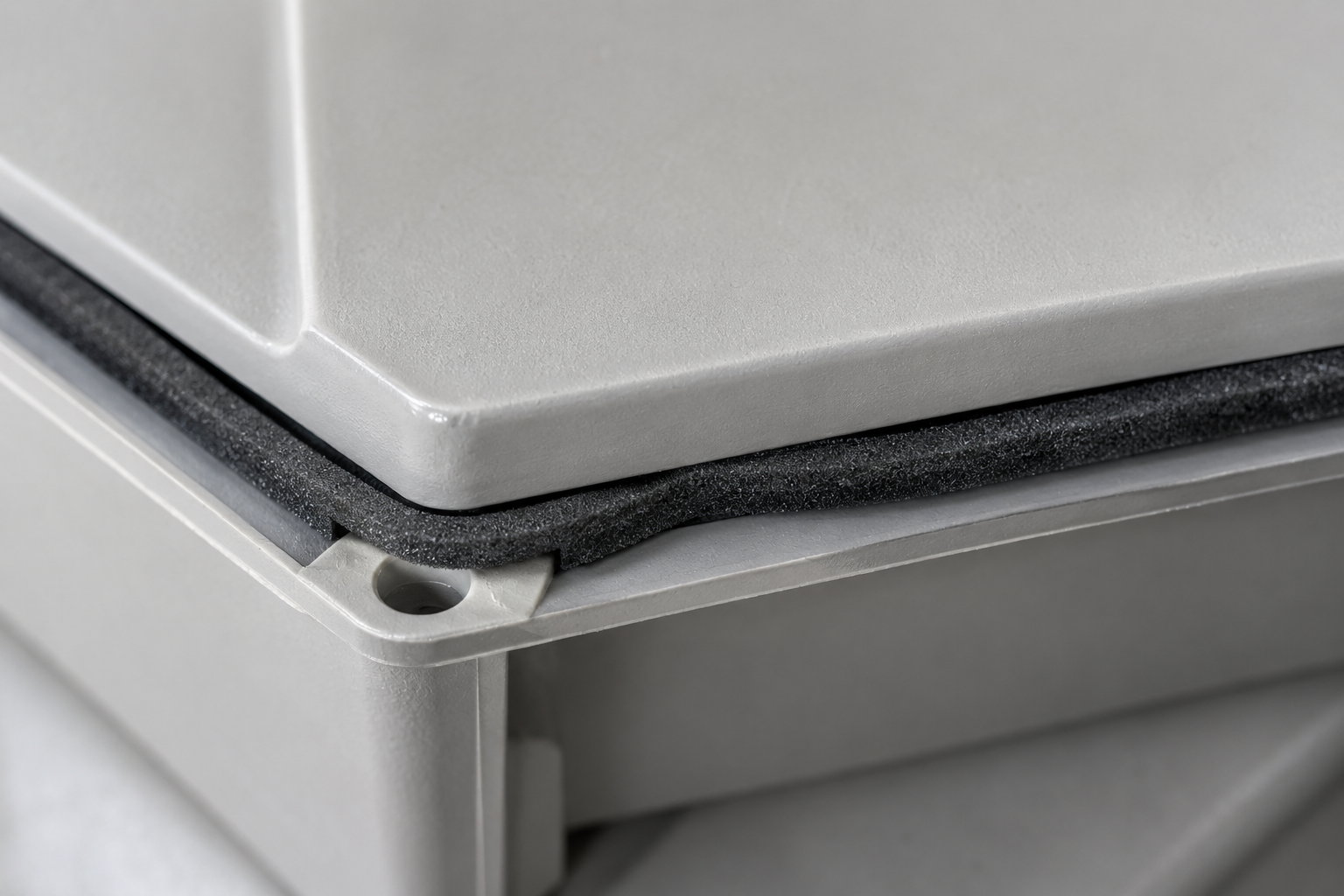
Identify Why the Foam Gasket Is Losing Sealing Performance
Different sealing symptoms can point to different material, design, or assembly problems. Before changing the foam, engineers should identify when and where the failure occurs.
| Observed problem | Possible cause | What should be checked |
|---|---|---|
| The gasket remains flattened after long-term compression | Excessive compression or unsuitable compression-set performance | Working gap, compression range, and foam grade |
| Leakage appears along one edge | Uneven housing gap or insufficient local contact | Surface flatness, tolerance stack-up, and sealing-wall width |
| The gasket shifts during assembly | Adhesive mismatch or unstable placement | Bonding surface, liner design, and application method |
| Sealing varies between units | Inconsistent gap, fastening load, or positioning | Housing dimensions, assembly method, and placement tolerance |
| Foam hardens or shrinks after aging | Thermal, humidity, or chemical exposure | Actual service environment and selected material grade |
| Adhesive separates from the foam | Adhesive or lamination incompatibility | Foam surface, adhesive structure, and aging requirements |
Before changing the material, connect the symptom to the compression condition, foam behavior, adhesive layer, gasket geometry, mating surface, or assembly process.
Control the Working Compression Range
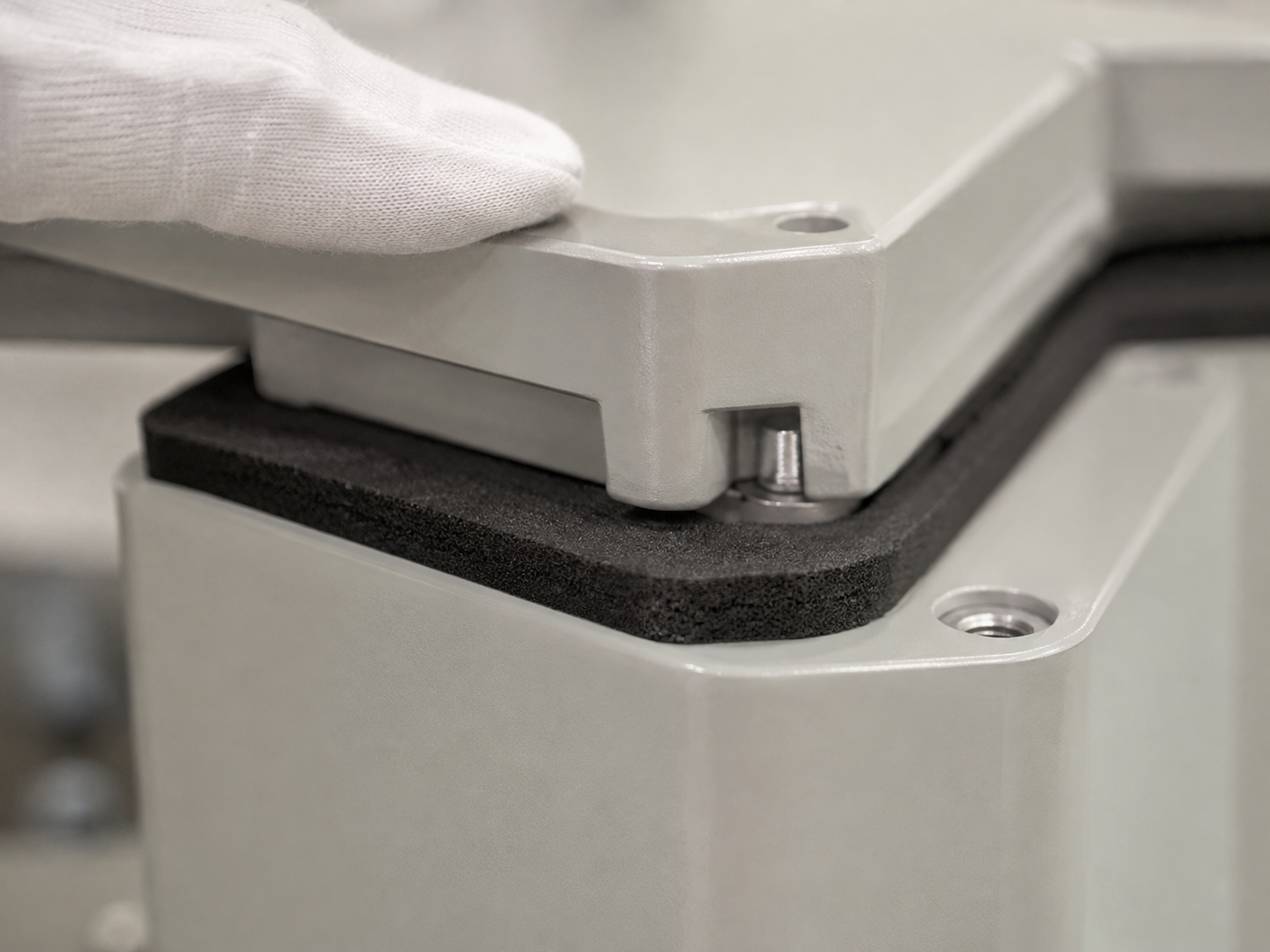
Foam gaskets need compression to create continuous contact, but excessive compression can damage the foam.
If the gasket is barely compressed, it may not fill the complete gap. If it is compressed too much, the cell structure may deform and the gasket may lose rebound. If the assembly gap varies across the housing, some areas may seal while others remain open.
The design should define the working gap and a suitable compression range for the selected grade. The gasket needs enough deflection to accommodate gap variation while retaining recovery capacity after aging.
Over-compression can result from:
- Excessive gasket thickness
- An assembly gap that is smaller than expected
- Uncontrolled fastening load
- Foam density or hardness that does not match the design
- Uneven mating surfaces
- The absence of a compression stop or support feature
A compression stop, support rib, or controlled housing gap can help prevent excessive compression, especially in screw-fastened electronic housings and equipment covers.
Choose Foam With Suitable Compression-Set Performance
Compression set describes the extent to which a foam fails to recover after it has been compressed for a defined period under specified conditions.
A foam with unsuitable compression-set performance may remain flattened and lose the force needed to maintain contact, contributing to leakage, rattle noise, or an unstable assembly fit.
For die-cut foam gasket applications, buyers should not select material only by softness, thickness, or price. Foam density, hardness, cell structure, rebound, compression set, temperature exposure, and required service life should be reviewed together.
Match the Foam Grade to the Working Environment
Different foam families and grades behave differently under compression and environmental exposure.
| Foam type | Typical consideration | What should be validated |
|---|---|---|
| EVA foam | General cushioning and light sealing | Compression recovery, temperature exposure, and required sealing level |
| PE foam | Lightweight sealing and moisture-resistant structures | Conformability, hardness, and actual gap variation |
| PU foam | Soft cushioning, acoustic control, and gap filling | Compression set, humidity exposure, and long-term recovery |
| EPDM foam | Weather-exposed sealing and vibration control | Selected grade, compression set, temperature, and chemical exposure |
| Silicone foam | Applications involving elevated temperatures | Selected grade, compression behavior, and adhesive compatibility |
| Rubber foam | Damping and sealing support | Hardness, recovery, environmental resistance, and bonding method |
Foam type alone does not confirm long-term performance. The grade should be evaluated using the actual gap, temperature, humidity, vibration, chemical exposure, and expected service duration.
Control the Adhesive Backing and Release Liner
Many adhesive-backed die-cut components use an adhesive layer to keep the gasket aligned during handling and assembly. The adhesive may not create the primary seal in every design, but a bonding failure can allow the gasket to shift, wrinkle, lift, or lose contact.
Common problems include edge lifting, weak bonding, adhesive residue, difficult liner removal, and gasket stretching during peeling. Adhesive selection should match the substrate material, coating, texture, cleanliness, and surface energy. The liner should release without deforming a narrow foam frame.
Improve the Die-Cut Geometry
A foam gasket can lose sealing performance because of its shape, even when the selected material is suitable.
Design features requiring careful review include narrow sealing walls, sharp internal corners, thin bridges, holes near edges, long unsupported strips, and profiles that can stretch during handling.
Rounded corners and stable sealing-wall widths generally improve handling and reduce local deformation. Peel tabs or extended liners can help operators remove adhesive-backed gaskets without stretching the functional area.
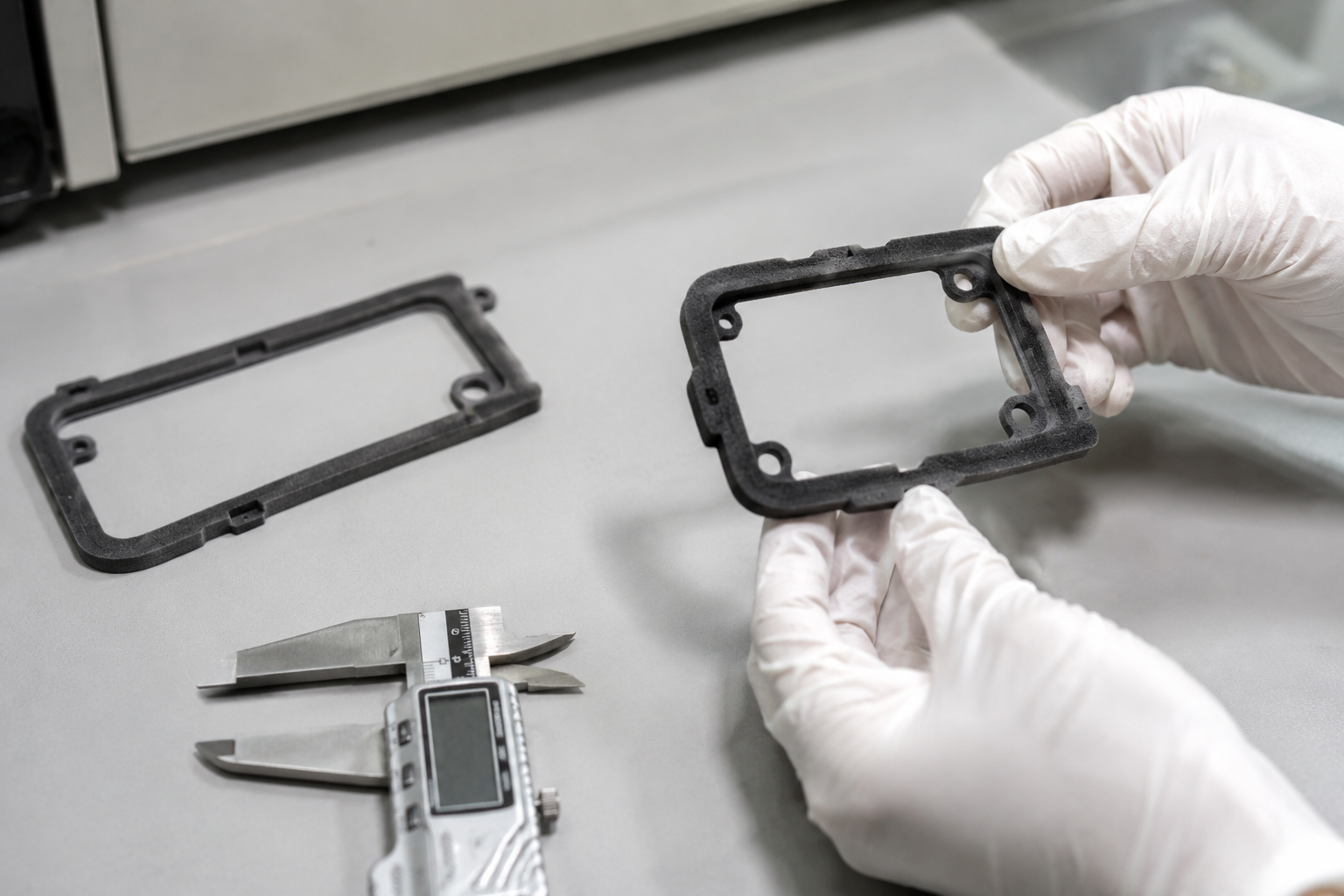
For adhesive-backed foam gaskets, precision die cutting, kiss cutting, and waste stripping must be controlled carefully. If a narrow part stretches during waste removal, its final shape may no longer match the housing.
Check Surface Flatness and Contact
A gasket can seal only when it maintains contact with the mating surface. Warped housings, molded ribs, rough textures, sink marks, fastening variation, and poor alignment can create inconsistent compression.
A softer or thicker foam may accommodate some surface variation, while a thinner high-recovery foam may suit a tightly controlled assembly. Any change must still be checked for over-compression.
The gasket should be evaluated with representative production parts rather than only on flat laboratory surfaces.
Test Under Representative Aging Conditions
A foam gasket that seals immediately after assembly may perform differently after prolonged compression or environmental exposure. Validation should reflect the actual application rather than relying only on a room-temperature dimensional check.
Representative evaluation may include:
- Compression-set testing at the intended working deflection
- Thermal aging and temperature cycling
- Humidity or moisture exposure
- Vibration or repeated opening and closing, when relevant
- Adhesive peel or holding evaluation
- Final sealing verification in the representative assembly
Conditions and acceptance criteria should follow the selected grade and actual application. No single test temperature, duration, or compression percentage applies to every foam gasket.
Avoid Performance Loss During Storage and Packaging
Foam gaskets can be damaged before assembly if packaging applies continuous pressure or allows contamination, moisture exposure, liner deformation, or shape distortion.
The selected sheet, roll, or kit delivery format should match the material, geometry, liner, storage period, and assembly method. Soft foam parts should not remain tightly stacked under pressure. Clean electronic or display applications may also require dust-controlled packaging.
What Buyers Should Confirm Before Production
Before tooling and mass production, buyers and engineers should confirm:
- Nominal gap, gap variation, and intended compression
- Sealing function and service environment
- Foam type, grade, density, hardness, and thickness
- Bonding surface and adhesive-backing requirement
- Critical dimensions, sealing-wall widths, holes, and corners
- Application method and liner design
- Aging, adhesive, and sealing validation requirements
- Delivery format, packaging, storage, and production volume
These details help identify material, geometry, converting, and assembly risks before production begins.
How Sanken Supports Foam Gasket Reliability
Sanken converts customer-specified foam, adhesive, and liner materials into custom die-cut gaskets for automotive, electronic, appliance, optical, and industrial assemblies.
Our project review covers foam grade, compression behavior, adhesive structure, geometry, liner design, edge quality, packaging, and assembly. Processing support includes lamination, die cutting, kiss cutting, waste removal, sampling, and dimensional inspection.
The objective is a gasket that fits the assembly, releases cleanly, maintains its geometry during placement, and can be validated under representative conditions.
Conclusion
Foam gaskets can lose sealing performance because of unsuitable compression, excessive permanent deformation, environmental aging, adhesive failure, unstable geometry, uneven surface contact, or poor storage and packaging.
Long-term sealing reliability should therefore be evaluated as a complete system rather than by foam type alone. Engineers should review the working gap, compression range, material grade, adhesive structure, die-cut geometry, housing tolerance, liner, and application method together.
Final approval should be based on representative samples tested under the actual compression, temperature, humidity, vibration, and service conditions defined for the assembly.
Related Articles
- Die Cut Foam Gaskets: 7 Mistakes That Cause Poor Sealing
- Custom Die Cut Foam Gaskets: Automotive Electronics Design and Production Tips
- From Foam Rolls to Finished Parts: How Die Cutting Works
- Adhesive-Backed Die Cut Components: Materials, Risks and OEM Assembly Tips
- Die Cut Parts in Sheets, Rolls, or Kits: How to Choose the Right Format