

Is PET Film Suitable for Automotive Applications?
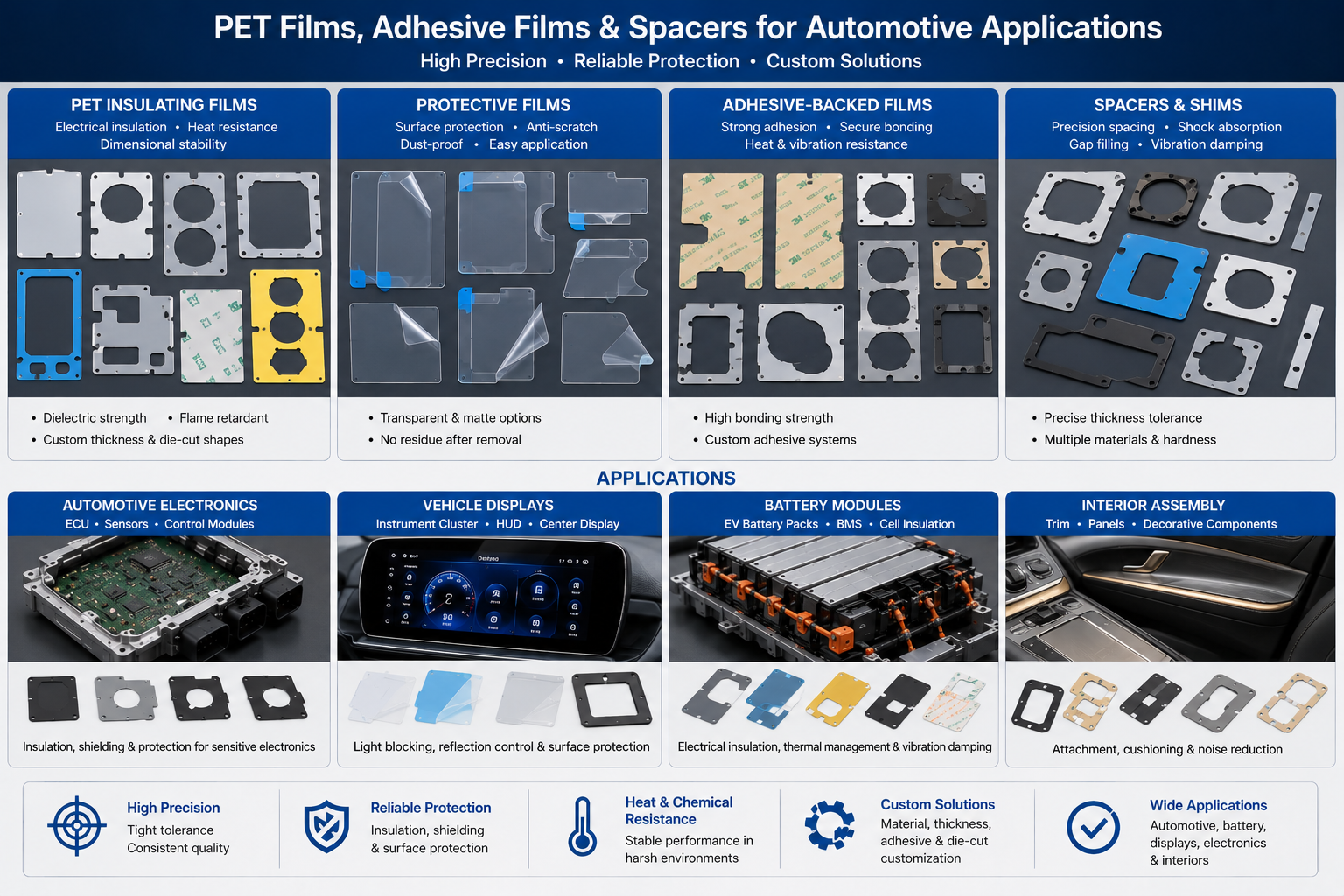
Yes, PET film is suitable for many automotive applications, especially when the part needs thin insulation, surface protection, dimensional stability, adhesive backing, clean die cutting, or lightweight spacing support.
But PET film should not be selected simply because it is common or cost-effective. In automotive projects, the real question is:
Can this PET film part survive heat, humidity, vibration, compression, adhesive aging, and long-term assembly stress without creating failure risk?
A PET film component may be hidden behind a display, inside a battery pack, under a trim part, around a sensor, or within an electronic control unit. It may look like a simple film, but it can affect insulation, bonding, noise control, surface protection, and assembly stability.
For OEM buyers, PET film becomes valuable when it is designed as a functional automotive component, not just a plastic sheet.
Why PET Film Is Used in Automotive Parts
Automotive products need materials that are stable, thin, lightweight, and suitable for long-term use. PET film fits many of these requirements.
It is commonly used because it offers:
- Good dimensional stability
- Electrical insulation
- Surface protection
- Thin thickness options
- Good die-cut performance
- Compatibility with adhesive lamination
- Lightweight structure
- Good handling in production
- Stable shape for precision parts
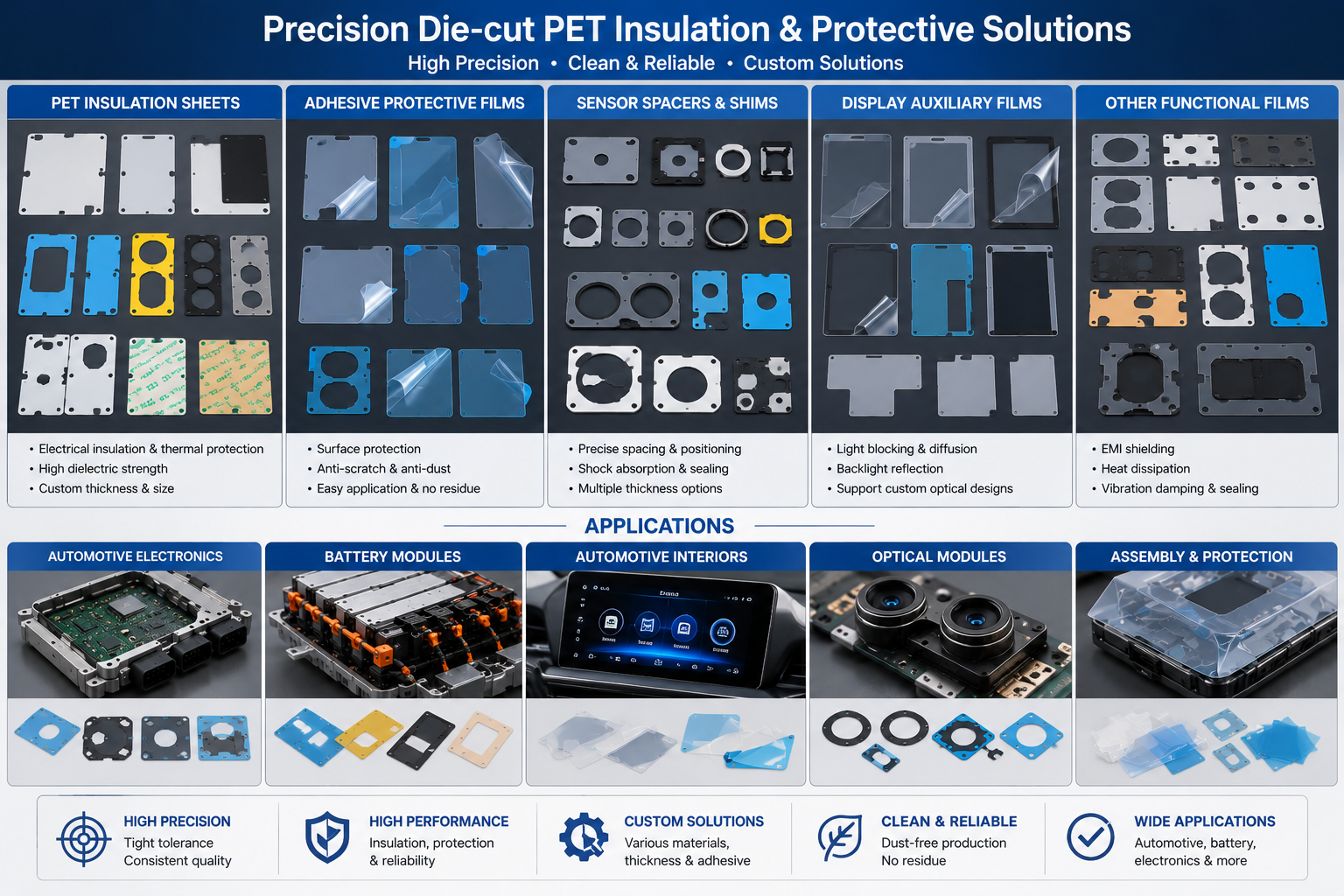
This makes PET film useful in automotive electronics, displays, sensors, battery systems, interior parts, lighting modules, control panels, and protective assemblies.
In many cases, PET film is chosen because it can provide function without adding much thickness or weight.
PET Film for Automotive Electronics
Modern vehicles contain more electronic systems than ever before. Displays, sensors, control units, cameras, battery modules, lighting systems, and driver-assistance components all require small insulating and protective parts.
PET film can be used as:
- Electrical insulation patches
- Circuit protection films
- Battery protection layers
- Sensor module spacers
- Camera module protective films
- Adhesive-backed electronic components
- Thin dielectric barriers
- Die-cut insulation sheets
In automotive electronics, a small insulation failure can cause serious reliability problems. PET film helps separate conductive areas and protect sensitive components.
However, the film must be cut accurately. If the PET insulation part is too small, it may fail to cover the risk area. If it shifts during assembly, the insulation function may be weakened. If the adhesive lifts after aging, the part may move.
This is why automotive PET film components should be validated under real use conditions, not only checked as flat samples.
PET Film for Automotive Displays
Automotive displays require materials with good cleanliness, stable thickness, and accurate dimensions.
PET film may be used in:
- Center displays
- Touch panels
- Dashboard displays
- Control screens
- Rear-seat entertainment screens
- Camera display modules
- Head-up display support structures
Common PET film functions include:
- Surface protection
- Optical spacer support
- Display auxiliary films
- Insulation layers
- Adhesive-backed frame parts
- Temporary process protection
- Light-shielding support layers
Poorly converted PET film can cause bubbles, edge lifting, scratches, dust contamination, poor bonding, or screen pressure marks.
For automotive displays, these problems are especially serious because the screen must remain reliable under heat, sunlight, vibration, and long-term use.
A PET film that performs well in consumer electronics may still need extra validation for automotive display environments.
PET Film for EV Battery and Power Components
PET film is also suitable for some battery and power-related automotive components.
In electric vehicles and hybrid vehicles, insulation and surface protection are critical. PET film may be used for:
- Battery cell insulation
- Module protection films
- Die-cut insulation barriers
- Edge protection
- Adhesive-backed battery films
- Electrical separation layers
- Protective covers for conductive areas
The benefit of PET film is that it can provide thin insulation while fitting complex shapes.
But battery applications require careful evaluation. Buyers should check heat resistance, adhesive aging, flame-retardant requirements if needed, compression conditions, and dimensional stability.
A PET film part may pass initial assembly but fail after temperature cycling, vibration, or long-term exposure if the material structure is not properly selected.
PET Film for Surface Protection During Automotive Assembly
Automotive parts often need temporary protection during manufacturing, shipping, painting, assembly, and final inspection.
PET protective film can help protect:
- Display surfaces
- Glossy trim
- Painted surfaces
- Metal decorative parts
- Plastic panels
- Lens covers
- Touch control areas
- Camera windows
The purpose is simple: prevent scratches, dust, fingerprints, and handling damage before the final product reaches the customer.
For temporary protection, removable adhesive performance is critical.
If the adhesive is too weak, the film may fall off during handling.
If the adhesive is too strong, it may leave residue.
If the film shrinks or curls, it may lift at the edges.
If the surface is sensitive, poor adhesive selection may damage the finish.
For automotive appearance parts, clean removal is just as important as protection.
PET Film for Sensors and Camera Modules
Automotive sensors and camera systems require stable positioning and clean protective materials.
PET film can be used around:
- Camera modules
- Optical sensors
- LiDAR support parts
- Radar-related electronic housings
- Interior monitoring sensors
- Parking assistance cameras
- Driver monitoring systems
In these applications, PET film may work as a spacer, protective film, insulation layer, adhesive carrier, or light-shielding support part.
The key risks are misalignment, dust, light leakage, adhesive lifting, and dimensional change.
For camera and sensor modules, inner hole accuracy and clean die-cut edges are very important. A small particle or misaligned opening can affect optical performance or assembly yield.
PET Film for Automotive Interior Components
PET film can also be used in automotive interior assemblies where thin protection, spacing, or bonding support is needed.
Possible uses include:
- Decorative trim protection
- Adhesive-backed support films
- Label and identification layers
- Thin spacers
- Anti-scratch films
- Control panel protection
- Backing films for adhesive structures
Interior parts face heat, sunlight exposure, vibration, and repeated user contact. A PET film component should not curl, lift, yellow, shrink, or leave adhesive residue under normal use conditions.
For visible interior surfaces, appearance stability is especially important.
Where PET Film Performs Well
PET film is a good choice when the automotive application needs:
| Requirement | Why PET Film Helps |
|---|---|
| Thin insulation | PET provides electrical separation without adding much thickness |
| Dimensional stability | PET holds shape better than many softer films |
| Precision die cutting | PET can be converted into accurate shapes |
| Surface protection | PET helps prevent scratches and handling damage |
| Adhesive lamination | PET works well as a carrier film for adhesive parts |
| Lightweight design | PET adds minimal weight |
| Clean converting | PET can be processed for display and electronic components |
| Stable spacing | PET can act as a thin spacer film |
For many automotive projects, PET film offers a strong balance between function, processing efficiency, and cost control.
Where PET Film May Not Be the Best Choice
PET film is suitable for many automotive applications, but it is not perfect for every condition.
It may not be the best choice when the part needs:
- Very high temperature resistance beyond PET limits
- Strong elastic sealing
- Soft cushioning
- High compression recovery
- Thick vibration damping
- Long-term rubber-like flexibility
- Special chemical resistance
- Direct structural load bearing
In these cases, other materials may be better.
For example:
| Requirement | Possible Better Material |
|---|---|
| High heat resistance | PI film |
| Soft cushioning | PU foam, EVA foam, PE foam |
| Strong sealing | EPDM rubber, silicone rubber |
| Vibration damping | Rubber foam or elastomer |
| Flexible skin-contact surface | TPU film or soft elastomer |
| Thick gap filling | Foam gasket |
The best solution may also be a multilayer structure, such as PET film with adhesive, PET film with foam, or PET film combined with light-blocking material.
Adhesive Selection Is Critical for Automotive PET Film
Many automotive PET film parts use adhesive backing.
The adhesive must match:
- Bonding surface
- Temperature exposure
- Humidity
- Vibration
- Surface energy
- Assembly pressure
- Required service life
- Removal requirement if temporary protection is needed
Common adhesive problems include:
- Edge lifting
- Peeling
- Residue
- Adhesive transfer
- Bubble formation
- Weak bonding after aging
- Difficult liner release
For automotive applications, adhesive PET film should be tested after heat aging, humidity exposure, vibration, and real assembly conditions.
A part that sticks well during sample review may not be reliable enough for vehicle production.
Die Cutting Quality Affects Automotive Performance
PET film usually needs to be converted before it becomes an automotive component.
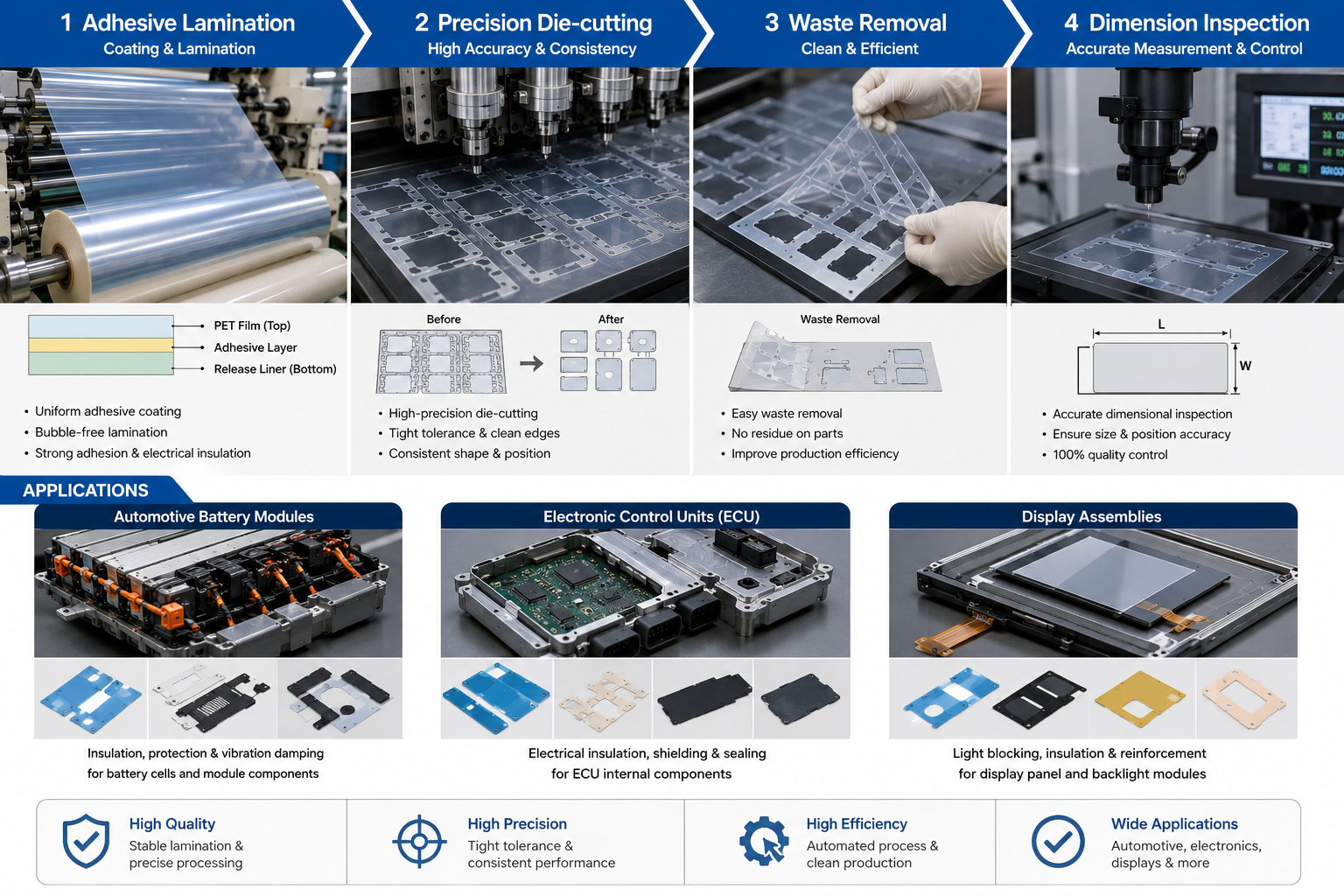
The process may include:
- Slitting
- Adhesive lamination
- Precision die cutting
- Kiss cutting
- Waste stripping
- Dimensional inspection
- Clean packaging
Poor converting can cause failures even when the raw PET film is good.
Examples include:
- Rough edges creating particles
- Wrong dimensions causing poor fit
- Deep kiss cuts damaging liners
- Adhesive overflow causing contamination
- Poor waste removal deforming small parts
- Film curling after lamination
- Packaging scratches before assembly
For automotive buyers, the finished die-cut PET part should be evaluated as a production component, not only as raw material.
What Buyers Should Confirm Before Using PET Film in Automotive Projects
Before choosing PET film for an automotive application, buyers should ask:
- What function must the PET film perform?
- Is it for insulation, protection, spacing, bonding, or display support?
- What temperature range will it face?
- Will it experience humidity, vibration, compression, or sunlight?
- Does it require adhesive backing?
- Is the adhesive permanent or removable?
- What thickness and tolerance are required?
- Does the part need clean die-cut edges?
- Will the component be used in a visible or hidden location?
- Does the application require flame-retardant, low-VOC, or special automotive-grade material?
- Will parts be applied manually or automatically?
- Can the supplier support prototype validation and mass production consistency?
These questions prevent a common mistake: using a material that looks acceptable in early samples but fails in long-term automotive conditions.
How Sanken Supports Automotive PET Film Components
For automotive PET film projects, Sanken Manufacturing focuses on the final application first.
Instead of only asking for film thickness and shape, we help customers review the risk behind the part:
- Will the PET film lift after heat aging?
- Will the adhesive leave residue?
- Will the spacer thickness affect display pressure?
- Will the insulation film cover the risk area correctly?
- Will the die-cut edge create particles?
- Will the part be easy to peel and apply on the assembly line?
Sanken supports PET film converting, adhesive lamination, precision die cutting, kiss cutting, protective film processing, insulation film cutting, dimensional inspection, and prototype-to-mass-production support.
The goal is to help customers reduce assembly problems, improve part consistency, and avoid late-stage quality failures.
Conclusion
PET film is suitable for many automotive applications, especially in electronics, displays, sensors, camera modules, battery systems, surface protection, and interior assemblies. It is thin, stable, insulating, lightweight, and compatible with precision die cutting and adhesive lamination.
However, PET film should be selected based on the real automotive environment. Heat, humidity, vibration, compression, adhesive aging, cleanliness, and tolerance all matter.
For OEM buyers, the best PET film solution is not simply the cheapest film or the easiest sample. It is the finished converted structure that protects the product, fits the assembly, survives testing, and performs consistently in mass production.