

What Industries Use Custom PET Film Die Cutting?
Custom PET film die cutting is used by industries that need thin, accurate, stable, and functional film components for insulation, protection, bonding, spacing, masking, and assembly support.
PET film is not used only because it is a common plastic film. It is used because many products need a material that can stay flat, hold tight dimensions, resist handling damage, provide electrical insulation, and be converted into precise custom shapes.
For OEM buyers, the real question is not only “Which industries use PET film die cutting?” The better question is:
“Where can a die-cut PET film component reduce assembly risk, protect sensitive parts, and improve production consistency?”
A well-designed PET film die cut may prevent a short circuit in a battery pack, protect a display from scratches, separate electronic components, support a sensor module, mask a surface during processing, or help workers place adhesive parts faster and more accurately.
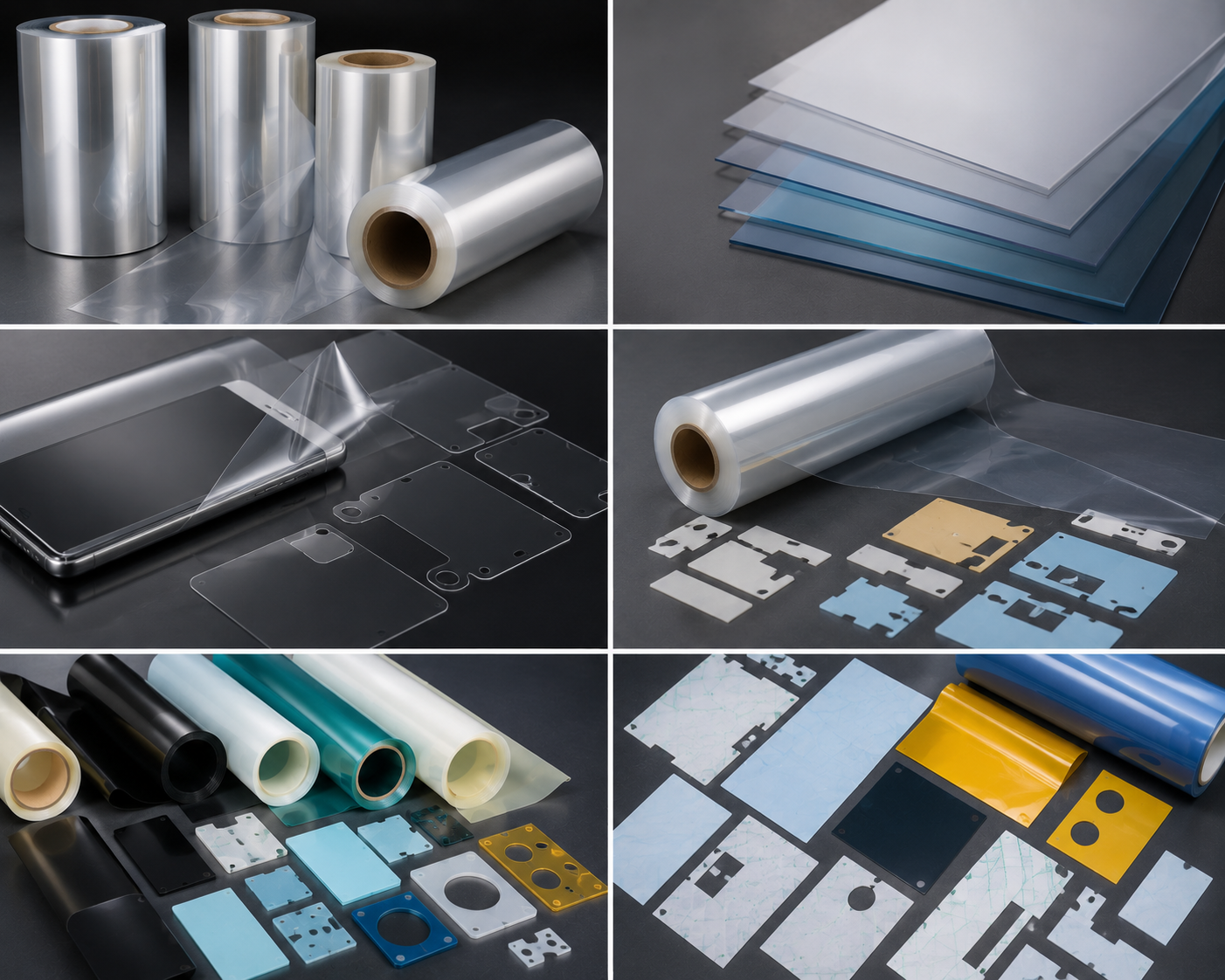
Why PET Film Is Suitable for Custom Die Cutting
PET film is widely used for custom die-cut components because it offers a useful balance of properties.
It is:
- Thin
- Lightweight
- Dimensionally stable
- Electrically insulating
- Easy to laminate with adhesives
- Suitable for clean die cutting
- Available in different thicknesses
- Useful as a carrier film, spacer, insulation layer, or protective layer
This makes it valuable in industries where small parts must fit accurately and perform reliably.
However, PET film die cutting is not just about cutting film into a shape. The final part may need adhesive backing, release liner control, kiss cutting, anti-static handling, clean packaging, or tight tolerance inspection.
That is why the industry application matters. A PET film part for packaging protection does not face the same risk as a PET insulation film inside a battery system or a display module.
Electronics Industry
The electronics industry is one of the largest users of custom PET film die cutting.
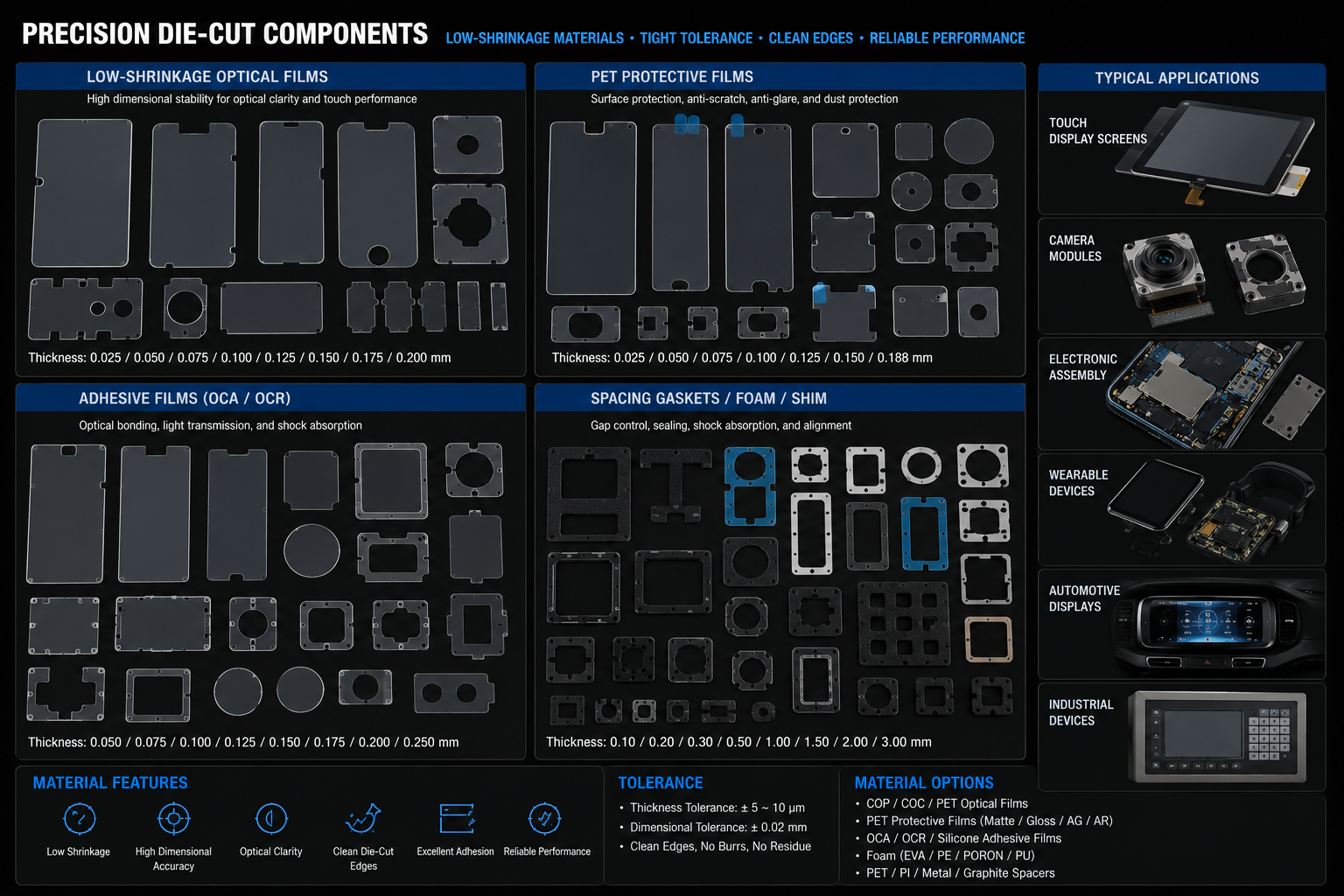
Electronic products often need thin insulation and protection in very compact spaces. PET film can be die cut into small shapes that fit around batteries, circuits, sensors, speakers, cameras, connectors, and housings.
Common electronic applications include:
- Battery insulation films
- PCB protection layers
- Camera module films
- Speaker protection films
- Sensor spacers
- Adhesive-backed insulation parts
- Protective covers
- Conductive area separation films
- Thin spacer films
- Die-cut labels and functional identification parts
In electronics, the part may be small, but the risk can be large.
If a PET insulation film is too small, it may expose a conductive area.
If a die-cut hole is misaligned, it may block a sensor or speaker opening.
If the adhesive lifts, the part may move during use.
If the edge creates particles, it may contaminate sensitive components.
This is why electronics buyers care about tolerance, edge quality, adhesive selection, and clean packaging.
Display and Optical Industry
Displays and optical products use custom PET film die cutting because they require clean, accurate, and visually reliable film components.
PET film may be used in:
- Touch panels
- Automotive displays
- Wearable screens
- Industrial displays
- Medical screens
- Camera windows
- Optical sensor modules
- Protective display films
Typical PET film die-cut parts include:
- Screen protective films
- Optical spacer films
- Display auxiliary films
- Temporary process protection layers
- PET insulation films
- Black or transparent frame films
- Adhesive-backed display support films
- Release liner-based optical parts
For display applications, small defects can become visible defects.
Dust can create black dots.
Scratches can reduce appearance quality.
Bubbles can cause rejection.
Poor edge accuracy can create light leakage or fitting problems.
Film shrinkage can cause misalignment after lamination.
Display and optical industries often require controlled handling, clean converting, stable thickness, and careful adhesive lamination.
Automotive Industry
The automotive industry uses custom PET film die cutting in electronics, displays, sensors, battery systems, lighting modules, and interior components.
Vehicles face heat, humidity, vibration, sunlight, and long service life requirements. PET film is useful when the application needs thin insulation, protection, spacing, or adhesive-backed assembly support.
Common automotive PET film applications include:
- EV battery insulation films
- Automotive display protective films
- Camera module protection films
- Sensor spacer films
- Interior trim protection films
- Lighting module insulation layers
- Adhesive-backed electronic films
- Control panel protective films
- Wire harness support films
- Die-cut identification films
Automotive buyers often need more than a good-looking sample. They need parts that remain stable after aging, temperature cycling, vibration testing, and assembly stress.
A PET film that works in consumer electronics may still need additional validation before use in automotive production.
EV Battery and Energy Storage Industry
Battery and energy storage applications use die-cut PET film for insulation, protection, and separation.
This is especially important in EV battery modules, energy storage systems, power tools, and portable power products.
PET film may be used as:
- Battery cell insulation layers
- Edge protection films
- Die-cut insulation barriers
- Adhesive-backed battery protection films
- Module separation films
- Protective covers for conductive areas
- Surface protection films
- Electrical isolation components
The purpose is to reduce electrical risk while keeping the structure thin.
In battery applications, material and process control are critical. A film that shifts, lifts, shrinks, or fails to cover the risk area may weaken the insulation function.
Buyers should review PET film thickness, adhesive aging, heat resistance, flame-retardant needs if required, die-cut accuracy, and placement stability.
Medical Device and Healthcare Industry
Medical and healthcare products use custom PET film die cutting for protection, insulation, labels, diagnostic devices, wearable health sensors, and disposable device components.
Common applications include:
- Medical device insulation films
- Sensor support films
- Wearable health monitor components
- Diagnostic test device films
- Protective covers
- Adhesive-backed film layers
- Medical equipment display protection
- Die-cut labels and identification films
Medical-related applications may require clean handling, stable materials, traceability, edge quality, and compatibility with the final device environment.
The PET film part may not always touch the patient, but it can still affect product safety, assembly quality, and device reliability.
For wearable health devices, PET film may also be combined with adhesive, foam, TPU film, or light-blocking materials to support sensor alignment and protection.
Industrial Equipment Industry
Industrial equipment manufacturers use custom PET film die cutting for insulation, labeling, masking, spacing, and surface protection.
Examples include:
- Control panel protection films
- Industrial display films
- Electrical insulation patches
- Equipment labels
- Adhesive-backed spacer films
- Protective covers
- Motor and component insulation parts
- Assembly masking films
Industrial equipment often faces dust, oil, vibration, heat, and long operating life. PET film is useful when the part needs to be thin, stable, and easy to apply.
In industrial applications, durability and handling efficiency are often more important than appearance alone.
A die-cut PET film part that is easy to peel and place can improve assembly speed and reduce operator error.
Consumer Products and Appliances
Consumer products and home appliances also use custom PET film die cutting.
Applications include:
- Control panel protective films
- Appliance display films
- Surface protection films
- Decorative film backing
- Adhesive-backed labels
- Insulation films
- Spacer films
- Temporary shipping protection
PET film helps protect visible surfaces during production and transport.
For consumer products, appearance matters. A scratched panel, residue mark, or lifted protective film can affect the customer’s first impression.
Removable adhesive PET film is often used when the film must be peeled off cleanly after shipping or installation.
Aerospace, Communication, and Precision Devices
Some precision industries use custom PET film die cutting where stable thin materials are needed for insulation, protection, and assembly support.
These may include:
- Communication devices
- Precision instruments
- Optical equipment
- Small sensor assemblies
- Test equipment
- Specialized electronic modules
In these fields, PET film may be chosen for stable dimensions, clean converting, and compatibility with adhesive-backed structures.
The supplier may need to control small holes, narrow strips, tight tolerances, and packaging cleanliness.
Packaging and Logistics Industry
PET film die cuts are also used in packaging-related applications, especially when products need surface protection, anti-scratch layers, clear protective covers, or labels.
Common uses include:
- Protective films for premium products
- Clear window films
- Die-cut labels
- Masking films
- Transport protection layers
- Anti-scratch shipping films
Packaging applications may not always require the same tolerance as electronics, but adhesive behavior and removability still matter.
A protective film that leaves residue can damage the product experience. A film that peels too easily may fail during shipping.
PET Film Die Cutting by Function
Instead of looking only at industries, buyers can also classify PET film die cutting by function.
| Function | Typical Industries |
|---|---|
| Electrical insulation | Electronics, automotive, battery, industrial equipment |
| Surface protection | Displays, appliances, automotive interiors, consumer products |
| Optical support | Displays, sensors, cameras, medical screens |
| Adhesive-backed assembly | Electronics, automotive, medical devices, industrial equipment |
| Battery protection | EV battery, energy storage, portable electronics |
| Masking | Industrial processing, consumer products, automotive parts |
| Spacing and gap control | Sensors, displays, electronics, precision devices |
| Identification labels | Electronics, medical devices, appliances, industrial equipment |
This helps buyers define the real purpose before selecting material and tolerance.
What Buyers Should Confirm Before Ordering Custom PET Film Die Cuts
Before placing an order, buyers should confirm:
- What industry and final product will use the PET film?
- Is the part for insulation, protection, spacing, bonding, masking, or display support?
- What PET film thickness is required?
- Does the part need adhesive backing?
- Is the adhesive permanent or removable?
- What tolerance is necessary?
- Does the part require clean edges or low-particle handling?
- Will it face heat, humidity, vibration, compression, or sunlight?
- Does it need anti-static packaging?
- Will it be applied manually or automatically?
- Does the design include small holes, windows, or narrow strips?
- Can the supplier support prototype testing before mass production?
These questions reduce the risk of choosing a PET film part that looks correct in a sample but fails during assembly or use.
How Sanken Supports Custom PET Film Die Cutting
For custom PET film die cutting projects, Sanken Manufacturing focuses on the application risk behind the part.
A buyer may send a drawing, but the drawing does not always show the full problem. The part may need to prevent short circuits, protect a display, avoid scratches, control spacing, bond to a difficult surface, or survive aging.
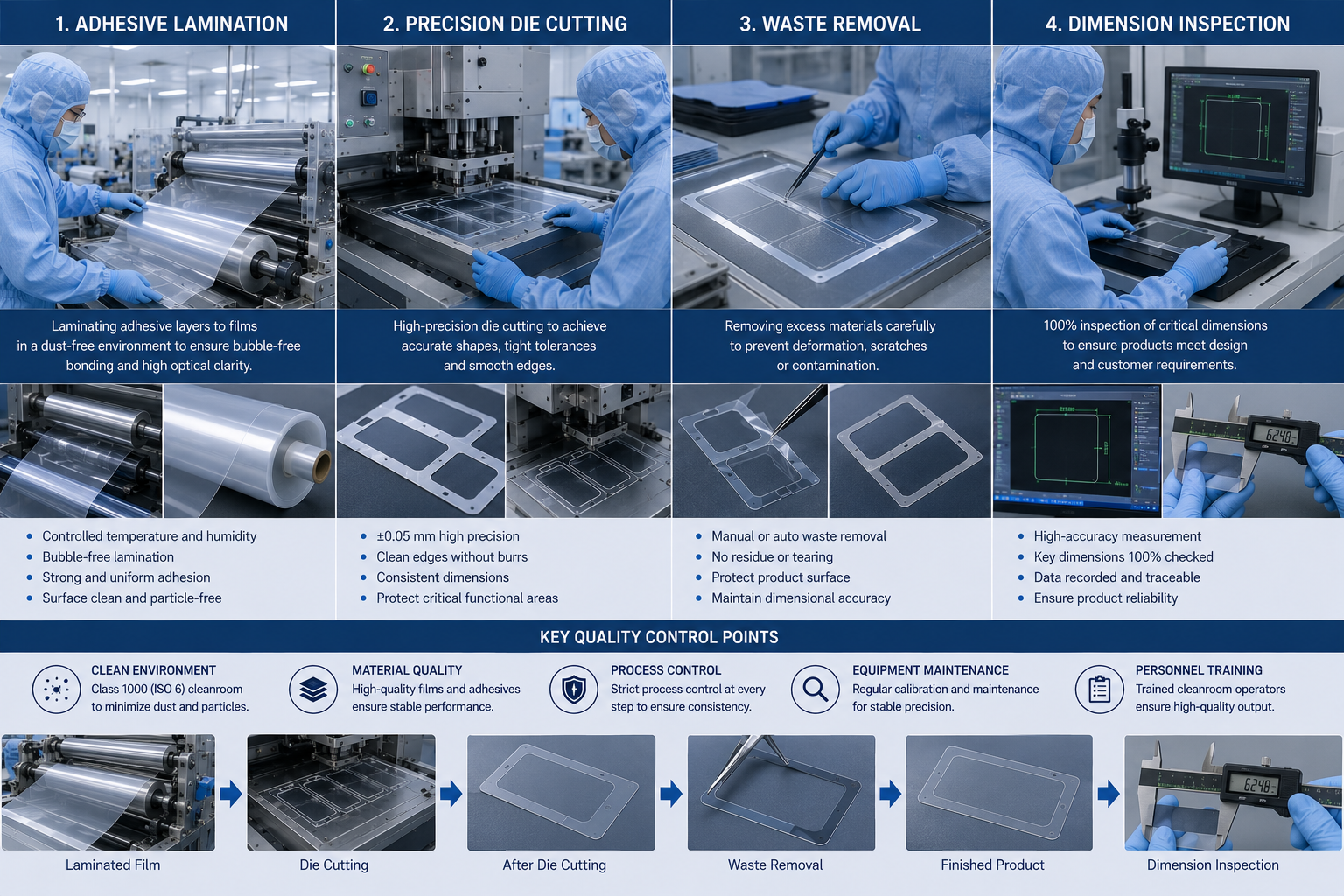
Sanken supports PET film converting, adhesive lamination, precision die cutting, kiss cutting, release liner control, waste stripping, dimensional inspection, protective packaging, and prototype-to-mass-production support.
The goal is to help customers avoid common issues such as poor fit, edge lifting, film curling, adhesive residue, dust contamination, difficult peeling, and unstable mass production quality.
Conclusion
Custom PET film die cutting is used in electronics, displays, automotive, EV batteries, medical devices, industrial equipment, appliances, consumer products, communication devices, precision instruments, and packaging.
These industries use PET film because it is thin, stable, insulating, protective, lightweight, adhesive-compatible, and suitable for precision converting.
For OEM buyers, the best PET film die-cut part is not simply the cheapest film shape. It is the finished component that fits the product, supports assembly, protects critical areas, and performs consistently in real production.