
What Precisely Is Polyethylene Closed Cell Foam?
Manufacturers in automotive, electronics, medical devices, packaging, and industrial equipment often need materials that are lightweight, durable, moisture-resistant, and capable of providing cushioning, insulation, and sealing performance. One of the most widely used materials for these applications is polyethylene closed cell foam.
Polyethylene (PE) closed cell foam is a lightweight foam material made from polyethylene resin that contains millions of sealed, non-interconnected cells. Because the cells are completely enclosed, the foam offers excellent moisture resistance, thermal insulation, cushioning, impact protection, and chemical resistance. PE closed cell foam is commonly used in automotive NVH systems, consumer electronics, packaging, insulation, and industrial sealing applications.
Unlike open-cell foams, closed cell foam prevents water and air from freely passing through the material, making it suitable for demanding environments.
What Does "Closed Cell" Mean?
The term "closed cell" refers to the internal structure of the foam.
Each microscopic cell is completely enclosed and separated from neighboring cells.
This structure creates several advantages:
- Low water absorption
- Better thermal insulation
- Higher buoyancy
- Improved compression resistance
- Greater durability
Because the cells are sealed, liquids and gases cannot easily penetrate the foam.
Theme: Polyethylene Closed Cell Foam Materials
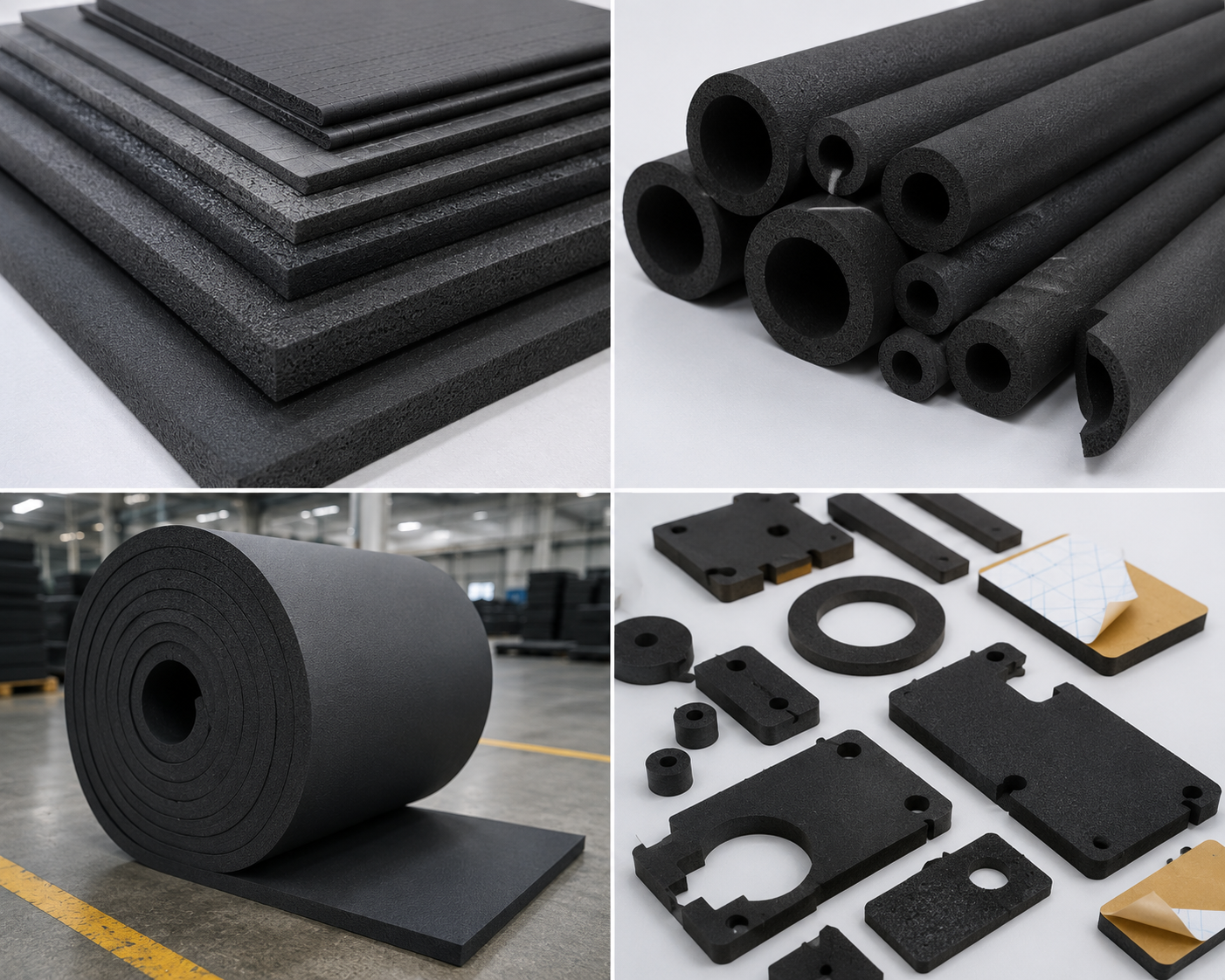
How Is Polyethylene Closed Cell Foam Manufactured?
PE foam is produced by expanding polyethylene resin using specialized blowing agents.
During manufacturing:
- Polyethylene resin is heated.
- Expansion agents create microscopic cells.
- The foam expands into sheets, rolls, or blocks.
- The cellular structure becomes permanently sealed.
The result is a lightweight material with a smooth surface and uniform internal structure.
Depending on the manufacturing process, the foam may be:
- Cross-linked PE foam (XLPE)
- Non-cross-linked PE foam
- Physically cross-linked foam
- Chemically cross-linked foam
Each version offers different performance characteristics.
Key Properties of Polyethylene Closed Cell Foam
Lightweight
PE foam contains a high percentage of trapped air.
This allows it to provide excellent performance while adding very little weight.
Benefits include:
- Reduced shipping costs
- Easier handling
- Lower product weight
Water Resistance
One of the biggest advantages of closed cell foam is its low water absorption.
Unlike open-cell materials, PE foam resists:
- Moisture
- Humidity
- Water penetration
This makes it suitable for outdoor and industrial environments.
Thermal Insulation
The sealed cells trap air and reduce heat transfer.
As a result, PE foam is widely used for:
- Thermal insulation
- HVAC systems
- Automotive applications
- Electronics protection
Shock Absorption
PE foam absorbs impact energy effectively.
This helps protect products from:
- Vibration
- Impact damage
- Transportation shock
Theme: Precision Foam Components
Polyethylene Closed Cell Foam vs Open Cell Foam
Many buyers confuse closed cell foam with open cell foam.
The two materials perform very differently.
| Property | Closed Cell PE Foam | Open Cell Foam |
|---|---|---|
| Water Resistance | Excellent | Poor |
| Air Permeability | Very Low | High |
| Thermal Insulation | Excellent | Moderate |
| Compression Strength | Higher | Lower |
| Durability | Excellent | Moderate |
| Cushioning | Good | Excellent |
Closed cell foam is generally preferred when moisture resistance and durability are important.
Common Applications of PE Closed Cell Foam
Automotive Industry
PE foam is widely used for:
- NVH insulation components
- Door seals
- Interior cushioning
- Vibration damping materials
Its lightweight nature helps improve vehicle efficiency while enhancing comfort.
Consumer Electronics
Applications include:
- Foam gaskets
- Protective pads
- Display cushioning
- Battery insulation
Precision die-cut PE foam components are commonly used in smartphones, tablets, and wearable devices.
Packaging
PE foam provides excellent product protection.
Typical uses include:
- Electronic packaging
- Medical device packaging
- Industrial equipment protection
Construction and HVAC
Used for:
- Pipe insulation
- Thermal barriers
- Building insulation systems
The material helps improve energy efficiency and moisture protection.
Why PE Closed Cell Foam Is Popular in Precision Die Cutting
Polyethylene foam is easy to convert into custom components.
Manufacturers can perform:
- Precision die cutting
- Laminating
- Slitting
- Adhesive bonding
- CNC cutting
This flexibility makes it ideal for custom OEM applications.
Theme: Die-Cut Polyethylene Foam Components
How Sanken Manufacturing Supports PE Foam Applications
Dongguan Sanken Electronics Manufacturing Co., Ltd. specializes in custom converting and manufacturing solutions using polyethylene foam and other engineered materials.
Our capabilities include:
- Precision die cutting
- PE foam converting
- Adhesive laminating
- Non-woven material processing
- Rubber sealing products
- Thermal insulation assemblies
Key Advantages
- OEM and ODM customization
- ISO 9001 certified quality management
- RoHS and REACH compliant materials
- Domestic and overseas production bases
- Cleanroom precision manufacturing
- Tool development from drawings or samples
We support automotive NVH insulation, consumer electronics die-cut materials, and custom sealing applications.
Featured Snippet Summary
Polyethylene closed cell foam is a lightweight foam material made from polyethylene resin containing millions of sealed cells. Its closed-cell structure provides excellent moisture resistance, thermal insulation, cushioning, chemical resistance, and durability, making it widely used in automotive, electronics, packaging, and industrial applications.
Conclusion
Polyethylene closed cell foam is one of the most versatile engineered foam materials available today. Its combination of lightweight construction, water resistance, thermal insulation, and impact protection makes it ideal for a wide range of OEM applications.
When combined with precision die cutting and converting technologies, PE closed cell foam can be transformed into highly customized components that improve product performance, reliability, and manufacturing efficiency.