
Understanding Rotary Die Cutting
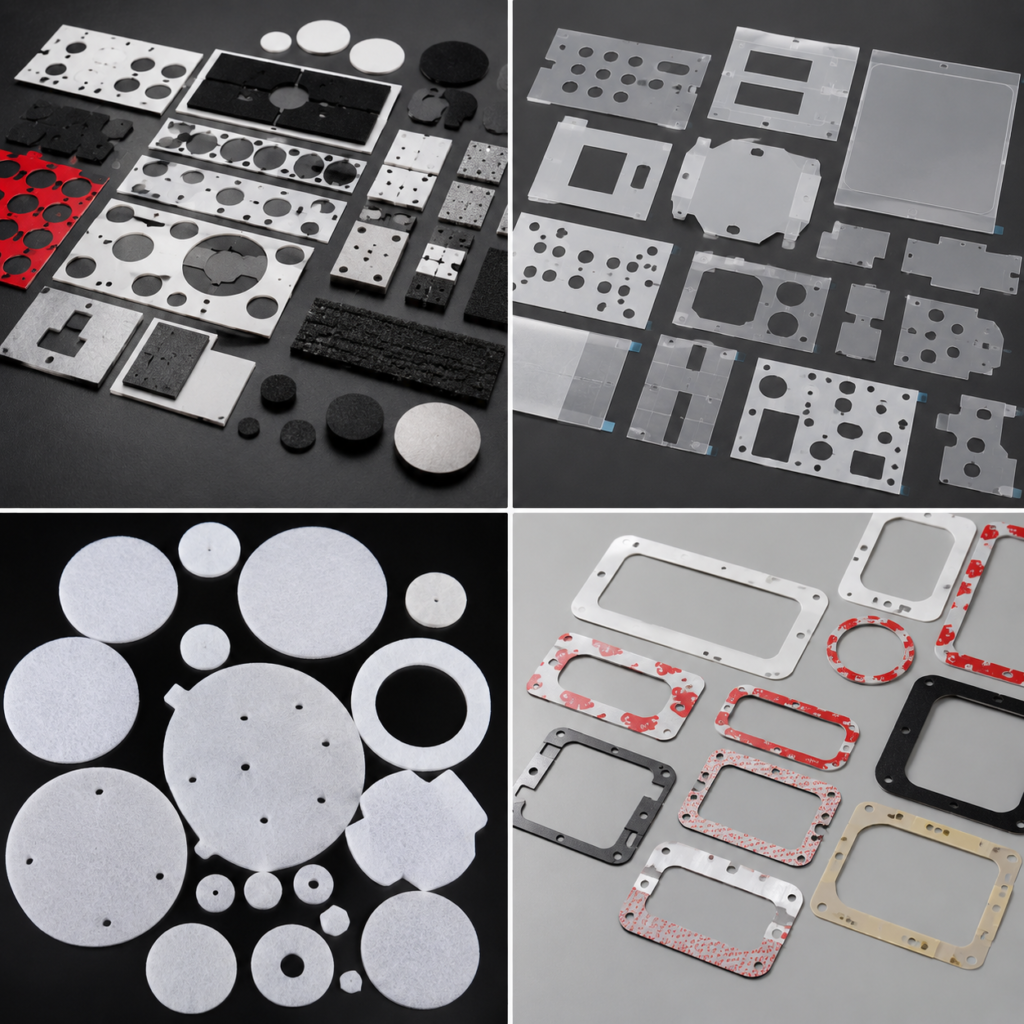
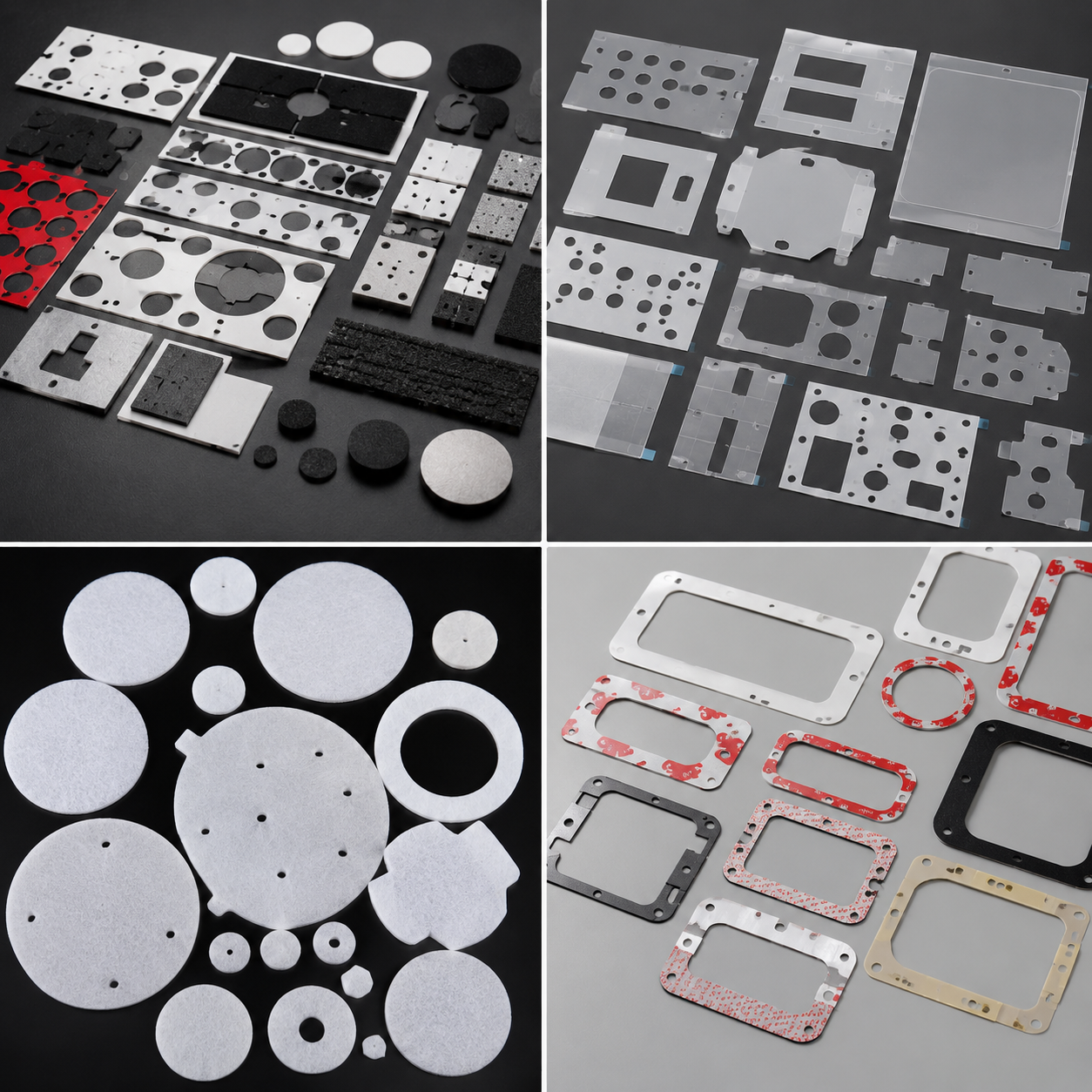
Rotary die cutting is a high-speed converting process that uses a rotating cylindrical die to cut, kiss-cut, score, perforate, or shape flexible materials into precise parts. It is widely used for adhesive tapes, foam, PET film, protective film, non-woven fabric, rubber sheets, labels, gaskets, insulation films, medical components, and electronic assembly materials.
But the real value of rotary die cutting is not simply speed.
For OEM buyers, rotary die cutting is useful when a part must be produced repeatedly, cleanly, and efficiently in roll form. It helps reduce manual handling, improve part consistency, support automated assembly, and control waste during mass production.
The key question is not only “What is rotary die cutting?” The more useful question is:
“When does rotary die cutting make production more stable, and when should another cutting method be used instead?”
How Rotary Die Cutting Works
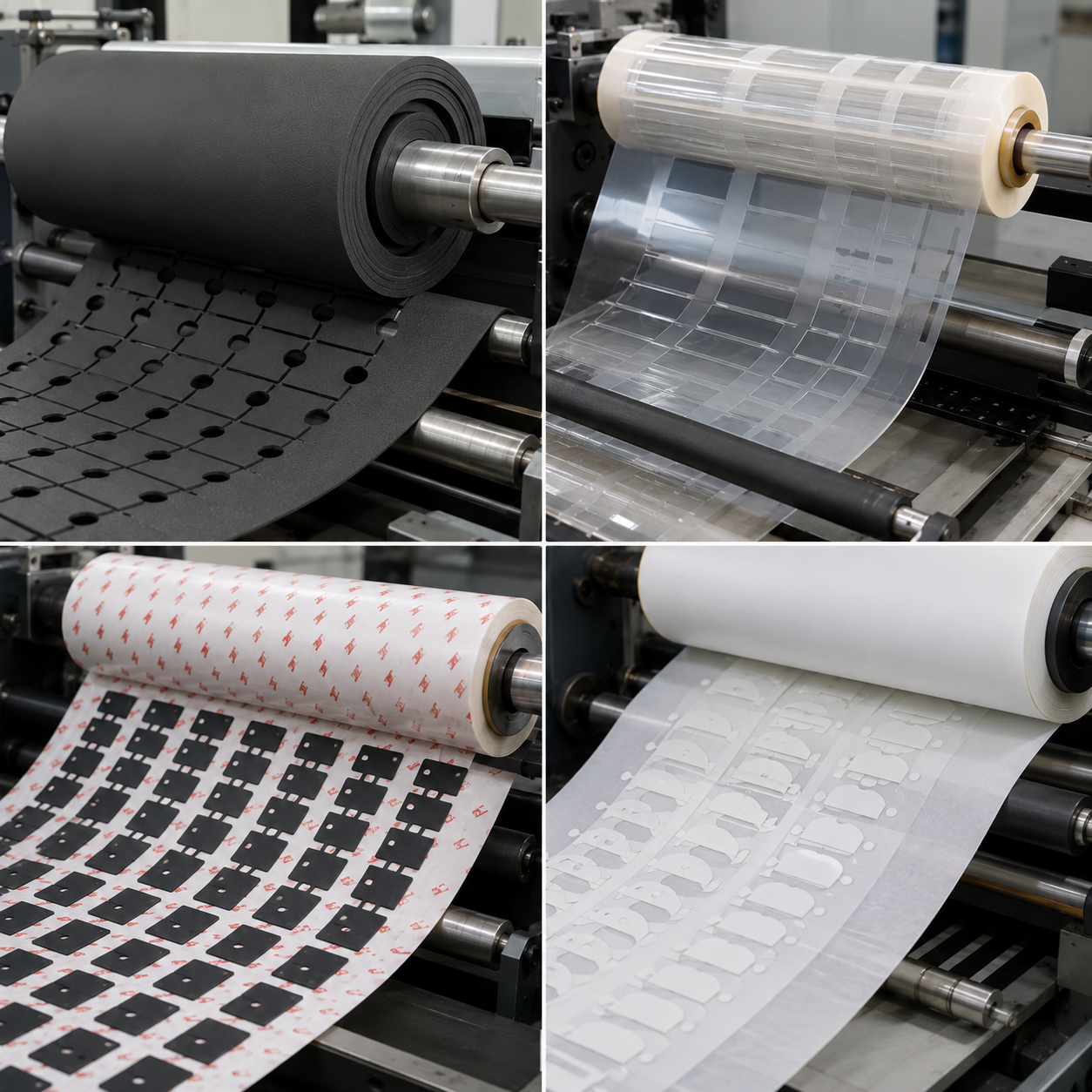
Rotary die cutting uses a cylindrical cutting tool mounted on a rotary press. As the material moves through the machine, the die rotates and cuts the material continuously.
The material is usually supplied in roll form.
The process may include:
- Unwinding material
- Laminating adhesive or liner
- Cutting the required shape
- Kiss cutting through selected layers
- Removing waste material
- Rewinding finished parts
- Inspecting size, edge quality, and spacing
Unlike flatbed die cutting, where the tool presses down on a material sheet, rotary die cutting works continuously. The tool rolls with the material, which allows faster production and better efficiency for long runs.
This is why rotary die cutting is common in high-volume converting.
Rotary Die Cutting Is Best for Roll-to-Roll Production
Rotary die cutting is especially suitable for roll-to-roll materials.
Common materials include:
| Material | Typical Rotary Die-Cut Use |
|---|---|
| Double-sided tape | Adhesive pads, strips, frames, bonding parts |
| PET film | Insulation parts, protective films, spacers |
| Foam tape | Gaskets, cushioning pads, anti-rattle parts |
| Non-woven fabric | Filters, dust-proof layers, acoustic pads |
| Rubber sheet | Seals, washers, thin gaskets |
| Protective film | Screen protection, surface masking |
| Release liner | Carrier liner for adhesive parts |
| Optical film | Display auxiliary components |
If the customer needs thousands or millions of similar parts, rotary die cutting can be more efficient than cutting sheets one by one.
However, rotary die cutting only works well when the material, tool, tolerance, liner, and waste removal are properly designed.
What Is Kiss Cutting in Rotary Die Cutting?
Kiss cutting is one of the most important advantages of rotary die cutting.
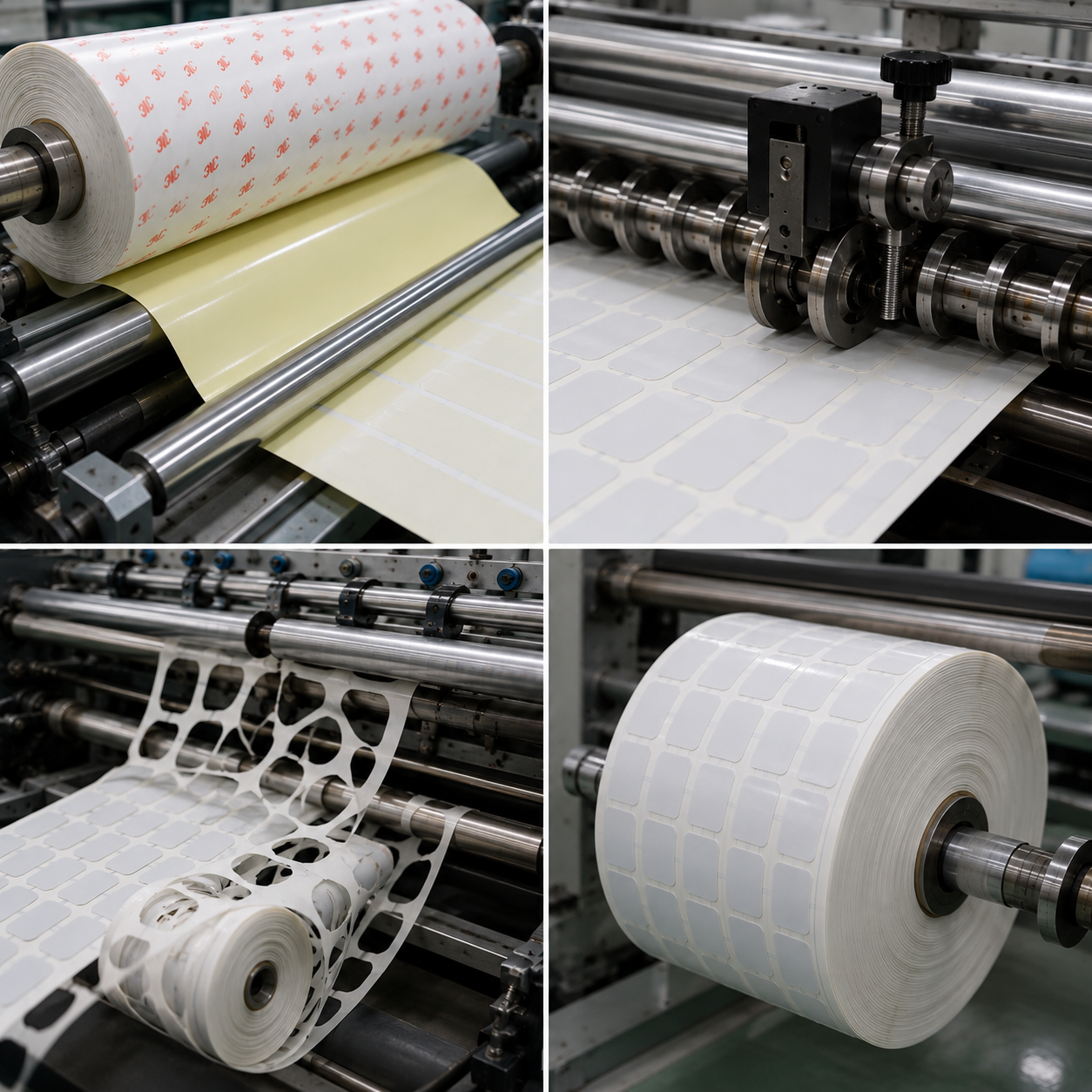
In kiss cutting, the die cuts through the top layer but does not cut through the release liner underneath.
For example, a double-sided adhesive tape may be cut into small shapes while staying attached to the liner. This makes the parts easy to peel and apply during assembly.
Kiss cutting is widely used for:
- Adhesive tape parts
- Foam tape gaskets
- PET insulation patches
- Protective films
- Labels
- Spacer pads
- Medical adhesive components
- Electronic assembly aids
The cutting depth must be controlled carefully.
If the cut is too shallow, the part may not peel cleanly.
If the cut is too deep, the liner may tear.
If the adhesive edge is damaged, the part may lift, stretch, or leave residue.
For OEM production, kiss cutting is not a small detail. It directly affects assembly speed.
Why Rotary Die Cutting Helps Mass Production
Rotary die cutting is often chosen because it supports repeatable, high-volume production.
The benefits include:
- Faster production speed
- Consistent part spacing
- Better roll-to-roll efficiency
- Lower manual handling
- Cleaner waste removal
- Suitable for adhesive-backed parts
- Easier integration with lamination
- Stable output for repeated shapes
- Better support for automated assembly
For many buyers, the biggest benefit is not only lower unit cost. It is production stability.
If workers manually cut tape or foam parts, every piece may vary. Rotary die cutting delivers parts in a controlled format, often on a liner, sheet, or roll. This makes downstream assembly easier.
Where Rotary Die Cutting Is Commonly Used
Electronics
Electronics manufacturers use rotary die cutting for thin films, tapes, spacers, and insulation components.
Examples include:
- Battery insulation films
- Camera module foam pads
- Speaker mesh support layers
- Display adhesive frames
- PET protective films
- Dust-proof non-woven layers
- Sensor spacers
- Adhesive-backed grounding supports
Electronic parts are often small and difficult to handle. Rotary die cutting helps supply them in a format that operators can peel and place quickly.
Automotive
Automotive suppliers use rotary die cutting for foam tapes, adhesive strips, sealing gaskets, NVH materials, and protective films.
Examples include:
- Anti-rattle foam pads
- Door trim adhesive strips
- Dashboard spacer pads
- Display support films
- Camera module gaskets
- Wire harness protection pieces
- EV battery insulation layers
- Non-woven acoustic components
Automotive parts must also survive heat, vibration, humidity, and long service life. Rotary die cutting can produce these parts efficiently, but material validation is still critical.
Display and Optical Components
Display products often use die-cut PET films, protective films, black tapes, adhesive layers, and spacer films.
Rotary die cutting can be used when parts are suitable for roll processing and the design supports clean waste removal.
For display applications, the process must control particles, scratches, bubbles, liner release, and edge quality.
Medical and Healthcare Products
Rotary die cutting is widely used for adhesive medical components, non-woven layers, foam pads, filters, and disposable product parts.
Medical-related applications may require clean processing, traceable materials, and careful packaging.
Packaging and Labels
Labels and packaging components are classic rotary die-cut products.
Rotary die cutting can produce labels, protective seals, foam inserts, adhesive patches, and decorative elements quickly and consistently.
Rotary Die Cutting vs Flatbed Die Cutting
Rotary die cutting and flatbed die cutting both have value. The right choice depends on material, volume, design complexity, tolerance, and cost.
| Factor | Rotary Die Cutting | Flatbed Die Cutting |
|---|---|---|
| Best for | High-volume roll materials | Sheets, thicker materials, lower-volume projects |
| Speed | Very fast | Slower |
| Tooling | Cylindrical die | Flat die |
| Material format | Roll-to-roll | Sheet or roll-to-sheet |
| Good for adhesive parts | Excellent | Good |
| Best production stage | Mass production | Prototype, short runs, thicker materials |
| Cost advantage | Better at high volume | Better for lower volume |
| Waste removal | Efficient if designed well | Easier for some complex shapes |
Rotary die cutting is often better for high-volume roll-to-roll production. Flatbed die cutting may be better for thicker materials, short runs, prototypes, or designs that are difficult to strip in continuous roll form.
A smart supplier should not force every project into rotary die cutting. The process should match the part.
Common Problems in Rotary Die Cutting
Rotary die cutting can be very efficient, but it also has risks if the design or material is not suitable.
Common problems include:
Poor Kiss-Cut Depth
If cutting depth is not controlled, parts may not peel properly or liners may be damaged.
Adhesive Lifting
Adhesive-backed parts may lift at the edges if the adhesive, liner, or cutting pressure is wrong.
Difficult Waste Stripping
Small holes, narrow frames, sharp corners, and weak materials can make waste removal difficult.
Material Stretching
Soft foam, TPU film, thin adhesive layers, and flexible non-woven materials may stretch if tension is not controlled.
Edge Burrs or Particles
Dull tooling or wrong cutting pressure can create edge debris, especially in film, foam, or fiber-based materials.
Registration Error
For multilayer parts, poor alignment between layers can cause functional failure.
Curling After Lamination
A PET film or adhesive laminate may curl if material tension or layer balance is not controlled.
These problems are not always visible in the first sample. They may appear during mass production, storage, or customer assembly.
Why Part Design Matters
A rotary die-cut part should be designed for production, not only for drawing accuracy.
Buyers should review:
- Minimum hole size
- Narrow strip width
- Corner radius
- Waste removal direction
- Adhesive edge behavior
- Liner strength
- Part spacing
- Roll or sheet delivery format
- Manual or automated application method
A part with very sharp corners may look good in CAD but tear during waste stripping. A narrow adhesive ring may deform during peeling. A very small part may need a pull tab or special liner design.
Designing for rotary die cutting early can reduce repeated sampling and improve mass production yield.
What Buyers Should Confirm Before Choosing Rotary Die Cutting
Before starting a rotary die-cut project, buyers should ask:
- Is the material suitable for roll-to-roll processing?
- Is the order volume high enough for rotary tooling?
- Does the part need kiss cutting?
- What liner will carry the finished part?
- What tolerance is truly required?
- Can the waste be stripped cleanly?
- Does the material stretch under tension?
- Does the part need adhesive backing?
- Will the part be applied manually or automatically?
- Are there small holes, narrow strips, or fragile corners?
- Does the part need clean edges or low particle risk?
- Should the finished parts be supplied in rolls, sheets, or kits?
These questions help buyers avoid choosing rotary die cutting only because it sounds faster.
Speed is useful only when the process is stable.
How Sanken Supports Rotary Die Cutting Projects
For rotary die cutting projects, Sanken Manufacturing focuses on the full converting structure, not only the cutting step.
A customer may send a drawing, but the drawing does not always show the real production risk. The part may need controlled adhesive release, stable tension, clean waste stripping, precise layer alignment, easy peeling, or special packaging.
Sanken supports:
- Rotary die cutting
- Precision die cutting
- Kiss cutting
- Adhesive tape converting
- PET film die cutting
- Foam tape die cutting
- Non-woven fabric converting
- Rubber and gasket cutting
- Lamination and liner control
- Prototype validation
- Mass production supply
The goal is to help customers reduce assembly problems such as difficult peeling, poor fit, edge lifting, liner tearing, adhesive residue, and unstable part dimensions.
Conclusion
Rotary die cutting is a continuous, high-speed cutting process used to convert roll materials into precise custom parts. It is especially useful for adhesive tapes, foam, PET film, protective film, non-woven fabric, rubber sheets, labels, gaskets, and multilayer components.
Its main value is speed, consistency, and production efficiency. But successful rotary die cutting depends on more than the machine. Material behavior, adhesive structure, liner selection, cutting depth, waste stripping, tolerance, and final assembly method all matter.
For OEM buyers, rotary die cutting is a strong choice when the product requires high-volume, repeatable, roll-to-roll production. The best result comes when the part is designed for manufacturability from the beginning.