

What Is Foam Tape Used For?
Foam tape is used for bonding, sealing, cushioning, gap filling, vibration reduction, sound damping, surface protection, and assembly support. It is common in automotive parts, electronics, displays, appliances, packaging, medical devices, signage, construction products, and industrial equipment.
But foam tape should not be seen as “just sticky foam.”
In real manufacturing, foam tape often solves problems that screws, liquid glue, rigid spacers, or ordinary double-sided tape cannot solve well. It can bond two uneven surfaces, absorb movement, fill small gaps, reduce rattling, protect fragile parts, and make assembly faster.
For OEM buyers, the better question is not only “What is foam tape used for?” The more practical question is:
“Which foam tape structure can solve my bonding, sealing, cushioning, or assembly problem without lifting, compressing, shifting, or failing after aging?”
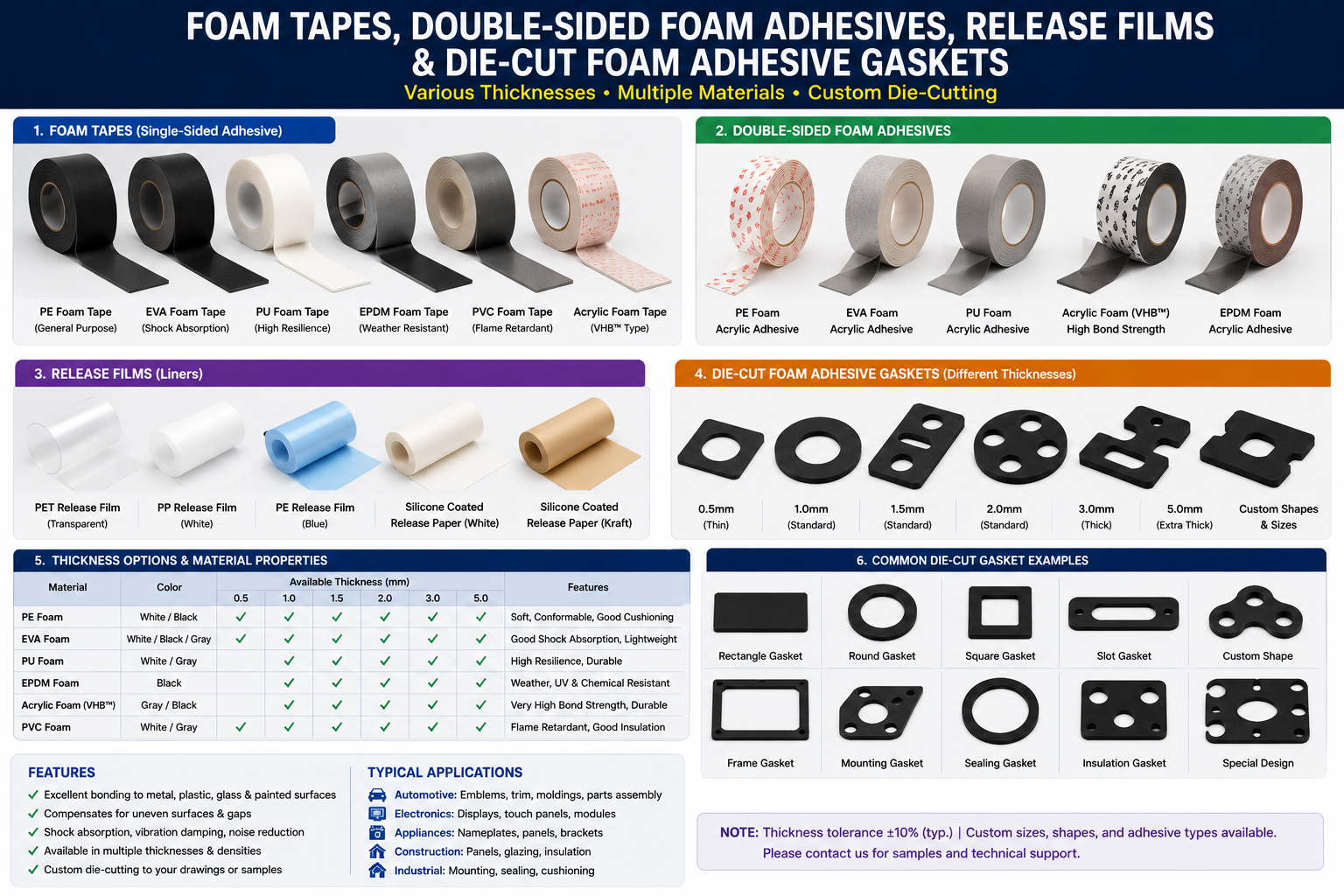
Foam Tape Combines Cushioning and Adhesion
Foam tape is usually made from a foam carrier with adhesive on one or both sides.
The foam layer provides thickness, softness, compression, and gap filling.
The adhesive layer provides bonding to the surface.
The release liner protects the adhesive before use.
This structure makes foam tape different from thin double-sided tape. Thin tape mainly bonds. Foam tape bonds and cushions at the same time.
That is why foam tape is useful when the two bonding surfaces are not perfectly flat.
A rigid adhesive layer may fail if the surface has texture or unevenness. Foam tape can compress slightly and create better contact.
Foam Tape for Bonding and Mounting
One of the most common uses of foam tape is bonding parts together.
Foam tape can be used to attach:
- Plastic housings
- Metal panels
- Decorative trim
- Nameplates
- Display parts
- Electronic components
- Rubber pads
- Foam gaskets
- Sensor covers
- Appliance panels
In many assemblies, foam tape reduces the need for screws, clips, rivets, or liquid glue.
This can improve product appearance because there are no visible fasteners. It can also simplify assembly because workers only need to peel, place, and press.
However, the tape must match the bonding surface. A foam tape that bonds well to painted metal may not bond well to low-surface-energy plastic. A tape that works indoors may fail in heat, humidity, or vibration if it is not selected correctly.
Foam Tape for Sealing Gaps
Foam tape is widely used as a sealing material.
It can help block:
- Dust
- Air
- Light
- Noise
- Limited moisture
- Small particles
- Surface contact gaps
Foam tape is often used around doors, panels, housings, displays, speakers, lighting units, and equipment covers.
For sealing, the foam needs the right compression. If the foam is too soft, it may collapse. If it is too hard, it may not conform to the surface. If the adhesive is weak, the tape may lift at the edge and lose sealing function.
Closed-cell foam tape is often used when better sealing is needed because its cell structure resists air and water movement better than open-cell foam.
Open-cell foam may be more useful for cushioning and sound absorption.
Foam Tape for Cushioning and Shock Absorption
Foam tape can protect components from impact, vibration, and pressure.
It is used in:
- Electronics packaging
- Battery modules
- Camera modules
- Display assemblies
- Medical device housings
- Automotive interiors
- Industrial equipment covers
- Appliance control panels
A foam tape pad can prevent two parts from hitting each other. It can also reduce pressure on fragile components.
For example, in an electronic device, foam tape may be placed between a battery and housing to reduce movement. In a display module, foam tape may support the screen while reducing hard contact. In packaging, foam tape can protect a surface from scratches or vibration damage.
The key is compression control.
Too much compression can deform the foam and create pressure. Too little compression may fail to protect the part.
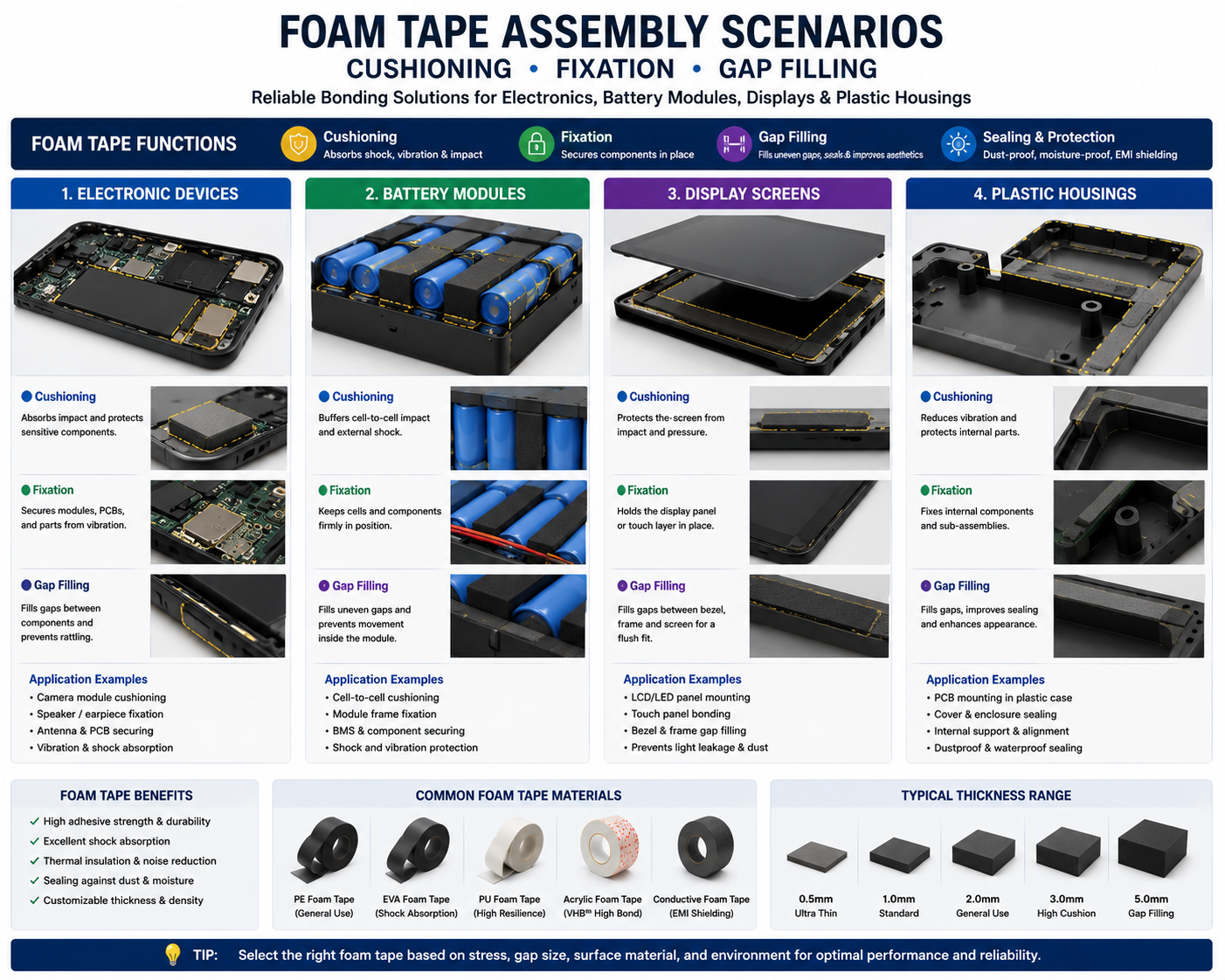
Foam Tape for Automotive Applications
Automotive products use foam tape in many hidden areas.
Common uses include:
- Door trim bonding
- Anti-rattle pads
- Dashboard cushioning
- Interior panel mounting
- Wire harness protection
- Sensor module support
- Camera module sealing
- Display spacer tape
- EV battery cushioning
- Weatherstrip support
- Decorative trim attachment
In vehicles, foam tape must handle heat, vibration, humidity, compression, and long service life.
A tape may look strong during sample testing, but automotive environments are much tougher. Interior temperatures can rise significantly under sunlight. Vibration can stress adhesive edges. Foam may compress after long-term load. Humidity can weaken certain adhesive systems.
For automotive buyers, the foam tape should be tested based on the real location and use condition, not only initial bonding strength.
Foam Tape for Electronics
Electronics need small, clean, accurate, and easy-to-assemble foam tape parts.
Foam tape may be used for:
- Speaker sealing
- Battery cushioning
- Camera module support
- Display bonding
- Dust-proof sealing
- Sensor spacing
- PCB protection
- Housing gap filling
- Anti-vibration pads
- Adhesive-backed foam gaskets
In compact electronics, foam tape helps save space because it can bond, cushion, and seal in one part.
But electronics also create risks.
If the foam tape is too thick, it may press against a display or battery. If it is too soft, it may collapse. If it creates particles, it may contaminate sensitive components. If the liner is hard to peel, workers may slow down during assembly.
For electronic parts, foam tape often needs precision die cutting, clean edges, stable thickness, and suitable release liner design.
Foam Tape for Displays and Touch Screens
Foam tape is commonly used in display assemblies, especially where the screen needs support, spacing, or light sealing.
Applications include:
- Display frame bonding
- Touch panel support
- Backlight cushioning
- Light leakage control
- Dust sealing
- Edge protection
- Screen gap filling
- Camera window sealing
Display applications are sensitive because small defects become visible.
Poor foam tape selection may cause:
- Screen pressure marks
- Uneven bonding
- Dust contamination
- Light leakage
- Edge lifting
- Assembly misalignment
- Foam compression marks
For display products, black foam tape is often used when light blocking is required. Thin foam tape may be used when space is limited. Adhesive selection and die-cut edge quality are especially important.
Foam Tape for Sound and Vibration Reduction
Foam tape is useful for reducing rattles, squeaks, buzzing, and vibration noise.
This is common in:
- Automotive interiors
- Appliances
- Electronics
- Industrial machines
- HVAC equipment
- Control panels
- Equipment covers
Noise often happens when two parts touch, vibrate, or move against each other.
Foam tape can separate the surfaces and absorb small movements.
For example, a small foam tape strip behind a plastic cover can stop rattling. A foam tape gasket around a speaker can reduce air leakage and improve sound performance. A foam layer inside a machine cover can reduce vibration contact.
The correct foam density and thickness matter. A very soft foam may compress too easily. A very hard foam may not damp vibration well.
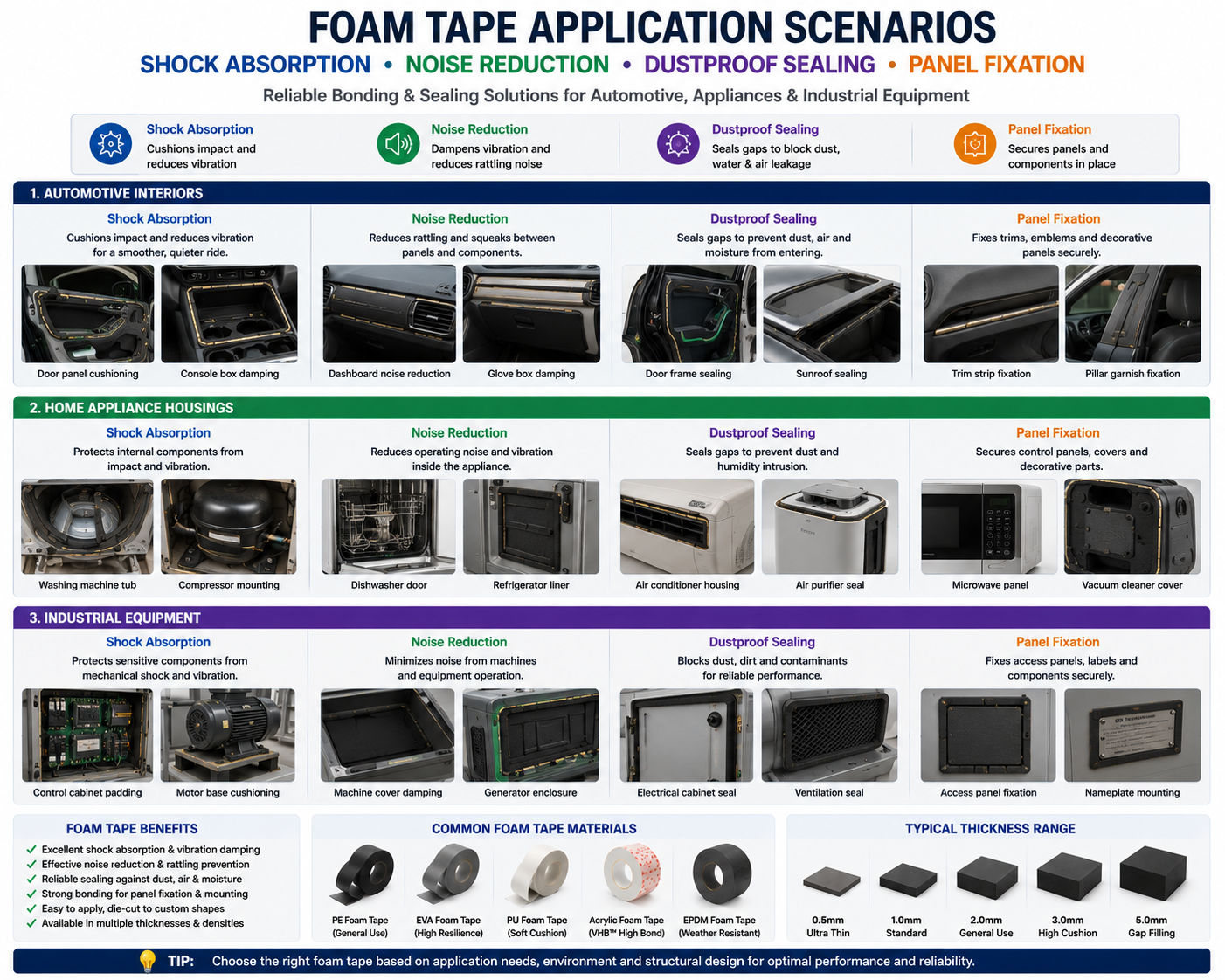
Foam Tape for Packaging and Surface Protection
Foam tape is also used in packaging and product protection.
It may protect:
- Glass surfaces
- Painted parts
- Metal panels
- Electronic products
- Medical devices
- Instruments
- Decorative parts
- Fragile components
Foam tape can hold a product in place during shipping or protect contact points from scratches.
In premium packaging, foam tape or foam pads can improve the product presentation. In industrial packaging, the focus is usually protection and damage reduction.
The adhesive should be chosen carefully. If the tape is temporary, it should remove cleanly. If it leaves residue, packaging protection can become a customer complaint.
Foam Tape for Medical and Healthcare Devices
Foam tape is used in some medical and healthcare products for cushioning, mounting, sealing, and comfort-related structures.
Applications may include:
- Device cushioning pads
- Wearable sensor support
- Medical equipment gaskets
- Protective foam layers
- Adhesive-backed soft pads
- Packaging protection
- Disposable product components
Medical-related applications may require cleaner processing, stable materials, traceability, skin-contact review if applicable, and reliable adhesive performance.
For wearable devices, foam tape may need to balance comfort, adhesion, compression, and moisture resistance.
Common Types of Foam Tape
Different foam tapes are used for different functions.
| Foam Tape Type | Common Use |
|---|---|
| EVA foam tape | Cushioning, light sealing, general assembly |
| PE foam tape | Gap filling, mounting, protection, sealing |
| PU foam tape | Soft cushioning, sound absorption, comfort applications |
| EPDM foam tape | Automotive sealing, weather resistance, vibration control |
| Acrylic foam tape | Strong bonding, mounting, automotive trim |
| Silicone foam tape | Higher temperature or special sealing needs |
| Conductive foam tape | EMI shielding or electronic grounding support |
The best foam tape depends on the application, not only the material name.
Why Foam Tape Sometimes Fails
Foam tape failures usually come from poor matching between tape, surface, and working environment.
Common failure reasons include:
| Problem | Possible Cause |
|---|---|
| Edge lifting | Wrong adhesive or poor surface preparation |
| Foam collapse | Density too low or compression too high |
| Weak bonding | Surface contamination or low pressure |
| Residue after removal | Wrong adhesive type |
| Tape shifting | Stress before bond strength develops |
| Water or dust leakage | Wrong foam cell structure |
| Screen pressure marks | Tape too thick or too hard |
| Difficult peeling | Poor liner or die-cut design |
Many of these problems can be avoided if the foam tape is selected based on the final use condition.
What Buyers Should Confirm Before Choosing Foam Tape
Before ordering foam tape or die-cut foam tape parts, buyers should confirm:
- What problem should the foam tape solve?
- Is the main function bonding, sealing, cushioning, spacing, or vibration control?
- What surface will it bond to?
- Is the surface smooth, rough, painted, plastic, metal, glass, rubber, or coated?
- What temperature and humidity will it face?
- Does it need to resist vibration or compression?
- Should the tape be permanent or removable?
- What thickness and density are required?
- Does it need closed-cell or open-cell foam?
- Will the part be applied manually or automatically?
- Does it need custom die cutting?
- Does the finished part need pull tabs, liner control, or clean packaging?
These questions help buyers avoid selecting foam tape only by thickness or price.
Why Custom Die-Cut Foam Tape Is Often Better Than Roll Tape
Roll foam tape is useful for simple jobs. But many OEM assemblies need custom shapes.
Custom die-cut foam tape can be made into:
- Pads
- Rings
- Frames
- Strips
- Gaskets
- Spacers
- Seals
- Mounting parts
- Cushioning components
- Complex multilayer structures
Custom die cutting helps improve assembly speed and consistency. Workers do not need to cut tape by hand. The part arrives in the right shape, with the right liner, spacing, and adhesive structure.
For mass production, this reduces handling mistakes and improves repeatability.
How Sanken Supports Foam Tape Applications
For foam tape projects, Sanken Manufacturing helps customers focus on the real application problem first.
The issue may be poor bonding, dust leakage, vibration noise, difficult assembly, screen pressure, foam collapse, or adhesive residue.
Sanken supports foam tape converting, adhesive lamination, precision die cutting, kiss cutting, liner control, custom gasket production, prototype samples, and mass production supply.
We can help customers review:
- Foam type
- Adhesive selection
- Thickness and density
- Compression behavior
- Die-cut shape
- Liner format
- Application surface
- Assembly method
- Packaging requirements
The goal is not only to provide sticky foam. The goal is to help customers receive foam tape components that bond, seal, cushion, and assemble reliably in real production.
Conclusion
Foam tape is used for bonding, sealing, cushioning, gap filling, vibration reduction, sound damping, surface protection, packaging, and assembly support. It is widely used in automotive, electronics, displays, appliances, medical devices, industrial equipment, and consumer products.
The best foam tape is not simply the thickest, softest, or strongest one. It is the foam tape that matches the surface, environment, compression requirement, adhesive need, and production method.
For OEM buyers, custom die-cut foam tape can reduce assembly time, improve consistency, prevent quality problems, and make products more reliable in real use.