

What Benefits of Factory Customized Gaskets for Wearable Optical Sensors?
Wearable optical sensors are small, sensitive, and easy to disturb during assembly. A slight gap, uneven pressure, weak adhesive, dust leakage, or lens movement can affect signal quality and user comfort.
This is why factory customized gaskets matter.
For wearable devices such as smartwatches, fitness bands, health monitors, optical heart-rate sensors, SpO₂ modules, skin-contact sensors, and compact medical wearables, the gasket is not just a sealing ring. It helps control light, pressure, moisture, alignment, comfort, and long-term reliability.
For OEM buyers, the real question is not only “Can we buy a standard gasket?” The better question is: “Can a customized gasket reduce sensor failure, improve assembly yield, and create a more comfortable wearable product?”
Factory customized gaskets can be made from silicone rubber, foam, TPU film, PET film, adhesive tape, non-woven material, light-blocking film, or multilayer die-cut composites. The best choice depends on the sensor design, skin-contact requirement, sealing target, optical path, adhesive surface, and expected product life.
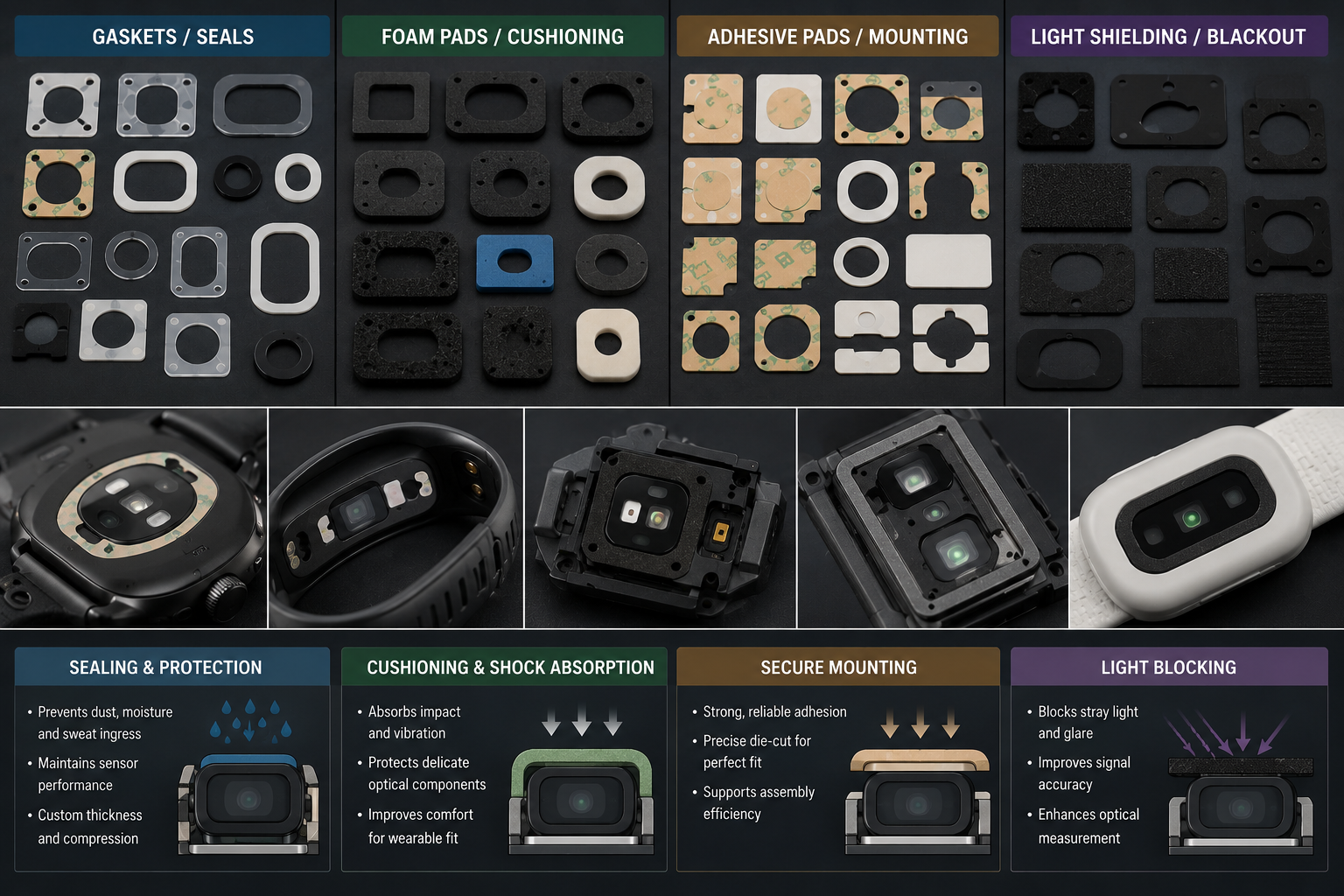
Why Wearable Optical Sensors Need Custom Gaskets
Wearable optical sensors often work close to the skin.
They may measure heart rate, blood oxygen, motion, pressure, or other health-related signals. In many designs, the sensor uses light to read information from the body. That means the structure around the sensor must be stable.
A gasket may need to do several jobs at the same time:
- Block unwanted light leakage
- Seal against sweat and dust
- Cushion the sensor module
- Control the gap between sensor and housing
- Reduce vibration and movement
- Improve skin comfort
- Support adhesive bonding
- Protect internal electronics
- Maintain pressure during long-term wear
A standard gasket may fit the size, but it may not solve the real problem.
For wearable optical sensors, “almost right” can still cause unstable readings, poor user experience, or product returns.
Benefit 1: Better Light Control Around the Sensor
Optical sensors are sensitive to stray light.
If the gasket does not block light properly, the sensor may receive unwanted signals. This can reduce measurement accuracy or create unstable readings.
Customized gaskets can help by using:
- Black foam
- Black PET film
- Light-blocking adhesive
- Silicone rubber with pigment
- Multilayer light-shielding structures
The gasket can be designed around the exact optical window, LED position, sensor opening, and housing geometry.
This helps reduce:
- Light leakage
- Signal interference
- Reflection issues
- Sensor instability
- False readings
For optical wearable products, light control is often one of the most important gasket functions.
Benefit 2: More Stable Sensor Alignment
A wearable optical sensor must stay in the correct position.
If the gasket is too thick, it may push the sensor module out of position.
If it is too thin, it may fail to support the sensor.
If it compresses unevenly, the sensor may tilt.
Customized die-cut gaskets help control:
- Inner hole size
- Outer shape
- Thickness
- Compression range
- Adhesive position
- Assembly clearance
- Sensor window alignment
This is especially important for compact devices where every millimeter matters.
A custom gasket can be designed to fit the exact module layout instead of forcing the product design to adapt to a standard gasket.
Benefit 3: Improved Sweat and Dust Protection
Wearable devices face sweat, skin oil, dust, moisture, cosmetics, cleaning fluids, and daily movement.
A poorly designed gasket may allow moisture or particles to enter the sensor area.
This can cause:
- Signal drift
- Corrosion risk
- Adhesive failure
- Fogging
- Dust contamination
- Shortened product life
Customized gaskets can improve sealing by matching the real contact surface.
Depending on the design, the gasket may use closed-cell foam, silicone rubber, adhesive-backed film, or a multilayer sealing structure.
For stronger sealing, material recovery and compression set resistance must be reviewed carefully. A gasket that flattens over time may stop sealing.
Benefit 4: Better Comfort for Skin-Contact Products
Wearable devices are different from industrial equipment. They touch people.
A gasket around an optical sensor may affect how the device feels on the wrist, finger, arm, or body.
If the gasket is too hard, users may feel pressure.
If it is too soft, it may collapse.
If the edge is rough, it may irritate the skin.
If the adhesive or material is poorly selected, it may create residue or discomfort.
Factory customization allows the gasket to be designed for both function and comfort.
Important comfort factors include:
- Softness
- Edge smoothness
- Material flexibility
- Thickness control
- Compression behavior
- Skin-contact safety requirements
- Surface cleanliness
For wearable products, comfort is part of product performance.
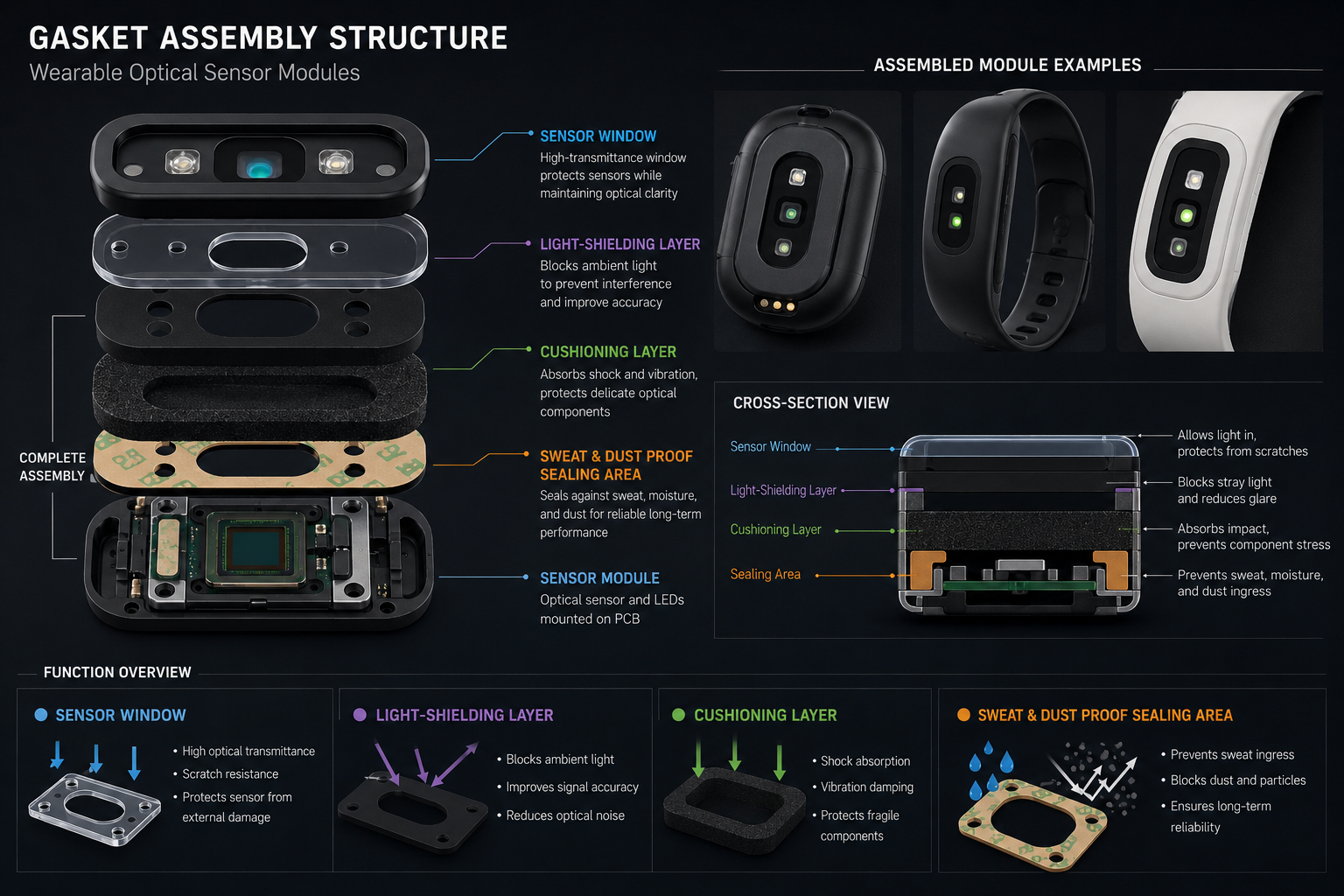
Benefit 5: Cleaner Assembly and Higher Production Yield
A good gasket should not slow down assembly.
In mass production, workers or automated equipment need parts that are easy to peel, place, align, and press.
Customized adhesive-backed gaskets can be supplied on release liners with features such as:
- Pull tabs
- Kiss-cut format
- Easy-peel liner
- Positioning holes
- Sheet or roll delivery
- Stable adhesive layout
- Controlled part spacing
This can reduce assembly errors and improve production speed.
Poor gasket design can create hidden cost. Operators may spend extra time peeling parts. Adhesive may stretch during removal. Small rings may deform during placement. Scrap may increase because parts are hard to handle.
A factory customized gasket can be designed for how the production line actually works.
Benefit 6: Better Control of Compression and Rebound
Gasket performance often depends on compression.
For wearable optical sensors, compression affects sealing, cushioning, sensor position, and comfort.
If compression is too high, it may stress the sensor or housing.
If compression is too low, sealing may fail.
If the material does not recover, the gasket may flatten over time.
Customized gaskets allow engineers to choose the right material and thickness based on:
- Assembly force
- Housing gap
- Sensor module height
- Long-term wear condition
- Temperature and humidity exposure
- Desired sealing pressure
Foam, rubber, silicone, and multilayer composites all behave differently. The right choice depends on the final product design.
Benefit 7: Fewer Problems From Standard Part Limitations
Standard gaskets may seem cheaper at first, but they often create compromises.
Common problems include:
| Standard Gasket Issue | Possible Result |
|---|---|
| Wrong thickness | Sensor height mismatch |
| Poor inner hole fit | Optical path interference |
| Weak adhesive | Edge lifting or shifting |
| Low compression recovery | Sealing loss over time |
| Poor light blocking | Signal interference |
| Difficult handling | Slow assembly and higher scrap |
| Wrong material hardness | User discomfort or poor sealing |
A custom gasket costs more to develop, but it can reduce the cost of repeated failures.
For OEM buyers, the cheapest gasket is not always the lowest-cost solution. The better solution is the gasket that reduces rework, complaints, and production instability.
Benefit 8: Material Structure Can Match the Real Failure Mode
Different sensor problems require different gasket structures.
A product with light leakage may need black PET or black foam.
A product with vibration movement may need foam or elastomer cushioning.
A product with sweat exposure may need closed-cell foam or silicone rubber.
A product with tight assembly space may need a thin PET spacer with adhesive.
A product with comfort problems may need a softer skin-contact structure.
Common customized structures include:
| Gasket Structure | Main Purpose |
|---|---|
| Black PET + adhesive | Light blocking and precise spacing |
| Closed-cell foam + adhesive | Cushioning and sealing support |
| Silicone rubber gasket | Elastic sealing and comfort |
| Foam + black film | Cushioning with light shielding |
| TPU film + adhesive | Flexible sealing in compact spaces |
| Multilayer foam + film + adhesive | Combined sealing, spacing, and assembly support |
The best structure should be chosen based on the product’s failure risk, not only material price.
Design Points Buyers Should Confirm
Before ordering customized gaskets for wearable optical sensors, buyers should confirm:
- What is the sensor function?
- Does the gasket need to block light?
- Does it need to seal against sweat, dust, or moisture?
- What is the required thickness?
- What compression range is acceptable?
- Does the part contact skin directly?
- Does it need adhesive backing?
- Will it be applied manually or automatically?
- What tolerance is required for the inner hole?
- Will the device face heat, humidity, cleaning fluids, or long-term wear?
- Does the part need low outgassing or low particle generation?
- Can the supplier support prototypes before mass production?
These questions help avoid choosing a gasket that looks correct in a drawing but fails in real assembly.
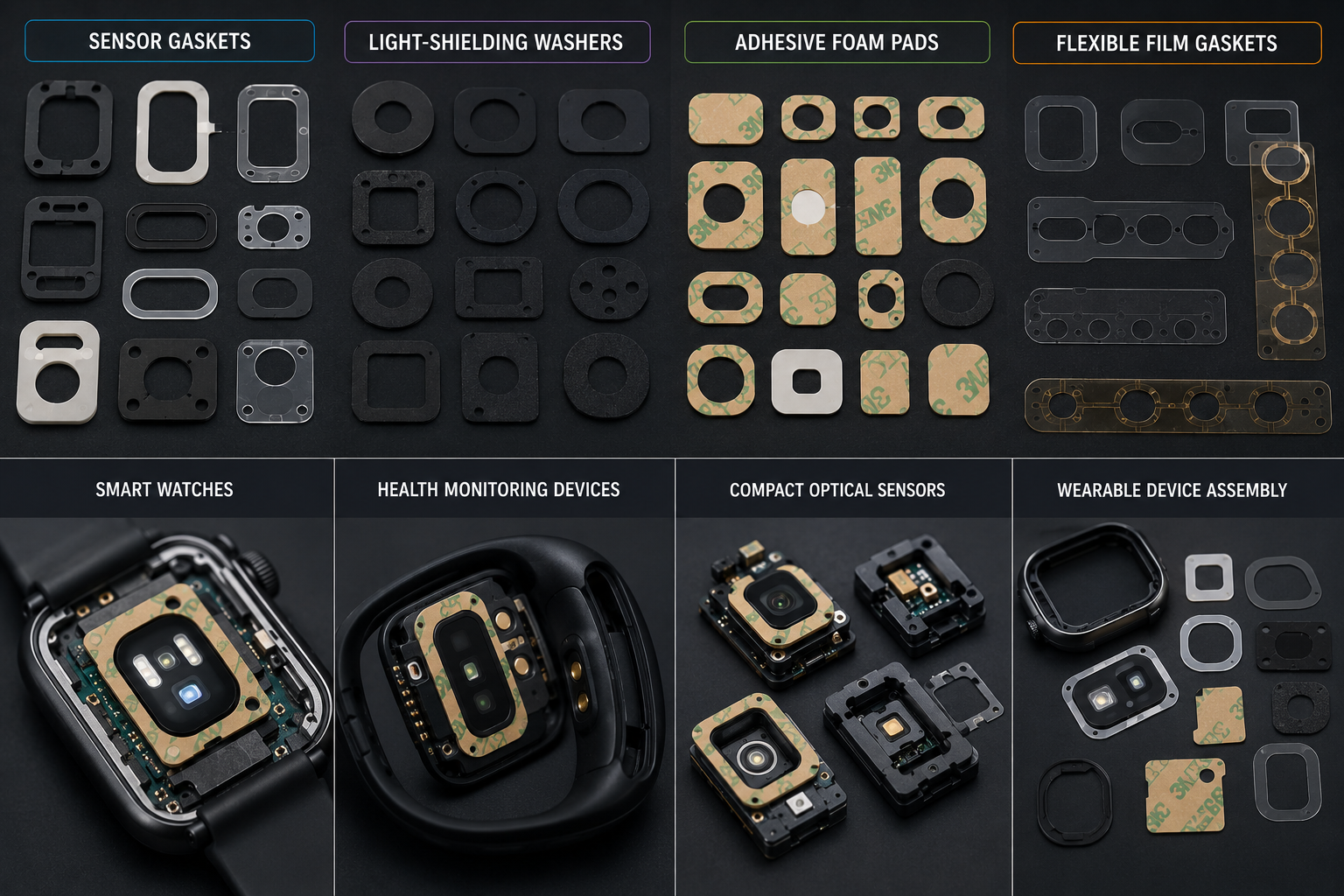
Common Mistakes in Wearable Sensor Gasket Selection
Choosing the Softest Material
Soft material may feel comfortable, but it may collapse and lose sealing force.
Ignoring Light Leakage
A gasket may seal mechanically but still fail optically if it does not block stray light.
Treating Adhesive as a Minor Detail
Adhesive affects placement, bonding, aging, and final gasket stability.
Not Testing After Sweat and Heat Exposure
Initial samples may pass, but performance may change after humidity, sweat simulation, or temperature cycling.
Designing the Gasket Too Late
If the gasket is added after the housing and sensor design are fixed, there may be little room to solve problems properly.
Why Factory Customization Is Worth Considering Early
A wearable optical sensor gasket should be reviewed early in product development.
Early customization can help:
- Reduce design revisions
- Improve sensor stability
- Prevent sealing failures
- Improve assembly speed
- Reduce scrap rate
- Improve user comfort
- Support mass production consistency
A good custom gasket is not simply a part that fills space. It is a small design element that protects sensor performance.
How Sanken Helps With Custom Gaskets for Wearable Optical Sensors
For wearable optical sensor projects, Sanken Manufacturing can support material selection, adhesive lamination, precision die cutting, kiss cutting, clean-edge processing, and prototype-to-mass-production conversion.
More importantly, we help customers review the real problem behind the gasket:
- Is the issue light leakage?
- Is the sensor moving during assembly?
- Is sweat affecting bonding?
- Is the gasket too hard for user comfort?
- Is the foam compressing after aging?
- Is the adhesive difficult to peel or place?
- Is the part shape increasing scrap?
By reviewing these risks early, customers can avoid repeated trial-and-error and move toward stable production more quickly.
Conclusion
Factory customized gaskets benefit wearable optical sensors by improving light control, sealing, sensor alignment, comfort, assembly efficiency, compression stability, and long-term reliability.
The best gasket is not simply the cheapest standard ring. It is the structure that matches the sensor design, housing gap, adhesive surface, skin-contact requirement, and production method. For OEM buyers, customized gaskets can reduce assembly risk, improve sensor performance, and support a better wearable product experience.