
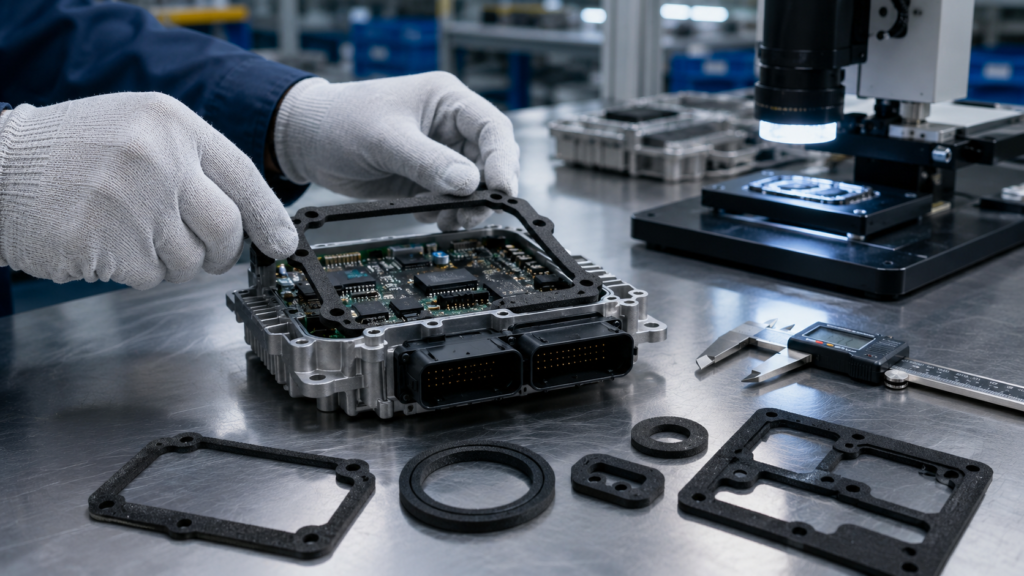
Automotive electronics fail quietly before they fail completely. A small gasket can allow dust, moisture, vibration, heat, or electrical interference to enter the wrong place. I have seen projects delayed because a gasket looked correct on the drawing but failed during testing or assembly.
When choosing die cut gaskets for automotive electronics, buyers should first check the application environment, material performance, sealing target, compression range, adhesive system, tolerance requirements, cleanliness level, and long-term reliability. These gaskets are not ordinary soft pads. They protect ECUs, battery modules, sensors, camera systems, display units, connectors, and control housings. At Sanken, we help OEM customers design and manufacture die cut gaskets that can survive real automotive conditions, not just pass a simple sample review.
A gasket is small, but it has a serious job. If it fails, the electronic system may become noisy, unstable, wet, hot, or completely unreliable.
Why are die cut gaskets important in automotive electronics?
Automotive electronics are exposed to vibration, temperature changes, moisture, dust, pressure, and long service life requirements.
That makes sealing and cushioning extremely important.
Die cut gaskets are commonly used in:
- ECU housings
- Battery management systems
- EV battery packs
- Camera and sensor modules
- Infotainment displays
- Lighting electronics
- Connectors and control units
- ADAS components
These parts may need to seal, cushion, insulate, block dust, reduce vibration, or support bonding.
In automotive electronics, a gasket is not just a spacer.
It is a functional protection component.
What is the first thing buyers should check?
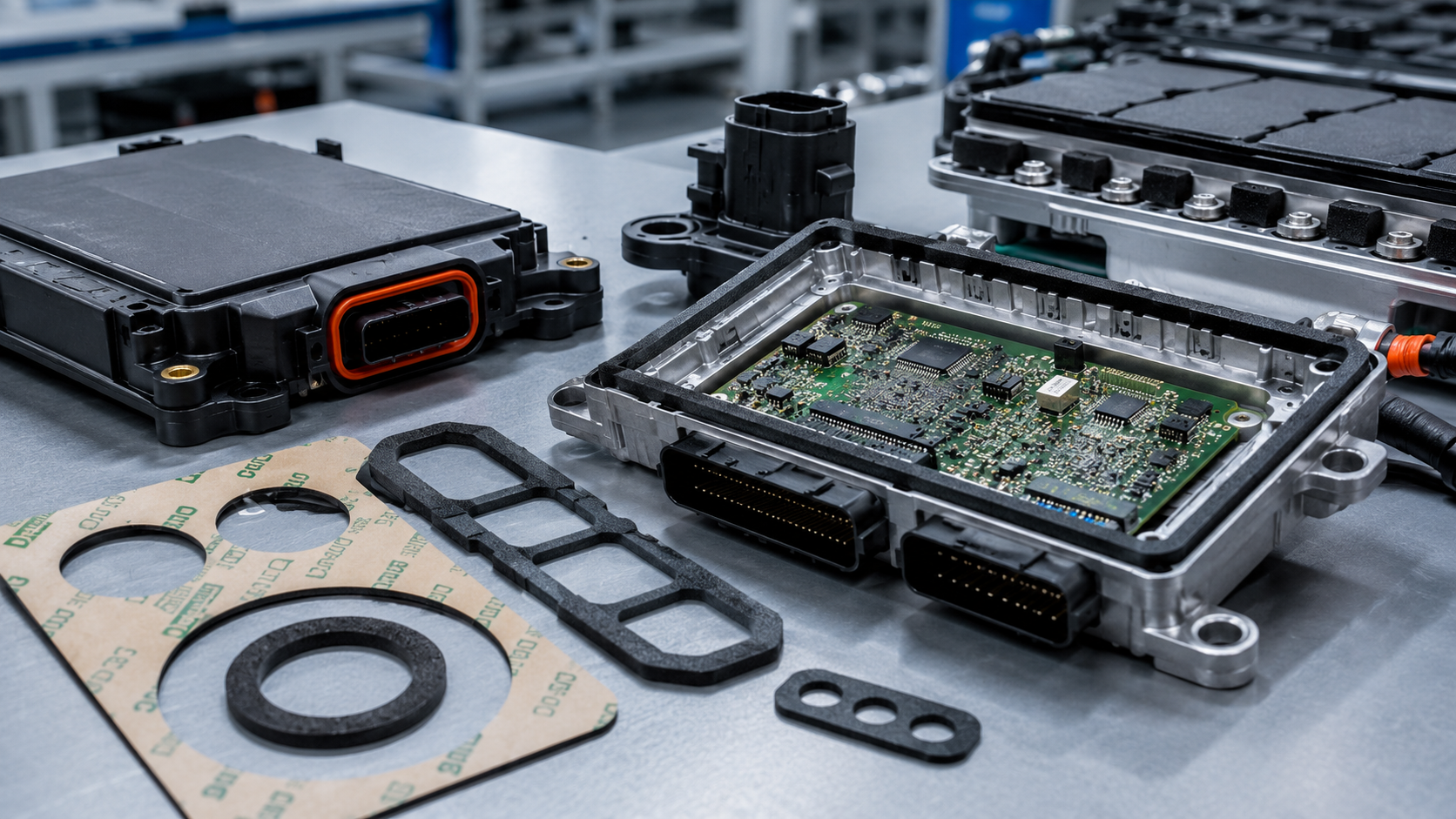
The first thing to check is the real working environment.
Before discussing price or tooling, I always want to know where the gasket will be used.
Will it face heat?
Moisture?
Oil?
Dust?
Vibration?
Compression?
Electrical risk?
Long-term aging?
A gasket inside a vehicle display is different from a gasket near an EV battery module. A gasket near a camera sensor is different from one used inside a power control unit.
If the supplier does not ask about the application environment, the risk is already high.
At Sanken, we always start from the function of the gasket, then work backward to material, adhesive, thickness, tolerance, and process.
Which gasket materials work best for automotive electronics?
There is no single “best” material for every automotive electronic gasket.
The right material depends on the sealing target and working condition.
Common materials include:
| Material | Common Function |
|---|---|
| EPDM Foam | Weather resistance and sealing |
| Silicone Foam | Heat resistance and compression recovery |
| PU Foam | Cushioning and dust sealing |
| EVA Foam | General sealing and shock absorption |
| PET Film | Electrical insulation |
| Rubber | Waterproof sealing |
| Non-woven Fabric | Acoustic and dust control |
| Conductive Foam | EMI shielding |
For high-temperature or long-life applications, silicone foam may be suitable.
For dust sealing and cushioning, PU or EVA foam may be enough.
For waterproof automotive sealing, EPDM or rubber may be better.
For electronic protection, PET insulation films or conductive gasket materials may be required.
This is why material selection must be based on function, not habit.
Why does compression control matter so much?
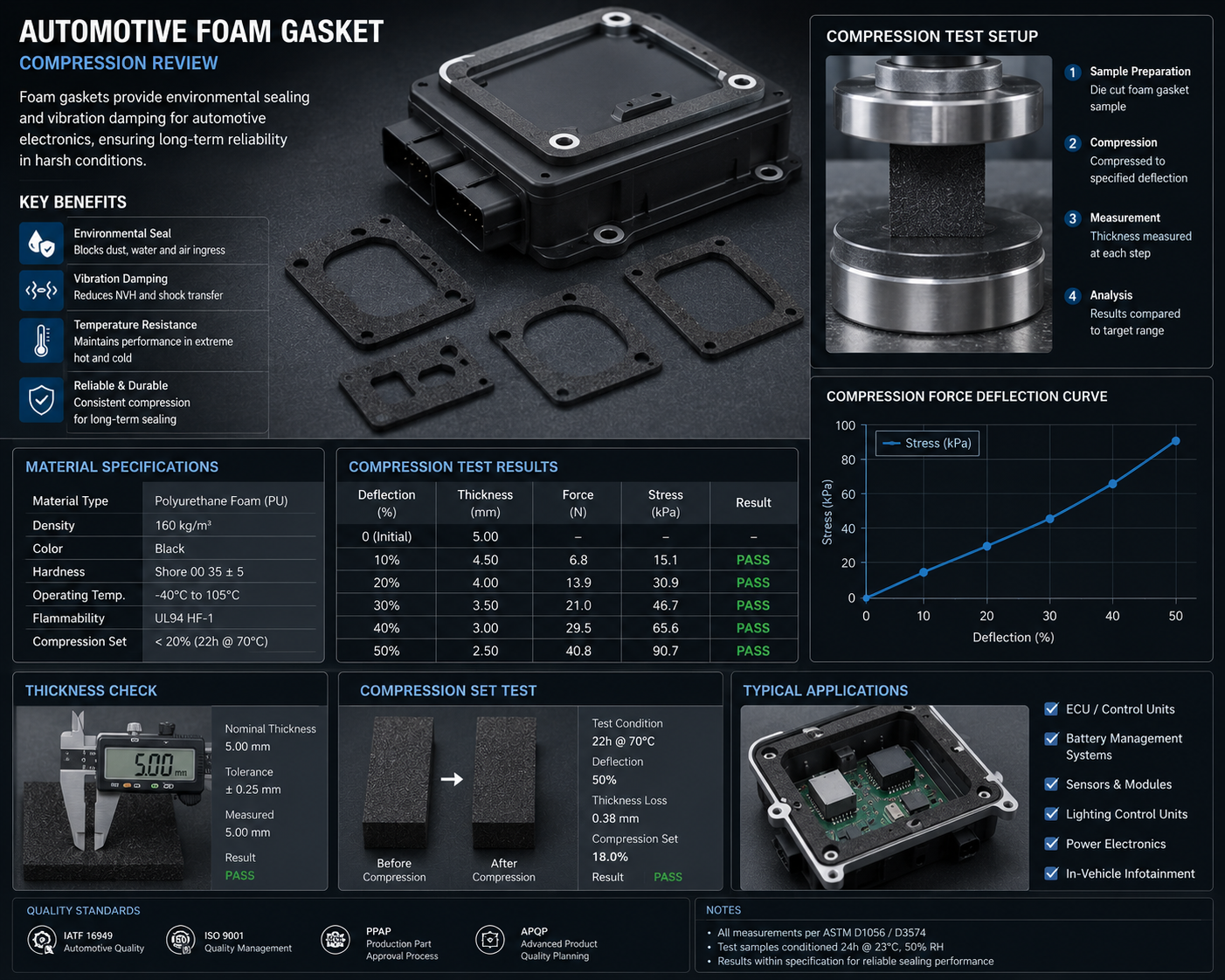
Most die cut gaskets seal through compression.
If the compression is too low, gaps remain.
If the compression is too high, the gasket may collapse, deform, or lose recovery.
In automotive electronics, poor compression control can cause:
- Dust leakage
- Water ingress
- Vibration noise
- Housing deformation
- Poor electrical insulation
- Long-term sealing failure
Foam gaskets are especially sensitive because different foams compress and recover differently.
At Sanken, we review the gap design, housing structure, gasket thickness, compression ratio, and material recovery before production.
This helps prevent a common mistake: choosing a foam that looks good but cannot recover after long-term compression.
How important is tolerance for automotive electronic gaskets?
Tolerance is critical.
Small dimensional errors can create big assembly problems.
For automotive electronics, buyers should check:
- Outer dimensions
- Inner openings
- Hole positions
- Thickness tolerance
- Adhesive position
- Edge quality
- Layer alignment
- Critical sealing areas
A gasket that is slightly oversized may interfere with housing assembly.
A hole that shifts may block a screw or positioning pin.
An inner opening that is too small may affect airflow, sensor exposure, or connector access.
At Sanken, we control tolerance through precision die cutting, tooling optimization, in-process inspection, and final quality verification.
One good sample is not enough.
The real question is whether the supplier can maintain the same precision in repeated mass production.
Should automotive electronic gaskets use adhesive backing?
Many automotive electronic gaskets use adhesive backing to help positioning during assembly.
But adhesive must be selected carefully.
The bonding surface may be:
- Aluminum
- Painted metal
- ABS
- PC
- PP
- Rubber
- Glass
- Powder-coated surfaces
Each surface requires different adhesive thinking.
If the adhesive is wrong, the gasket may lift, shift, peel, or contaminate the assembly.
Buyers should check:
| Adhesive Factor | Why It Matters |
|---|---|
| Surface compatibility | Prevents peeling |
| Temperature resistance | Prevents softening or failure |
| Shear strength | Prevents shifting |
| Peel strength | Supports long-term bonding |
| Liner release | Improves assembly efficiency |
| Adhesive overflow control | Prevents contamination |
At Sanken, we combine adhesive laminating, kiss cutting, and precision die cutting to reduce adhesive-related failures.
We do not simply add glue and hope for the best.
Hope is not a process control plan.
What about EMI shielding and electrical insulation?
Automotive electronics often need more than sealing.
They may also need EMI shielding or electrical insulation.
For example:
- PET films can provide insulation
- Conductive foam can support shielding
- Conductive fabric tape can reduce electromagnetic interference
- Foam and film composites can combine cushioning and insulation
If the gasket is used near electronic circuits, battery systems, sensors, or communication modules, buyers should check electrical requirements early.
A normal foam gasket may solve dust sealing but fail EMI protection.
A conductive gasket may shield well but require tighter dimensional control.
At Sanken, we support multilayer converting for applications where sealing, insulation, cushioning, and shielding must work together.
Why does cleanliness matter in automotive electronics?
Cleanliness is becoming more important in automotive electronic assemblies.
Dust, foam particles, adhesive strings, burrs, or liner debris can create serious issues.
They may affect:
- Sensors
- Camera modules
- Displays
- Circuit boards
- Connectors
- Optical surfaces
- Battery electronics
Poor die cutting can create rough edges, foam dust, adhesive strings, or loose particles.
At Sanken, we control edge quality, waste removal, material handling, and inspection standards to reduce contamination risk.
For sensitive projects, we can discuss cleaner processing and packaging requirements before production.
What should buyers validate before mass production?
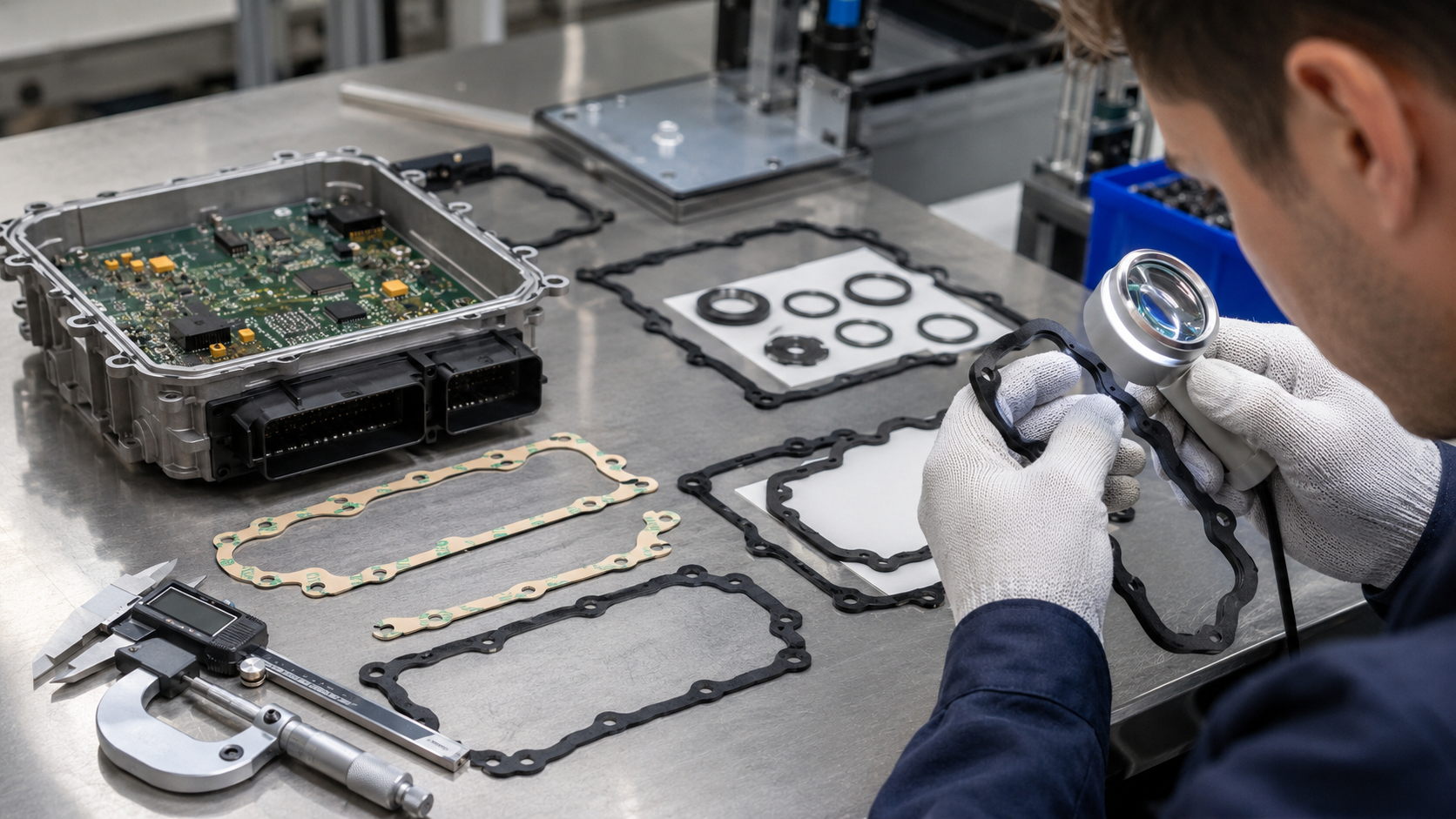
Before mass production, buyers should validate more than shape.
A proper validation plan may include:
- Material confirmation
- Dimension inspection
- Thickness inspection
- Compression recovery testing
- Adhesive bonding test
- Aging test
- Temperature exposure test
- Assembly fit test
- Sealing verification
- Packaging review
This step is especially important for automotive electronics because product failure can be costly.
At Sanken, we support customers from sample development to pre-production verification and stable mass production.
It is much cheaper to fix a gasket before mass production than after assembly failure.
Why do OEM customers choose Sanken for automotive electronic gaskets?
OEM customers choose Sanken because we are not only a cutting supplier.
We provide precision material converting solutions.
Our capabilities include:
- Precision die cutting
- Rotary die cutting
- Foam converting
- Rubber converting
- PET film converting
- Adhesive laminating
- Kiss cutting
- Multi-layer bonding
- Hot pressing
- Spraying and gluing
- Silk screen printing
- Injection molding support
This helps customers reduce supplier coordination, shorten development time, and improve batch stability.
For automotive electronics, that matters.
The part may be small.
The quality responsibility is not.
Conclusion
For automotive electronics, die cut gaskets must be checked for environment, material, compression, adhesive, tolerance, cleanliness, and validation before production. At Sanken, we combine precision die cutting, material converting, adhesive laminating, and quality control to help OEM customers build safer, more reliable electronic assemblies.