
Why Do Die Cut Foam Gaskets Seal Poorly? 7 Mistakes Buyers Should Avoid
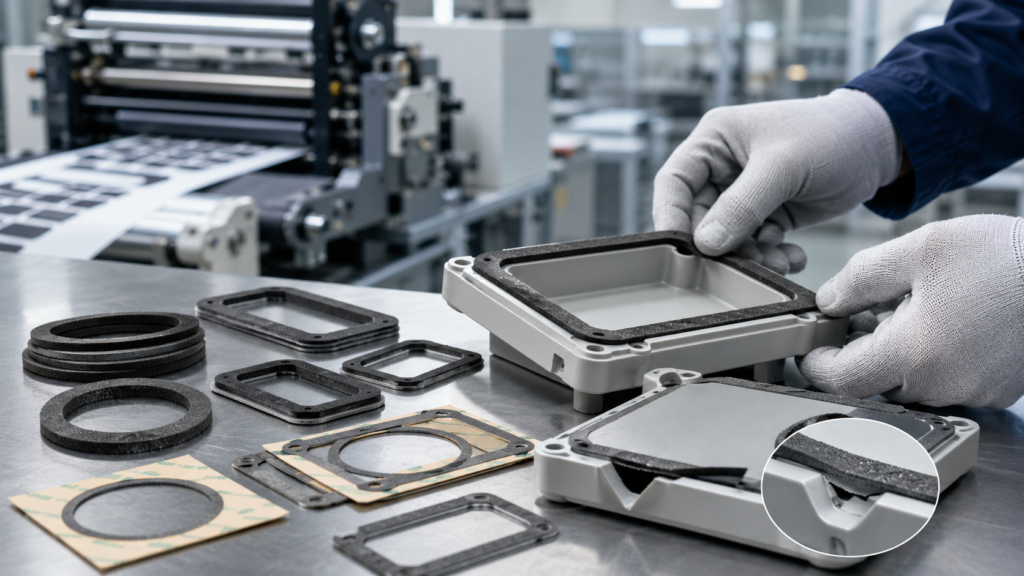
A foam gasket can look perfect and still fail where it matters most. I have seen buyers approve samples, start production, and then run into leaks, noise, dust ingress, or weak compression recovery. The result is rework, delay, and extra cost that could have been avoided much earlier.
In my experience, poor sealing in die cut foam gaskets usually comes from seven preventable mistakes: choosing the wrong foam, using the wrong thickness, ignoring compression range, selecting the wrong adhesive, allowing weak tolerance control, overlooking the real application environment, and skipping validation before mass production. At Sanken, we prevent these issues by combining material selection, precision die cutting, laminating, and process verification into one controlled manufacturing workflow.
The gasket is small. The consequences are not. If the gasket fails, the whole product can look unreliable.
Why do die cut foam gaskets fail even when the sample looks fine?
This is one of the most common questions I hear.
A sample may look fine on the table because appearance is only one part of sealing performance. Real sealing depends on compression, rebound, surface contact, dimensional stability, adhesive performance, and the actual working environment.
That is why a part can pass visual review and still fail in assembly, aging, vibration, or temperature testing.
At Sanken, we never judge a gasket only by shape. We also review how it will work inside the customer’s final product.
1) Are you choosing the wrong foam material?
This is mistake number one, and it causes more problems than many buyers expect.
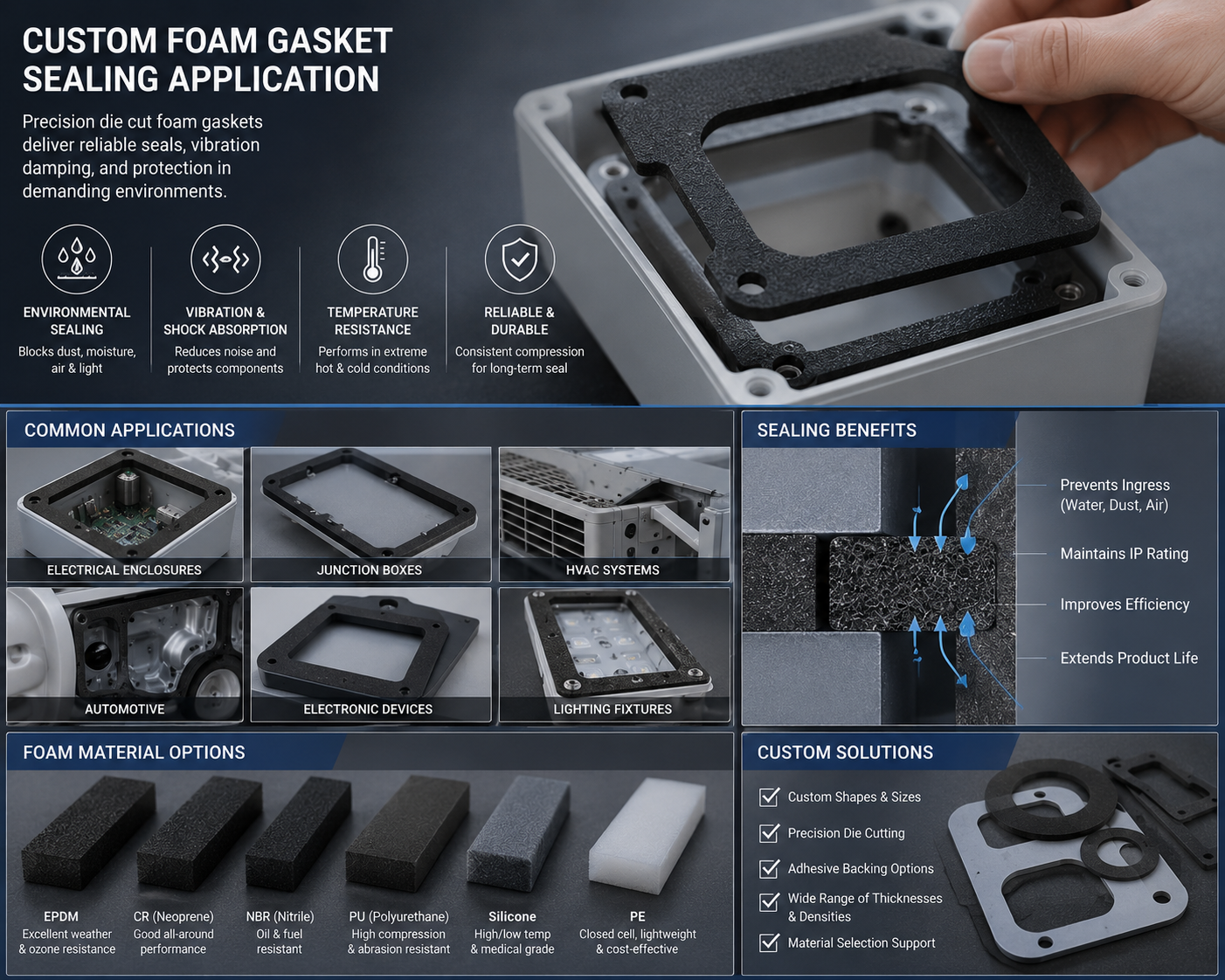
Not all foam materials behave the same way. EVA, EPDM, CR, PU, PE, PVC, and silicone foam each have different properties in compression set, temperature resistance, sealing behavior, aging performance, and chemical resistance.
If the material is too soft, it may collapse over time.
If it is too hard, it may not compress enough to seal.
If it lacks aging resistance, the gasket may shrink, harden, or crack after service.
I always recommend starting with the application, not the price. A foam gasket for automotive sealing is not the same as a foam gasket for consumer electronics or appliance cushioning.
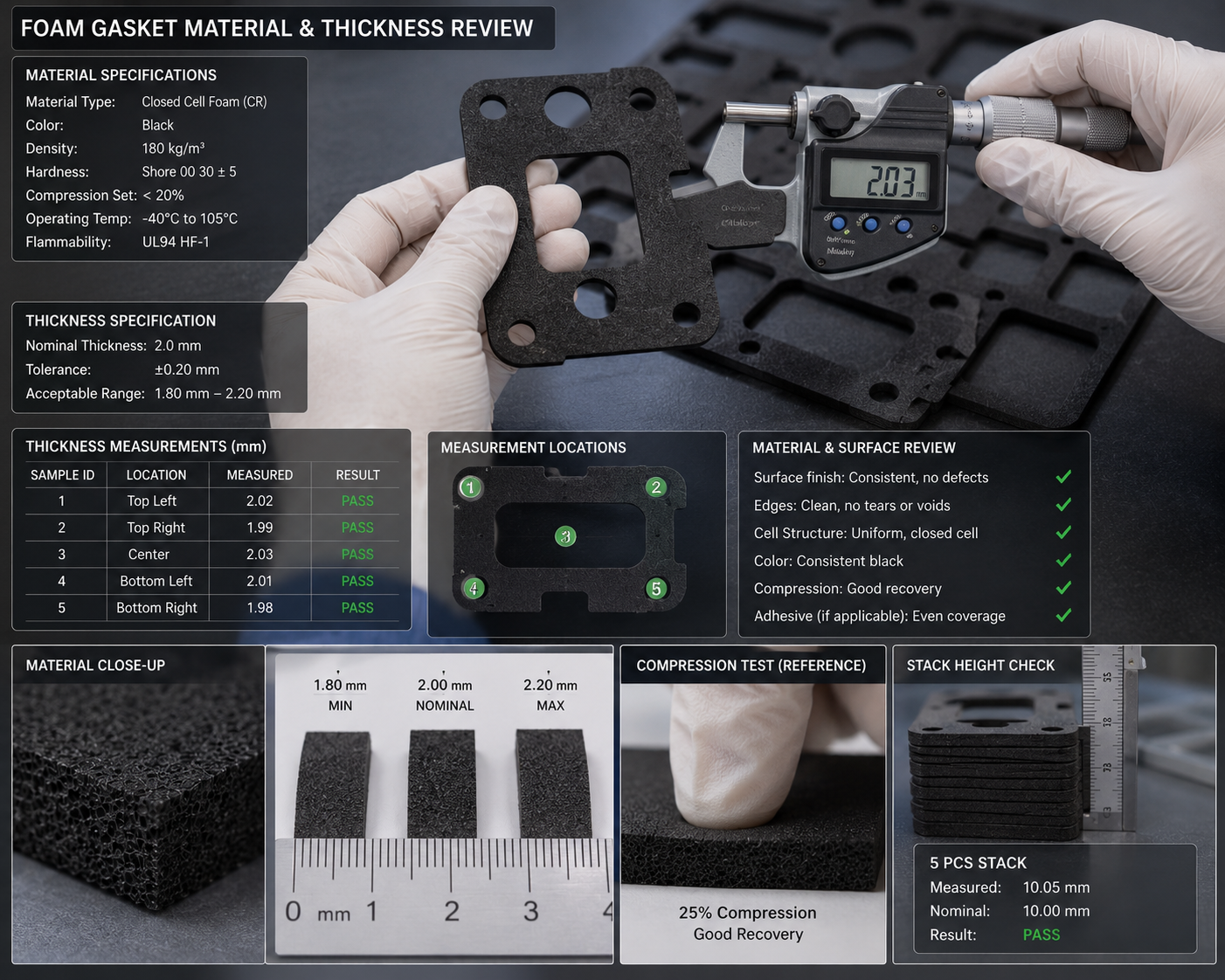
2) Is the gasket thickness wrong for the application?
Thickness is not just a drawing number.
It directly affects compression and sealing force.
A gasket that is too thin may not fill the gap properly. A gasket that is too thick may create excessive assembly force, distortion, or long-term compression failure.
Buyers sometimes choose thickness by habit instead of engineering need. That is risky.
At Sanken, we look at the gap, the housing structure, the clamping force, and the expected compression range before recommending thickness. That saves a lot of trouble later.
3) Are you ignoring the correct compression range?
A foam gasket seals because it compresses.
But too little compression causes leakage, while too much compression permanently damages the foam structure.
This is where many suppliers fail. They cut the shape correctly, but they do not evaluate how the part behaves after assembly.
Compression ratio should be matched to the foam type, cell structure, density, and final application.
For example, an enclosure seal in electronics may require a different compression strategy than an automotive air or water sealing application.
At Sanken, we review compression behavior and recovery early, because sealing performance is not only about the first assembly. It is also about what happens after weeks or months of use.
4) Is the wrong adhesive causing the gasket to lift or shift?
Many die cut foam gaskets use adhesive backing for positioning and assembly convenience.
This seems simple. It is not.
The wrong adhesive can cause lifting, shifting, peeling, edge curl, or poor bonding during installation. Different surfaces such as painted metal, ABS, PC, PP, glass, rubber, and textured plastics all behave differently.
Acrylic adhesive, rubber adhesive, and specialty adhesive systems each have different strengths.
If the adhesive does not match the substrate and environment, the gasket may move out of position before it can even do its sealing job.
That is why Sanken does not only die cut the foam. We also evaluate the adhesive structure, liner, and lamination process to improve assembly stability.
A gasket can fail even when the material is good and the adhesive is correct.
Why?
Because tolerance errors create assembly problems.
If the outer dimensions are off, the gasket may not fit correctly.
If the inner opening is wrong, it may interfere with airflow, light, sensors, or part movement.
If hole positions are inaccurate, installation becomes difficult.
If thickness varies too much, compression becomes inconsistent.
This is why precision die cutting matters.
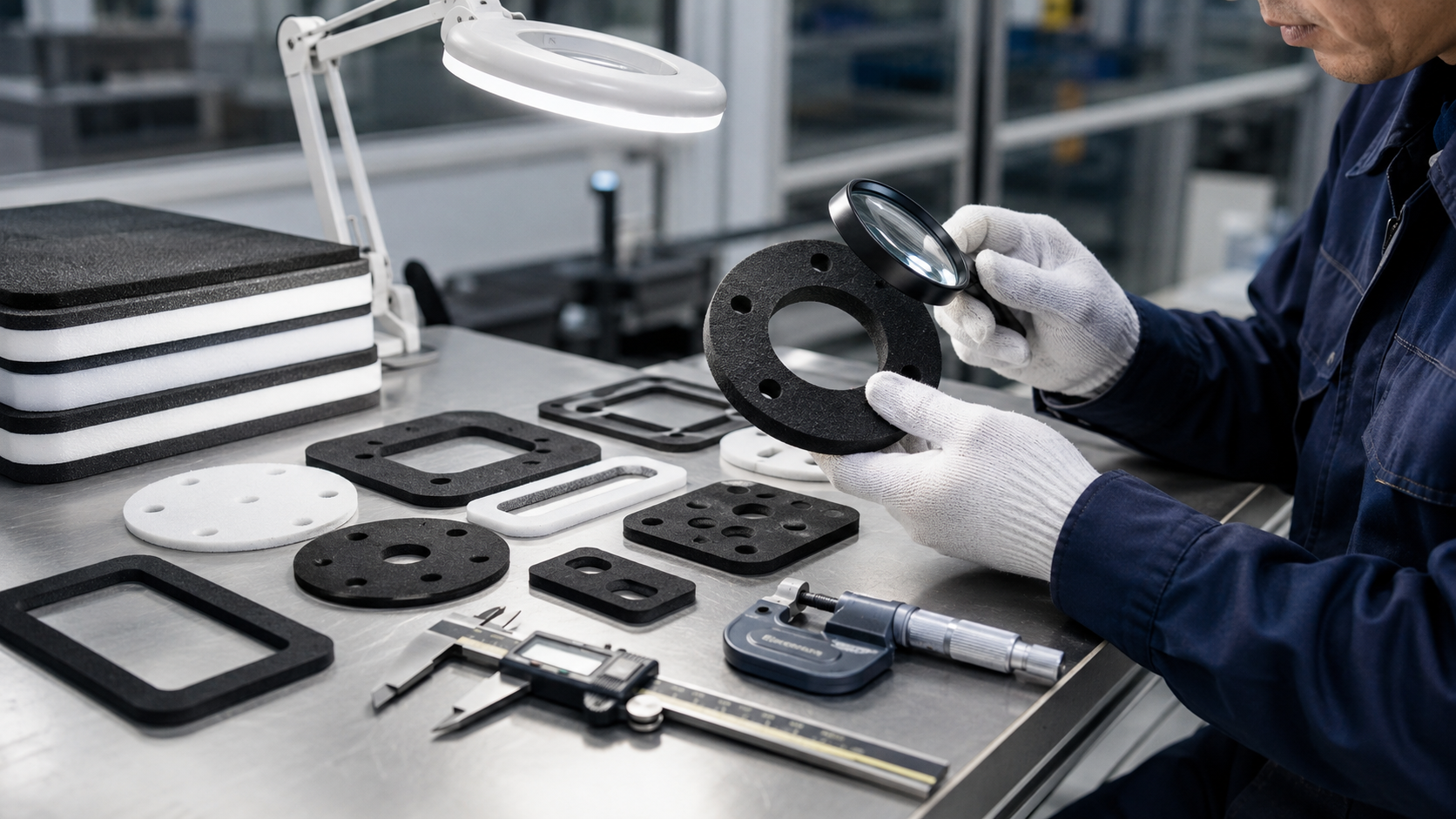
At Sanken, we control key inspection points such as outer dimensions, inner cut profiles, hole positions, thickness, adhesive position, and edge quality. A gasket is only reliable when it is dimensionally stable from batch to batch.
6) Are you forgetting the real working environment?
This is a major mistake.
Many buyers approve gaskets based on basic fit checks, but real products face much more than that.
A foam gasket may need to survive:
- Heat
- Humidity
- Water exposure
- Dust
- Oil or chemicals
- UV exposure
- Repeated compression
- Vibration
- Uneven mating surfaces
If the supplier never asks about the real use environment, that is a warning sign.
At Sanken, we always want to know how and where the gasket will be used. That allows us to recommend better materials, more suitable adhesives, and more stable processing conditions.
7) Are you skipping validation before mass production?
This is the final and often most expensive mistake.
Many gasket problems could be prevented with proper pre-production validation.
Instead, some buyers only approve appearance and basic dimensions, then move directly to larger orders.
That is when failure becomes expensive.
A better validation process may include:
- Dimension inspection
- Thickness inspection
- Compression recovery testing
- Adhesion testing
- Aging testing
- Assembly fit testing
- Sealing verification
- Environmental testing
At Sanken, we believe it is much cheaper to correct a problem before mass production than after field complaints begin.
What should buyers check before ordering die cut foam gaskets?
I recommend checking these points before you place the order:
| Check Item | Why It Matters |
|---|---|
| Foam material | Determines sealing, durability, and compression behavior |
| Thickness | Affects gap filling and assembly pressure |
| Compression range | Controls sealing performance and recovery |
| Adhesive system | Prevents lifting, shifting, and poor bonding |
| Tolerances | Ensures fit, alignment, and consistent compression |
| Application environment | Prevents premature failure in heat, humidity, vibration, or aging |
| Validation plan | Reduces risk before mass production |
A supplier that cannot discuss these points clearly is likely focusing only on cutting, not on performance.
Why do OEM buyers choose Sanken for die cut foam gaskets?
Because we do more than cut shapes.
We help solve sealing problems.
Our capabilities include:
- Precision die cutting
- Foam converting
- Adhesive laminating
- Kiss cutting
- Multi-layer bonding
- Hot pressing
- Spraying and gluing
- Silk screen printing
- Injection molding support
For B2B buyers, that means fewer surprises, faster problem-solving, and a more stable path from sample to mass production.
Conclusion
Poor sealing in die cut foam gaskets is usually not caused by one big mistake. It comes from several small ones stacking together. At Sanken, we help buyers avoid these seven common problems through material expertise, precision die cutting, adhesive lamination, and pre-production validation that supports stable mass production.