
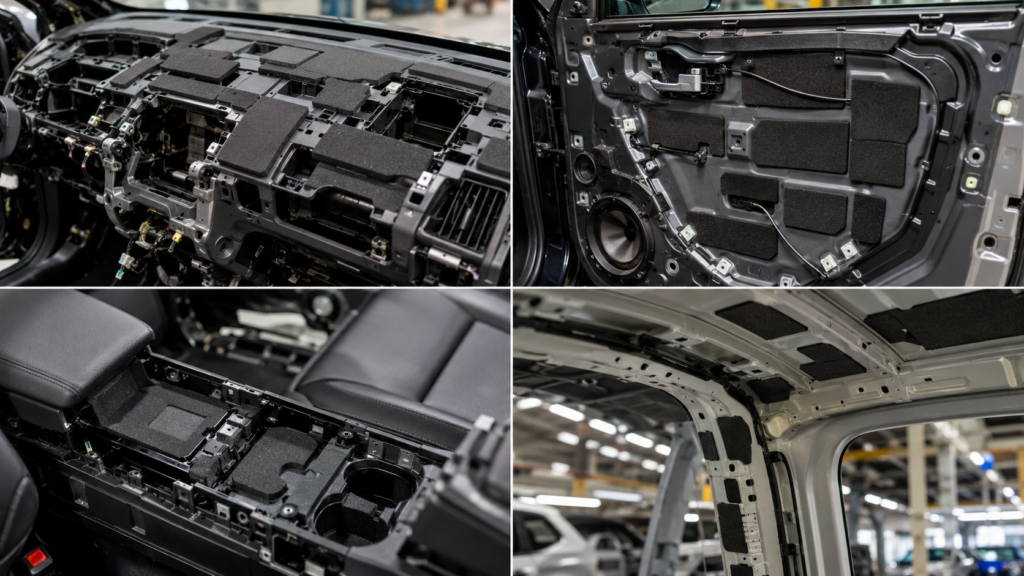
How Die Cut Foam Helps Reduce Vehicle Noise and Vibration?
Modern vehicles contain thousands of components working together in a limited space. While engines, motors, and road conditions contribute to overall noise, many unwanted sounds actually originate from small gaps, loose parts, vibrating panels, and component-to-component contact. As vehicle manufacturers pursue quieter cabins and higher customer satisfaction, controlling Noise, Vibration, and Harshness (NVH) has become a critical engineering objective.
Die cut foam helps reduce vehicle noise and vibration by absorbing sound energy, isolating moving components, filling gaps, preventing friction, and damping structural vibrations. Custom die-cut foam components are widely used throughout automotive interiors, battery systems, electronic modules, door assemblies, and body structures to improve cabin comfort and vehicle quality.
For both traditional vehicles and electric vehicles (EVs), precision die-cut foam has become an essential NVH solution.
What Is Automotive NVH?
NVH stands for:
- Noise
- Vibration
- Harshness
It is used to evaluate how comfortable and refined a vehicle feels during operation.
Common NVH issues include:
- Dashboard rattles
- Door panel squeaks
- Wind noise
- Road noise
- Wire harness vibration
- Electronic module buzzing
- Interior trim movement
Even minor noises can significantly affect a driver's perception of vehicle quality.
Theme: Automotive NVH Foam Components
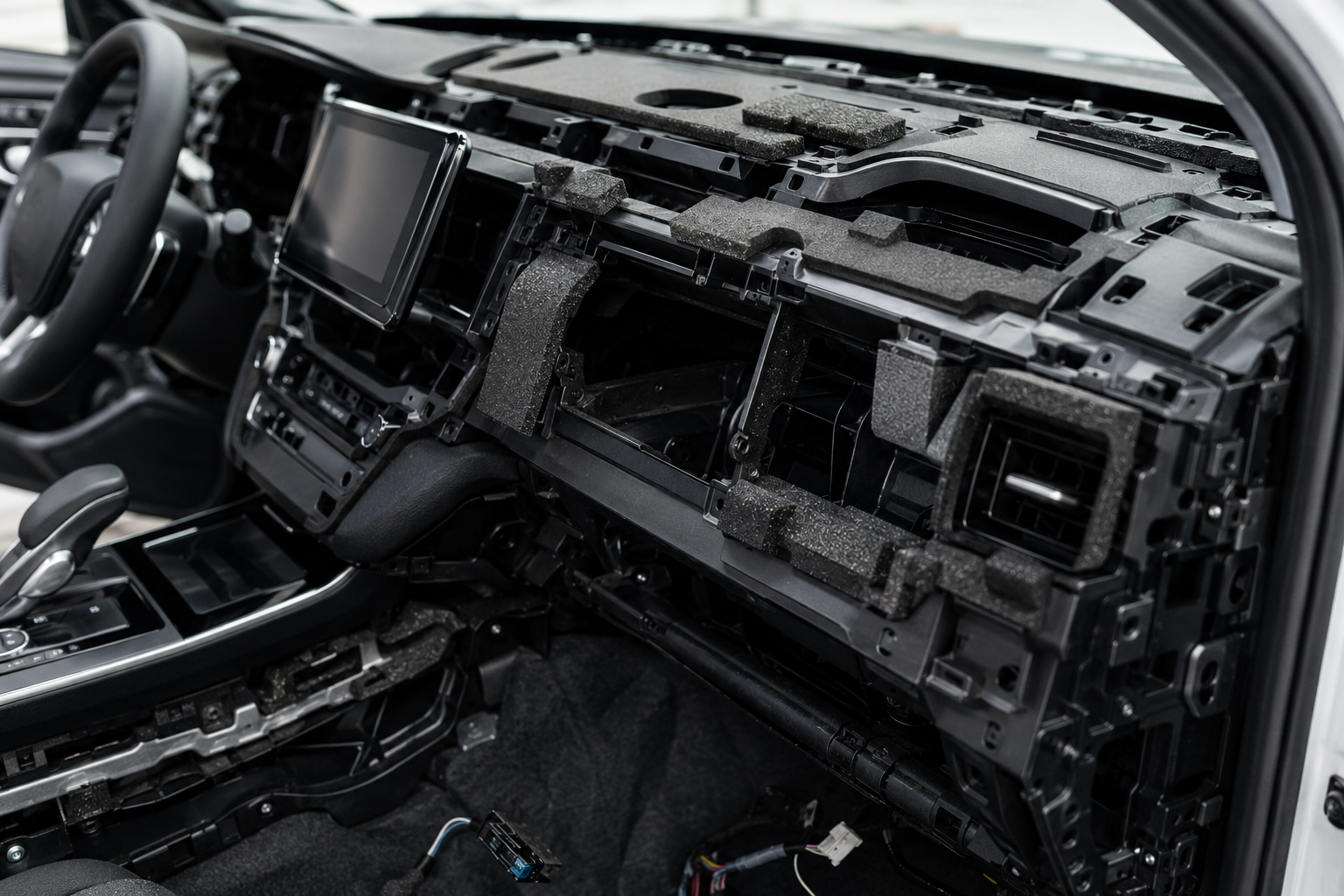
Why Foam Is Effective for Noise Reduction
Foam materials contain millions of microscopic air cells that absorb and dissipate energy.
Unlike rigid materials, foam can:
- Compress under load
- Absorb sound waves
- Reduce vibration transmission
- Isolate contact points
- Prevent impact noise
When vibration energy enters the foam structure, part of the energy is converted into heat rather than being transferred through the vehicle.
This helps reduce the noise heard by passengers.
How Die Cut Foam Controls Vibration
Many vehicle components generate vibration during normal driving.
Examples include:
- HVAC systems
- Wire harnesses
- Display modules
- Battery packs
- Plastic trim components
- Electronic control units
Custom die-cut foam acts as a vibration isolator.
Benefits include:
- Reduced component movement
- Lower vibration transfer
- Improved mounting stability
- Reduced wear between parts
This is especially important in electric vehicles where the absence of engine noise makes smaller vibrations easier to notice.
Reducing Squeaks and Rattles
One of the most common customer complaints involves interior squeaks and rattles.
These noises often occur when:
- Plastic touches plastic
- Plastic touches metal
- Components move during driving
- Wire harnesses rub against brackets
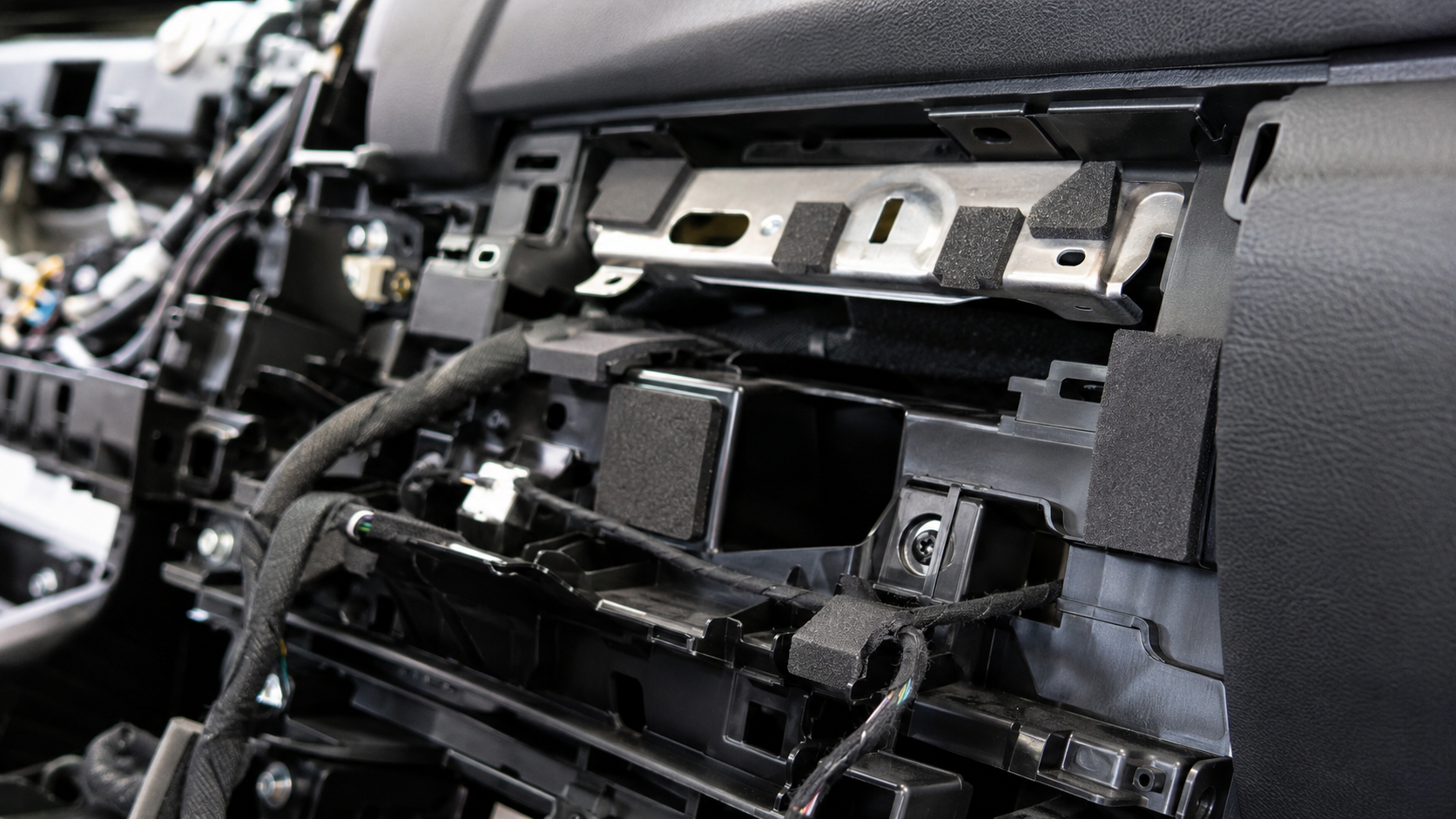
Die-cut foam pads help by:
- Filling clearance gaps
- Providing cushioning
- Reducing friction
- Maintaining compression force
A small foam pad costing only a few cents can eliminate a noise issue that would otherwise require expensive engineering changes.
Theme: Die Cut Foam Anti-Rattle Applications
Improving Acoustic Insulation
In addition to vibration control, foam also improves acoustic performance.
Common noise sources include:
- Tire noise
- Road noise
- Wind turbulence
- Electric motors
- Mechanical systems
Depending on the foam type, materials can:
- Absorb sound waves
- Reduce resonance
- Block sound transmission
- Improve cabin quietness
Many automotive NVH systems combine foam with needle-punched non-woven felt to achieve higher sound absorption performance.
This combination is widely used throughout modern vehicle interiors.
Automotive Interior Applications
Dashboard Systems
Die-cut foam helps:
- Reduce panel vibration
- Eliminate buzz noises
- Improve component stability
Door Panels
Applications include:
- Vibration damping
- Noise reduction
- Gap filling
- Anti-rattle protection
Center Consoles
Foam pads prevent noise caused by contact between adjacent plastic components.
Roof and Pillar Assemblies
Acoustic foam helps reduce airborne noise entering the cabin.
Theme: Automotive Interior Foam Applications
Die Cut Foam in Automotive Electronics
Modern vehicles contain an increasing number of electronic systems.
Applications include:
- Infotainment displays
- Sensors
- Radar modules
- Camera systems
- Battery management units
Die-cut foam provides:
- Vibration isolation
- Shock absorption
- Thermal separation
- Noise reduction
This improves both reliability and passenger comfort.
Why EVs Require More NVH Materials
Electric vehicles present unique NVH challenges.
Without engine noise masking other sounds, occupants become more aware of:
- Interior rattles
- Road noise
- Electronic buzzing
- Structural vibration
To address these issues, EV manufacturers increasingly use:
- Acoustic foam
- Non-woven felt insulation
- Foam gaskets
- Battery cushioning materials
Precision die-cut NVH materials play a critical role in creating a premium EV driving experience.
Common Foam Materials Used in Automotive NVH Applications
| Material | Main Advantages |
|---|---|
| PU Foam | Excellent sound absorption |
| PE Foam | Lightweight vibration damping |
| EVA Foam | High durability and compression resistance |
| EPDM Foam | Weather and aging resistance |
| Silicone Foam | High-temperature performance |
The best material depends on the application environment, compression requirements, and NVH targets.
Why Precision Die Cutting Matters
Automotive foam components must fit accurately to perform correctly.
Poorly cut parts can result in:
- Assembly difficulties
- Noise leakage
- Inconsistent compression
- Reduced NVH effectiveness
Precision die cutting ensures:
- Accurate dimensions
- Clean edges
- Consistent thickness
- Reliable installation
For automotive OEMs, repeatability is essential for maintaining vehicle quality across large production volumes.
How Sanken Manufacturing Supports Automotive NVH Projects
Dongguan Sanken Electronics Manufacturing Co., Ltd. specializes in automotive NVH materials and custom die-cut foam solutions.
Our capabilities include:
- Precision die cutting
- Automotive needle-punched felt converting
- Foam gasket manufacturing
- Adhesive laminating
- Multi-layer material assembly
- Rubber sealing products
- Cleanroom precision manufacturing
Key Advantages
- OEM and ODM customization
- ISO 9001 certified quality management
- RoHS and REACH compliant materials
- Domestic and overseas production bases
- Automotive-grade production support
- Tool development from drawings or samples
We provide custom die-cut foam, non-woven felt, insulation materials, and sealing components for automotive interiors, battery systems, electronic modules, and NVH applications.
Featured Snippet Summary
Die-cut foam helps reduce vehicle noise and vibration by absorbing sound energy, isolating vibrating components, filling gaps, preventing friction, and damping structural movement. It is widely used in automotive interiors, battery systems, electronic modules, and EV applications to improve NVH performance and passenger comfort.
Conclusion
Vehicle noise and vibration directly influence customer satisfaction and perceived quality. Custom die-cut foam components offer an effective solution for reducing rattles, road noise, vibration, and component movement without major design changes.
By combining the right foam material with precision die-cutting technology, automotive manufacturers can achieve quieter cabins, better NVH performance, and a more refined driving experience for end users.