
Many OEM buyers assume that the die-cutting process is the primary factor affecting part cost. In reality, material selection often has a much greater impact. Two die-cut parts with the same dimensions and identical drawings can have significantly different prices simply because they use different materials.
Material choice changes the cost of die cut parts by affecting raw material price, processing difficulty, material utilization, production speed, tooling requirements, waste generation, and long-term product performance. Selecting the right material helps OEM manufacturers balance cost, quality, and reliability without over-engineering the product.
Understanding how materials influence manufacturing costs allows engineers and purchasing teams to make better sourcing decisions from the beginning of a project.
Why Material Selection Matters
Every die-cut component starts with a material.
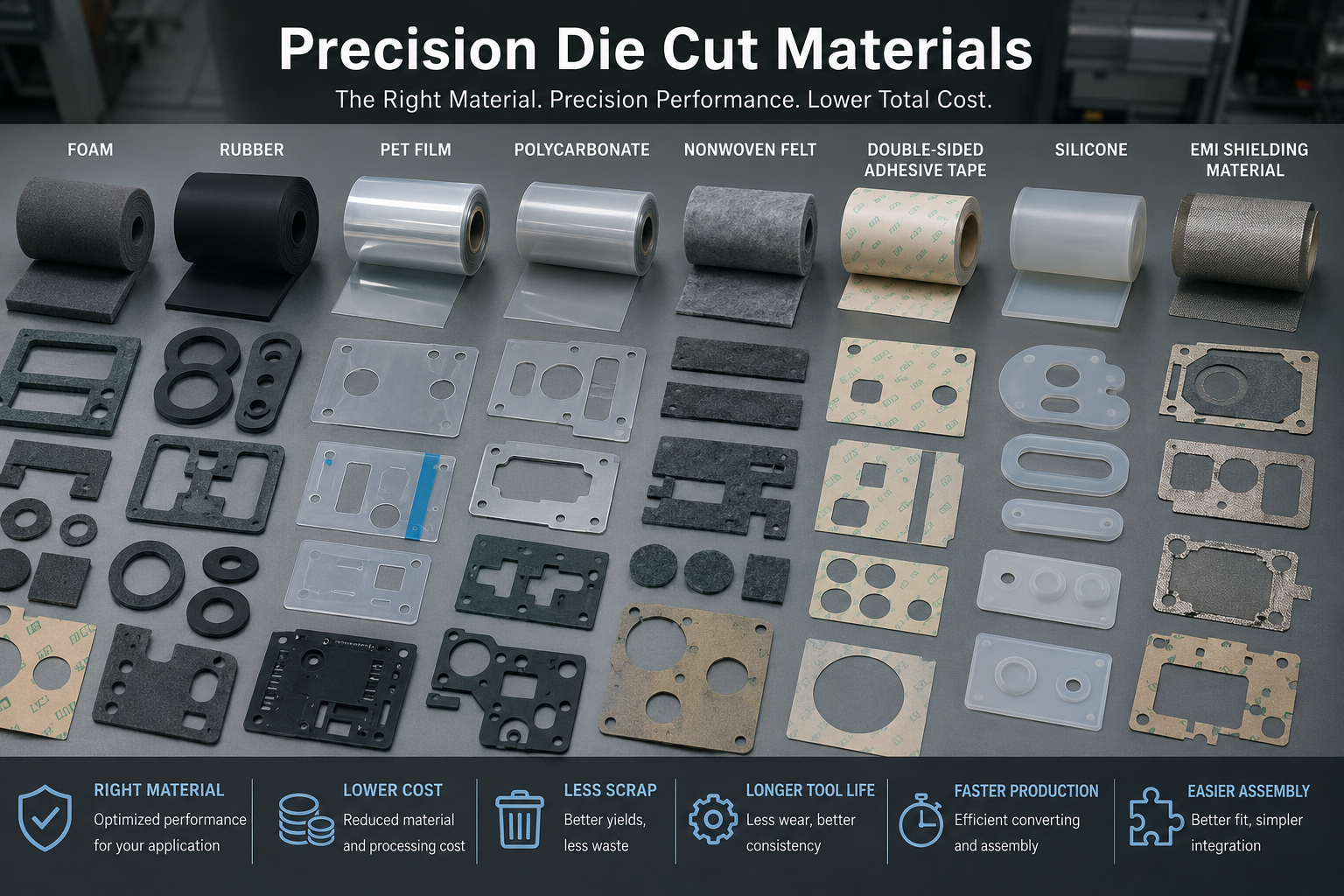
Whether it is:
- Foam
- Rubber
- PET film
- Polycarbonate
- Nonwoven felt
- Double-sided adhesive tape
- Silicone
- EMI shielding material
Each material behaves differently during converting and manufacturing.
The wrong material may increase:
- Material costs
- Scrap rates
- Tool wear
- Processing time
- Assembly complexity
Choosing the correct material often reduces the total project cost.
Theme: Precision Die Cut Materials
Raw Material Cost Is Only One Factor
Higher-priced materials do not always create more expensive products.
For example:
A premium foam with better dimensional stability may reduce production waste.
A higher-quality adhesive may eliminate secondary assembly steps.
A stronger PET film may reduce product failures in the field.
Instead of comparing only material prices, manufacturers should evaluate the overall manufacturing cost.
Material Thickness Affects Production Cost
Material thickness directly influences die-cutting efficiency.
Thicker materials often require:
- Higher cutting force
- Stronger tooling
- Slower production speed
- More frequent tool maintenance
Very thin materials can also present challenges such as:
- Curling
- Static electricity
- Material stretching
- Handling difficulties
Selecting an appropriate thickness helps optimize production efficiency.
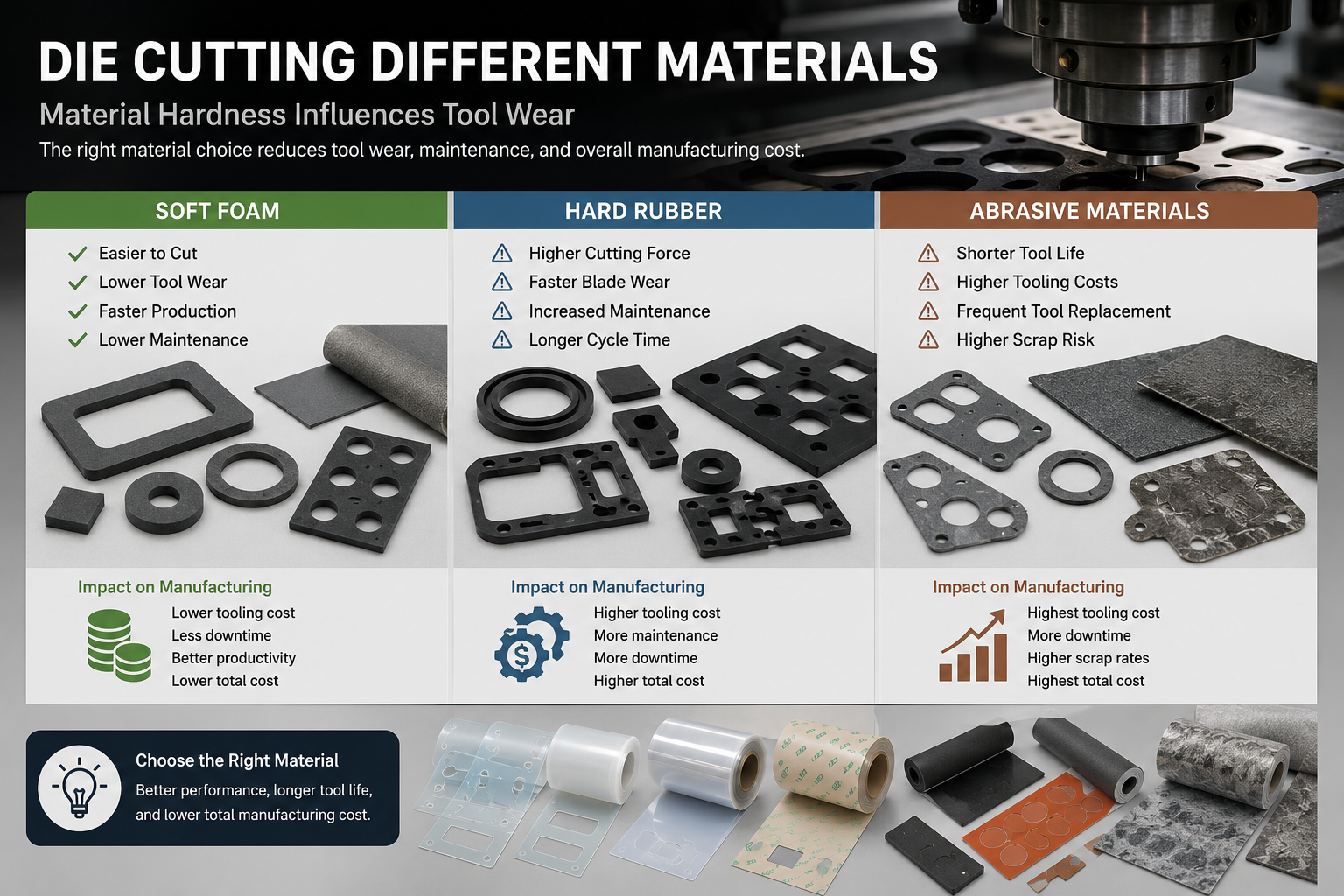
Material Hardness Influences Tool Wear
Different materials affect tooling differently.
For example:
Soft foam:
- Easier to cut
- Lower tool wear
- Faster production
Hard rubber:
- Higher cutting force
- Faster blade wear
- Increased maintenance
Abrasive materials:
- Shorter tool life
- Higher tooling costs
These factors contribute to the overall manufacturing cost.
Theme: Die Cutting Different Materials
Material Utilization Impacts Cost
Efficient nesting reduces material waste.
However, some materials have limitations due to:
- Grain direction
- Surface texture
- Protective liners
- Roll width
- Material defects
Poor material utilization increases:
- Scrap
- Raw material consumption
- Unit cost
Experienced die-cut manufacturers optimize part layouts to maximize material yield.
Adhesive Selection Can Affect Total Cost
Many die-cut parts include pressure-sensitive adhesives.
Different adhesive systems vary in:
- Bond strength
- Thickness
- Temperature resistance
- Processing characteristics
- Material compatibility
A lower-cost adhesive may result in:
- Product failures
- Rework
- Warranty claims
Choosing the correct adhesive often reduces overall project costs.
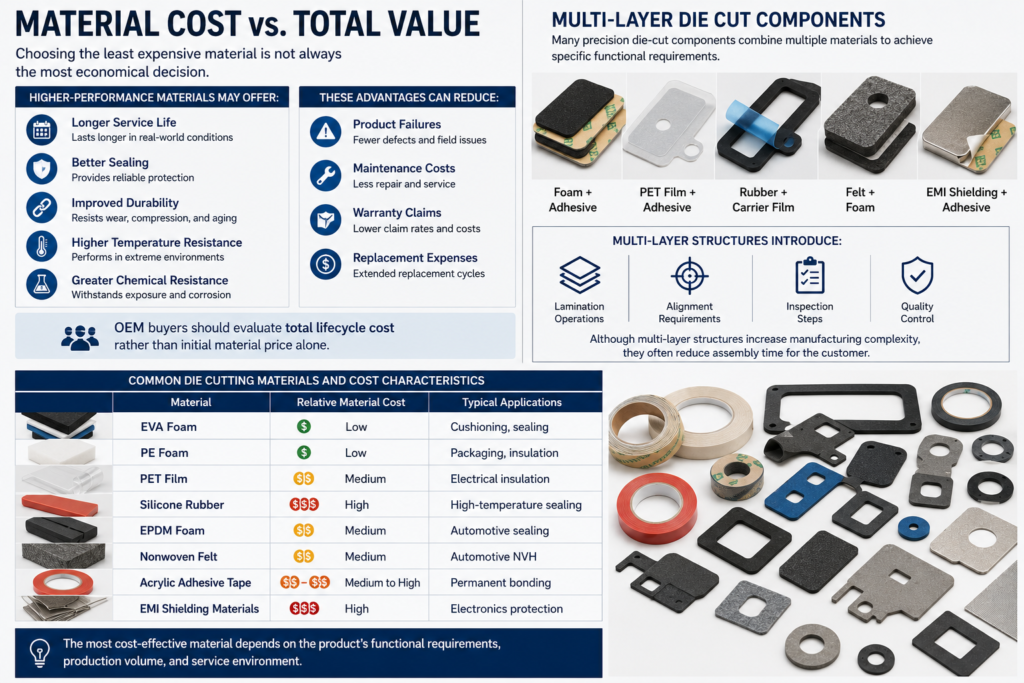
Multi-Layer Materials Increase Manufacturing Complexity
Many precision die-cut components combine multiple materials.
Examples include:
- Foam + adhesive
- PET film + adhesive
- Rubber + carrier film
- Felt + foam
- EMI shielding + adhesive
Each additional layer introduces:
- Lamination operations
- Alignment requirements
- Inspection steps
- Quality control
Although multi-layer structures increase manufacturing complexity, they often reduce assembly time for the customer.
Material Availability Matters
Common materials are generally easier to source and have shorter lead times.
Specialty materials may require:
- Long procurement cycles
- Minimum order quantities
- Import logistics
- Limited suppliers
Material availability directly affects:
- Production planning
- Inventory management
- Project timelines
Selecting widely available materials can improve supply chain stability.
Material Performance Can Reduce Lifetime Costs
Choosing the least expensive material is not always the most economical decision.
Higher-performance materials may offer:
- Longer service life
- Better sealing
- Improved durability
- Higher temperature resistance
- Greater chemical resistance
These advantages can reduce:
- Product failures
- Maintenance costs
- Warranty claims
- Replacement expenses
OEM buyers should evaluate total lifecycle cost rather than initial material price alone.
Common Die Cutting Materials and Cost Characteristics
| Material | Relative Material Cost | Typical Applications |
|---|---|---|
| EVA Foam | Low | Cushioning, sealing |
| PE Foam | Low | Packaging, insulation |
| PET Film | Medium | Electrical insulation |
| Silicone Rubber | High | High-temperature sealing |
| EPDM Foam | Medium | Automotive sealing |
| Nonwoven Felt | Medium | Automotive NVH |
| Acrylic Adhesive Tape | Medium to High | Permanent bonding |
| EMI Shielding Materials | High | Electronics protection |
The most cost-effective material depends on the product's functional requirements, production volume, and service environment.
How Sanken Manufacturing Helps Optimize Material Selection
Dongguan Sanken Electronics Manufacturing Co., Ltd. works closely with OEM customers to recommend materials that balance performance, manufacturability, and cost.
Our capabilities include:
- Precision die cutting
- Material selection support
- Foam converting
- Rubber processing
- PET film converting
- Adhesive laminating
- Multi-layer material assembly
- Cleanroom precision manufacturing
Key Advantages
- OEM and ODM customization
- ISO 9001 certified quality management
- RoHS and REACH compliant materials
- Domestic and overseas production bases
- Material optimization during DFM review
- Tool development from drawings or samples
We help customers reduce total manufacturing costs while maintaining product quality and reliability.
Featured Snippet Summary
Material choice changes the cost of die-cut parts by affecting raw material prices, processing difficulty, tooling wear, production speed, material utilization, adhesive selection, and long-term product performance. Choosing the right material helps manufacturers optimize both production costs and product reliability.
Conclusion
Material selection is one of the most important decisions in any die-cutting project. The lowest-priced material is not always the lowest-cost solution when manufacturing efficiency, assembly performance, durability, and product reliability are considered.
By selecting materials based on the complete manufacturing process rather than raw material price alone, OEM manufacturers can reduce costs, improve production efficiency, and deliver higher-quality products. Working with an experienced die-cut manufacturing partner helps ensure the best balance between performance, cost, and long-term value.