
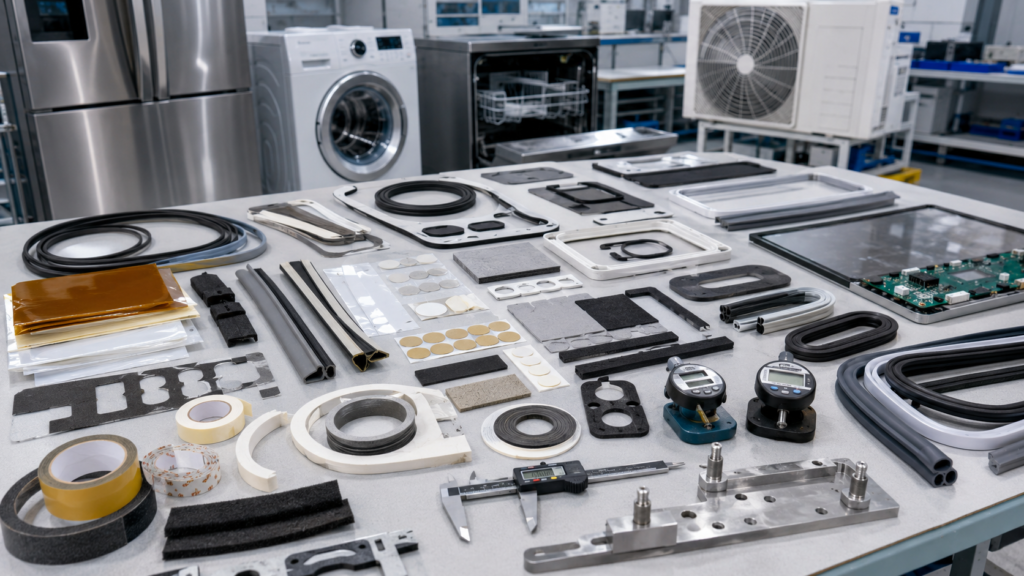
Modern household appliances have evolved far beyond simple mechanical products. Today's refrigerators, washing machines, dishwashers, air conditioners, coffee machines, robotic vacuum cleaners, water purifiers, and smart kitchen appliances integrate advanced electronics, sensors, displays, motors, pumps, compressors, and intelligent control systems.
Behind these products are hundreds of precision die cut components that improve sealing, electrical insulation, vibration control, thermal protection, surface protection, and assembly efficiency. Although these parts are rarely visible to consumers, they play a critical role in appliance quality, durability, energy efficiency, and manufacturing consistency.
For OEM engineers and sourcing teams, selecting the right die cut materials requires balancing sealing performance, compression behavior, electrical insulation, adhesive compatibility, temperature resistance, dimensional accuracy, and production efficiency.
At Sanken, we manufacture precision die cut foam gaskets, rubber seals, PET and PI insulation films, adhesive tape components, protective films, non-woven felt materials, vibration pads, and multilayer laminated components for household appliances, HVAC systems, consumer electronics, and industrial equipment.
Why Precision Die Cutting Is Essential for Modern Appliances
Modern appliances contain increasingly compact assemblies with limited installation space. Precision die cut parts allow manufacturers to install multiple functional materials exactly where they are needed.
These components help provide:
- Water sealing
- Air sealing
- Dust protection
- Electrical insulation
- Thermal insulation
- Noise reduction
- Vibration damping
- Surface protection
- Component positioning
- Fast and reliable assembly
Without precision die cut components, appliances may suffer from:
- Water leakage
- Air leakage
- Dust contamination
- Electrical short circuits
- Excessive vibration
- Higher operating noise
- Loose internal components
- Reduced energy efficiency
- Increased warranty claims
Foam Gaskets Improve Sealing and Assembly
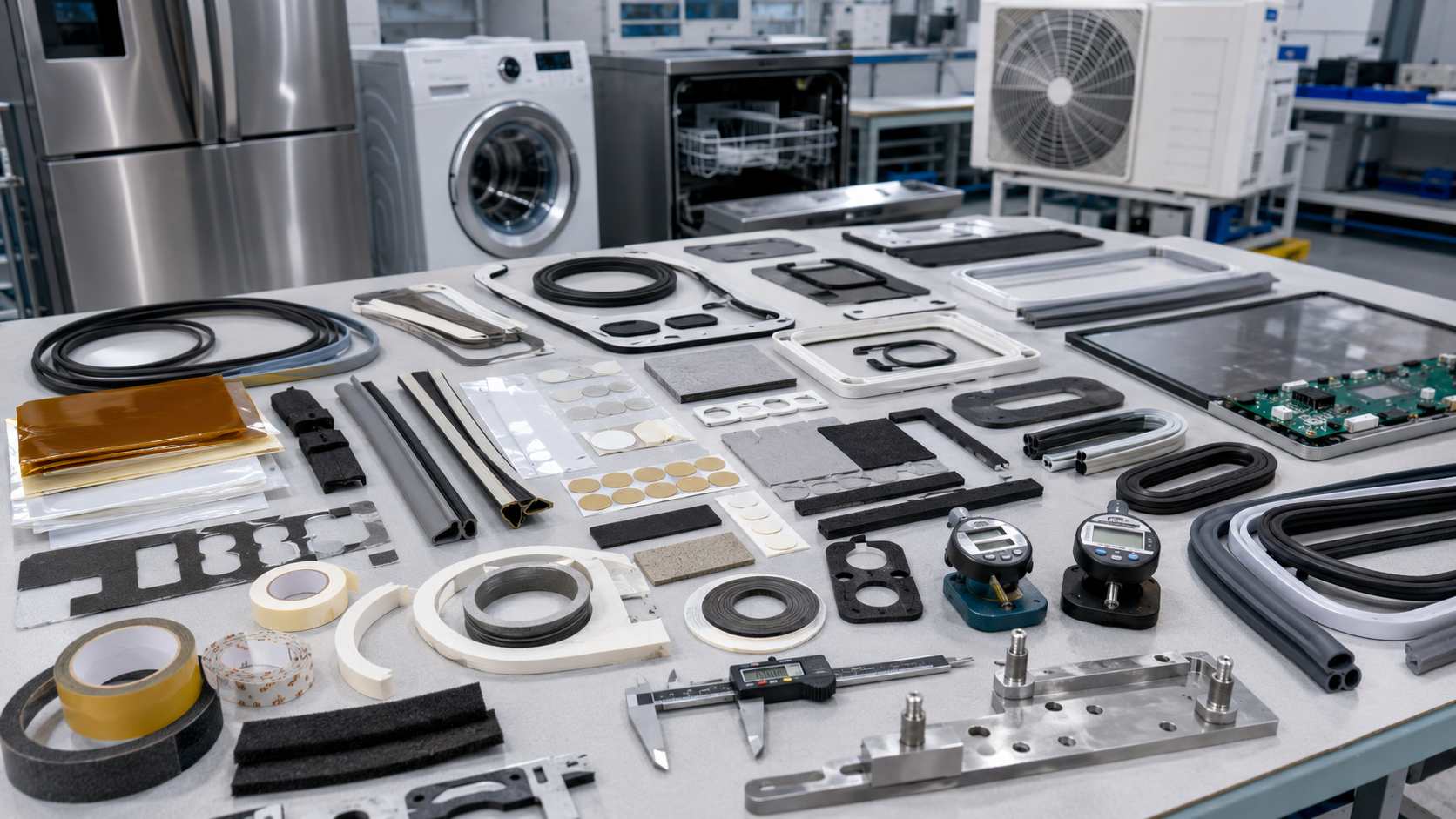
Foam gaskets are among the most widely used die cut components in household appliances.
Typical applications include:
- Refrigerator doors
- Air conditioner housings
- Washing machine covers
- Dishwasher cabinets
- Water purifier housings
- Coffee machine sealing
- Small appliance enclosures
Common foam materials include:
- EVA foam
- PE foam
- EPDM foam
- Silicone foam
- Polyurethane foam
Foam gaskets provide:
- Water sealing
- Air sealing
- Dust protection
- Compression sealing
- Gap filling
- Vibration cushioning
Proper gasket thickness and compression help compensate for manufacturing tolerances while maintaining reliable sealing throughout the product's service life.
Rubber Seals Improve Long-Term Reliability
Rubber die cut components are selected where higher durability and environmental resistance are required.
Common rubber materials include:
- EPDM rubber
- Silicone rubber
- NBR
- CR rubber
Typical applications include:
- Water pumps
- Compressor sealing
- Water valves
- HVAC systems
- Outdoor appliance assemblies
- Cable entry protection
Compared with foam, rubber generally provides:
- Better weather resistance
- Higher chemical resistance
- Excellent compression recovery
- Longer sealing life
- Improved durability
Selecting the correct hardness and thickness helps maintain sealing while minimizing assembly force.
PET and PI Insulation Films Protect Electronic Systems
Today's appliances contain increasingly sophisticated electronic control systems that require reliable electrical insulation.
PET insulation films are commonly used for:
- PCB insulation
- Display insulation
- Connector protection
- Wire harness protection
- Motor insulation
PI insulation films are selected for applications requiring higher temperature resistance, including:
- Heating modules
- Power control boards
- Motor assemblies
- High-temperature electronic areas
Both materials can be supplied as precision die cut parts with adhesive backing, custom holes, slots, and multilayer laminated structures for efficient installation.
Adhesive Die Cut Parts Improve Assembly Efficiency
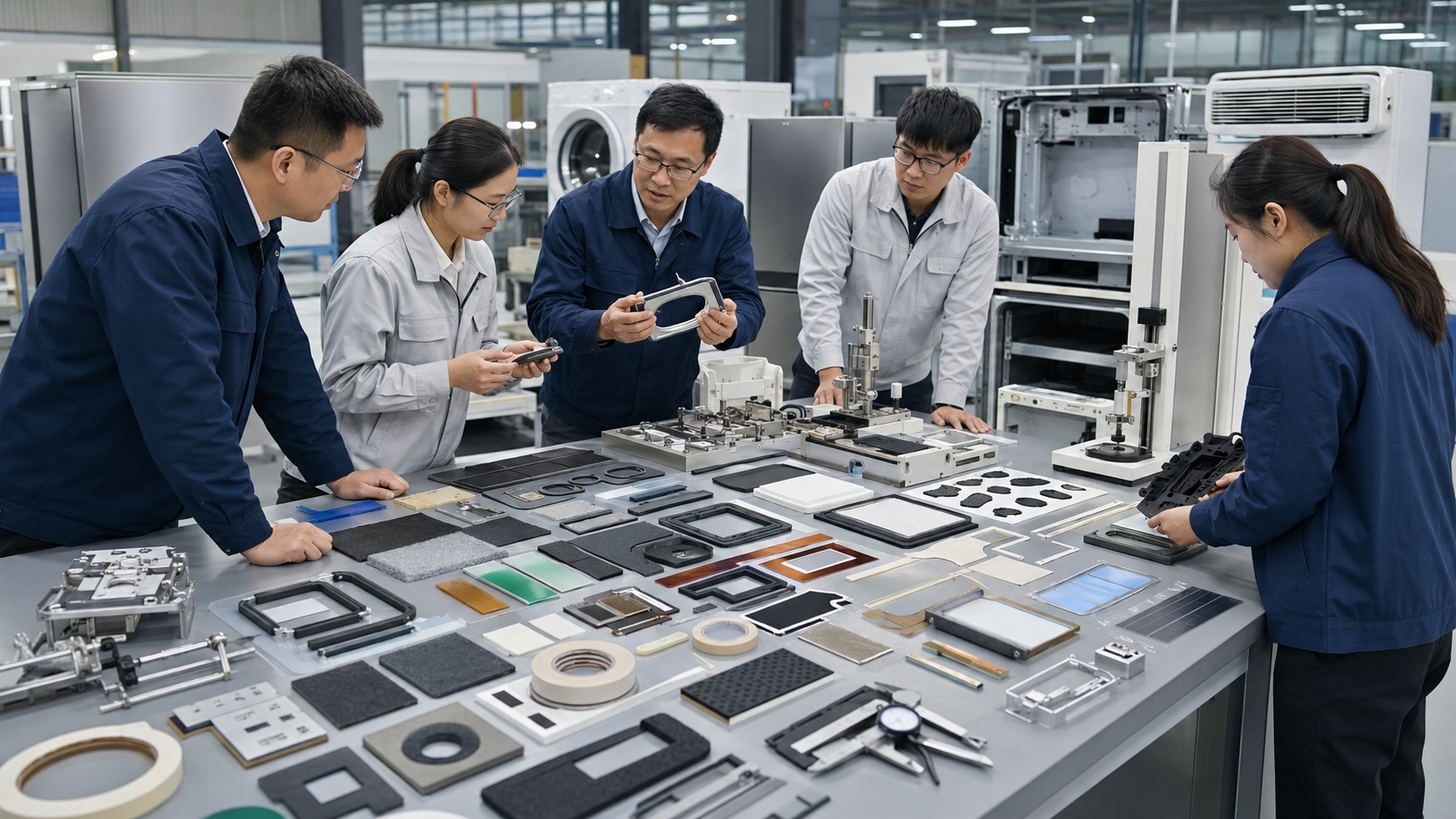
Modern appliance manufacturers increasingly replace screws, clips, and rivets with precision adhesive components.
Typical applications include:
- Display mounting
- Decorative panel bonding
- Sensor attachment
- Foam gasket positioning
- Wire harness fixing
- Plastic housing assembly
- Nameplate installation
- Cable management
Common adhesive systems include:
- Acrylic adhesive
- Double-sided tape
- Foam tape
- Transfer adhesive
- PET carrier tape
Die cut adhesive parts improve positioning accuracy, reduce assembly time, simplify automation, and reduce product weight.
Non-Woven Felt Reduces Noise and Vibration
Consumers expect household appliances to operate quietly.
Precision die cut non-woven felt materials help reduce:
- Plastic contact noise
- Metal contact noise
- Motor vibration
- Fan vibration
- Cabinet resonance
- Cable rattling
Applications include:
- Washing machines
- Refrigerators
- Dishwashers
- Air conditioners
- Vacuum cleaners
- Smart home appliances
Proper placement of non-woven materials significantly improves acoustic performance without increasing product weight.
Protective Films Prevent Surface Damage
Protective films help maintain product appearance throughout manufacturing, transportation, and installation.
Typical applications include:
- Stainless steel panels
- Appliance displays
- Glass control panels
- Plastic housings
- Decorative trim
- Painted metal parts
A properly selected protective film prevents:
- Scratches
- Fingerprints
- Dust contamination
- Handling damage
The film should remove cleanly after assembly without leaving adhesive residue.
Multilayer Die Cut Components Simplify Production
Many appliance components combine multiple materials into one precision die cut part.
Examples include:
| Multilayer Structure | Main Function |
|---|---|
| Foam + Adhesive | Sealing and positioning |
| PET Film + Adhesive + Liner | Electrical insulation |
| Rubber + Adhesive | Vibration damping |
| Non-Woven Felt + Adhesive | Noise reduction |
| PI Film + Adhesive | High-temperature insulation |
| Protective Film + Pull Tab | Surface protection |
Multilayer converting reduces handling, improves positioning accuracy, shortens assembly time, and increases production consistency.
Precision Die Cutting Supports Automated Manufacturing
Home appliance manufacturers increasingly rely on automated production lines.
Precision die cut parts support:
- Robotic assembly
- Pick-and-place systems
- Automated adhesive application
- Consistent component positioning
- Faster production cycles
- Reduced manual handling
Accurate dimensions, clean cutting edges, and stable material quality are essential for automated manufacturing.
Quality Control for Appliance Die Cut Components
Consistent quality is critical for appliance assembly.
Important inspection items include:
| Inspection Item | Purpose |
|---|---|
| Material verification | Confirms approved material |
| Thickness | Controls compression performance |
| Dimensions | Ensures assembly fit |
| Hole alignment | Matches product structure |
| Adhesive position | Improves placement accuracy |
| Compression recovery | Confirms sealing performance |
| Edge cleanliness | Prevents contamination |
| Surface quality | Protects appearance |
| Liner release | Supports assembly efficiency |
| Packaging condition | Prevents transportation damage |
Stable quality control helps reduce production defects while improving long-term product reliability.
How Sanken Supports Home Appliance OEM Manufacturers
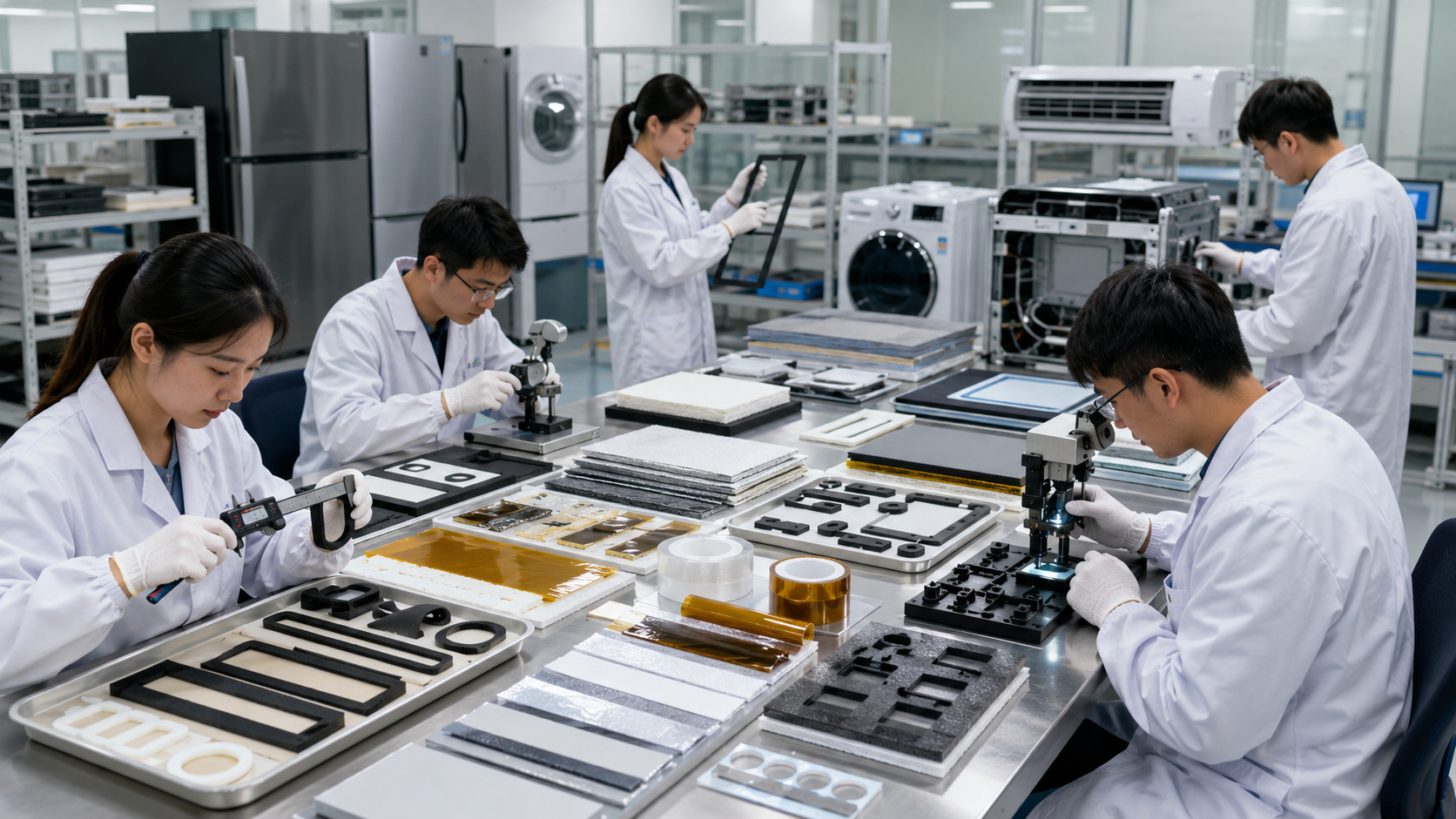
Sanken provides precision die cut solutions for global home appliance manufacturers.
Our capabilities include:
- Foam gasket converting
- Rubber gasket manufacturing
- PET insulation films
- PI insulation films
- Double-sided adhesive tape converting
- Transfer adhesive converting
- Protective films
- Non-woven felt converting
- Multilayer lamination
- Precision die cutting
- Sample development
- Quality inspection
- Assembly-ready packaging
Every project is reviewed according to sealing performance, electrical insulation, adhesive compatibility, compression behavior, dimensional tolerance, assembly method, and production volume.
Our goal is to help customers improve assembly efficiency, reduce manufacturing costs, minimize warranty claims, and achieve stable high-volume production.
Buyer Checklist Before Requesting Samples
To optimize appliance die cut components, buyers should prepare:
- 2D drawing
- 3D CAD file (if available)
- Appliance application
- Material preference
- Thickness requirement
- Operating temperature
- Compression requirement
- Adhesive requirement
- Bonding surface
- Assembly process
- Packaging format
- Annual production volume
- Existing sample (if available)
Providing complete project information helps shorten development time while ensuring the most suitable material selection.
FAQ
What is precision die cutting in household appliances?
It is a manufacturing process that converts foam, rubber, films, adhesives, and other flexible materials into custom components for sealing, insulation, vibration control, protection, and assembly.
What materials are commonly used?
Common materials include EVA foam, PE foam, EPDM foam, silicone foam, EPDM rubber, silicone rubber, PET films, PI films, adhesive tapes, protective films, non-woven felt, and multilayer laminated materials.
Why are foam gaskets widely used?
Foam gaskets provide sealing, cushioning, vibration isolation, thermal insulation, and tolerance compensation while remaining lightweight and cost-effective.
Why are adhesive die cut parts replacing screws?
They improve assembly speed, reduce product weight, increase positioning accuracy, and support automated manufacturing.
Why are PET and PI films important?
PET films provide electrical insulation for general electronic assemblies, while PI films are used where higher temperature resistance is required.
Can Sanken manufacture custom appliance die cut components?
Yes. Sanken manufactures custom foam gaskets, rubber seals, PET and PI insulation films, adhesive tape components, protective films, non-woven materials, and multilayer die cut parts for household appliance OEM manufacturers.
Conclusion
Precision die cutting has become an essential manufacturing technology for modern household appliances. From sealing and vibration control to electrical insulation, adhesive bonding, and surface protection, precision die cut components improve product quality, simplify assembly, support automation, and extend product life.
By selecting the right materials and precision converting processes, OEM manufacturers can improve production efficiency, reduce warranty costs, and deliver more reliable appliances to customers worldwide.
At Sanken, we help home appliance manufacturers develop precision die cut solutions that deliver consistent quality from prototype development to high-volume production.