
PAS Opening (Problem–Agitate–Solution)
In automotive manufacturing, material failure is not just a technical issue. It is a financial risk. One small deviation in a die cut gasket, foam pad, or nonwoven insulation layer can lead to noise complaints, sealing failure, or even full system malfunction. For OEM suppliers, this risk multiplies at scale.
The problem is not die cutting itself. The real problem is unknown material behavior under real-world automotive conditions. Temperature, compression, vibration, humidity, and aging all interact in unpredictable ways when materials are not properly tested.
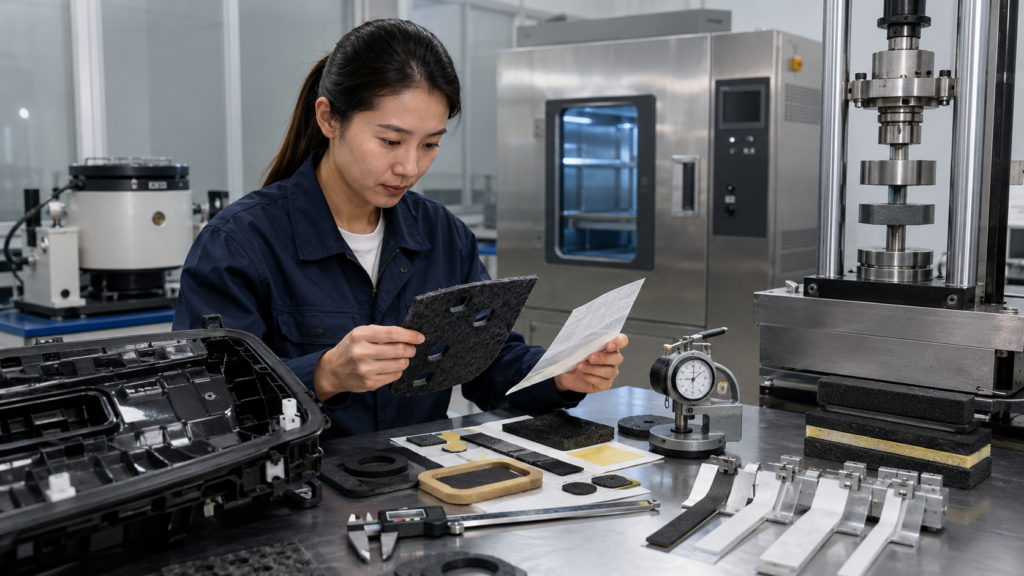
At Sanken , we reduce this risk by integrating full testing capability into our automotive die cut material system, ensuring every component is validated before mass production begins.
Why Automotive Die Cut Materials Carry High Risk
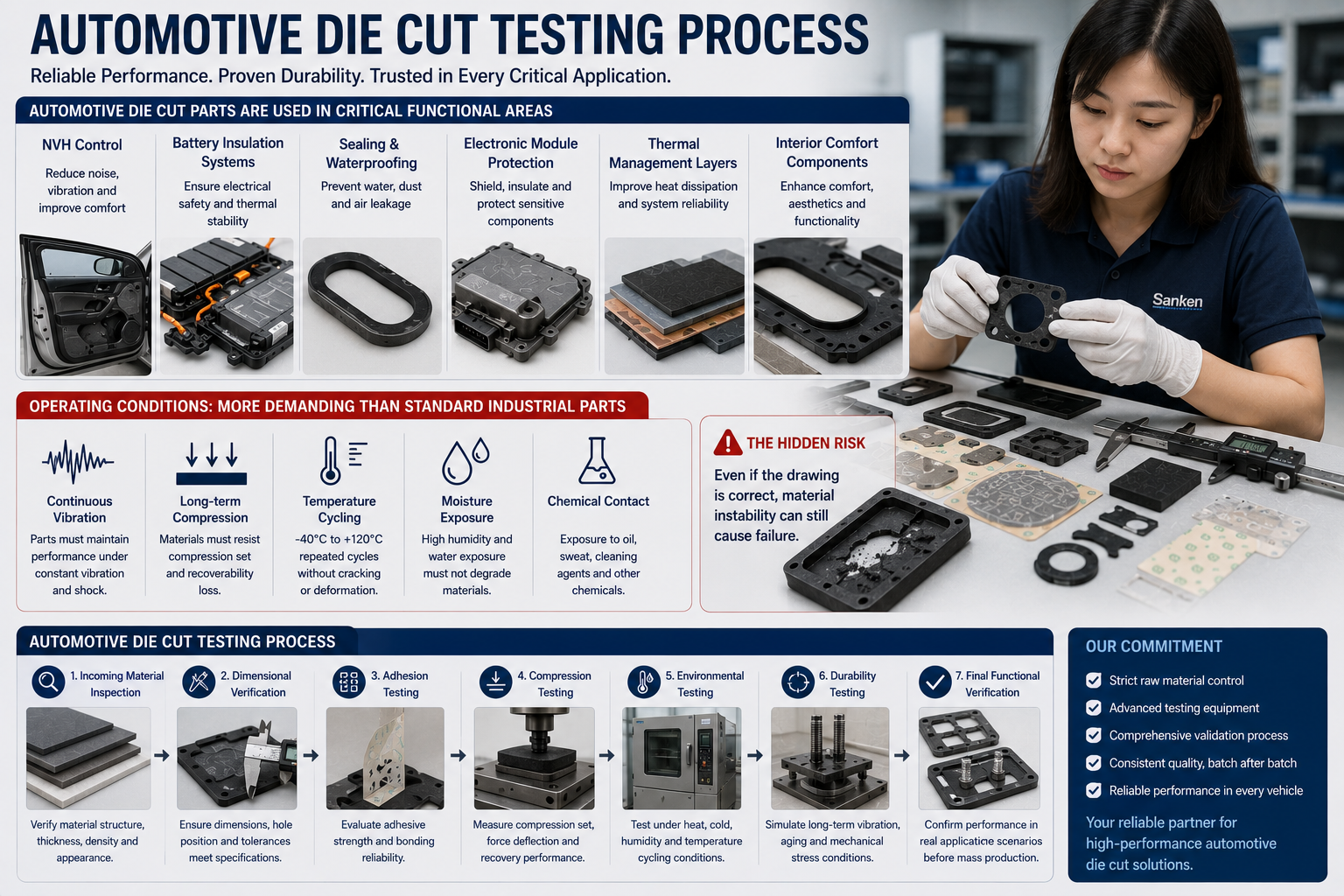
Automotive die cut parts are used in critical functional areas:
- NVH (Noise, Vibration, Harshness) control
- Battery insulation systems
- Sealing and waterproofing structures
- Electronic module protection
- Thermal management layers
- Interior comfort components
Unlike standard industrial parts, these components operate under:
- Continuous vibration
- Long-term compression
- Temperature cycling (-40°C to +120°C)
- Moisture exposure
- Chemical contact (oil, sweat, cleaning agents)
Even if the drawing is correct, material instability can still cause failure.
Theme: Automotive Die Cut Testing Process
What “Testing Capability” Really Means in Die Cutting
Many suppliers say they can “test materials”, but real automotive-grade testing includes:
1. Material Performance Testing
- Compression set testing
- Tensile strength
- Density stability
- Elastic recovery
- Adhesive peel strength
2. Environmental Simulation
- High/low temperature cycling
- Humidity aging
- UV exposure
- Salt spray testing
3. Functional Testing
- NVH vibration damping
- Sealing performance
- Electrical insulation
- Thermal resistance
4. Process Validation
- Die cutting repeatability
- Dimensional stability
- Batch consistency
At Sanken, testing is part of engineering—not an afterthought.
Why Testing Capability Reduces Automotive Risk
Without testing, you are guessing material behavior.
With testing, you are controlling it.
1. Reducing Material Failure in Mass Production
Common failures include:
- foam deformation
- gasket leakage
- adhesive delamination
- NVH performance drift
Testing eliminates unstable materials before production.
2. Improving NVH Stability
NVH performance depends on:
- density variation
- compression behavior
- vibration absorption
Testing ensures consistent cabin acoustic performance.
3. Preventing Adhesive Failure
Adhesive risks include:
- edge lift
- bubbles
- poor bonding
- aging degradation
Testing validates real-world bonding conditions.
Theme: Automotive NVH and Sealing Materials
4. Ensuring Compression Set Stability
Compression issues can cause:
- sealing loss
- vibration increase
- long-term deformation
Testing confirms recovery performance under stress.
5. Faster Development Cycles
Testing actually reduces time by avoiding:
- repeated sampling
- redesign loops
- production delays
6. Better Supply Chain Confidence
OEMs need predictable performance:
- stable batches
- consistent materials
- verified results
Testing provides engineering confidence.
7. Supporting Material Optimization
Testing data helps improve:
- foam density
- nonwoven structure
- adhesive selection
- compression behavior
This creates a closed-loop engineering system.
Where Testing Matters Most
Automotive Interior
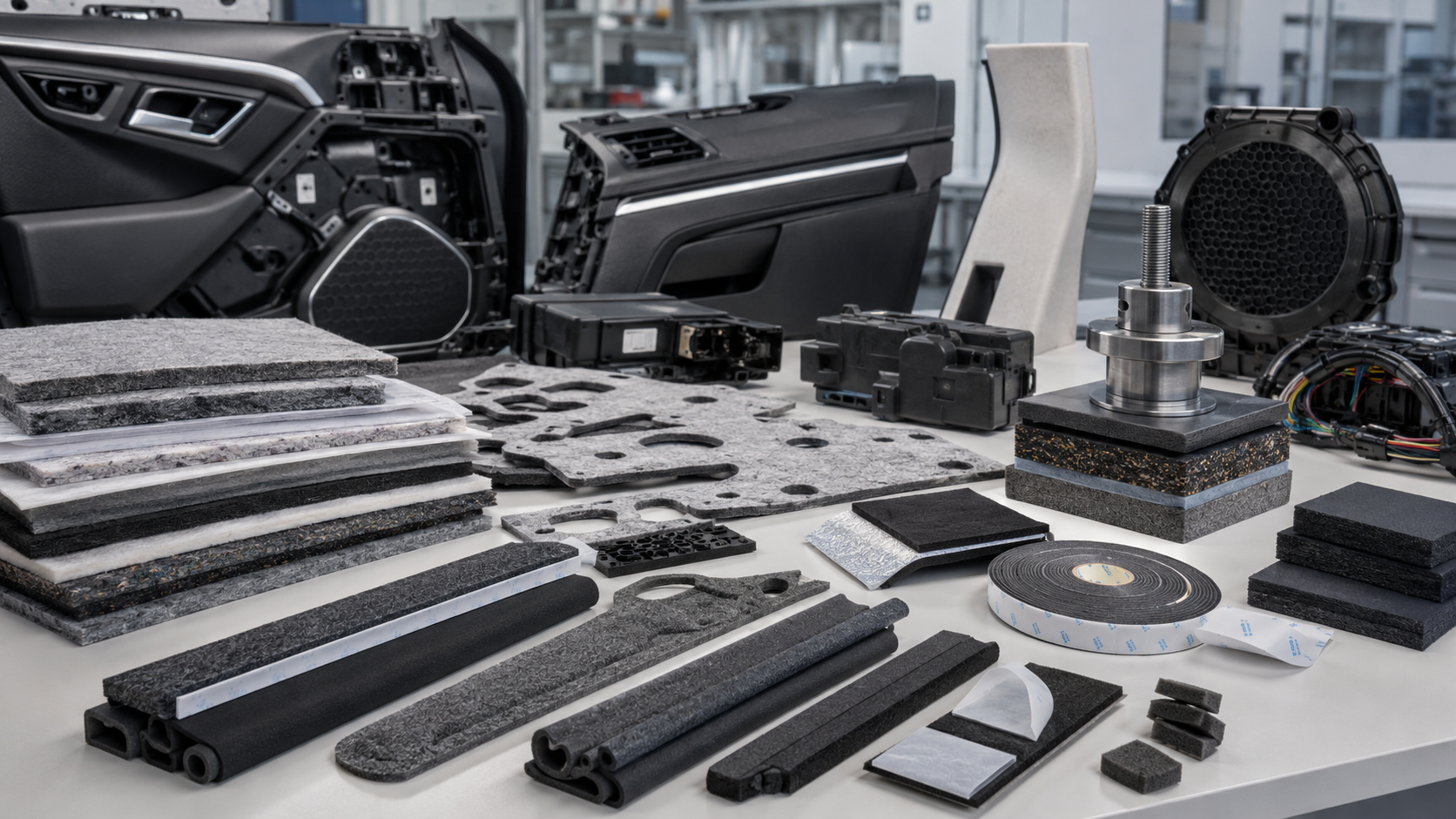
- NVH pads
- door trims
- dashboard insulation
EV Battery Systems
- insulation layers
- vibration pads
- thermal barriers
Electronics
- ECU protection
- sensor insulation
- connector sealing
Sealing Systems
- waterproof gaskets
- dust protection layers
Sanken Testing & Manufacturing Capability
At Sanken (三肯), we integrate:
- material testing
- die cutting
- adhesive lamination
- foam and rubber converting
- multi-layer assembly
- PPAP support
We serve:
- automotive OEMs
- Tier 1 suppliers
- EV manufacturers
- industrial system integrators
Featured Snippet Summary
Testing capability in automotive die cut materials reduces risk by validating material performance, ensuring compression stability, improving adhesive reliability, and preventing failures in NVH, sealing, and insulation applications.
Conclusion
In automotive die cutting, precision alone is not enough.
Testing is what ensures reliability.
It reduces uncertainty, improves stability, and prevents costly failures in mass production.
At Sanken, we believe:
👉 No testing = risk
👉 Testing = confidence
👉 Engineering + testing = reliability