
Custom die-cut part production can be delayed by unclear drawings, wrong material selection, late adhesive changes, tooling revisions, poor sampling approval, and unstable supply planning. For OEM buyers, these delays can affect assembly schedules, product launches, and customer delivery commitments.
To avoid delays in custom die-cut part production, manufacturers should confirm material requirements early, provide complete drawings or samples, define tolerances clearly, approve prototypes quickly, validate adhesives before mass production, and work with a supplier that offers DFM support, tooling capability, and stable production planning.
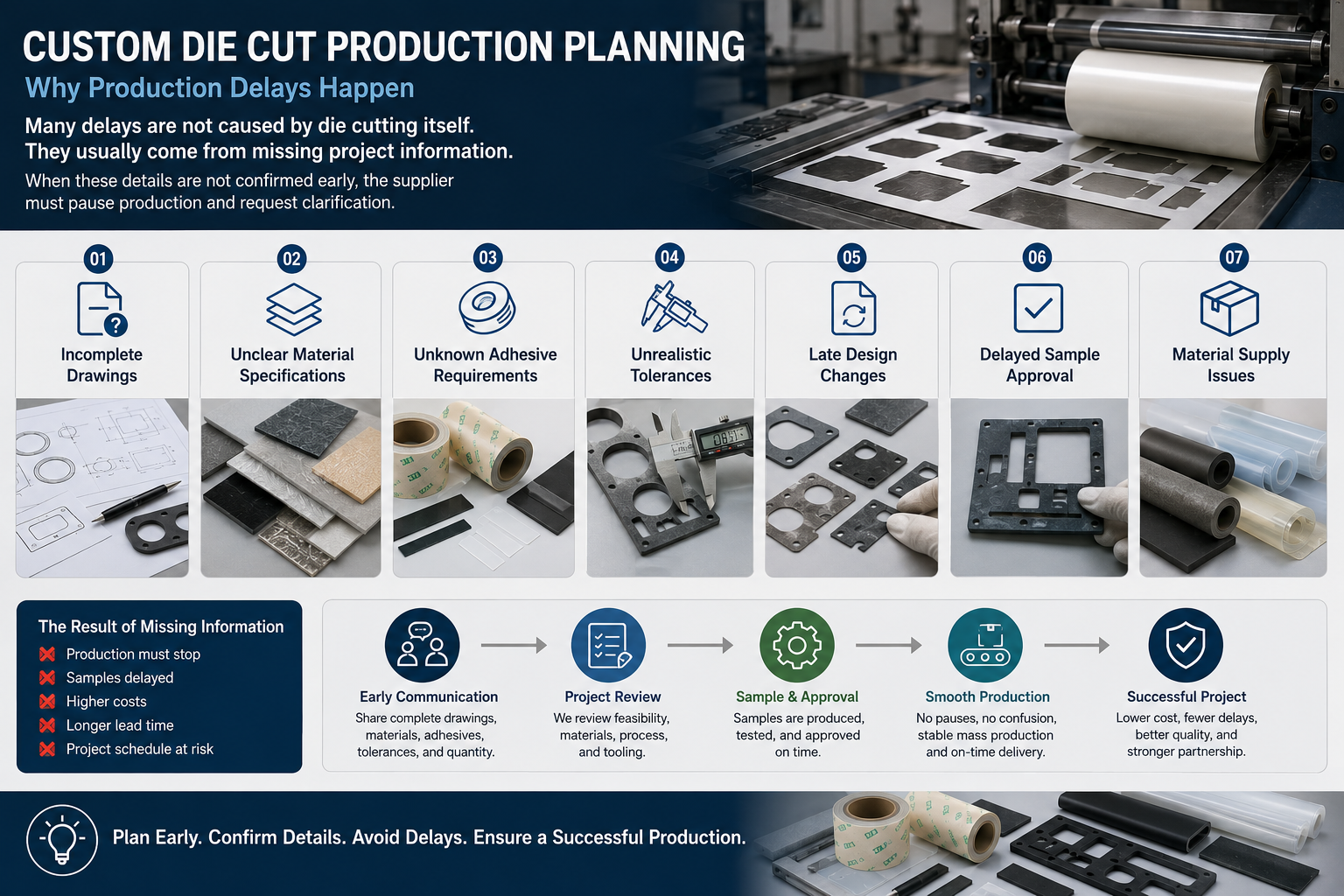
Why Production Delays Happen
Many delays are not caused by die cutting itself.
They usually come from missing project information.
Common causes include:
- Incomplete drawings
- Unclear material specifications
- Unknown adhesive requirements
- Unrealistic tolerances
- Late design changes
- Delayed sample approval
- Material supply issues
When these details are not confirmed early, the supplier must pause production and request clarification.
Theme: Custom Die Cut Production Planning
Provide Complete Drawings and Samples
A clear drawing helps the supplier understand the part quickly.
Useful information includes:
- 2D drawing
- 3D file if available
- Material thickness
- Tolerance requirements
- Adhesive side
- Release liner type
- Application position
- Annual volume estimate
If drawings are not available, physical samples can help the supplier evaluate material, structure, and function.
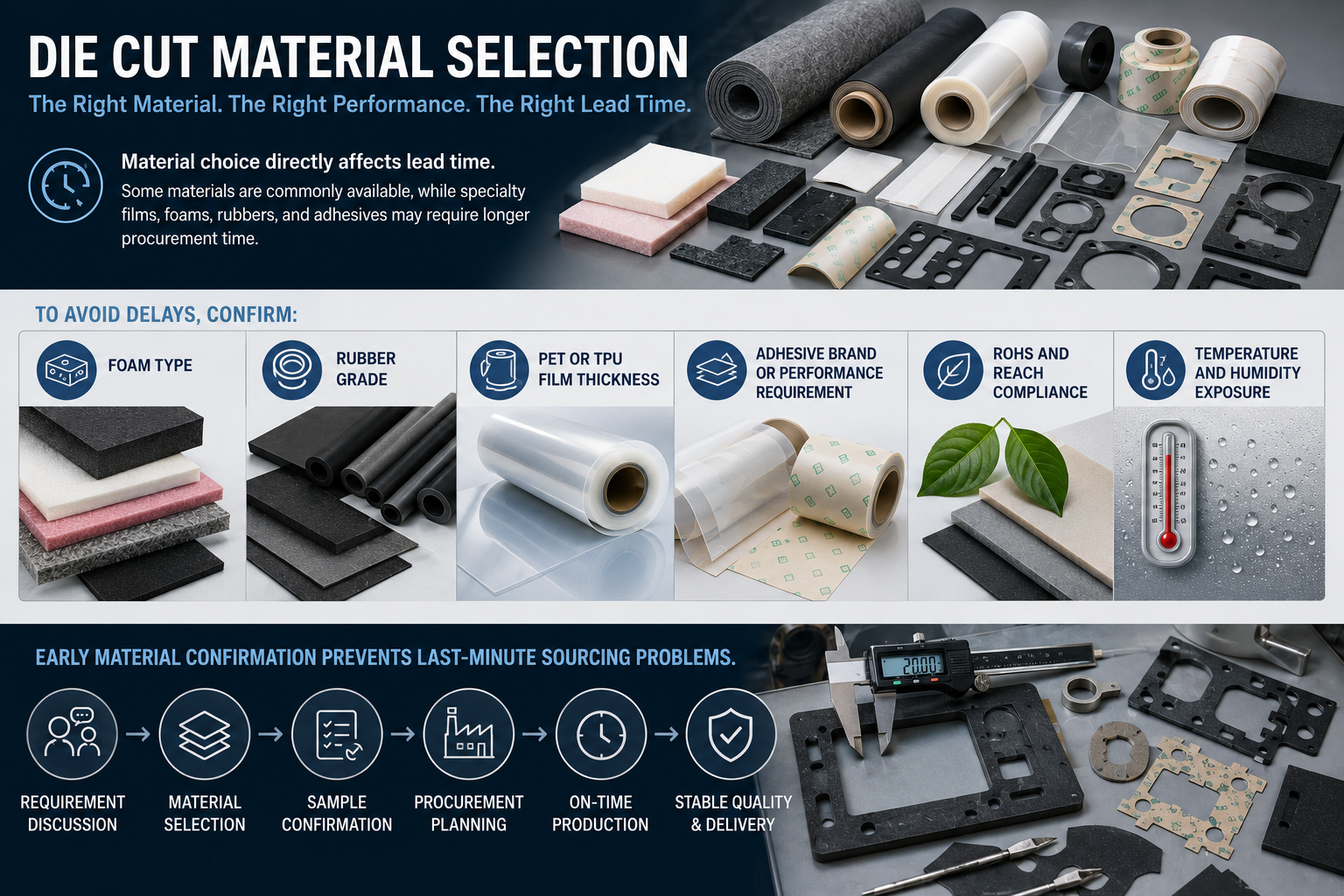
Confirm Material Requirements Early
Material choice directly affects lead time.
Some materials are commonly available, while specialty films, foams, rubbers, and adhesives may require longer procurement time.
To avoid delays, confirm:
- Foam type
- Rubber grade
- PET or TPU film thickness
- Adhesive brand or performance requirement
- RoHS and REACH compliance
- Temperature and humidity exposure
Early material confirmation prevents last-minute sourcing problems.
Theme: Die Cut Material Selection
Use DFM Review Before Tooling
Design for Manufacturability helps identify problems before the cutting tool is made.
DFM review can check:
- Tiny holes
- Narrow slots
- Sharp corners
- Weak bridges
- Waste removal risk
- Liner removal difficulty
- Tolerance feasibility
Fixing these issues before tooling is much faster than changing tools after sample failure.
Approve Samples Efficiently
Sample approval is a common delay point.
To speed up approval, buyers should define:
- Who reviews the samples
- What tests are required
- What dimensions are critical
- What defects are unacceptable
- How feedback should be reported
Clear approval standards help avoid repeated sampling cycles.
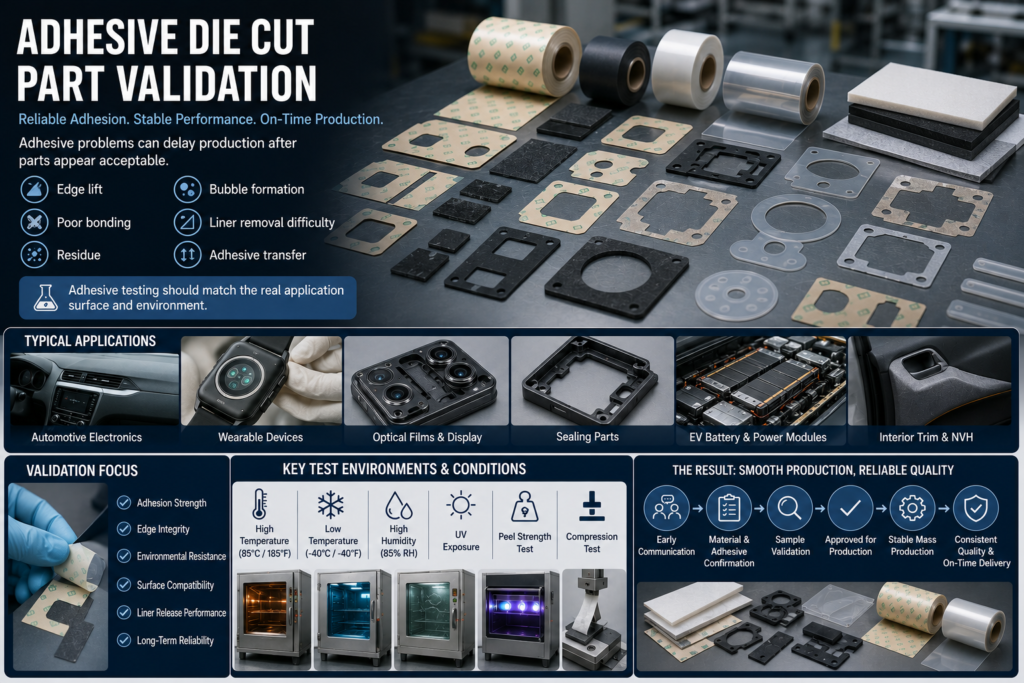
Validate Adhesive Performance Before Mass Production
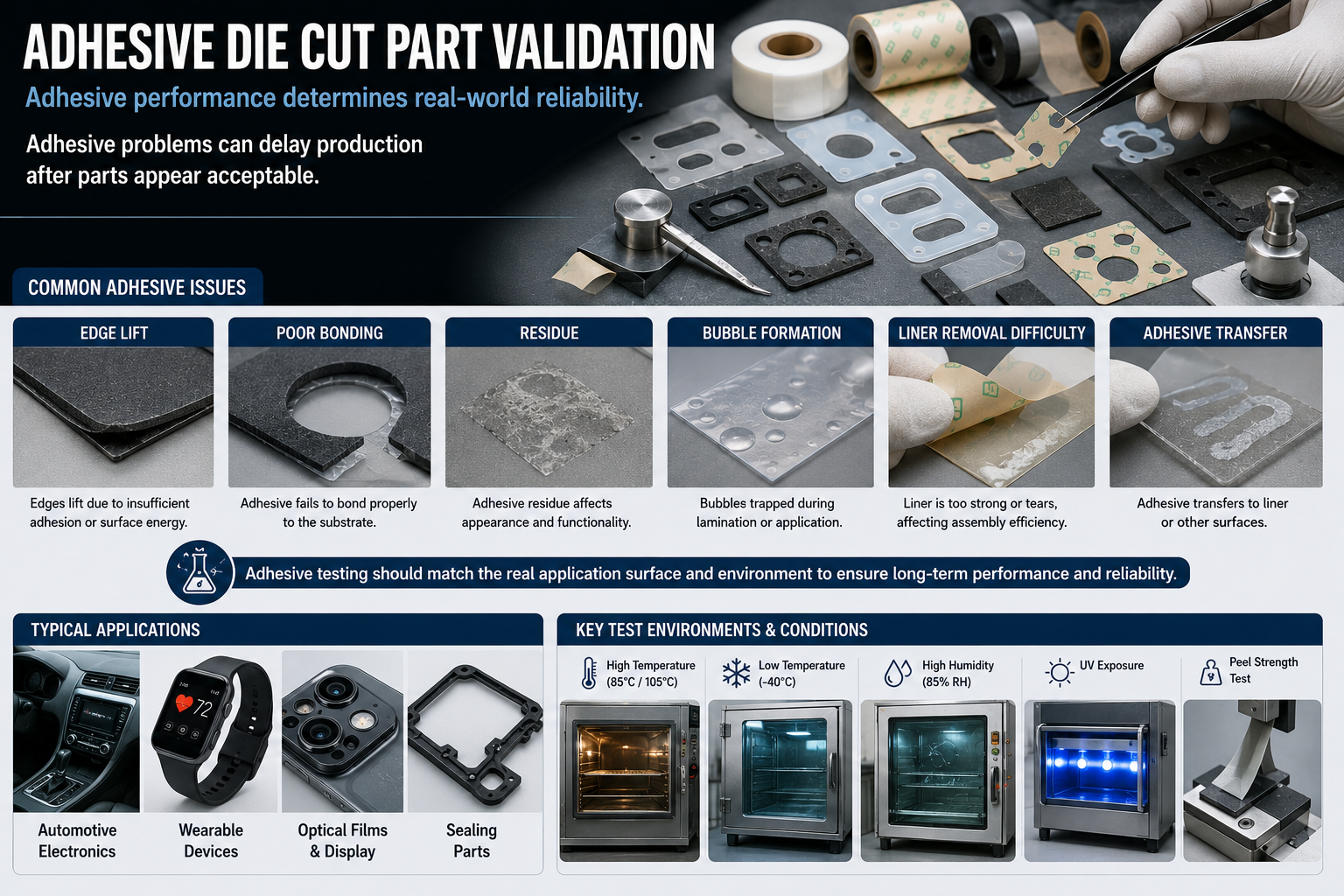
Adhesive problems can delay production after parts appear acceptable.
Common issues include:
- Edge lift
- Poor bonding
- Residue
- Bubble formation
- Liner removal difficulty
- Adhesive transfer
Adhesive testing should match the real application surface and environment.
This is especially important for automotive electronics, wearable devices, optical films, and sealing parts.
Theme: Adhesive Die Cut Part Validation
Plan Tooling and Material Lead Time
Custom die-cut parts often require tooling.
Tooling lead time depends on:
- Part complexity
- Tool type
- Material thickness
- Required precision
- Production volume
Material lead time should also be checked before confirming the delivery schedule.
For urgent projects, standard materials and simpler geometry usually help shorten lead time.
Avoid Late Design Changes
Late changes are one of the biggest reasons for delay.
A small design change may require:
- New tooling
- New samples
- New material testing
- Updated drawings
- New approval
To avoid this, confirm the design before tooling begins.
If changes are necessary, separate urgent functional changes from cosmetic improvements.
Improve Communication Between Engineering and Purchasing
Purchasing teams often focus on price and delivery.
Engineering teams focus on function and reliability.
Both sides should confirm:
- Critical dimensions
- Material function
- Assembly method
- Testing requirements
- Packaging format
- Production volume
Good communication reduces misunderstanding and avoids repeated quotation or sampling delays.
How Sanken Supports Faster Custom Die Cut Production
Dongguan Sanken Electronics Manufacturing Co., Ltd. supports OEM and ODM customers with custom precision die-cut solutions.
Our capabilities include:
- Precision die cutting
- Foam converting
- Rubber gasket processing
- PET and TPU film converting
- Non-woven felt processing
- Adhesive laminating
- Cleanroom precision production
- Tool development from drawings or samples
Key Advantages
- ISO 9001 quality management
- RoHS and REACH compliant materials
- Domestic and overseas production bases
- DFM engineering support
- OEM/ODM customization
- Support for automotive, electronics, wearable, optical, and industrial applications
We help customers reduce project delays through early material review, prototype support, tooling planning, and stable production control.
Featured Snippet Summary
Custom die-cut part production delays can be avoided by providing complete drawings, confirming materials early, using DFM review, validating adhesives, approving samples quickly, planning tooling lead time, and avoiding late design changes.
Conclusion
Most custom die-cut part delays can be prevented before production begins. Clear drawings, confirmed materials, realistic tolerances, early DFM review, and fast sample approval help keep projects on schedule.
By working with an experienced die-cut supplier early, OEM manufacturers can reduce production risk, shorten development time, and receive stable parts for mass assembly.