
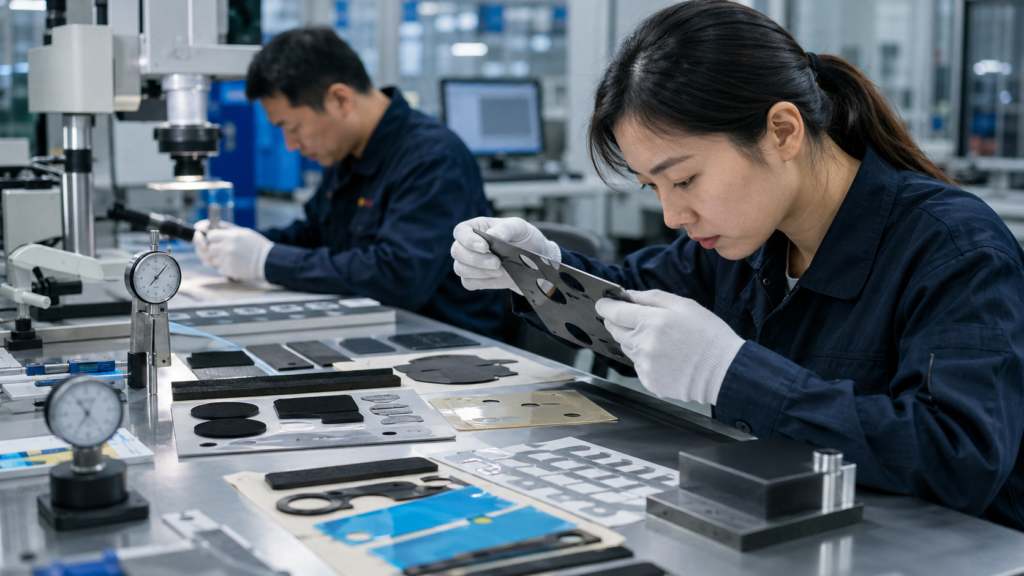
Chinese automotive die cut parts can be reliable when they are produced by a qualified manufacturer with strong material control, drawing review, process stability, inspection standards, and OEM project experience. The real question is not whether the parts are made in China. The real question is whether the supplier can control material performance, die cut tolerance, adhesive behavior, liner release, edge quality, cleanliness, packaging, and batch consistency.
For automotive OEM buyers and engineers, die cut parts are often small but important. A foam gasket may protect an electronic housing. A non-woven felt pad may reduce rattle noise. A PET insulation film may prevent electrical contact risk. A rubber pad may reduce vibration. An adhesive tape component may support clean and repeatable assembly.
At Sanken, we support automotive and automotive electronics customers with custom precision die cutting, adhesive lamination, material converting, foam gaskets, non-woven felt NVH parts, PET and PI insulation films, protective films, adhesive tape parts, rubber pads, sealing components, and multilayer die cut auxiliary materials.
Why Buyers Ask This Question
Many overseas buyers search for Chinese automotive die cut parts because China has a mature supply chain for flexible materials, adhesive tapes, films, foams, rubber sheets, tooling, converting, and OEM production. At the same time, buyers worry about quality stability, material substitution, communication, inspection reliability, and long-term batch consistency.
These concerns are reasonable.
Automotive parts must support stable assembly and long service life. Even a small die cut component can create problems if it is made with the wrong material or poor process control.
Common buyer concerns include:
- Will the supplier use the approved material?
- Can the tolerance stay stable in mass production?
- Will adhesive parts peel cleanly from the liner?
- Will foam gaskets maintain compression?
- Will PET insulation films have clean edges and accurate holes?
- Will felt parts shed fibers?
- Will packaging prevent deformation?
- Can the supplier support OEM drawings, samples, and inspection requirements?
Reliable Chinese die cut parts depend on the supplier’s engineering ability, not only country of origin.
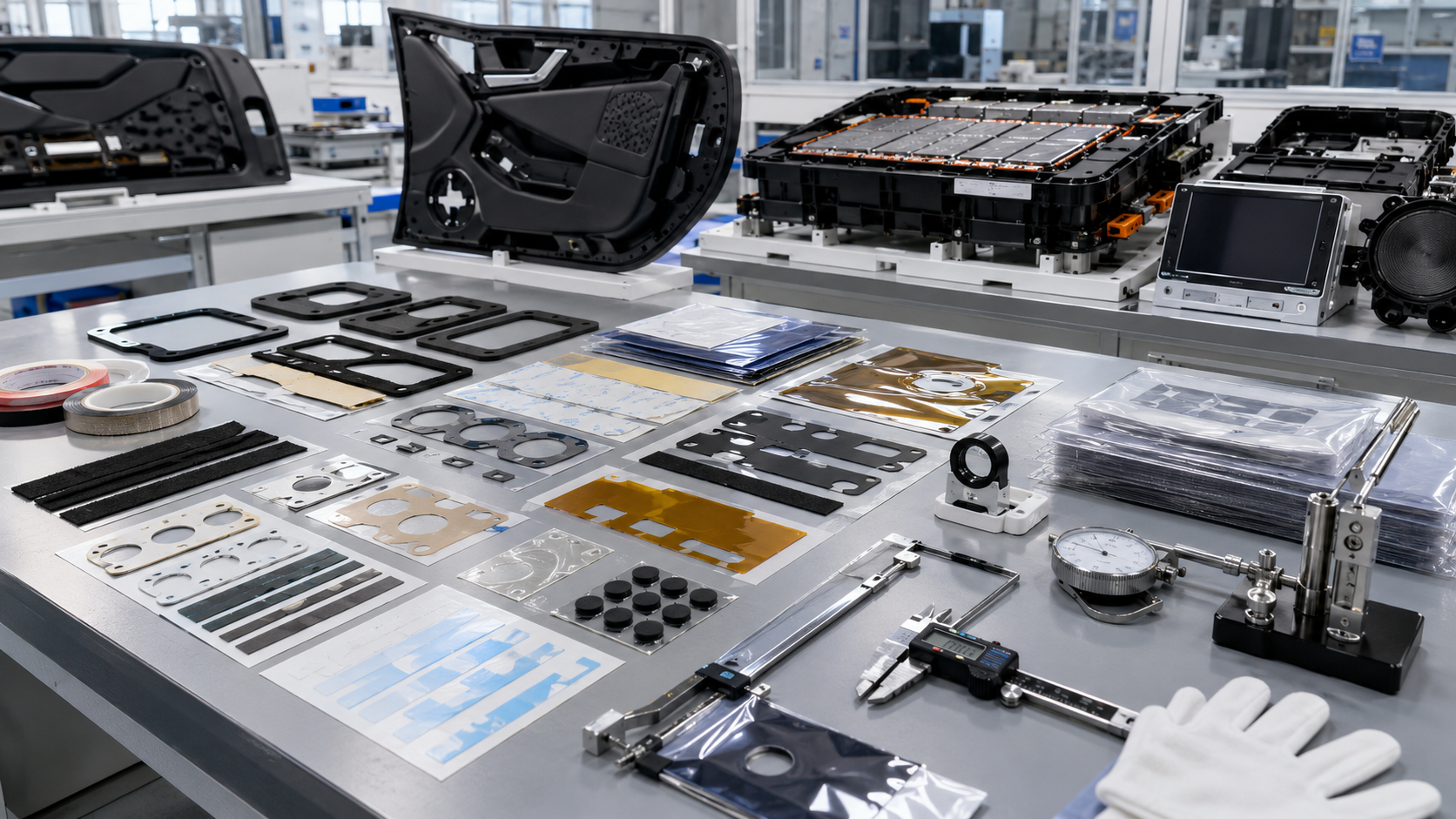
What Makes Automotive Die Cut Parts Reliable?
Automotive die cut parts are reliable when they perform consistently in the final assembly.
Reliability depends on several factors:
| Reliability Factor | Why It Matters |
|---|---|
| Correct material selection | Prevents sealing, insulation, bonding, or NVH failure |
| Stable thickness and tolerance | Supports fit and assembly repeatability |
| Controlled adhesive behavior | Prevents lifting, residue, and peeling problems |
| Clean die cut edges | Reduces particles, fibers, burrs, and contamination |
| Good liner release | Improves operator handling and assembly speed |
| Proper packaging | Prevents curling, compression, shifting, and damage |
| Inspection before shipment | Reduces incoming quality risk |
| Engineering review | Finds problems before mass production |
A low price alone does not make a part reliable. A reliable part must pass both inspection and real assembly use.
Common Automotive Die Cut Materials from Chinese Manufacturers
Chinese die cutting manufacturers often work with a wide range of flexible materials used in automotive interiors, electronics, battery areas, sensors, displays, and industrial vehicle assemblies.
| Material | Typical Automotive Use | Key Control Point |
|---|---|---|
| Non-woven felt | NVH, anti-rattle, anti-squeak, friction reduction | Fiber shedding and edge cleanliness |
| PE / PU / EVA foam | Cushioning, spacing, gap filling | Density, compression, thickness |
| EPDM / silicone foam | Sealing, dust protection, heat resistance | Compression set and aging resistance |
| Rubber | Damping, anti-slip, impact resistance | Hardness, rebound, edge quality |
| PET film | Electrical insulation, spacing, protection | Hole accuracy and clean edges |
| PI film | High-temperature insulation | Heat resistance and dimensional stability |
| Double-sided tape | Bonding and positioning | Adhesive match and liner release |
| Protective film | Surface protection | Residue control and scratch prevention |
At Sanken, these materials are selected based on the customer’s drawing, application location, bonding surface, compression requirement, tolerance, and assembly method.
Quality Control Starts With Material Approval
The first step in reliable production is material approval.
Automotive die cut parts often fail when a supplier changes material grade, adhesive type, liner type, thickness, density, or hardness without confirming with the customer.
For OEM projects, buyers should confirm:
- Material name or specification
- Thickness and tolerance
- Foam density or rubber hardness
- Adhesive type and liner type
- Flame-retardant or environmental requirement if needed
- RoHS or REACH compliance if required
- Temperature or aging requirement
- Approved sample or reference sample
- Material certificate or test report when needed
A reliable manufacturer should not treat materials as interchangeable unless the customer approves the change.
For example, two black foam materials may look similar but have different compression force. Two double-sided tapes may look similar but bond differently to PP plastic, painted metal, or coated surfaces. Two PET films may have different stiffness, surface quality, or insulation performance.
Tolerance Control Is Critical
Automotive OEM parts must fit real assemblies. Tolerance control is therefore one of the most important quality factors.
Die cut tolerance may include:
- Outer profile dimension
- Hole position
- Slot size
- Gasket width
- Material thickness
- Adhesive alignment
- Liner spacing
- Kiss cutting depth
- Layer registration
A supplier must understand that different materials hold tolerance differently. PET film can usually hold tighter dimensions than soft foam. Rubber may rebound after cutting. Felt may have edge variation because of fiber structure. Adhesive tape may stretch during waste removal.
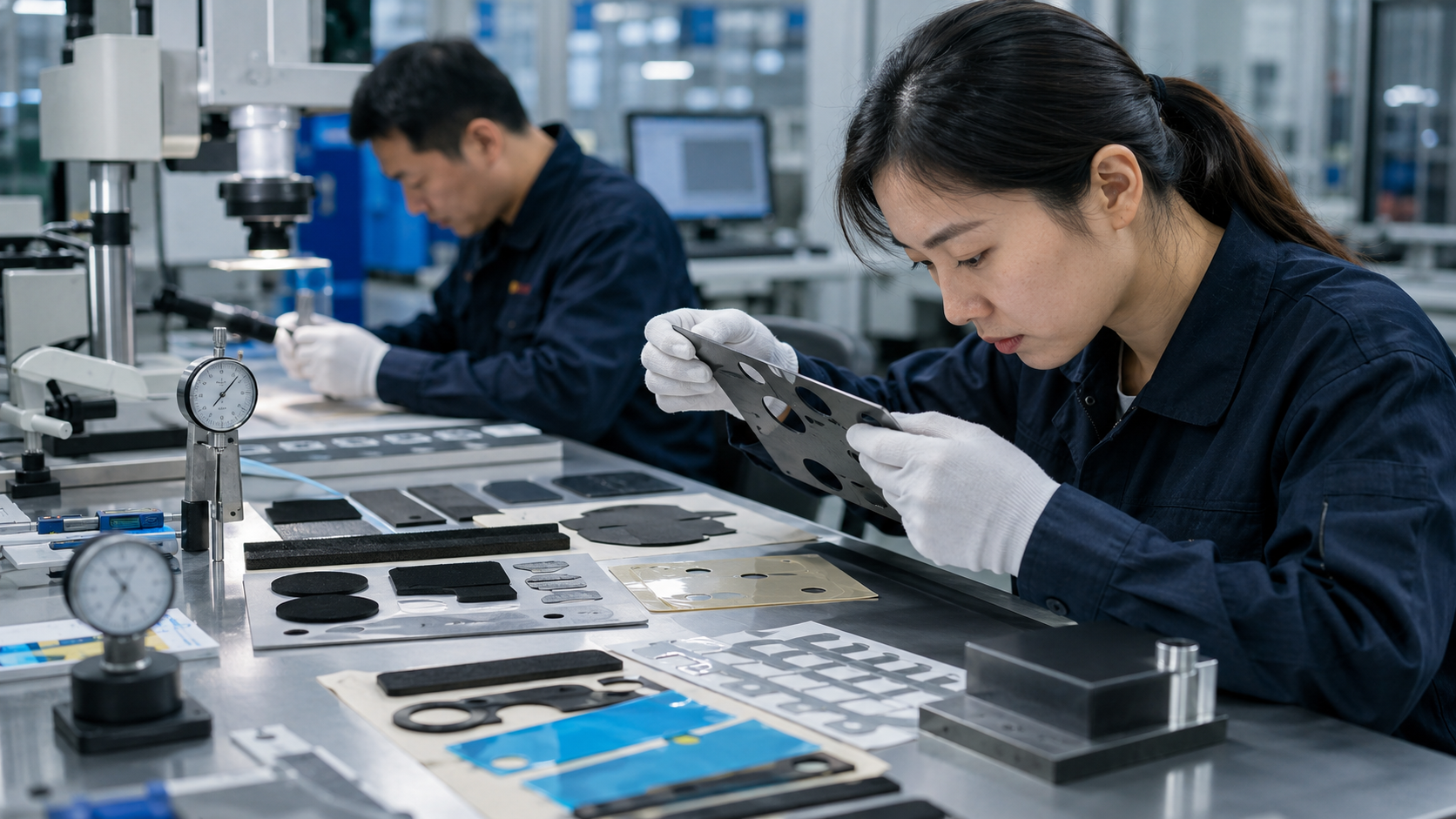
A reliable supplier should review which dimensions are critical to function. For example, holes around screws, clips, connectors, sensors, and positioning posts usually need tighter control than non-functional outer edges.
Adhesive and Liner Control
Many automotive die cut parts are adhesive-backed. This includes foam tape gaskets, adhesive-backed felt strips, PET adhesive films, protective film tabs, double-sided tape pads, and rubber adhesive pads.
For adhesive die cut parts, reliability depends on both bonding and handling.
Important control points include:
- Adhesive grade
- Bonding surface compatibility
- Liner release force
- Kiss cutting depth
- Adhesive overflow
- Edge lifting
- Storage condition
- Peel direction
- Pull tab design
- Packaging format
A part may pass dimension inspection but still fail on the assembly line if it is hard to peel, stretches during application, or lifts after bonding.
For automotive surfaces such as ABS, PC, PP, PE, painted metal, powder-coated surfaces, fabric, rubber, and glass, adhesive selection must be tested carefully. A strong adhesive is not always the best adhesive. It must match the surface, pressure, temperature, and assembly method.
Clean Edges and Contamination Control
Automotive electronics, sensors, displays, battery areas, and interior trim parts often require clean die cut edges.
Poor edge control can create:
- Foam dust
- Felt fibers
- Rubber burrs
- Film particles
- Adhesive strings
- Rough edges
- Blocked holes
- Surface scratches
These defects may cause inspection rejection, poor appearance, poor bonding, or assembly contamination.
For PET and PI insulation films, clean edges and accurate holes are especially important. For non-woven felt NVH parts, fiber shedding must be controlled. For adhesive tape parts, adhesive strings and liner damage must be prevented.
Reliable die cutting requires correct tooling, sharp blades, suitable cutting pressure, stable lamination, controlled waste removal, and proper inspection.
Automotive OEM Standards and Customer Requirements
Automotive OEM projects usually require more than simple cutting accuracy. The supplier may need to support project-specific quality requirements, drawings, material approvals, inspection reports, environmental compliance, and traceability.
Depending on the customer and project, requirements may include:
- Drawing-based production
- Sample approval
- First article inspection
- Critical dimension inspection
- Material traceability
- RoHS and REACH documentation if required
- Adhesive or material test data if required
- Packaging approval
- Batch consistency control
- Corrective action support if problems occur
For automotive OEM supply, communication is also part of quality. A reliable supplier should confirm unclear drawing requirements, flag manufacturability risks, and avoid silent material changes.
At Sanken, the focus is not only cutting parts. We review the part function, material structure, tolerance, adhesive, liner, packaging, and assembly condition so the finished component can support real OEM production.
Common Problems With Low-Quality Die Cut Suppliers
Not every low-cost supplier is suitable for automotive projects. Buyers should be careful when a supplier only focuses on price and ignores engineering control.
Common warning signs include:
| Warning Sign | Possible Risk |
|---|---|
| Quotes without asking application details | Wrong material or adhesive |
| Cannot explain material differences | High risk of performance mismatch |
| Accepts every tolerance without review | Inspection failure or high rejection |
| No discussion of liner release | Hard peeling and slow assembly |
| No packaging review | Curling, compression, or deformation |
| No incoming material control | Batch variation |
| No clear inspection plan | Customer-side quality risk |
| No support for samples or design review | Repeated trial failure |
For automotive projects, buyers should choose a supplier that can discuss function, process, and quality risk, not only price.
How to Evaluate a Chinese Automotive Die Cut Parts Supplier
A buyer can evaluate supplier reliability by asking practical questions.
| Question | What It Reveals |
|---|---|
| What materials do you recommend for this application? | Material knowledge |
| Can you review the drawing before tooling? | Engineering support |
| How do you control hole alignment and tolerance? | Process capability |
| How do you control adhesive liner release? | Assembly experience |
| What inspection items will you check? | Quality planning |
| Can you support sample testing? | Development ability |
| How will the parts be packed? | Assembly and shipping awareness |
| Can you provide material documentation if needed? | OEM support capability |
A good supplier should be able to explain the reasoning behind material and process recommendations.
How Sanken Supports Reliable Automotive Die Cut Parts
Sanken Manufacturing Co., Ltd. supports automotive OEM customers with precision die cutting, adhesive lamination, material converting, foam and rubber components, PET and PI insulation films, protective films, non-woven felt NVH parts, sealing gaskets, and custom adhesive-backed components.
For automotive projects, we review:
- Application function
- Vehicle assembly area
- Material type
- Thickness and density
- Foam compression
- Rubber hardness
- Felt fiber shedding risk
- Film stability
- Adhesive structure
- Bonding surface
- Liner release
- Die cut tolerance
- Hole alignment
- Edge cleanliness
- Packaging format
- Inspection requirements
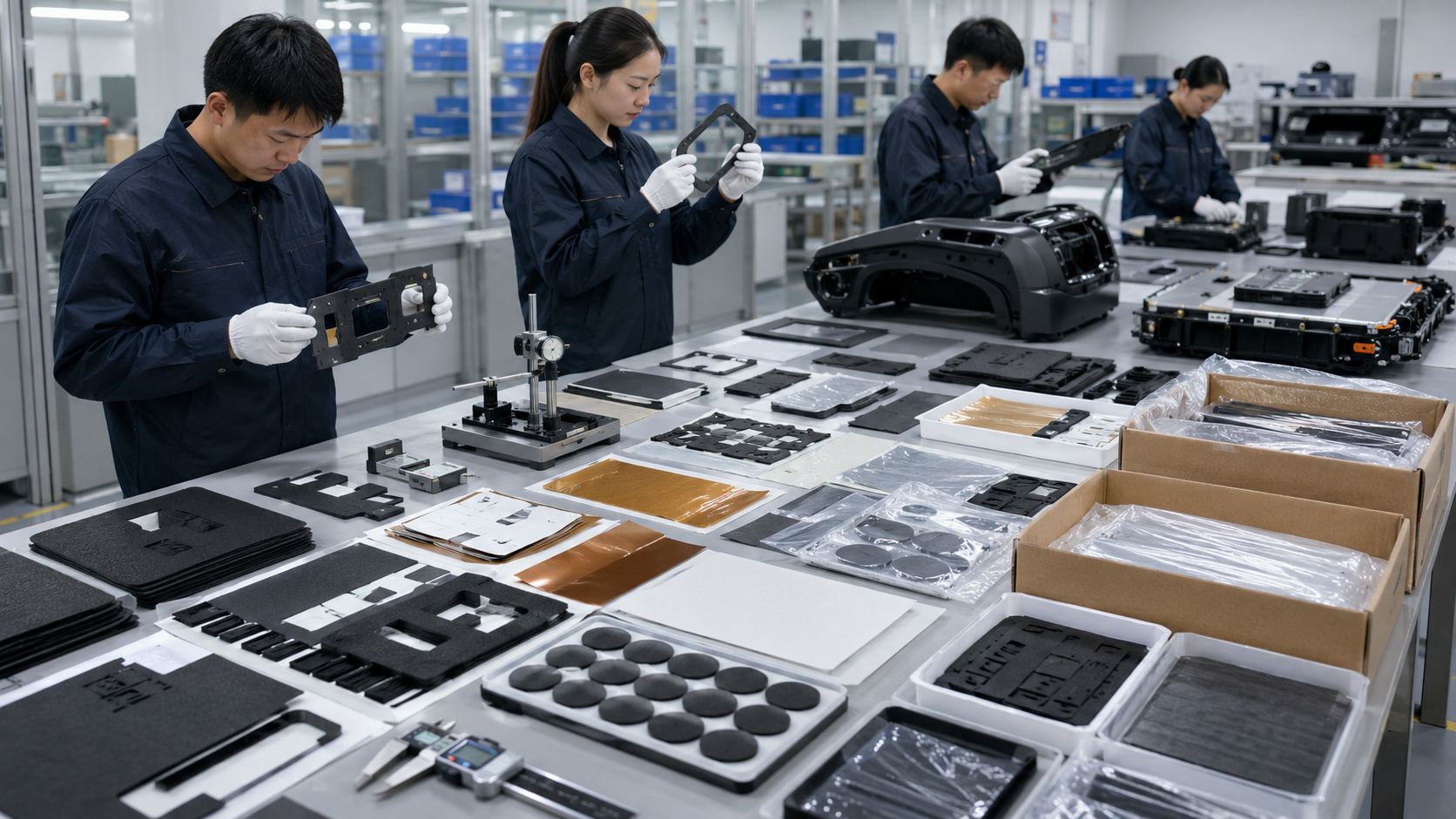
We help customers develop foam gaskets, adhesive-backed felt strips, rubber damping pads, PET insulation films, PI films, protective films, double-sided tape parts, sealing strips, light-blocking films, and multilayer converted components.
Our goal is to help customers reduce poor fit, adhesive lifting, fiber shedding, liner tearing, contamination, repeated samples, inspection failure, and unstable mass production.
Conclusion
Chinese automotive die cut parts can be reliable when the supplier has strong control over materials, tolerance, adhesive behavior, liner release, edge quality, inspection, packaging, and OEM project communication. Reliability depends on engineering capability and production discipline, not only where the parts are manufactured.
For automotive OEM buyers, the safest approach is to evaluate the supplier’s material knowledge, drawing review ability, sample support, inspection process, and mass production consistency.
At Sanken, we help overseas customers develop custom die cut foam, felt, rubber, film, tape, and multilayer automotive components that are clean, accurate, easy to assemble, and stable from sample development to mass production.