
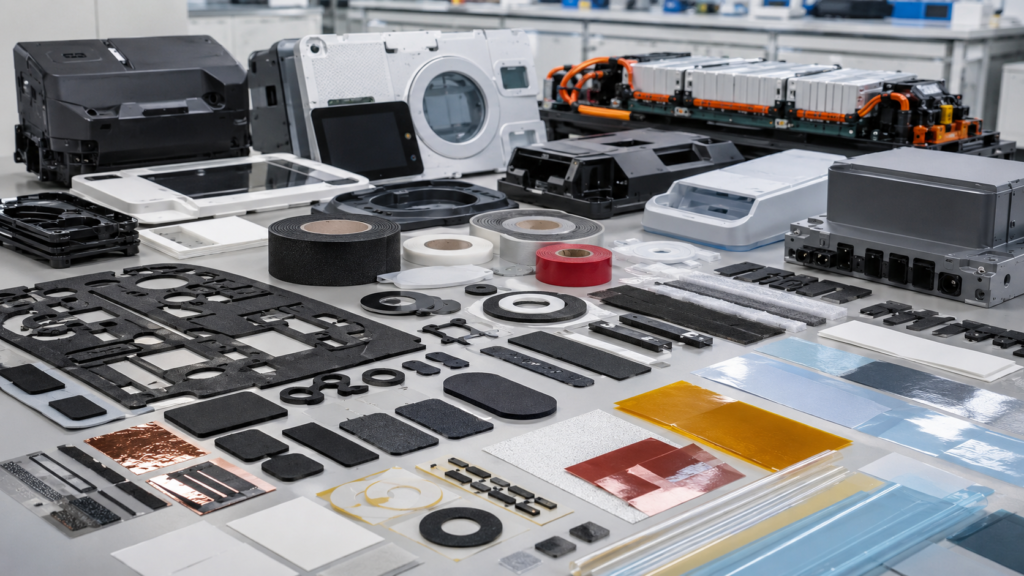
Choosing a one-stop OEM manufacturing partner for custom parts is not only about finding a factory that can produce many products. The real value is finding a supplier that can understand your design, recommend suitable materials, control tooling, support sampling, manage production risks, and deliver stable parts from prototype to mass production.
For OEM buyers and engineers, custom parts often involve more than one process. A product may need foam gaskets, adhesive tape parts, PET insulation films, rubber pads, injection molded housings, sealing components, protective films, non-woven felt pads, and assembly-ready kits. If these parts are managed by different suppliers, communication becomes slower and quality risks increase.
At Sanken, we support OEM customers with precision die cutting, adhesive lamination, material converting, foam and rubber components, plastic injection molding, sealing parts, protective films, PET and PI insulation films, non-woven felt parts, and custom assembly-ready components for automotive, electronics, battery, medical device, appliance, and industrial applications.
What Does a One-Stop OEM Manufacturing Partner Mean?
A one-stop OEM manufacturing partner provides multiple manufacturing and support capabilities under one coordinated system. Instead of only making one part, the supplier helps customers manage related materials, processes, tooling, samples, quality control, packaging, and delivery.
For custom parts, this may include:
- Material selection
- Drawing review
- Mold or tooling development
- Precision die cutting
- Adhesive lamination
- Foam and rubber converting
- Injection molding
- Rubber sealing parts
- Protective film converting
- PET and PI insulation films
- Sample testing
- Quality inspection
- Packaging and kitting
- Mass production support
The goal is not simply to reduce the number of suppliers. The goal is to reduce project risk, shorten development time, improve assembly fit, and make production more stable.
Why OEM Projects Need One-Stop Support
Many custom parts are connected to each other in the final product.
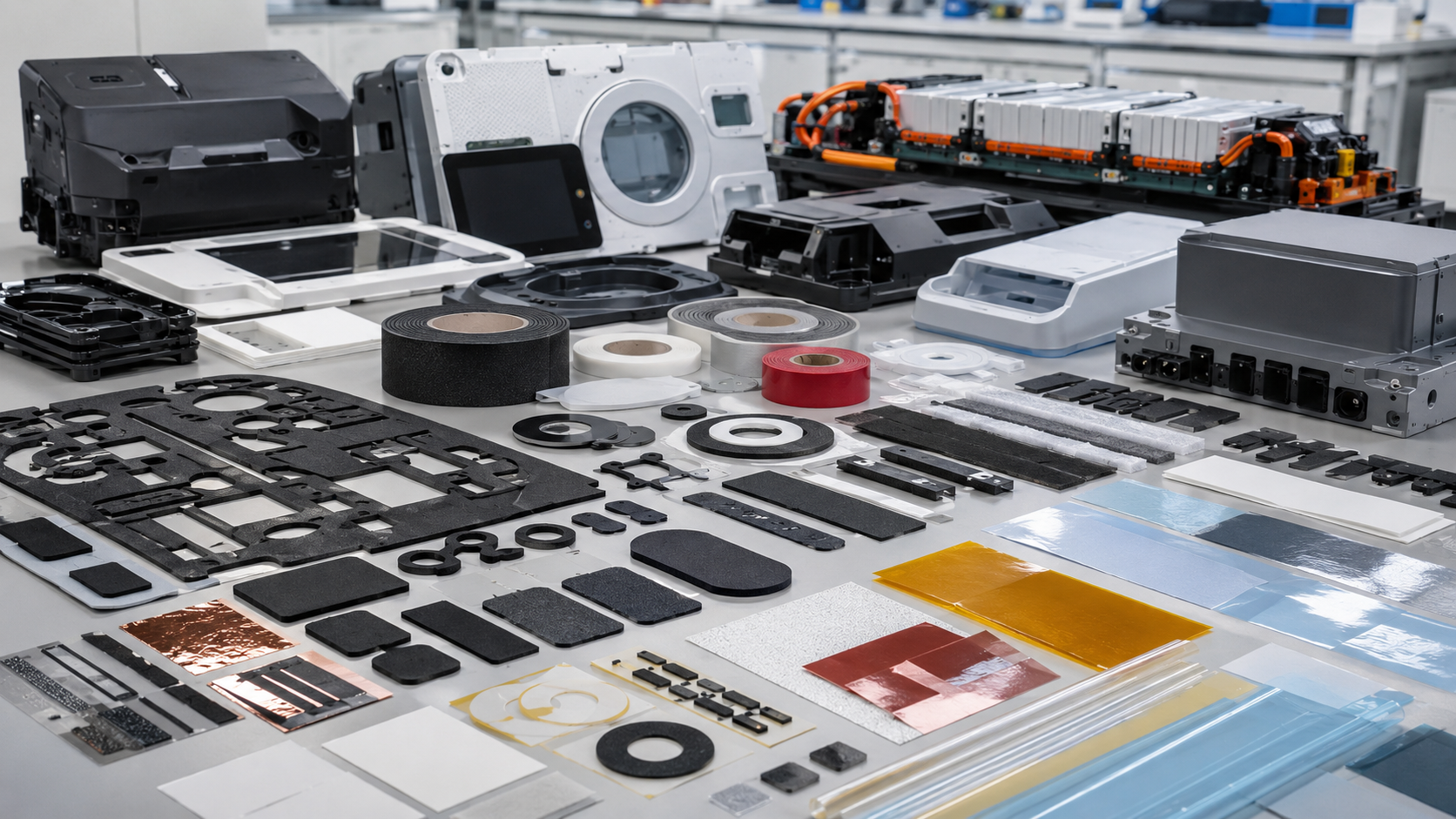
For example, an automotive electronic module may need an injection molded housing, a foam sealing gasket, PET insulation film, adhesive tape pads, rubber damping pads, and protective film during assembly. If each component is handled separately, small design mismatches may appear late.
Common problems include:
- Foam gasket does not match the plastic housing
- Adhesive tape does not bond well to the molded surface
- PET film holes do not align with screw posts
- Rubber pad thickness creates assembly stress
- Protective film leaves residue on the surface
- Different suppliers use different tolerance standards
- Packaging format does not match assembly needs
- Sampling takes too long because each supplier works separately
A one-stop partner can review the complete assembly instead of only one isolated part.
Check the Supplier’s Core Manufacturing Capabilities
Before choosing a partner, buyers should confirm whether the supplier’s capabilities match the project requirements.
| Capability | Why It Matters for Custom Parts |
|---|---|
| Precision die cutting | Converts foam, film, tape, rubber, felt, and protective materials into custom shapes |
| Adhesive lamination | Combines foam, film, tape, liner, and multilayer structures |
| Material converting | Supports slitting, laminating, kiss cutting, through cutting, and roll/sheet preparation |
| Injection molding | Produces custom plastic housings, covers, and structural parts |
| Rubber processing | Supports sealing pads, damping parts, washers, and custom rubber components |
| Tooling support | Helps develop molds, dies, and production fixtures |
| Quality inspection | Controls dimensions, thickness, adhesion, edge quality, and assembly fit |
| Packaging and kitting | Delivers parts in assembly-ready formats |
A true one-stop partner should not only list these processes. The supplier should understand how these processes work together in the final product.
Material Knowledge Is Essential
Custom OEM parts often fail because the wrong material is selected at the beginning.
A reliable partner should understand foam, rubber, film, tape, plastic, felt, and adhesive materials. They should be able to explain why one material is suitable and another is risky.
For die cut parts, material selection may include:
- PE foam
- PU foam
- EVA foam
- EPDM foam
- Silicone foam
- Rubber sheets
- PET film
- PI film
- PC film
- Protective film
- Double-sided tape
- Transfer adhesive
- Non-woven felt
- Light-blocking film
- Multilayer laminated materials
For molded or sealing parts, the supplier should also understand plastic and rubber material behavior, such as shrinkage, hardness, flexibility, aging resistance, and assembly performance.
A good partner should not select materials only by price. They should consider function, tolerance, compression, bonding surface, temperature exposure, cleanliness, and long-term reliability.
Engineering Review Before Tooling
One of the biggest advantages of a one-stop OEM manufacturing partner is early engineering review.
Before tooling, the supplier should check:
- Whether the drawing is manufacturable
- Whether the tolerance matches the material
- Whether the part shape creates waste removal problems
- Whether foam thickness matches the assembly gap
- Whether adhesive backing is suitable for the bonding surface
- Whether holes align with molded posts or screws
- Whether rubber hardness is suitable for compression
- Whether the plastic part design supports assembly
- Whether packaging prevents deformation
- Whether the final part can be inspected properly
This review helps prevent repeated samples and expensive changes after mass production begins.
Evaluate Sampling and Prototype Support
Sampling is where many OEM projects either move forward smoothly or become delayed.
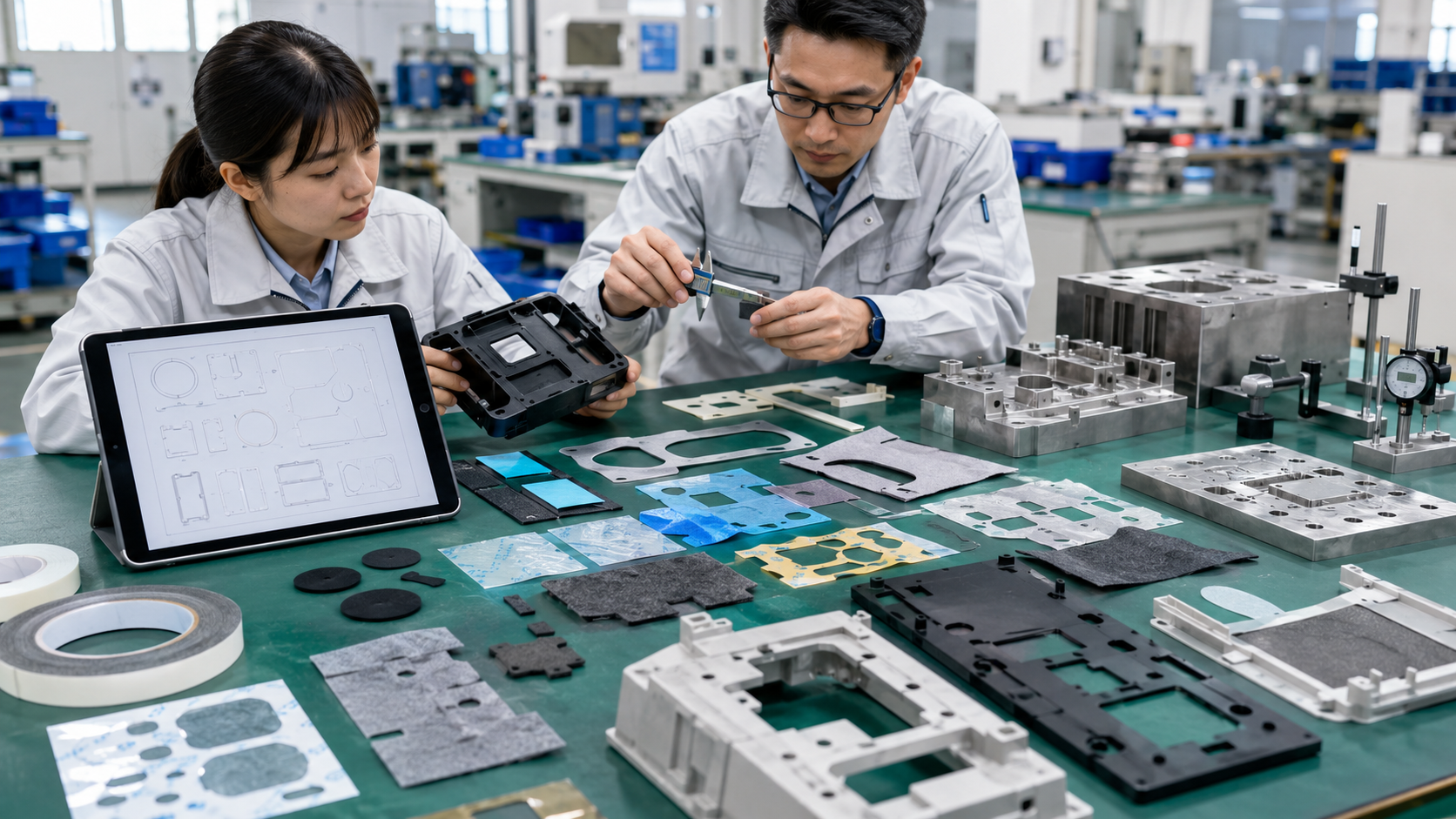
A strong one-stop partner should support sample development for different component types, such as die cut foam gaskets, adhesive tape parts, PET insulation films, rubber pads, protective films, molded plastic parts, and multilayer assemblies.
Good sampling support should include:
- Material sample comparison
- Drawing and tolerance review
- Prototype tooling or sample cutting
- Adhesive and liner testing
- Foam compression testing
- Rubber hardness review
- Plastic part fit review
- Assembly trial support
- Packaging trial
- Feedback-based improvement
A sample should not only look correct. It should fit the real product, peel correctly, bond well, compress properly, and support the customer’s assembly process.
Quality Control Must Cover Every Process
A one-stop partner must have quality control across materials, tooling, production, inspection, and packaging.
For custom die cut parts, important inspection items include:
- Outer dimensions
- Hole alignment
- Material thickness
- Edge cleanliness
- Adhesive position
- Liner release
- Kiss cutting depth
- Foam compression
- Rubber hardness
- Film flatness
- Surface cleanliness
- Packaging condition
For injection molded or rubber parts, inspection may include:
- Molded dimensions
- Surface appearance
- Warpage
- Shrinkage
- Flash
- Hardness
- Sealing fit
- Assembly compatibility
Quality control should not be limited to final inspection. It should include incoming material checks, first article inspection, in-process control, final inspection, and packaging review.
Look at Assembly Fit, Not Only Individual Parts
A custom part can pass individual inspection but still fail during final assembly.
For example:
- A die cut foam gasket may pass dimension checks but be too thick for the housing gap.
- A molded plastic part may meet drawing dimensions but not bond well with the adhesive tape.
- A PET insulation film may be clean but its holes may interfere with assembly posts.
- A rubber pad may fit the drawing but create too much compression force.
- A protective film may cover the surface but become difficult to remove.
A good OEM partner should review how each part works in the final assembly. This is especially important for automotive electronics, EV battery modules, display components, medical devices, appliance housings, and industrial equipment.
Compare Total Project Cost, Not Only Unit Price
Choosing the lowest unit price supplier can create higher total cost if the supplier cannot control quality or support engineering review.
Hidden costs may include:
| Hidden Cost | Common Cause |
|---|---|
| Repeated samples | Poor material or drawing review |
| Rework | Poor fit or unstable tolerance |
| Assembly delay | Hard peeling, poor packaging, or unclear part layout |
| Scrap | Material defects or process instability |
| Tooling changes | Design risk not identified early |
| Inspection cost | Inconsistent batch quality |
| Customer complaints | Adhesive failure, sealing failure, or poor appearance |
| Supplier management cost | Too many suppliers and slow communication |
A reliable one-stop OEM partner may not always offer the lowest first quotation, but they can reduce total project risk and improve production efficiency.
Packaging and Delivery Format Matter
Packaging is part of the manufacturing solution. Poor packaging can damage good parts before they reach the assembly line.
Custom parts may be delivered as:
- Loose pieces
- Roll format
- Sheet format
- Liner-backed die cut sheets
- Tray-packed parts
- Protective bags
- Kitted component sets
- Assembly-ready packages
Soft foam should not be compressed too tightly. Thin films should be kept flat. Adhesive-backed parts should stay stable on the release liner. Rubber parts should be protected from deformation. Molded parts should be packed to avoid scratches or surface damage.
A good supplier should recommend packaging based on the customer’s assembly method, not only shipping convenience.
How Sanken Supports One-Stop OEM Custom Part Projects
Sanken Manufacturing Co., Ltd. supports OEM customers with integrated manufacturing and converting capabilities for custom parts.
Our main support areas include:
- Precision die cutting
- Foam gasket converting
- Adhesive tape die cutting
- PET and PI insulation films
- Protective film components
- Non-woven felt NVH parts
- Rubber pads and sealing parts
- Plastic injection molded components
- Adhesive lamination
- Multilayer material converting
- Sample development
- Quality inspection
- Assembly-ready packaging
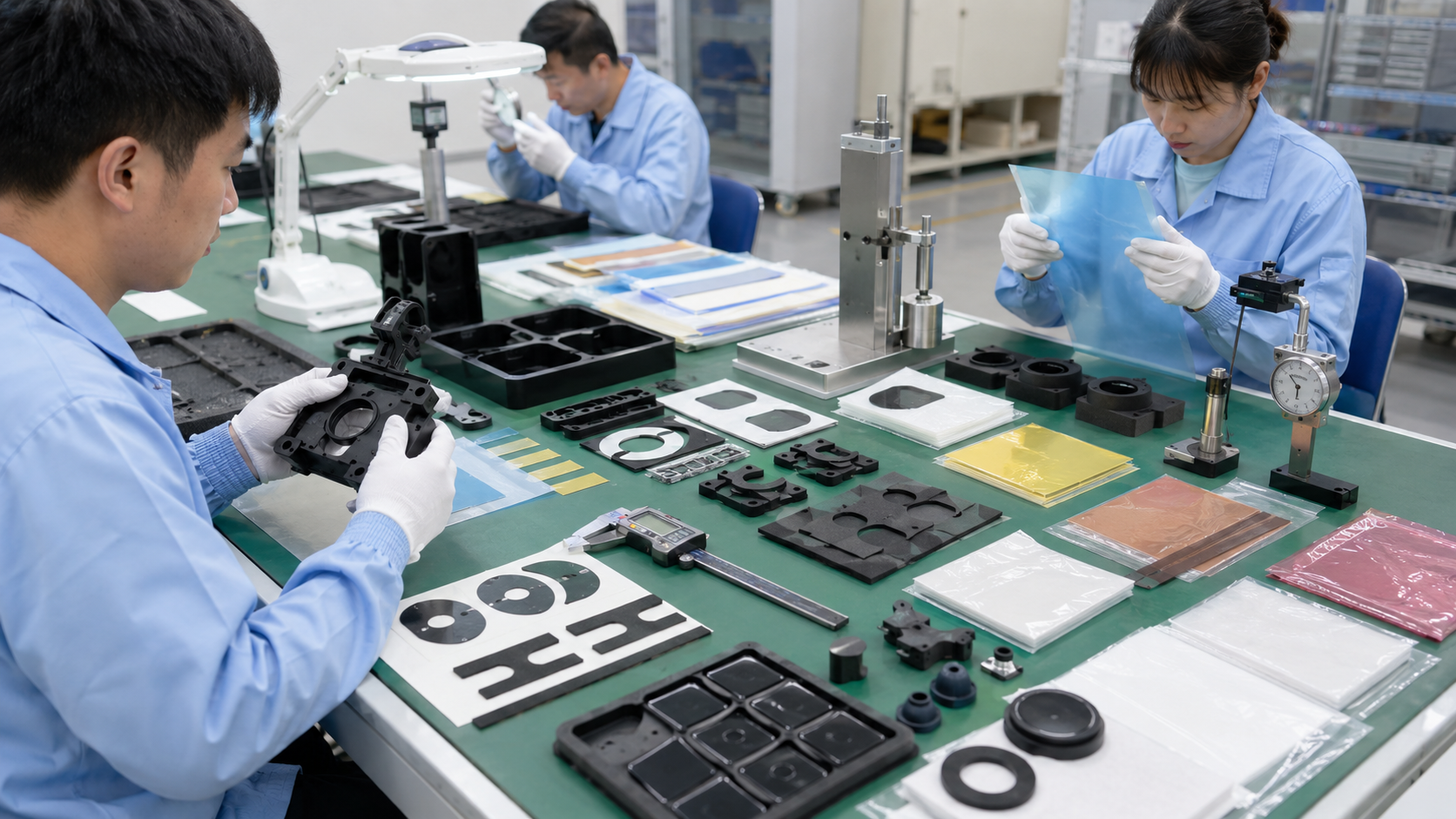
For each project, we review part function, material structure, tolerance, tooling method, adhesive performance, foam compression, rubber hardness, plastic fit, edge quality, packaging, and assembly method.
Our goal is to help customers reduce repeated sampling, poor fit, adhesive lifting, liner release problems, tolerance issues, packaging damage, and unstable mass production.
Questions to Ask Before Choosing a One-Stop OEM Partner
Before selecting a supplier, buyers should ask practical questions:
| Question | What It Reveals |
|---|---|
| Can you review our drawing before tooling? | Engineering support |
| What materials do you recommend for this application? | Material knowledge |
| Can you support both die cut and molded parts? | One-stop capability |
| How do you control tolerance? | Process stability |
| How do you test adhesive and liner release? | Assembly experience |
| Can you support sample improvement? | Development flexibility |
| What inspection items do you check? | Quality control depth |
| How will the parts be packed? | Assembly and delivery awareness |
| Can you support mass production consistency? | OEM reliability |
A supplier that can answer these questions clearly is more likely to support a successful OEM project.
Common Warning Signs
Be careful if a supplier:
- Only discusses price
- Quotes without understanding the application
- Cannot explain material differences
- Accepts all tolerances without review
- Has no clear sampling process
- Does not discuss adhesive or liner release
- Ignores packaging requirements
- Cannot support assembly fit review
- Has weak communication during project changes
- Cannot explain quality control methods
A one-stop partner should reduce complexity, not create new risks.
Conclusion
Choosing a one-stop OEM manufacturing partner for custom parts requires more than checking factory size or comparing unit price. The right partner should understand materials, tooling, die cutting, molding, rubber components, adhesive lamination, inspection, packaging, and final assembly conditions.
For automotive, electronics, battery, medical device, appliance, and industrial products, custom parts must be accurate, clean, reliable, and easy to assemble. A strong one-stop partner can help reduce development time, supplier communication, rework, poor fit, adhesive failure, and mass production risk.
At Sanken, we help OEM customers turn foam, rubber, film, tape, felt, and plastic materials into reliable custom components that support real product performance and stable mass production.