
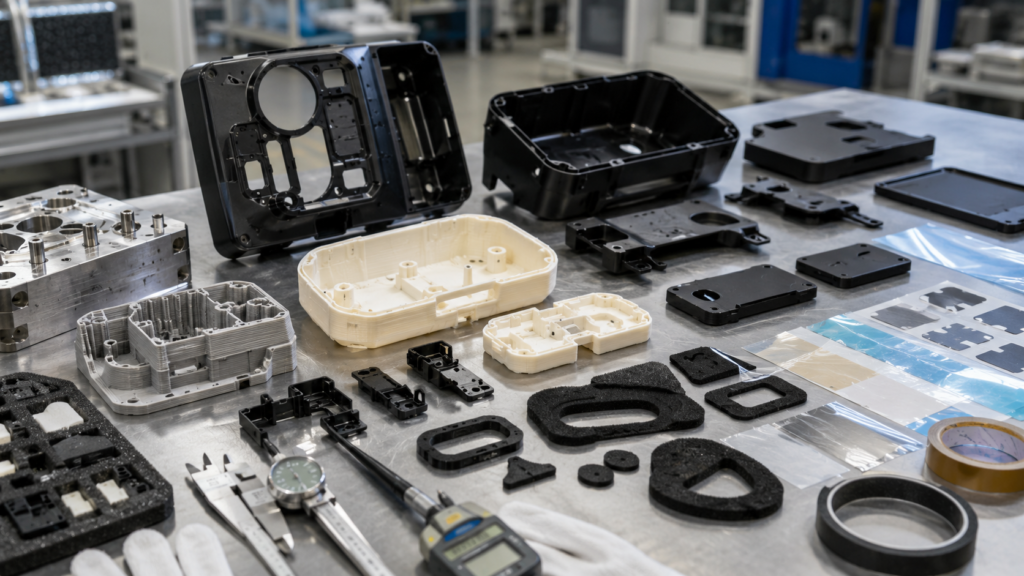
Injection molding and 3D printing are both useful methods for making custom OEM parts, but they serve different project needs. Injection molding is usually better for stable mass production, consistent dimensions, material strength, surface finish, and lower unit cost at volume. 3D printing is usually better for early prototypes, quick design checks, small batches, and complex shapes before tooling investment.
For OEM engineers and purchasing teams, the best choice depends on quantity, material requirement, tolerance, part function, surface quality, tooling budget, lead time, and final assembly conditions.
At Sanken, we support OEM customers with custom injection molded plastic parts, precision die cut components, foam gaskets, rubber pads, PET and PI insulation films, adhesive tape parts, protective films, non-woven felt parts, sealing components, and assembly-ready custom parts for automotive, electronics, battery, medical device, appliance, and industrial applications.
Why This Comparison Matters for OEM Projects
OEM custom parts are not only judged by appearance. They must fit real products, pass inspection, survive assembly, and remain stable in mass production.
A plastic housing may need strength, dimensional stability, and clean assembly fit. A die cut foam gasket may need controlled compression. A PET insulation film may need accurate holes. A rubber pad may need vibration damping. An adhesive tape component may need reliable bonding and liner release.
3D printing can help confirm the shape of a molded plastic part before tooling. Injection molding can then produce consistent parts at scale. In many OEM projects, these methods are not enemies. They are used at different stages of product development.
What Is Injection Molding?
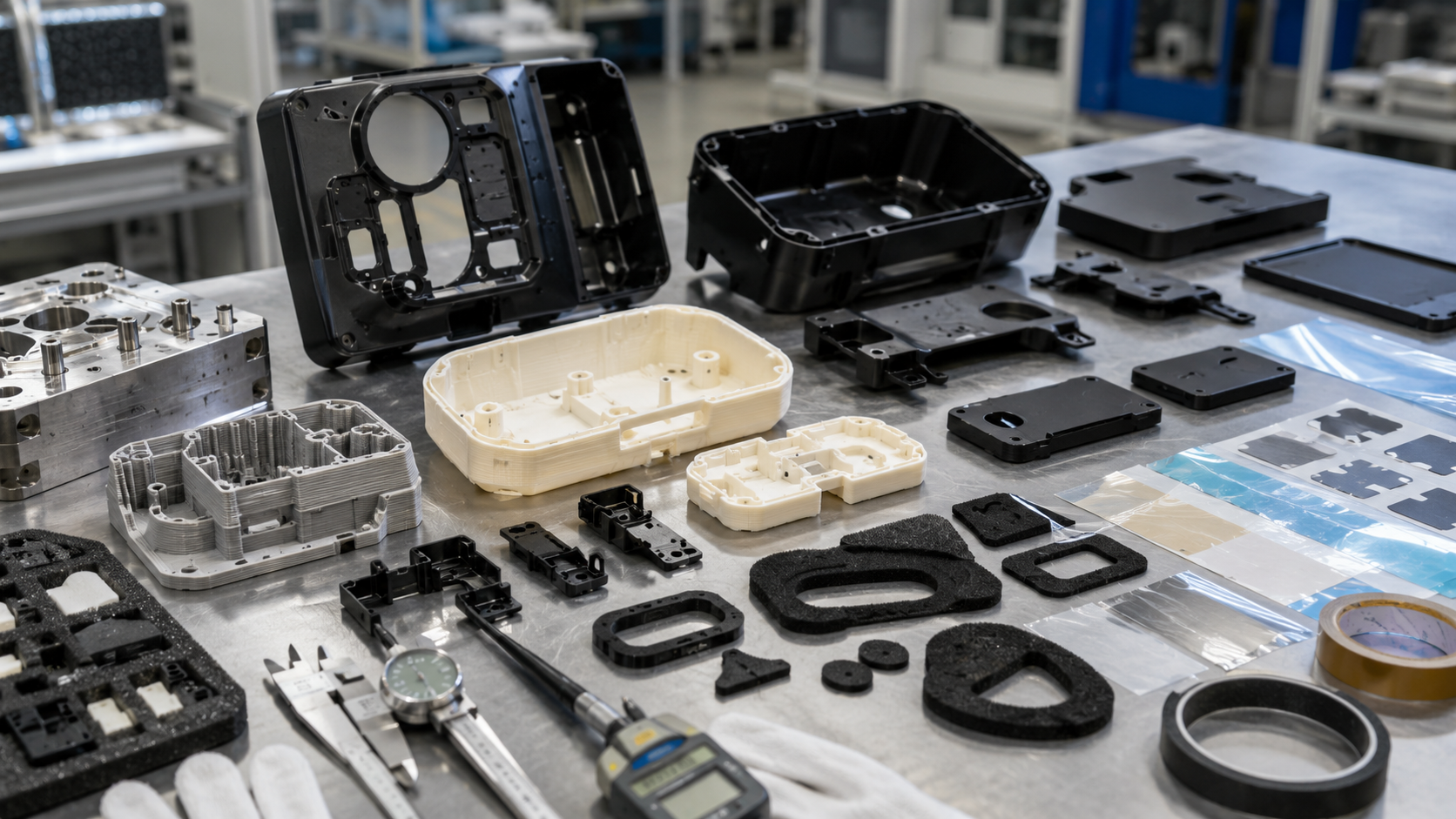
Injection molding is a manufacturing process that uses a mold to produce plastic parts. Plastic material is melted, injected into the mold cavity, cooled, and ejected as a finished part.
It is widely used for:
- Plastic housings
- Covers
- Brackets
- Clips
- Enclosures
- Connectors
- Medical device shells
- Appliance parts
- Automotive electronic housings
- Industrial plastic components
Injection molding requires tooling investment, but once the mold is ready, it can produce large quantities with stable dimensions and repeatable quality.
This makes it suitable for OEM projects that require consistent production, good surface finish, controlled material properties, and long-term supply.
What Is 3D Printing?
3D printing, also called additive manufacturing, builds parts layer by layer from digital files. It can produce prototypes quickly without traditional molds.
3D printing is useful for:
- Early concept models
- Form and fit testing
- Design verification
- Small trial batches
- Complex internal structures
- Engineering samples before tooling
- Visual prototypes for customer review
Its main advantage is speed and flexibility. Engineers can change the design and print a new sample without waiting for mold modification.
However, 3D printed parts may not always match the strength, surface finish, dimensional consistency, material performance, or production cost of injection molded parts in high-volume OEM manufacturing.
Quick Comparison: Injection Molding vs 3D Printing
| Factor | Injection Molding | 3D Printing |
|---|---|---|
| Best use | Mass production | Prototypes and small batches |
| Tooling cost | Higher upfront mold cost | No mold required |
| Unit cost at volume | Low | Usually higher |
| Lead time for first sample | Longer due to tooling | Faster |
| Design changes | Mold changes may cost more | Easy to revise |
| Material consistency | Strong for production-grade plastics | Depends on printing material and method |
| Surface finish | Usually better and more consistent | May show layer lines |
| Tolerance stability | Better for repeated production | Varies by printer and material |
| Production speed at scale | Very efficient | Slower for large volumes |
| OEM suitability | Strong for approved mass production | Strong for early development |
For most OEM projects, 3D printing is valuable before tooling, while injection molding is preferred for final production.
When Injection Molding Is Better
Injection molding is usually the better choice when the part needs to be produced repeatedly in medium or high volume.
It is suitable when the project requires:
- Stable dimensions
- Good surface appearance
- Strong material performance
- Repeatable assembly fit
- Lower unit cost at volume
- Consistent wall thickness
- Reliable snap-fit or screw-fit features
- Mass production quality control
- Long-term OEM supply
For example, an automotive electronic housing, appliance cover, medical device shell, or industrial enclosure usually needs consistent plastic material, controlled shrinkage, good fit with related parts, and stable batch quality. Injection molding is often the practical choice.
It also works well when the molded plastic part must combine with other custom components, such as foam gaskets, PET films, adhesive tapes, rubber pads, or protective films.
At Sanken, injection molded plastic parts can be reviewed together with die cut foam, tape, film, and rubber components so the final assembly fit is considered early.
When 3D Printing Is Better
3D printing is usually better during early development when the design is not final.
It is suitable when the project needs:
- Fast prototype samples
- Low initial investment
- Quick design changes
- Shape verification
- Assembly space checking
- Small batch testing
- Visual presentation samples
- Early engineering discussion
For example, if an OEM customer is still deciding the shape of a plastic housing, 3D printing can help check the outer form, screw position, connector space, and assembly clearance before investing in injection mold tooling.
3D printing can reduce early development risk because engineers can find design problems before the mold is made.
However, a 3D printed prototype should not always be treated as equal to a final injection molded part. The material, surface texture, strength, tolerance, and aging behavior may be different.
Material Performance Differences
Material performance is one of the biggest differences between injection molding and 3D printing.
Injection molding supports many production-grade thermoplastics, depending on the application. These materials can be selected for strength, flexibility, heat resistance, chemical resistance, surface quality, flame resistance, or dimensional stability.
3D printing materials are improving, but printed parts may still have limitations. Layer bonding, anisotropic strength, surface roughness, and material aging can affect performance.
For OEM custom parts, engineers should ask:
- Will the part carry load?
- Will it snap, bend, or flex?
- Will it be exposed to heat?
- Will it contact chemicals?
- Will it need a smooth cosmetic surface?
- Will it be assembled with screws, clips, foam gaskets, or adhesive tapes?
- Will the prototype material match the final production material?
When the part is functional and used in final products, injection molding is often more reliable for consistent material behavior.
Tolerance and Assembly Fit
Tolerance matters because OEM parts must fit real assemblies.
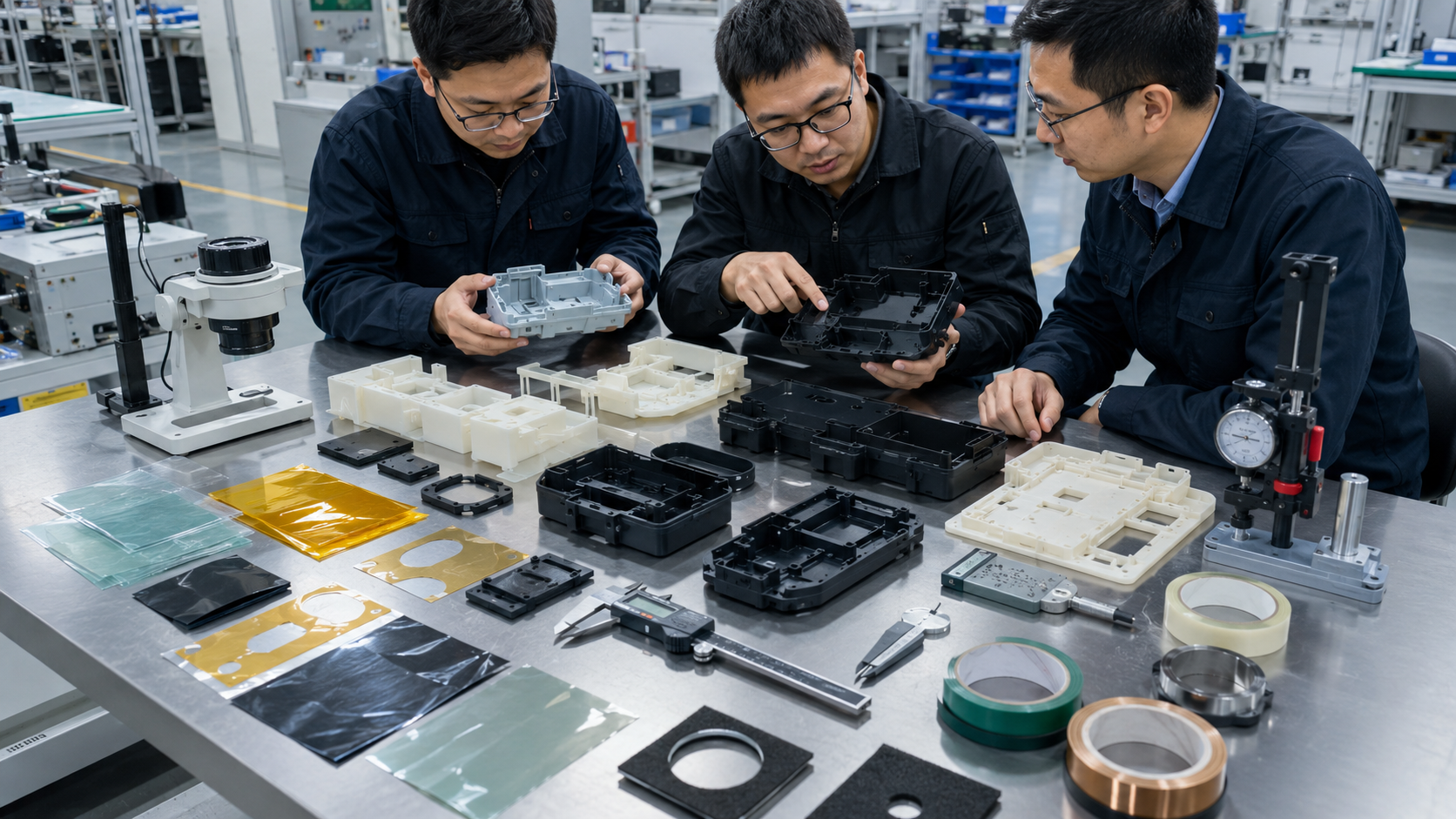
A 3D printed prototype may help check general shape, but final injection molded parts may behave differently because molded plastic shrinks during cooling. Mold design must consider shrinkage, draft angle, wall thickness, ribs, bosses, clips, and parting lines.
For injection molded parts, tooling design and process control are critical. For 3D printed parts, printer resolution, material shrinkage, layer height, and post-processing affect tolerance.
Tolerance becomes especially important when plastic parts must assemble with:
- Foam gaskets
- Adhesive tape components
- PET or PI insulation films
- Rubber pads
- Protective films
- Screws and clips
- Connectors and sensors
- Battery module parts
- Display components
A one-stop OEM partner can review the molded part and related die cut parts together. This helps prevent problems such as foam gasket mismatch, PET film hole misalignment, adhesive bonding failure, or rubber pad compression issues.
Cost: Tooling Cost vs Unit Cost
The cost difference is simple in principle but important in practice.
3D printing usually has lower upfront cost because no mold is required. This makes it attractive for prototypes and small batches.
Injection molding has higher upfront tooling cost, but the unit cost becomes much lower when production volume increases.
| Project Situation | Better Choice |
|---|---|
| One prototype for design review | 3D printing |
| Several samples for fit testing | 3D printing or prototype tooling |
| Small batch before final design | 3D printing may be useful |
| Medium-volume functional production | Injection molding may be better |
| High-volume OEM production | Injection molding is usually better |
| Final plastic part with strict appearance | Injection molding is usually better |
| Custom plastic part plus die cut gasket | Injection molding with die cut support |
The cheapest first sample is not always the lowest total project cost. A poor prototype strategy can delay tooling. A poorly reviewed mold can cause repeated modifications. A low-cost molded part can still fail if related foam, tape, film, or rubber components are not considered.
Surface Finish and Appearance
Injection molding usually provides a better and more consistent surface finish for final plastic parts. It can support different surface textures depending on mold design.
3D printed parts may show visible layer lines or require post-processing such as sanding, polishing, coating, or painting. This may be acceptable for engineering review, but not always acceptable for final OEM products.
For visible parts such as consumer electronics covers, medical device shells, appliance panels, and automotive interior parts, surface quality can strongly affect customer perception.
For hidden functional parts, appearance may matter less, but dimensional consistency and strength still matter.
How Die Cut Parts Work With Injection Molded Components
Many OEM custom parts are not only molded plastic parts. They also require flexible auxiliary components.
For example:
- A plastic housing may need a foam gasket.
- A battery cover may need PET insulation film.
- A display frame may need double-sided adhesive tape.
- A sensor housing may need light-blocking film.
- A medical device shell may need protective film.
- An appliance cover may need rubber damping pads.
- An automotive interior part may need non-woven felt strips.
This is where Sanken’s combined capabilities are useful. Injection molded parts can be developed together with custom die cut foam, rubber, film, tape, felt, and protective materials.
This helps improve assembly fit and reduce supplier coordination problems.
Common Mistakes When Choosing Between Injection Molding and 3D Printing
| Mistake | Possible Result |
|---|---|
| Choosing 3D printing for final mass production without cost review | High unit cost and unstable production efficiency |
| Investing in injection mold before design is confirmed | Expensive mold changes |
| Treating printed prototype as identical to molded part | Fit and strength differences |
| Ignoring material properties | Part failure in real use |
| Ignoring related die cut parts | Gasket, tape, or film mismatch |
| Choosing only by first sample cost | Higher total project cost |
| Not reviewing assembly tolerance | Poor fit during production |
| No packaging or inspection plan | Damage and quality issues |
The best decision should match the product stage and final application.
A Practical OEM Decision Path
For many OEM projects, the practical path is:
- Use 3D printing or prototype methods for early design review.
- Test assembly space, shape, screw positions, and part interfaces.
- Review related die cut parts such as foam gaskets, tapes, films, and rubber pads.
- Adjust the design before mold investment.
- Build injection mold for approved production design.
- Validate molded samples with final die cut components.
- Confirm inspection, packaging, and mass production control.
This approach reduces risk because it uses 3D printing where it is strongest and injection molding where it is strongest.
How Sanken Supports OEM Custom Parts
Sanken Manufacturing Co., Ltd. supports OEM customers with injection molding, precision die cutting, adhesive lamination, foam and rubber components, PET and PI insulation films, protective films, non-woven felt parts, sealing components, and multilayer material converting.
For custom OEM projects, we review:
- Part function
- Plastic material selection
- Molded part design
- Die cut gasket fit
- Adhesive tape bonding surface
- PET and PI film alignment
- Rubber pad compression
- Foam thickness and density
- Tolerance requirements
- Assembly method
- Packaging format
- Inspection standards
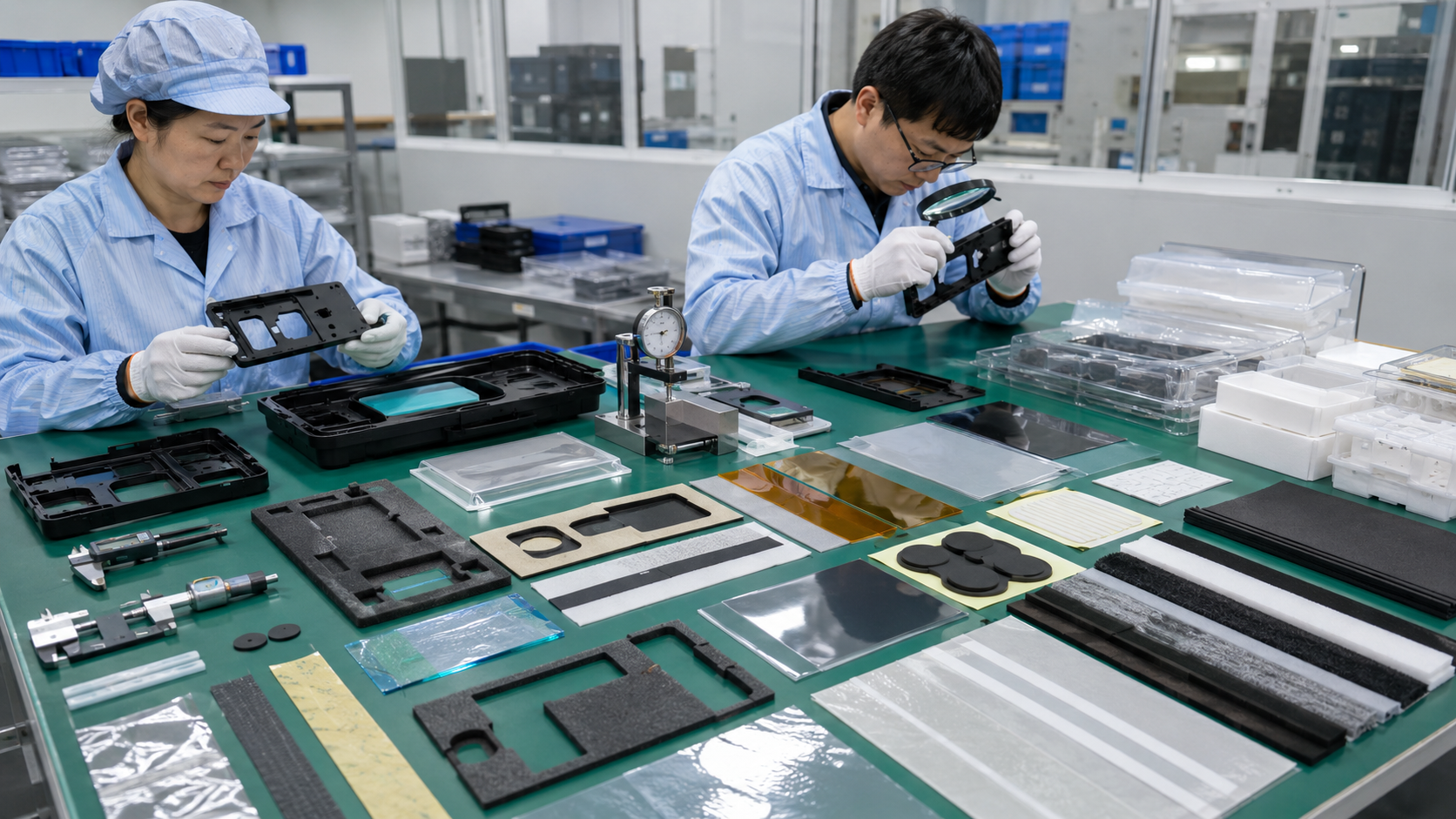
Our goal is to help customers reduce repeated samples, poor assembly fit, tooling changes, adhesive lifting, gasket mismatch, material waste, and unstable mass production.
FAQ
Is injection molding better than 3D printing for OEM custom parts?
Injection molding is usually better for mass production, stable dimensions, lower unit cost at volume, surface finish, and production-grade plastic parts. 3D printing is better for early prototypes, quick design changes, and small batches.
When should I use 3D printing?
Use 3D printing when the design is still being developed, when you need quick samples, or when you want to check shape, fit, and assembly space before investing in tooling.
When should I use injection molding?
Use injection molding when the design is approved and the project needs repeatable production, consistent material performance, better surface finish, and lower unit cost at volume.
Can 3D printed prototypes replace injection molded parts?
Sometimes for early testing, but not always for final production. 3D printed parts may differ in strength, surface finish, tolerance, and material behavior compared with injection molded parts.
Why should die cut parts be reviewed with molded plastic parts?
Foam gaskets, adhesive tapes, PET films, rubber pads, and protective films often attach to or fit inside molded plastic parts. Reviewing them together reduces assembly mismatch and rework.
Can Sanken support both molded and die cut custom parts?
Yes. Sanken supports custom injection molded plastic parts, precision die cut foam gaskets, adhesive tape parts, PET and PI films, protective films, rubber pads, non-woven felt components, and multilayer OEM parts.
Conclusion
Injection molding and 3D printing are both useful for OEM custom parts, but they are best used at different stages. 3D printing is valuable for early prototypes and design verification. Injection molding is usually better for approved designs, mass production, stable quality, better surface finish, and lower unit cost at volume.
For OEM buyers, the best choice is not only about the process. It is about product stage, material performance, tolerance, assembly fit, production quantity, and long-term reliability.
At Sanken, we help customers develop custom molded plastic parts together with die cut foam, rubber, film, tape, felt, and multilayer components so the final assembly is easier, cleaner, and more stable in mass production.