
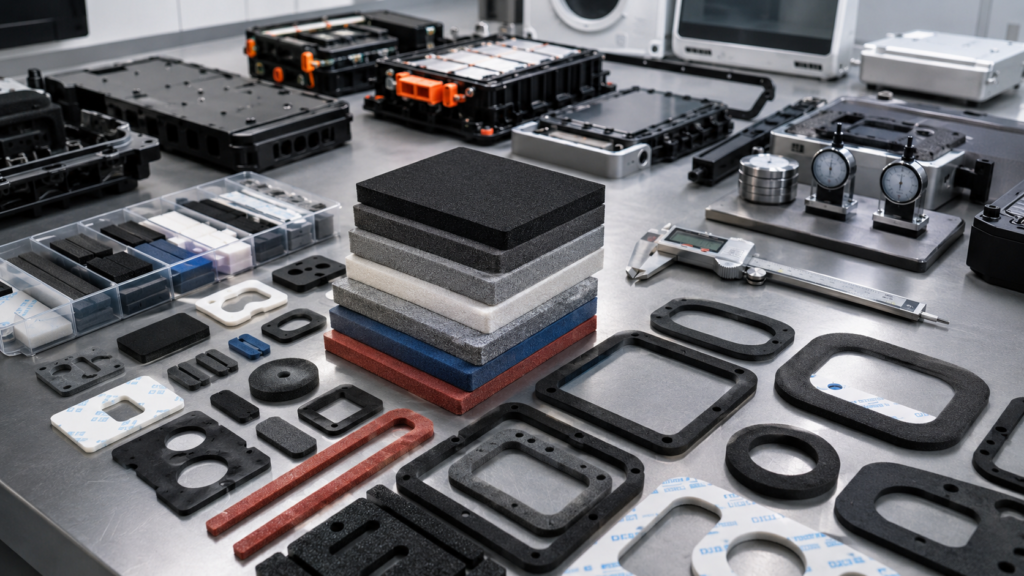
Choosing the right foam thickness for custom die cut foam gaskets is one of the most important decisions in sealing, cushioning, gap filling, vibration control, and OEM assembly design. A foam gasket may look simple, but if the thickness is wrong, the part may leak, lift, deform, create assembly stress, or fail after long-term compression.
For OEM buyers and engineers, foam thickness should not be selected only by visual judgment or by copying a previous project. The correct thickness depends on the housing gap, compression requirement, foam density, cell structure, adhesive backing, tolerance, assembly pressure, and final working environment.
At Sanken, we help customers develop custom die cut foam gaskets, adhesive-backed foam parts, sealing pads, PET insulation films, rubber components, protective films, and multilayer material converting solutions for automotive, electronics, battery, medical, appliance, and industrial applications.
Why Foam Thickness Matters
Foam thickness directly affects how a gasket seals, compresses, cushions, and stays in position. A foam gasket must usually compress enough to fill the gap between two surfaces, but not so much that it becomes damaged or creates excessive assembly force.
If the foam is too thin, it may not contact both surfaces properly. This can cause air leakage, dust entry, water ingress, vibration noise, or poor cushioning.
If the foam is too thick, it may create too much compression force. This can deform plastic housings, make assembly difficult, squeeze adhesive out of the edge, or cause long-term compression failure.
The best foam thickness is the one that fits the real assembly gap and compresses within the material’s safe working range.
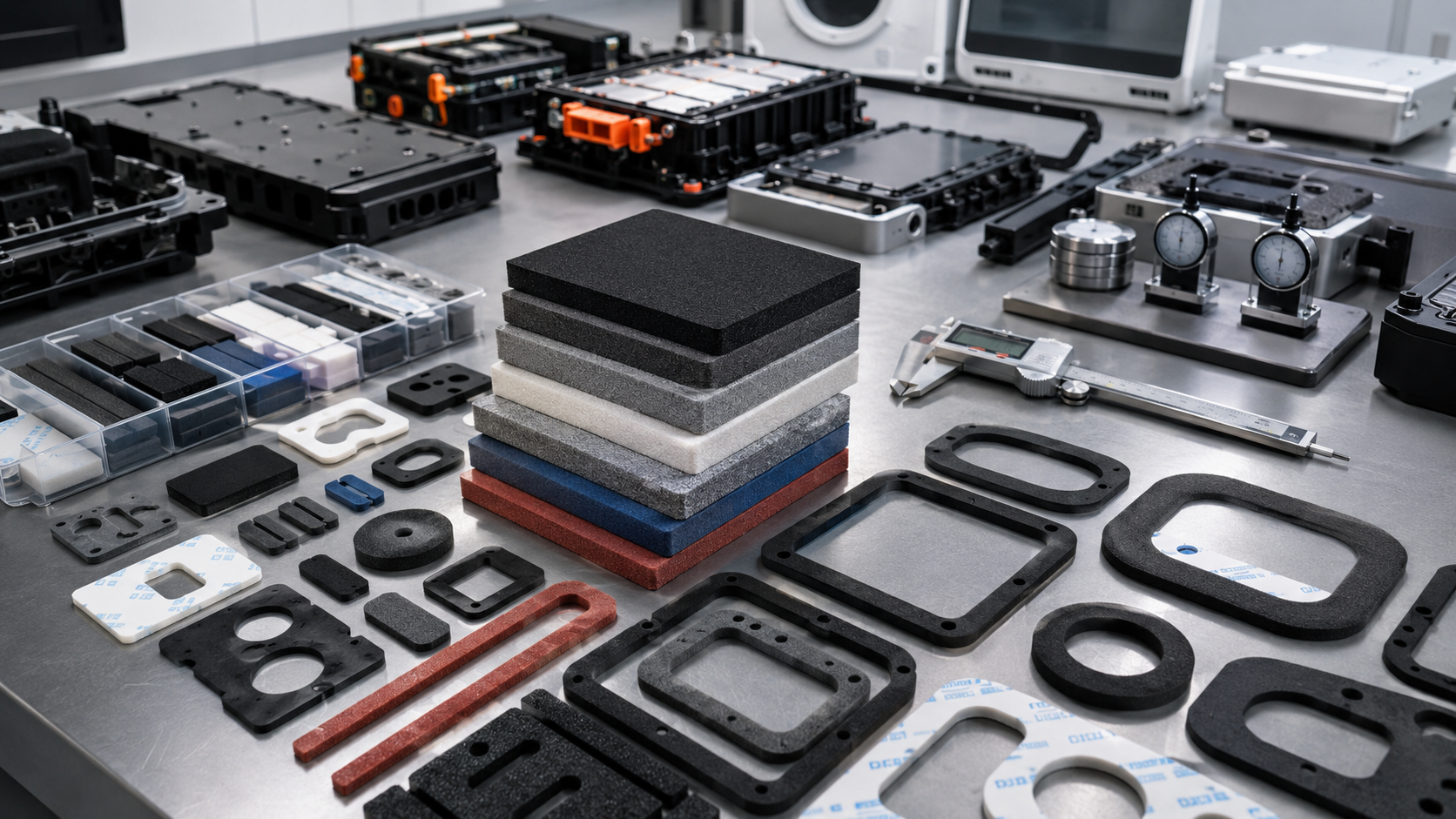
Start With the Actual Assembly Gap
The first step is to measure the real gap where the foam gasket will be installed.
This gap may be between two plastic housings, a metal cover and frame, an electronic enclosure, a battery module part, an automotive sensor housing, a display module, or an appliance panel.
Engineers should confirm:
- Minimum gap
- Maximum gap
- Nominal gap
- Surface flatness
- Housing tolerance
- Screw or clip compression
- Local high and low points
- Assembly pressure
- Long-term compression condition
The gasket thickness should be selected based on the full tolerance range, not only the nominal drawing gap.
For example, if the nominal gap is 2.0 mm but the actual gap may vary from 1.6 mm to 2.4 mm, the foam must still seal at 2.4 mm and avoid over-compression at 1.6 mm.
This is why real parts, drawings, and tolerance stack-up should be reviewed together before confirming foam thickness.
Understand Foam Compression Ratio
Foam gaskets work by compression. The compression ratio describes how much the foam is compressed after assembly.
A common design target for many foam gaskets is controlled compression within a safe working range. The exact range depends on foam type, density, cell structure, sealing requirement, and application environment.
| Compression Condition | Possible Result |
|---|---|
| Too little compression | Poor sealing, loose fit, vibration, leakage |
| Proper compression | Stable sealing, cushioning, and gap filling |
| Too much compression | High stress, foam damage, adhesive overflow, compression set |
For many sealing and cushioning applications, engineers may begin by evaluating a compression range around 20% to 50%, depending on the foam material and function. However, the final value should always be confirmed by material data, sample testing, and real assembly conditions.
A soft PU foam may compress more easily than a dense EVA foam. A closed-cell EPDM foam may require more force than a soft open-cell foam. Silicone foam may be selected when long-term compression stability and temperature resistance are important.
Common Foam Materials and Thickness Behavior
Different foam materials behave differently at the same thickness.
| Foam Material | General Thickness Behavior | Common Use |
|---|---|---|
| PU foam | Soft, highly compressible | Cushioning, soft contact, light sealing |
| PE foam | Lightweight, clean, moderate support | Packaging, spacing, general cushioning |
| EVA foam | Firm and stable | Inserts, pads, durable support |
| EPDM foam | Good sealing and weather resistance | Automotive sealing, dust and water protection |
| Silicone foam | Heat-resistant and stable compression | Electronics, battery, high-temperature areas |
| CR foam | Balanced sealing and cushioning | Industrial and automotive gaskets |
A 3 mm soft PU foam and a 3 mm EPDM foam may feel completely different in assembly. The same thickness does not mean the same sealing force.
This is why buyers should not only ask, “What thickness do I need?” They should also ask, “What foam material and density will create the right compression behavior at this thickness?”
Match Thickness to Gasket Function
Foam gasket thickness should match the function of the part.
| Gasket Function | Thickness Selection Focus |
|---|---|
| Dust sealing | Enough contact pressure to close small gaps |
| Water sealing | Closed-cell foam, stable compression, proper sealing width |
| Cushioning | Shock absorption and surface protection |
| Vibration reduction | Compression stability and material rebound |
| Gap filling | Gap tolerance and long-term recovery |
| Anti-rattle | Soft contact and friction control |
| Display protection | Thin, clean, low-pressure cushioning |
| Battery or electronics sealing | Insulation, heat, compression, and adhesive stability |
For example, a foam gasket used in an automotive electronic housing may need reliable compression recovery and adhesive backing. A foam pad used inside a display module may need controlled thickness and low compression force. A foam insert used for packaging may need thicker cushioning but less tight tolerance.
The same foam thickness cannot be used for all applications.
Consider Adhesive Backing Thickness
Many foam gaskets are laminated with pressure-sensitive adhesive. The adhesive layer and release liner affect the total thickness and assembly behavior.
When reviewing foam thickness, engineers should separate:
- Foam thickness
- Adhesive thickness
- Carrier film thickness
- Release liner thickness
- Total supplied thickness
- Final assembled thickness
The release liner is removed before assembly, so it should not be counted as part of the final gasket thickness. However, adhesive thickness remains in the final part and may affect bonding, fit, and compression.
For adhesive-backed foam gaskets, adhesive selection also affects performance. A strong adhesive may help positioning, but if it does not match the bonding surface, the gasket may lift. If the adhesive is too soft, it may flow or overflow during die cutting and compression.
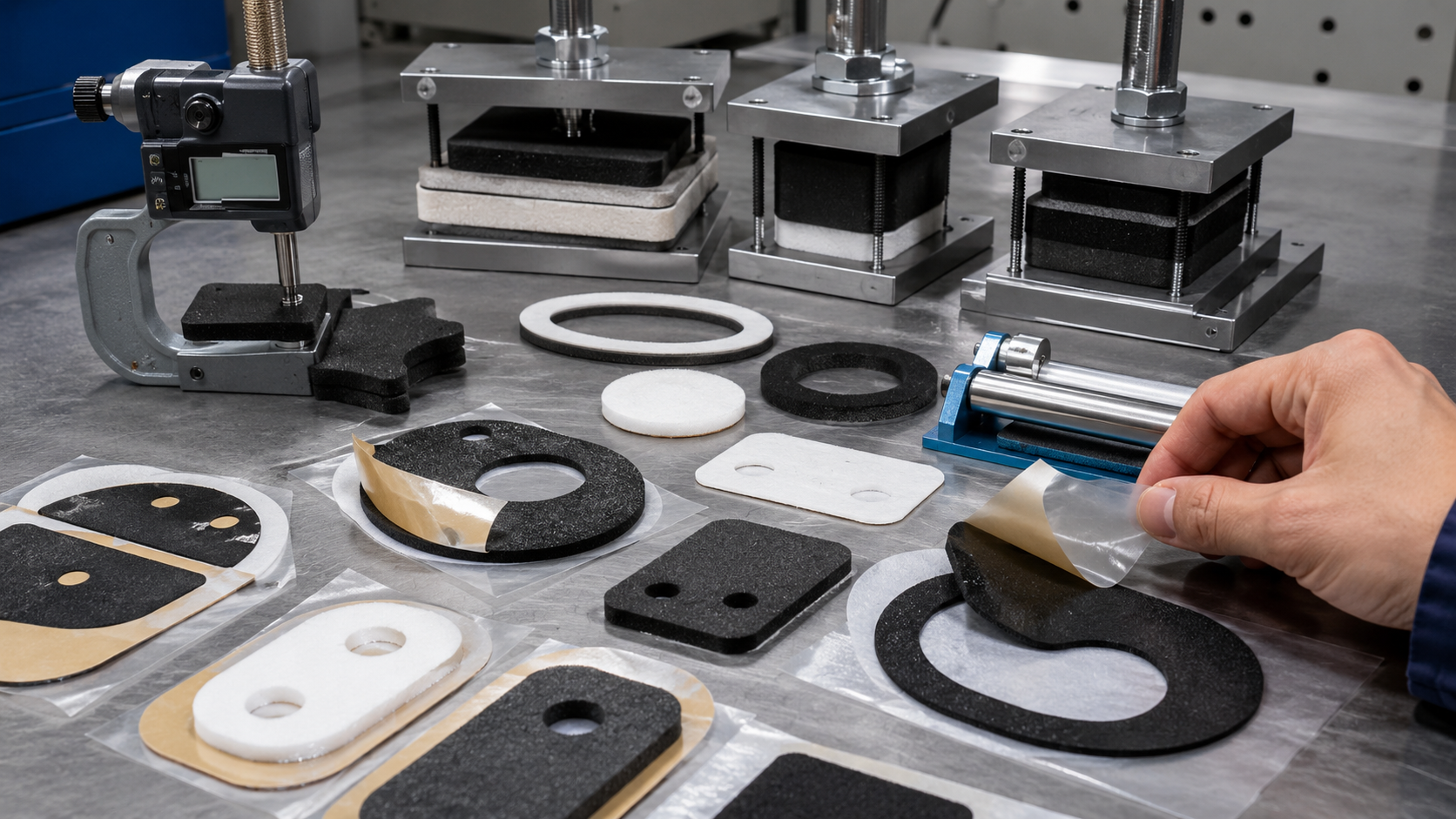
Check Tolerance Stack-Up
Foam thickness tolerance is important because foam is flexible and compressible.
A foam sheet may have natural thickness variation. Die cutting may also affect edge shape and compression behavior. The housing gap may vary because of molding tolerance, stamping tolerance, screw torque, or assembly variation.
Engineers should review:
- Foam material thickness tolerance
- Adhesive thickness tolerance
- Housing gap tolerance
- Compression variation
- Gasket width tolerance
- Surface flatness
- Assembly force variation
A gasket that works in one assembly position may fail in another if the gap is not consistent.
For OEM projects, testing should include worst-case conditions: the largest gap and the smallest gap. The gasket must still perform in both cases.
Avoid Over-Compression
Over-compression is one of the most common foam gasket problems.
When foam is compressed too much, it may lose recovery over time. This is called compression set. After long-term compression, the foam may not return to its original thickness. The sealing force may drop, and leakage or vibration may appear later.
Over-compression can also cause:
- Housing deformation
- Difficult assembly
- High closing force
- Adhesive squeeze-out
- Foam edge distortion
- Shorter service life
- Poor long-term sealing
- Increased part stress
If the assembly requires high sealing force, engineers should consider whether a different foam material, density, width, or gasket design is needed instead of simply increasing thickness.
Do Not Ignore Gasket Width
Foam thickness is important, but gasket width also matters.
A very narrow foam gasket may tear during die cutting or waste removal. It may also have less sealing area and weaker adhesive bonding.
A wider gasket can provide more sealing contact and more stable compression, but it may take more space and use more material.
Important width-related factors include:
- Minimum wall width
- Hole position
- Corner radius
- Sealing path
- Adhesive area
- Compression load distribution
- Material utilization
- Die cutting feasibility
Rounded corners often improve durability and reduce adhesive lifting. Very sharp corners can become stress points during peeling, assembly, and long-term use.
Test With Real Parts Before Mass Production
A foam gasket should not be approved only by measuring thickness.
It should be tested with the real product or a realistic assembly fixture.
Useful tests include:
- Fit test
- Compression test
- Peel test
- Seal test
- Dust or water resistance test
- Heat aging test
- Humidity exposure test
- Vibration test
- Liner release test
- Assembly force check
- Long-term compression check
For automotive, electronics, battery, medical, and industrial applications, testing under real conditions is much more valuable than checking the foam sample alone.
A gasket must be easy to assemble, stay in position, seal correctly, and remain stable after aging.
Common Thickness Selection Mistakes
| Mistake | Possible Result |
|---|---|
| Choosing thickness only by gap size | Poor compression design |
| Ignoring foam density | Wrong sealing force |
| Ignoring adhesive thickness | Assembly fit error |
| Counting release liner as final thickness | Incorrect gasket design |
| Using foam that is too soft | Collapse or poor long-term sealing |
| Using foam that is too hard | High assembly stress |
| Ignoring tolerance stack-up | Batch-to-batch fit problems |
| Skipping real assembly testing | Failure appears in mass production |
Most gasket thickness problems can be prevented by reviewing material, gap, compression, adhesive, tolerance, and assembly method together.
How Sanken Helps Choose Foam Thickness
Sanken Manufacturing Co., Ltd. helps OEM customers select and convert foam materials for custom die cut foam gaskets and sealing components.
For each foam gasket project, we review:
- Application function
- Housing gap
- Foam material
- Foam thickness
- Foam density
- Compression requirement
- Adhesive backing
- Bonding surface
- Gasket width
- Die cut tolerance
- Edge quality
- Liner release
- Packaging format
- Assembly method
- Testing requirements

For automotive applications, we support foam gaskets, anti-rattle pads, sealing strips, cushioning parts, and adhesive-backed components.
For electronics and battery applications, we support foam sealing pads, PET insulation films, protective films, adhesive spacers, and multilayer components.
For medical, appliance, and industrial applications, we focus on clean cutting, stable dimensions, controlled compression, and assembly-friendly delivery formats.
Our goal is to help customers reduce sealing failure, adhesive lifting, foam deformation, poor fit, repeated samples, and unstable mass production.
FAQ
How do I choose foam thickness for a gasket?
Start by measuring the actual assembly gap, including tolerance. Then choose a foam material and thickness that can compress enough to seal the gap without being over-compressed.
Should foam gasket thickness be larger than the gap?
Usually, yes. A foam gasket often needs to be thicker than the gap so it can compress and create sealing contact. The amount depends on the foam material and required compression ratio.
What happens if foam is too thick?
If foam is too thick, it may create high assembly force, deform the housing, cause adhesive overflow, damage the foam, or create long-term compression set.
What happens if foam is too thin?
If foam is too thin, it may not contact both surfaces properly. This can cause leakage, dust entry, vibration, poor cushioning, or weak sealing.
Does foam density affect thickness selection?
Yes. Foam density affects compression force and recovery. A soft foam and a dense foam with the same thickness may behave very differently during assembly.
Should adhesive thickness be included in gasket thickness?
Yes. Adhesive thickness remains in the assembled part, so it should be included in the final gasket structure. The release liner should not be counted because it is removed before assembly.
Can Sanken help choose foam thickness for custom die cut foam gaskets?
Yes. Sanken helps OEM customers review gap size, foam material, density, compression, adhesive backing, tolerance, die cut shape, and assembly conditions before producing custom foam gaskets.
Conclusion
Choosing foam thickness for custom die cut foam gaskets requires more than selecting a number from a material sheet. Engineers must review the assembly gap, compression ratio, foam density, cell structure, adhesive backing, tolerance stack-up, gasket width, assembly force, and final environment.
A good foam gasket should compress enough to seal, but not so much that it damages the foam or the housing. It should stay stable after assembly, aging, vibration, and long-term use.
At Sanken, we help OEM customers select and convert foam materials into custom die cut gaskets that support reliable sealing, cushioning, gap filling, vibration reduction, and mass production assembly.