

How to Cut Foam Board? A Practical Guide for Clean, Straight, and Accurate Results
Cutting foam board looks easy, but many people quickly run into the same problems: rough edges, crushed corners, torn paper surfaces, crooked lines, uneven thickness, or poor fitting during assembly.
For a school project, a slightly rough edge may not matter. But for packaging inserts, display panels, protective pads, automotive interior prototypes, electronics cushioning, medical device packaging, or industrial components, cutting quality directly affects appearance, fit, and function.
The best way to cut foam board is to use a sharp blade, a firm straightedge, stable support, light pressure, and multiple controlled passes. For higher precision or mass production, professional converting methods such as die cutting, CNC cutting, slitting, or kiss cutting may be more reliable.
At Sanken Manufacturing, we help OEM customers cut, laminate, die cut, and convert foam materials into accurate parts for automotive, electronics, packaging, medical equipment, and industrial applications.
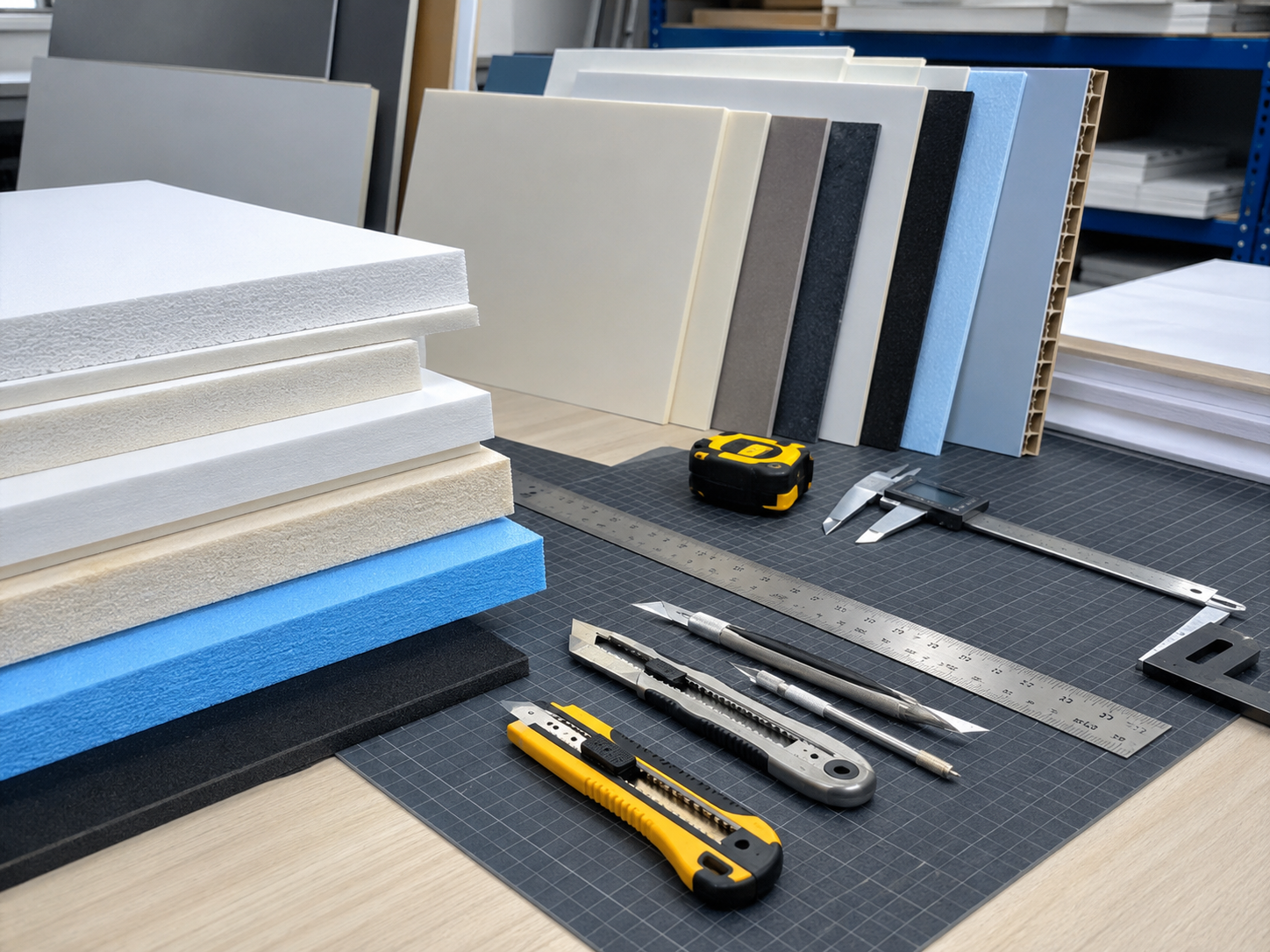
What Is Foam Board?
Foam board is a lightweight sheet material made with a foam core and surface layers.
Common foam board types include:
| Foam Board Type | Common Use |
|---|---|
| Paper-faced foam board | Signs, displays, craft projects |
| PVC foam board | Advertising boards, construction displays |
| EVA foam sheet | Cushioning, protective pads, die-cut parts |
| PE foam board | Packaging and impact protection |
| PU foam board | Insulation, cushioning, specialty uses |
Different foam boards cut differently.
A paper-faced foam board may tear if the blade is dull.
A thick EVA foam sheet may compress during cutting.
A PVC foam board may require different tools because it is denser and harder.
So before cutting, buyers and production teams should first confirm the material type, thickness, density, surface layer, and final use.
How to Cut Foam Board by Hand
For small projects, samples, and simple straight lines, manual cutting can work well.
1. Use a Sharp Blade
A sharp blade is the most important tool.
A dull blade drags through the foam and causes rough edges.
Suitable tools include:
- Utility knife
- Craft knife
- Precision cutter
- Long snap-off blade knife
- Foam board cutter
For thicker foam board, do not try to cut through the full thickness in one pass. Use several light passes instead.
This reduces compression and helps keep the edge straight.
2. Use a Metal Straightedge
A metal ruler or straightedge helps guide the blade.
Avoid soft plastic rulers because the blade may cut into them.
Hold the straightedge firmly and keep your cutting angle consistent.
If the guide moves during cutting, the edge will not be straight.
3. Cut on a Stable Surface
Foam board must be fully supported.
If part of the board hangs over the table, it may bend while cutting. This can cause uneven edges or inaccurate dimensions.
Use a flat table, cutting mat, or supported work surface.
4. Make Multiple Light Passes
Many cutting defects happen because people press too hard.
Too much pressure crushes the foam core and damages the surface.
A better method is:
- First pass: score the surface lightly.
- Second pass: cut deeper into the foam.
- Third pass: complete the cut cleanly.
This method creates a straighter edge and reduces tearing.
5. Keep the Blade Vertical
If the blade tilts, the top and bottom edges will not align.
This creates a slanted cut.
For parts that need accurate fit, blade angle is very important.
Best Tools for Cutting Foam Board
The best cutting tool depends on the material and production requirement.
| Tool | Best For | Limitation |
|---|---|---|
| Utility knife | Simple straight cuts | Depends on operator skill |
| Foam board cutter | Display boards and craft sheets | Limited for dense materials |
| Hot wire cutter | Some foam materials | Not suitable for all foam types |
| CNC cutter | Prototypes and complex shapes | Higher setup cost |
| Die cutting | Repeated custom parts | Requires tooling |
| Laser cutting | Selected foam prototypes | Heat, fumes, and edge melting risk |
For one or two simple pieces, manual cutting is enough.
For repeated production, hand cutting is usually not stable enough.
Can Foam Board Be Cut With a Laser?
Some foam boards can be laser cut, but not all.
Laser cutting creates heat. Some foam boards may melt, burn, shrink, or release harmful fumes.
Buyers should be especially careful with PVC foam board or unknown foam materials. If the material composition is unclear, laser cutting should be avoided.
Laser cutting may be useful for:
- Prototypes
- Thin foam sheets
- Low-volume samples
- Simple packaging concepts
However, for adhesive-backed foam, automotive foam parts, or mass production components, die cutting is often cleaner and more stable.
How to Cut Foam Board Without Rough Edges
Clean edges depend on both tools and technique.
To reduce rough edges:
- Use a new blade.
- Cut slowly.
- Avoid one heavy cut.
- Support the board fully.
- Keep the ruler fixed.
- Replace blades frequently.
- Use the right method for the foam density.
- Avoid dragging adhesive layers through the blade.
For paper-faced foam board, surface tearing is common when the blade is dull.
For EVA or PE foam board, edge compression is common when cutting pressure is too high.
For laminated foam board, layer separation may happen if the adhesive bond is weak or the cutting tool is unsuitable.
Why Straight Cutting Matters in OEM Applications
In OEM manufacturing, foam board is rarely just a flat sheet.
It often becomes a functional component.
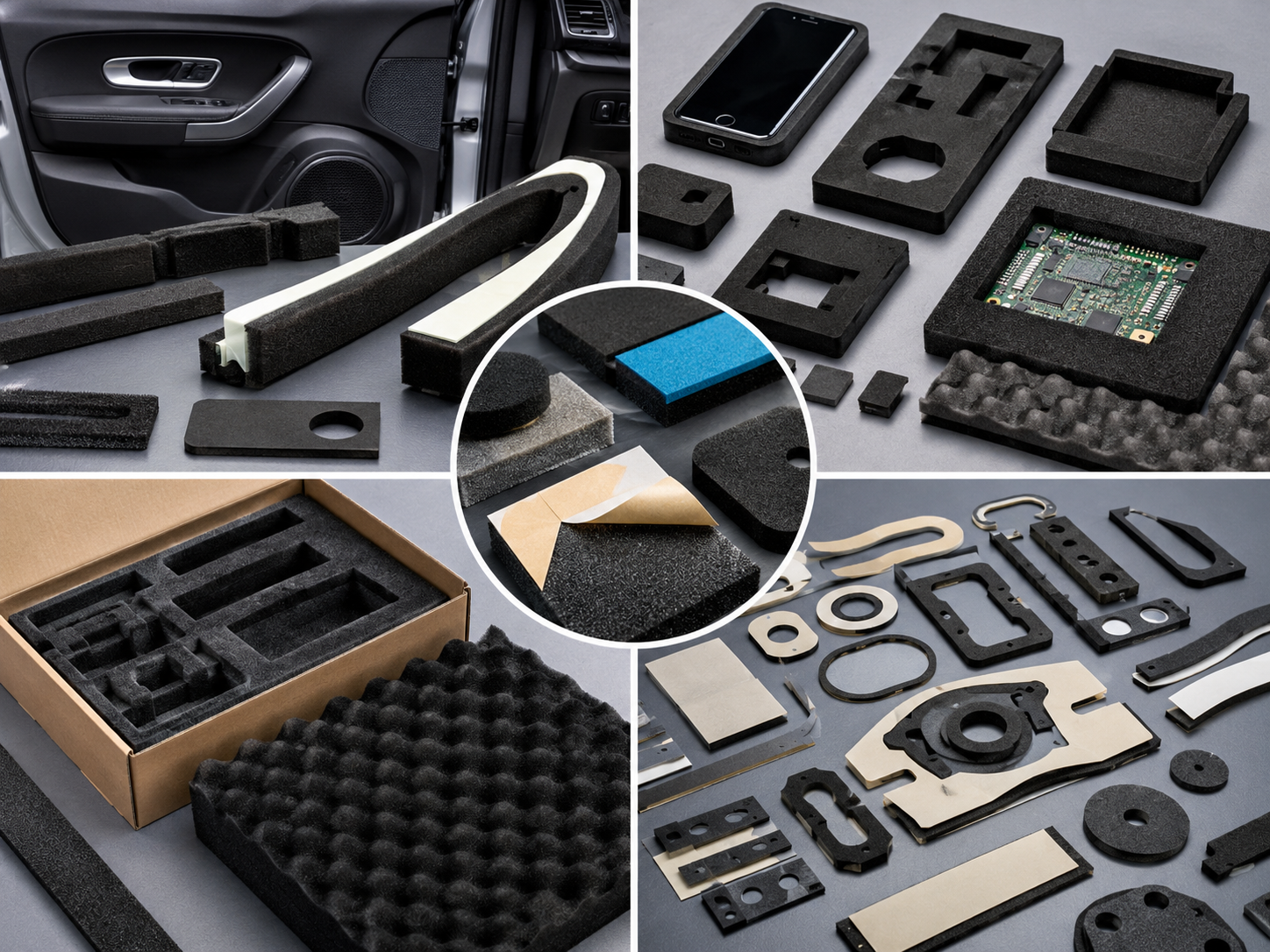
Automotive Applications
Foam board or foam sheet materials may be used for:
- Interior cushioning pads
- Anti-rattle strips
- Door panel support
- Dashboard spacers
- Trunk liner inserts
- Wire harness protection
- Acoustic support layers
If the foam is not cut accurately, it may create assembly gaps, squeaks, or poor fit.
Electronics Applications
Electronic products often need foam parts for:
- Battery cushioning
- Display protection
- Speaker damping
- Dust protection
- Shock absorption
- Internal spacers
Even small dimensional errors can cause pressure on sensitive components.
Packaging Applications
Foam board is widely used for protective packaging inserts.
A clean, accurate cut helps hold the product securely.
If the insert is too loose, the product moves during shipping.
If it is too tight, the customer may struggle to remove the product.
Industrial Applications
Industrial foam board parts may be used as:
- Pads
- Gaskets
- Spacers
- Liners
- Protective sheets
- Vibration control parts
Accuracy affects installation efficiency and long-term performance.
Common Mistakes When Cutting Foam Board
Using a Dull Blade
This is the most common mistake.
A dull blade tears the surface and crushes the foam core.
Cutting Too Fast
Fast cutting causes the blade to drift.
The result is a wavy edge.
Applying Too Much Pressure
Heavy pressure compresses the foam before cutting.
The edge may look uneven after the foam rebounds.
Ignoring Material Type
Paper foam board, EVA foam sheet, PE foam board, and PVC foam board do not cut the same way.
One method does not fit all materials.
Cutting Adhesive-Backed Foam Without Testing
Adhesive can stick to the blade, stretch, or create rough edges.
Adhesive-backed foam often needs controlled die cutting or kiss cutting.
When Should You Use Professional Foam Cutting?
Manual cutting is suitable for simple jobs.
Professional cutting is better when the part requires:
- Tight tolerance
- Repeated production
- Clean edges
- Complex shapes
- Holes or slots
- Adhesive backing
- Multilayer lamination
- Automotive or electronics use
- Mass production consistency
For high-volume projects, professional cutting can reduce scrap, improve efficiency, and create more stable parts.
At Sanken, we often help customers move from hand-cut samples to production-ready die-cut foam parts.
Die Cutting Foam Board for Better Accuracy
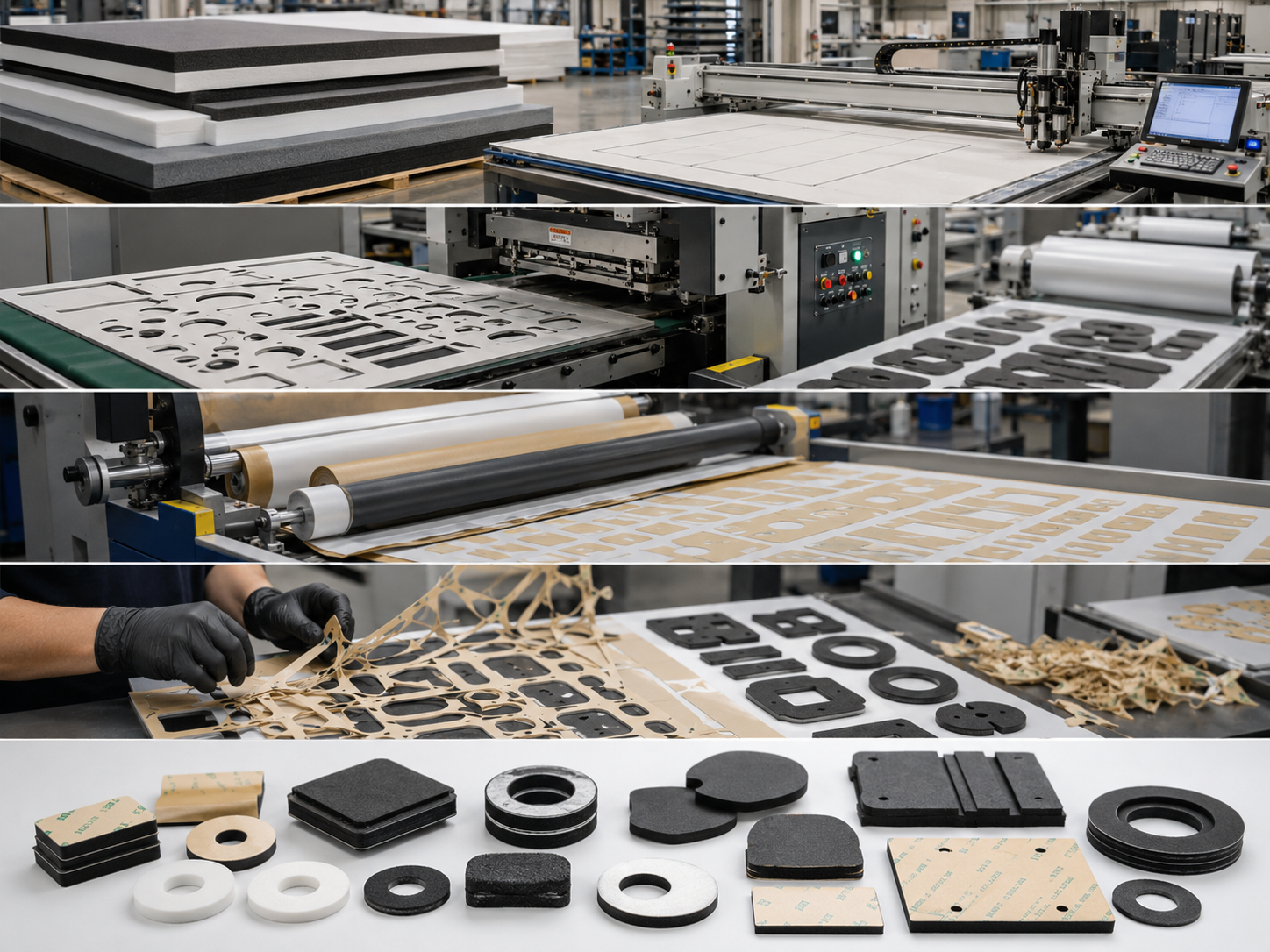
Die cutting is one of the most efficient methods for custom foam board parts.
It can create:
- Straight edges
- Round holes
- Custom shapes
- Foam gaskets
- Cushioning pads
- Protective inserts
- Adhesive-backed parts
- Multi-layer assemblies
For OEM buyers, die cutting is useful because it improves repeatability.
Once the tooling and process are confirmed, parts can be produced with consistent shape and size.
This is especially important for automotive, electronics, medical packaging, and industrial assembly.
What Should Buyers Confirm Before Ordering Cut Foam Board Parts?
Before ordering foam board parts, buyers should confirm:
- What foam material is required?
- What thickness and density are needed?
- Does the part need straight edges or complex shapes?
- Does it need adhesive backing?
- Will the foam stay under compression?
- What tolerance is required?
- Will the part be used in automotive, electronics, packaging, or industrial products?
- Does it need flame resistance, odor control, or aging resistance?
- Is this for prototype or mass production?
- Can the supplier support laminating, cutting, and assembly together?
These questions help avoid wrong material selection and poor cutting quality.
How Sanken Helps Customers Cut Foam Board Accurately
At Sanken Manufacturing, we help customers turn foam board and foam sheet materials into ready-to-use components.
Our capabilities include:
- Foam slitting
- Straight cutting
- Precision die cutting
- Kiss cutting
- Adhesive lamination
- Foam converting
- Hot pressing
- Multilayer assembly
- Prototype and mass production support
We work with EVA foam, PE foam, PU foam, rubber foam, adhesive-backed foam, non-woven composites, and other converted materials.
Our goal is to help customers reduce cutting defects, improve assembly fit, shorten development time, and achieve stable production quality.
Conclusion
Foam board can be cut straight and cleanly with a sharp blade, metal straightedge, stable work surface, light pressure, and multiple controlled passes. For simple projects, manual cutting may be enough.
For OEM applications, foam board cutting must be accurate, repeatable, and suitable for the final product environment. Precision die cutting, adhesive lamination, and professional foam converting can help customers achieve cleaner edges, better fit, lower scrap, and more stable mass production.