

Is It Possible to Use Foam Insulation in a Garage?
Yes, it is possible to use foam insulation in a garage, but the right choice depends on the garage structure, fire-safety rules, moisture conditions, temperature goals, installation area, and whether the foam will be left exposed.
Foam insulation can improve thermal comfort, reduce air leakage, help protect stored items, and make a garage more usable as a workshop, storage area, hobby space, or attached transition zone. However, foam insulation should not be selected or installed casually. Exposed foam plastic can create fire-safety concerns, and many building codes require foam insulation used on interior surfaces to be covered by an approved fire-rated material such as drywall. The U.S. Department of Energy notes that rigid foam insulation used inside a building generally must be covered with a fire-rated material, and local building officials should be consulted before installation. :contentReference[oaicite:0]{index=0}
For homeowners, contractors, and OEM material buyers, the better question is not only “Can I use foam insulation in a garage?” The better question is: “Which foam insulation structure is safe, durable, code-compliant, and suitable for the real garage environment?”
At Sanken Manufacturing, we focus on functional foam, rubber, adhesive, non-woven, and converted material solutions. While garage insulation is a construction application, the same material logic applies to automotive, electronics, industrial, and equipment components: choose the right foam structure, control the processing method, and avoid material failure in real use.
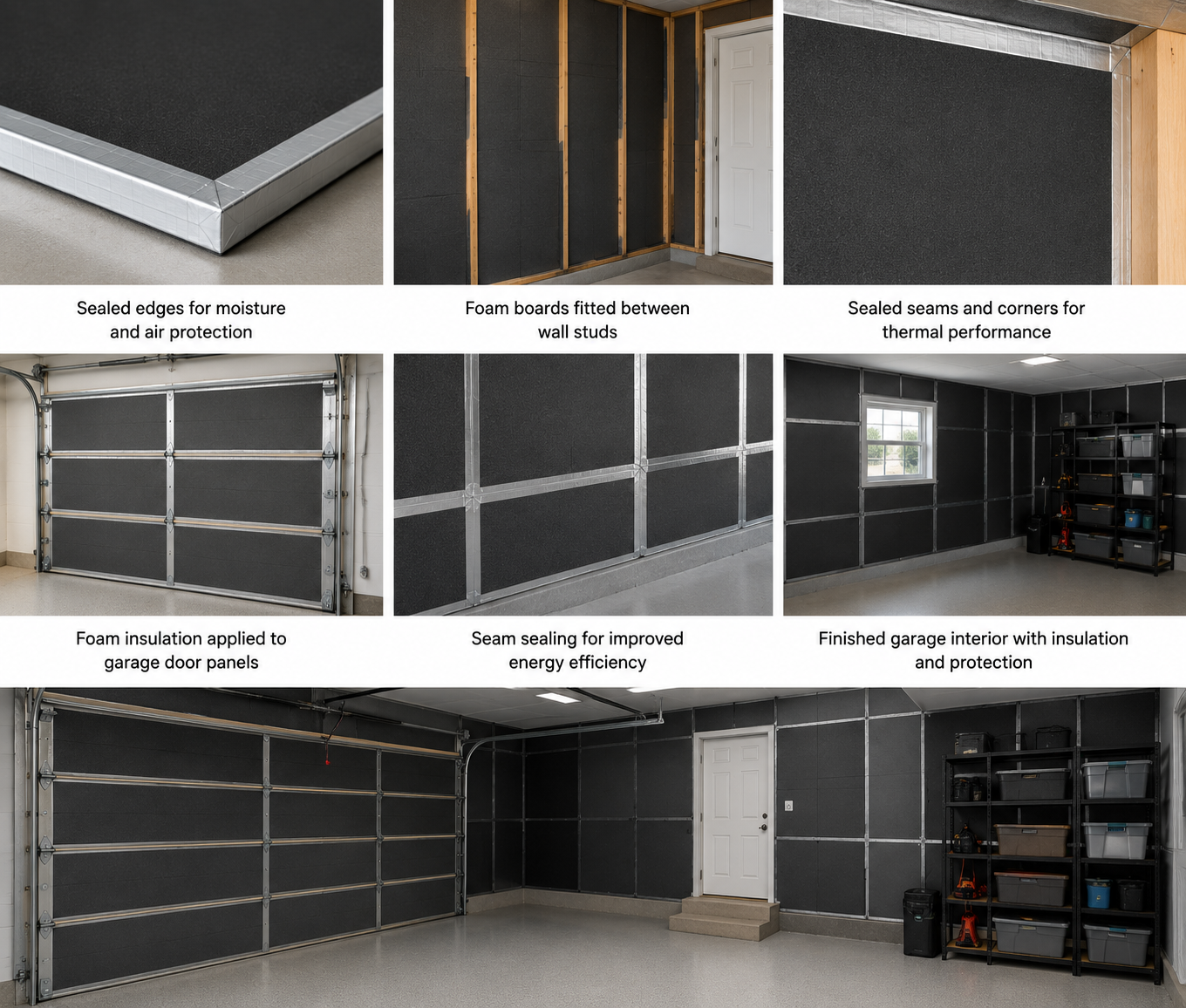
Why Use Foam Insulation in a Garage?
Many garages are uncomfortable because they are not insulated like living spaces.
Common problems include:
- Heat loss in winter
- Excessive heat in summer
- Drafts around doors and walls
- Cold floors and wall surfaces
- Moisture condensation
- Noise transfer from tools or equipment
- Poor comfort for workshop use
Foam insulation helps by reducing heat transfer and, in some forms, reducing air leakage. Foam boards are rigid insulation panels that can be used in many parts of a building and provide good thermal resistance relative to thickness. The U.S. Department of Energy describes foam boards as effective for reducing heat conduction through structural elements such as wood and steel studs. :contentReference[oaicite:1]{index=1}
For a garage, this can make the space more comfortable and more efficient, especially when the garage is attached to the house or used frequently.
Common Foam Insulation Options for Garages
Several types of foam insulation may be used in garage applications.
| Foam Type | Common Form | Main Advantage | Common Concern |
|---|---|---|---|
| EPS foam board | Rigid panel | Cost-effective insulation | Lower R-value per inch than some options |
| XPS foam board | Rigid panel | Moisture resistance and strength | Must be protected if used inside |
| Polyiso foam board | Rigid panel | Higher thermal resistance | Performance may vary by temperature |
| Spray polyurethane foam | Sprayed insulation | Air sealing and cavity filling | Requires professional installation and fire protection |
| PE or EVA foam products | Sheets, pads, seals | Cushioning, sealing, protection | Not usually primary building insulation |
For garage walls, doors, ceilings, and rim joist areas, rigid foam board and spray foam are the most common choices.
For smaller functional needs, such as sealing gaps, cushioning door panels, reducing vibration, or protecting surfaces, die-cut foam, adhesive-backed foam, or foam composite parts may be more suitable.
Where Foam Insulation Can Be Used in a Garage
Garage Walls
Foam board can be used on garage walls to improve thermal resistance. In many cases, the foam must be covered with drywall or another approved thermal barrier when installed on the interior side.
This is especially important for attached garages, where fire separation and local code requirements matter.
Garage Doors
Foam insulation panels are often added to garage doors to reduce heat transfer and improve comfort.
However, buyers should consider door weight, panel fit, adhesive stability, and long-term durability. A poorly fitted foam panel may loosen, rattle, or interfere with door movement.
Garage Ceilings
If there is living space above the garage, ceiling insulation becomes important.
Foam insulation may help reduce heat transfer, but installation should follow code and fire-safety requirements.
Rim Joists and Gaps
Spray foam is often used to seal gaps and rim joist areas because it can expand into cavities.
This can reduce drafts and improve energy efficiency.
Fire Safety: The Most Important Issue
Foam plastic insulation can burn or produce smoke if exposed to fire. This is why building codes often require foam insulation to be separated from interior spaces by a protective thermal barrier.
A commonly referenced thermal barrier is 1/2-inch gypsum board. Industry and code guidance often describe a 15-minute thermal barrier between foam plastic insulation and occupied space; one building code FAQ explains that 1/2-inch gypsum wallboard is an approved 15-minute thermal barrier. :contentReference[oaicite:2]{index=2}
The International Building Code includes requirements for foam plastics and thermal barriers, but the exact requirement for a garage depends on local code adoption, installation location, and product approval. :contentReference[oaicite:3]{index=3}
For buyers, this means:
- Do not leave exposed foam board inside a garage without checking code.
- Do not assume every foam product is safe for exposed interior use.
- Confirm whether a thermal barrier or ignition barrier is required.
- Check product documentation and local building rules.
- Use qualified installers for spray foam.
Safety should come before cost savings.
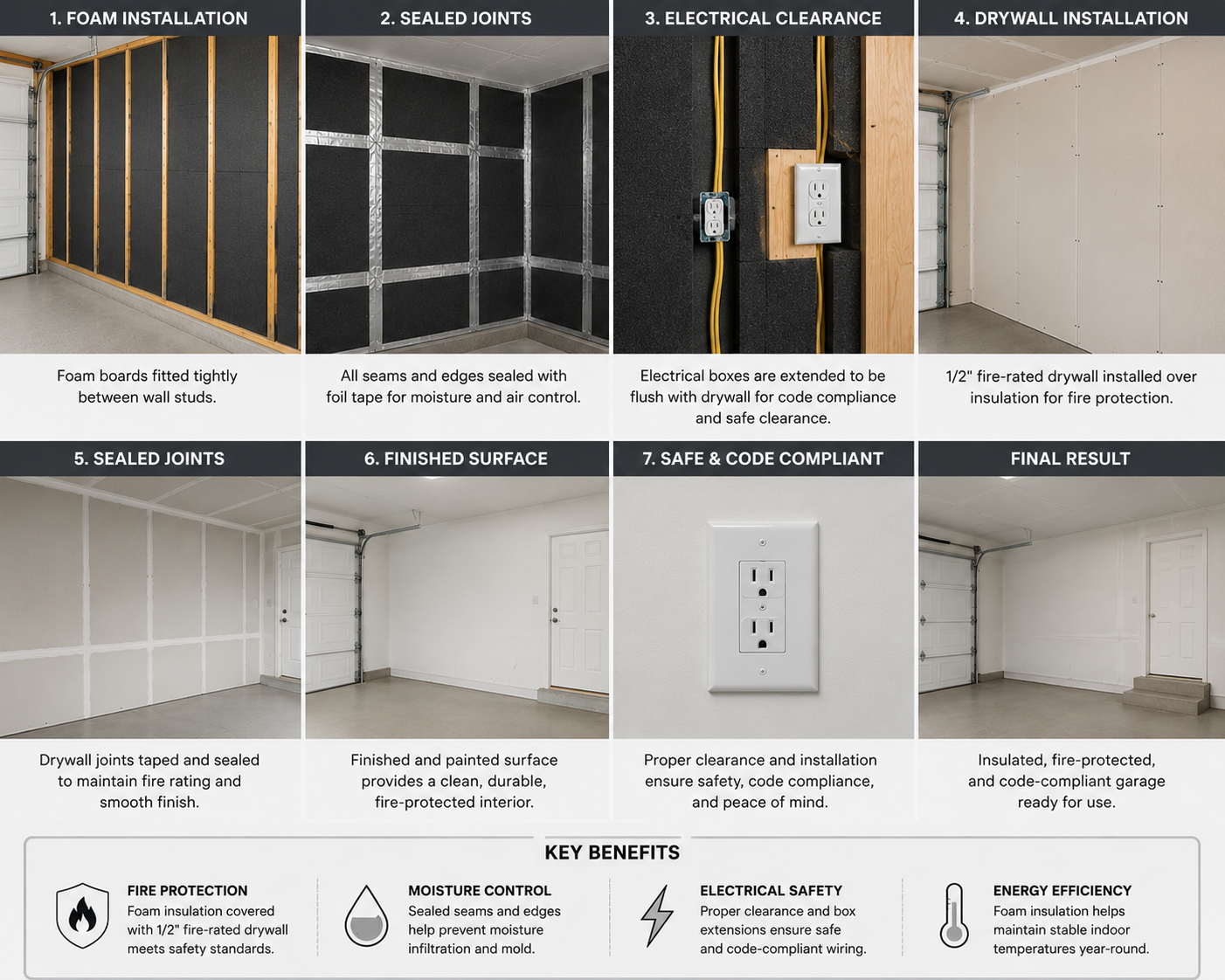
Moisture and Condensation Concerns
Garages often face moisture from vehicles, rain, snow, humidity, and temperature differences.
Foam insulation can help reduce condensation risk when installed correctly, but poor installation can trap moisture or hide water problems.
Buyers should consider:
- Is the garage dry?
- Are there leaks?
- Is the floor exposed to water?
- Will vehicles bring snow or rain inside?
- Is ventilation adequate?
- Will insulation be installed against masonry, wood, or metal?
- Does the foam need a vapor-control strategy?
Rigid foam boards can resist moisture better than many fibrous insulation materials, but seams, edges, and fastener points still matter.
If gaps are not sealed, warm moist air may move behind the insulation and condense on cold surfaces.
Foam Insulation vs Fiberglass in a Garage
Foam and fiberglass are both common insulation materials, but they perform differently.
| Requirement | Foam Insulation | Fiberglass Insulation |
|---|---|---|
| Air sealing | Strong with spray foam or sealed boards | Limited unless paired with air sealing |
| Moisture resistance | Often better | Can lose performance when wet |
| R-value per inch | Often strong | Moderate |
| Installation cost | Often higher | Usually lower |
| Fire protection requirement | Must be checked carefully | Usually installed behind drywall |
| Fit in irregular gaps | Spray foam performs well | Batts may leave gaps |
| DIY ease | Foam board may be manageable | Fiberglass batts are common DIY |
Foam insulation is often better when space is limited, moisture resistance matters, or air sealing is important.
Fiberglass may be more cost-effective when cavities are open and standard wall framing is used.
Is Foam Insulation Good for Sound Reduction in a Garage?
Foam insulation can help reduce some sound transmission, especially when it seals gaps or reduces vibration paths.
However, foam is not always the best standalone soundproofing material.
Sound reduction often requires:
- Mass
- Sealing
- Absorption
- Decoupling
- Layered construction
Foam may help with sealing and absorption, but stronger sound control may need drywall layers, acoustic sealant, rubber barriers, non-woven acoustic layers, or other assemblies.
For garage workshops, the main noise problems often come from tools, compressors, doors, and mechanical vibration. Foam may help, but it should be part of a broader acoustic design.
When Foam Insulation Is a Good Choice
Foam insulation can be a good choice when the garage needs:
- Better thermal comfort
- Reduced drafts
- Improved energy efficiency
- Moisture-resistant wall insulation
- Garage door insulation
- Rim joist sealing
- Cleaner finished wall assemblies
- Thin insulation with good thermal resistance
It is especially useful when the garage is attached to the house or used frequently.
When Foam Insulation May Not Be the Best Choice
Foam may not be ideal when:
- It will be left exposed without approved protection.
- Local code requirements are unclear.
- The garage has water leaks.
- The project budget is very limited.
- The surface is dirty, wet, or unstable.
- The installation involves electrical or fire-rated assemblies that require professional review.
- The goal is heavy soundproofing rather than thermal insulation.
In these cases, the project should be reviewed carefully before selecting foam.
Common Mistakes When Using Foam Insulation in a Garage
Leaving Foam Exposed
This is one of the most common mistakes. Interior foam insulation usually needs a fire-rated covering.
Ignoring Local Building Codes
Garage requirements vary by region and building type. Always confirm local requirements.
Poor Edge Sealing
Foam board seams and edges should be sealed properly. Otherwise, air leakage can reduce performance.
Choosing the Wrong Foam Type
A garage door panel, wall surface, ceiling, and rim joist may need different insulation solutions.
Forgetting Moisture Control
Insulation does not fix water leaks. Moisture problems should be solved first.
Using Adhesive Without Compatibility Testing
Some adhesives can fail on foam, metal, painted surfaces, or garage door panels.
What Buyers Should Confirm Before Installation
Before choosing foam insulation for a garage, confirm:
- Is the garage attached or detached?
- Which area needs insulation: wall, ceiling, door, or gaps?
- Will the foam be exposed or covered?
- What fire barrier is required by local code?
- Is moisture or water leakage present?
- What R-value is needed?
- Will the garage be heated or cooled?
- Does the installation need air sealing?
- Is sound reduction also a goal?
- Should the project use foam board, spray foam, fiberglass, or a composite system?
These questions reduce safety risks, wasted material, and poor insulation performance.
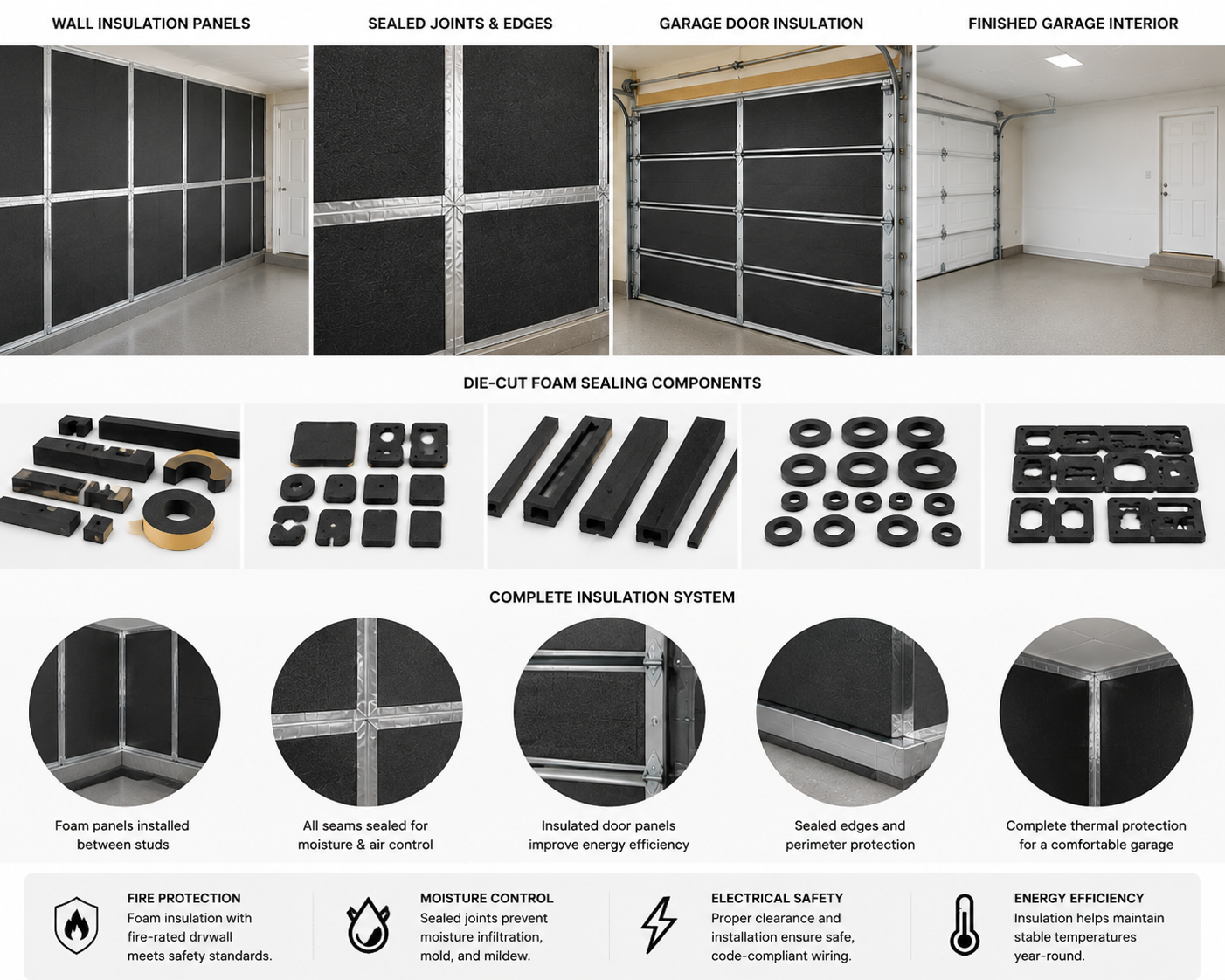
How Sanken’s Material Converting Experience Relates to Foam Insulation
Sanken Manufacturing does not position garage insulation as a simple DIY product. Our value is in precision material processing for OEM and industrial applications.
However, the material selection logic is similar.
For foam-related projects, we help customers solve problems such as:
- Foam compression failure
- Adhesive lifting
- Poor dimensional accuracy
- Edge defects
- Material mismatch
- Assembly gaps
- Long-term aging risk
- Multi-layer material bonding
Our capabilities include:
- Precision die cutting
- Foam converting
- Rubber processing
- Adhesive lamination
- Non-woven material converting
- Film lamination
- Hot pressing
- Custom assembly
- Prototype and mass production support
For automotive, electronics, medical, packaging, and industrial customers, this means foam is not just insulation or cushioning. It becomes a designed component that must fit, bond, seal, protect, and perform reliably.
Conclusion
Yes, foam insulation can be used in a garage, but it must be selected and installed correctly. Foam board and spray foam can improve thermal comfort, reduce drafts, and help make a garage more usable. However, fire safety, local building codes, moisture control, installation quality, and surface protection are critical.
Foam insulation should usually not be left exposed on interior garage surfaces unless the product and installation meet applicable code requirements. For the best result, choose the right foam type, seal edges properly, solve moisture problems first, and confirm whether a thermal barrier such as drywall is required.
At Sanken Manufacturing, we apply the same careful material thinking to foam, rubber, adhesive, non-woven, and composite components for OEM applications, helping customers reduce risk and improve long-term performance.