
Is Small Batch Film Die Cutting Prototype Service Worth Choosing?
Bringing a new product from concept to mass production is rarely a straight line.
A design that looks perfect on a CAD drawing may reveal unexpected challenges once physical parts are produced. Alignment issues, assembly difficulties, material incompatibilities, and tolerance problems often appear during development rather than during design.
For products that rely on film materials—such as consumer electronics, automotive displays, medical devices, batteries, and industrial equipment—small batch film die-cut prototypes can help identify these risks before expensive production tooling and large-volume orders begin.
However, some purchasing managers and engineers still ask:
Is a small batch film die cutting prototype service really worth the additional time and cost?
In most cases, the answer is yes.
The cost of discovering a problem during mass production is usually far greater than the cost of finding it during prototyping.

What Is Small Batch Film Die Cutting?
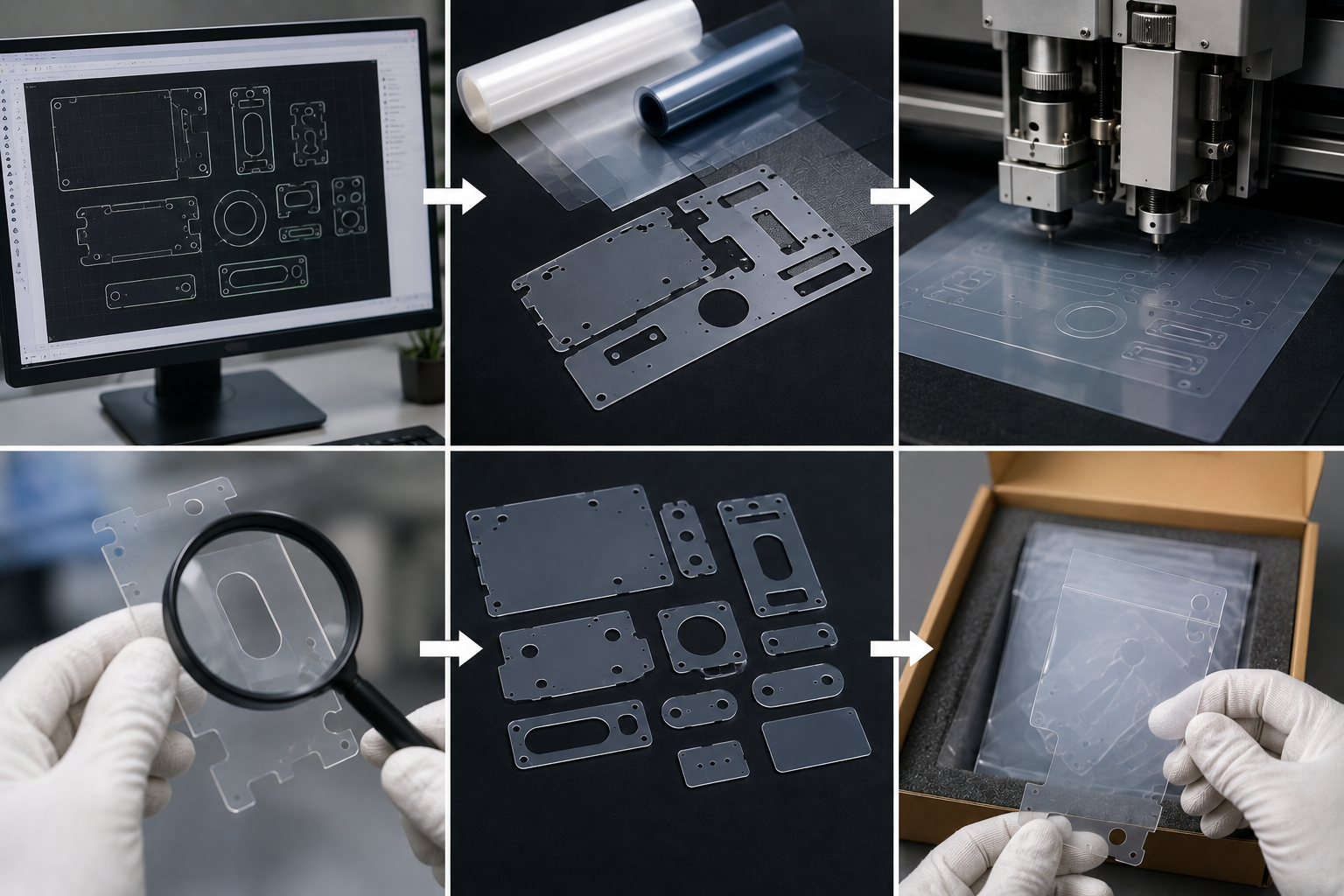
Small batch film die cutting refers to the production of limited quantities of die-cut film components before full-scale manufacturing begins.
Typical prototype quantities range from:
- 10 pieces
- 50 pieces
- 100 pieces
- 500 pieces
- 1,000 pieces
depending on project requirements.
Materials commonly used include:
- PET film
- Polycarbonate film
- Optical films
- Protective films
- Insulation films
- Adhesive tapes
- EMI shielding materials
The goal is not simply to make parts.
The goal is to validate the entire design before committing to production tooling.
Why Prototyping Matters More Than Ever
Modern products are becoming:
- Smaller
- Thinner
- Lighter
- More integrated
As complexity increases, so does the risk of design issues.
A tiny dimensional deviation may lead to:
- Display misalignment
- Assembly interference
- Adhesive failure
- Reduced product reliability
Without prototypes, these problems may remain hidden until production starts.
At that stage, changes become significantly more expensive.
Validate Design Concepts Before Tool Investment
Production tooling often requires substantial investment.
For complex die-cut components, tooling costs can increase quickly depending on:
- Material type
- Part complexity
- Tolerance requirements
- Multi-layer structures
Prototype services allow engineers to evaluate:
- Part fit
- Functional performance
- Material behavior
- Assembly compatibility
before final tooling approval.
This helps reduce development risk.
Confirm Material Selection
Choosing the wrong material is one of the most common causes of project delays.
On paper, multiple materials may appear suitable.
In reality, performance differences can be significant.
Prototype testing allows engineers to compare:
| Evaluation Area | What Can Be Verified |
|---|---|
| Adhesion | Bonding performance |
| Flexibility | Bending behavior |
| Optical Quality | Transparency and appearance |
| Insulation | Electrical performance |
| Durability | Environmental resistance |
Material validation during prototyping often prevents expensive redesigns later.
Improve Assembly Efficiency
A component that meets drawing requirements may still create assembly challenges.
Common issues include:
- Installation difficulty
- Misalignment
- Excessive assembly time
- Positioning inconsistencies
Prototype parts allow manufacturing teams to verify:
- Assembly processes
- Automation compatibility
- Fixture design
- Operator handling
This reduces production surprises.

Reduce Product Development Risk
Many companies focus heavily on product performance but underestimate manufacturing risks.
Prototype programs help uncover:
- Tolerance stack-up issues
- Adhesive positioning problems
- Material shrinkage
- Layer registration concerns
Identifying these challenges early allows corrective actions before mass production begins.
This significantly reduces project risk.
Accelerate Product Launch Schedules
Some organizations skip prototyping to save time.
Ironically, this often causes delays.
When problems are discovered after tooling release, teams may face:
- Engineering changes
- Tool modifications
- Material requalification
- Supplier delays
Prototype validation helps streamline the development process and supports faster commercialization.
In many projects, prototyping actually shortens the overall timeline.
Support Customer Approval Processes
Many OEMs require physical samples before approving suppliers.
Prototype parts allow customers to evaluate:
- Fit and function
- Material quality
- Cosmetic appearance
- Performance characteristics
Providing samples early helps build confidence and accelerate approval cycles.
For suppliers, prototypes can become an important business development tool.
Verify Multi-Layer Film Structures
Many modern products use laminated constructions.
Examples include:
- Film + adhesive
- Film + foam
- Film + EMI shielding
- Optical film stacks
Multi-layer assemblies introduce additional variables.
Prototype production helps verify:
- Layer alignment
- Lamination quality
- Thickness consistency
- Functional performance
This is especially important in electronics and automotive applications.
Evaluate Tolerance Capability
Precision requirements continue becoming tighter.
For many film components, tolerances may be measured in fractions of a millimeter.
Prototype production allows engineers to verify:
- Dimensional accuracy
- Registration capability
- Repeatability
before committing to production-scale manufacturing.
This provides valuable process confidence.
When Small Batch Prototyping May Not Be Necessary
Although prototyping offers significant benefits, there are situations where it may provide limited value.
Examples include:
- Mature products with no design changes
- Previously validated components
- Repeat production programs
- Simple low-risk geometries
However, for new product development, prototypes are generally recommended.
The greater the complexity, the greater the value of validation.
Cost Comparison: Prototype vs Production Failure
Consider two scenarios.
Scenario A
Prototype investment:
- Sample materials
- Prototype tooling
- Evaluation testing
Total cost remains relatively low.
Scenario B
Production failure:
- Tool redesign
- Material scrap
- Production delays
- Customer dissatisfaction
- Engineering rework
Costs can increase dramatically.
From a risk-management perspective, prototypes often provide an excellent return on investment.
Industries That Benefit Most From Film Die Cutting Prototypes
Small batch prototype services are especially valuable in:
Consumer Electronics
- Smartphones
- Tablets
- Wearables
- Display modules
Automotive
- Displays
- Battery systems
- Sensors
- Interior electronics
Medical Devices
- Diagnostic equipment
- Monitoring devices
- Disposable components
Industrial Electronics
- Control systems
- Sensors
- Interface assemblies
These industries frequently require extensive validation before mass production.
How Sanken Supports Prototype Development
At Sanken, we understand that successful production starts with successful validation.
Our prototype capabilities include:
- Precision film die cutting
- Digital cutting
- Kiss cutting
- Multi-layer lamination
- Adhesive integration
- Optical film converting
- Rapid sample production
We work closely with customers during product development to help optimize materials, improve manufacturability, and reduce production risks.
Our goal is not simply to provide prototype parts.
Our goal is to help customers move confidently from concept to production.
Conclusion
Small batch film die cutting prototype services are often one of the smartest investments during product development.
They help validate designs, confirm material selection, improve assembly processes, reduce risk, and accelerate product launches.
While prototypes add a small upfront cost, they frequently save significant time and money by preventing production failures.
For companies developing new film-based components, prototype validation is not simply an optional step—it is a valuable strategy for achieving successful mass production.